

Choosing kitchen cabinets with installation is about more than just buying the product; it’s about buying the entire experience. This all-in-one approach bundles your new cabinets with professional setup, turning what could be a chaotic renovation into a smooth, coordinated project. You're saved the headache of juggling multiple contractors, ensuring a beautiful result from the first measurement to the final knob.
Understanding The All-In-One Cabinet Service
When you opt for a full-service cabinet package, you're not just getting boxes and doors. You’re investing in an integrated process that delivers a finished kitchen with minimal stress on your part. Think of it this way: it’s like hiring a wedding planner instead of trying to book the caterer, the venue, and the florist all on your own. One path is expertly managed, while the other puts all the responsibility—and the risk—on you.
For homeowners in busy hubs like Toronto and Markham, having a single point of accountability is a huge relief. Rather than coordinating between a cabinet supplier, a separate installer, and maybe even a designer, you have one team responsible for the entire job.
What The Service Typically Covers
A full-service package almost always kicks off with an in-depth consultation. This is where designers help you map out your vision, turning your ideas into a practical layout and guiding you through material and finish choices that fit your budget and style. This first step is absolutely vital; it lays the groundwork for everything that follows.
After the design is settled, the team takes precise, professional measurements on-site. This is a make-or-break moment where a small error can cause big problems down the line. An integrated service means the people measuring are accountable for the final fit, which sidesteps the blame game that can happen when you use separate companies. Once those numbers are locked in, your cabinets are ordered and delivered.
The real magic of an all-in-one package is accountability. If something isn't right, there’s no finger-pointing between the supplier and the installer. There’s just one team with one mission: to make it perfect.
From Delivery To Completion
The installation phase is where the value of professional service truly shines. The process typically unfolds like this:
- Demolition and Removal: Your old cabinetry is carefully dismantled and removed, leaving a clean slate.
- Cabinet Installation: Experts assemble and securely mount all your base and wall cabinets, ensuring they are perfectly level and aligned.
- Hardware and Finishing: All the finishing touches are meticulously installed, from handles and pulls to crown moulding and light valances.
- Final Adjustments: Every door and drawer is fine-tuned to ensure they open smoothly and close flush for a flawless, high-end look.
- Site Cleanup: The crew cleans up the work area, leaving your new kitchen ready for the next phase of your renovation.
However, it's crucial to know what's usually not part of the deal. While convenient, a cabinet installation package isn't a full-blown renovation service.
The table below breaks down what you can generally expect to be included versus what often costs extra.
What Is Included In a Supply and Install Package
| Service Component | Typically Included | Often an Additional Cost |
|---|---|---|
| Consultation & Design | Yes, initial design and layout planning. | Yes, if extensive revisions are needed. |
| Measurements | Yes, professional on-site measuring. | No, this is standard. |
| Demolition | Yes, removal of old cabinets. | No, usually part of the scope. |
| Cabinet Installation | Yes, assembly and hanging of units. | No, this is the core service. |
| Hardware Installation | Yes, installing handles and knobs. | No, this is standard. |
| Plumbing & Electrical | No, requires licensed tradespeople. | Yes, must be hired separately. |
| Countertop Installation | No, usually a separate service. | Yes, coordinated but billed apart. |
| Appliance Installation | No, typically handled by appliance provider. | Yes, requires specialists. |
| Painting & Tiling | No, these are considered separate trades. | Yes, handled by other contractors. |
As you can see, the service focuses squarely on the cabinetry itself. Tasks like plumbing, electrical work, or countertop installation require different licensed professionals and are almost always handled and billed separately.
Choosing The Right Cabinet Materials and Finishes
Your kitchen cabinets are so much more than just storage boxes. They're the face of the room, setting the tone for its entire look and feel. The material you choose is a huge part of that—it dictates not just the style, but also how your kitchen will stand up to years of daily use.
Think of it like buying a winter coat here in Toronto. A stylish wool peacoat looks fantastic, but a high-tech parka is what you'll be grateful for during a January cold snap. It’s about balancing aesthetics with practicality. A real wood cabinet door has a timeless warmth, but the flawless finish of HDF might be a better fit for a clean, modern design. Let's dig into the most common choices so you can find the perfect match for your home.
The Enduring Appeal of Real Wood
There’s a reason solid wood cabinets, especially from woods like maple and oak, have been a kitchen staple for generations. They possess a classic beauty and sturdiness that’s hard to beat. Every door has its own unique grain, bringing an authentic, natural texture into your space that simply can't be faked. Those subtle variations aren't imperfections; they're what give the wood its character.
But it’s important to remember that wood is a natural material. It breathes, expanding and contracting with the swings in temperature and humidity we get in the GTA. Over time, you might notice tiny shifts at the joints. It's a normal characteristic of real wood, but something to keep in mind if you’re aiming for an absolutely perfect, unchanging look.
The Smooth Versatility of HDF
If you love the look of a perfectly painted cabinet, High-Density Fibreboard (HDF) is your best friend. HDF is an engineered wood product made by compressing wood fibres and resin under extreme pressure. This process creates a super-dense, stable panel that’s resistant to the warping or cracking that can sometimes affect solid wood.
Because HDF has no wood grain, it’s the perfect canvas for a smooth, even coat of paint. Whether you're dreaming of crisp white shaker doors or a dramatic, moody colour, HDF provides that clean, uniform look that’s ideal for modern and transitional kitchens. It's tough, durable, and a breeze to keep clean.
The bottom line is a trade-off. Real wood gives you that one-of-a-kind natural character, but you have to appreciate its organic nature. HDF offers incredible stability and a flawless painted finish, making it a super practical and popular choice for today’s homes.
Budget-Friendly and Durable Alternatives
Looking for great performance without the premium price tag? Laminate and thermofoil are two fantastic contenders. These aren't the cheap-looking materials of the past; modern advancements have made them incredibly durable and stylish.
- Laminates: Created by fusing layers of paper and resin onto a particleboard or HDF core, today's laminates are workhorses. They stand up remarkably well to scratches, stains, and moisture, making them a smart choice for busy families.
- Thermofoil: This is a vinyl film that’s heat-sealed and vacuum-pressed onto an HDF door. The result is a seamless, non-porous surface that’s incredibly easy to wipe down and highly resistant to humidity.
While they may not have the same prestige as solid wood, the practical upsides are hard to ignore. They deliver consistent colour and finish across every cabinet and are built to handle the chaos of a well-loved kitchen. To dive deeper, check out our complete guide on the best materials for kitchen cabinets.
Sustainability and Modern Manufacturing
The cabinet industry is making a real push towards more sustainable, healthier practices. This is about more than just being "green"—it's about the air quality in your home and reducing our collective environmental impact.
We're seeing a big shift toward using materials with low or no volatile organic compounds (VOCs). For example, strict regulations from the California Air Resources Board (CARB) have set new standards for formaldehyde limits, leading to the rise of safer adhesives and water-based finishes that reduce off-gassing. Industry analysis shows that the fastest-growing raw materials for cabinets are sustainable options like bamboo and recycled composites, with a projected 5.81% compound annual growth rate. You can read more about these market trends. This global focus means homeowners today have better access to healthier, more eco-friendly products than ever before.
What Does the Cabinet Installation Process Actually Look Like?
If you've ever watched a home reno show, you might think installing kitchen cabinets is a quick, one-day job. In reality, a professional installation is a careful, step-by-step process that guarantees your new kitchen not only looks fantastic but lasts for years. Knowing what's involved helps you understand what to expect when your kitchen turns into a temporary construction zone.
The real work starts long before a single cabinet is hung.
First up is the prep work. You can think of this as creating a blank canvas. The crew won't just start drilling holes; they'll begin by carefully tearing out and disposing of your old cabinets, countertops, and any other fixtures. Once the room is empty, they get down to business, inspecting the walls for any dings or damage, patching holes, and making sure the surfaces are smooth and flat.
This step is absolutely critical. Any bumps or bows in the wall can throw off the entire installation, leading to alignment problems and ugly gaps later on.
Laying the Groundwork
With the walls ready, the installers move on to the single most important part of the job: setting a perfectly level baseline. Using tools like a laser level, they’ll find the highest spot on your floor—because no floor is ever perfectly flat—and mark a level line around the entire room. This line dictates where the top of your base cabinets will sit.
Everything else follows from this line. It's what ensures your countertops will be level, your appliances will fit snugly, and the whole room looks balanced and professionally done. It’s the foundation that prevents a wobbly, crooked kitchen.
An installer’s most important tool isn't a drill or a saw—it's their level. Even in a brand-new home, floors and walls are rarely perfectly plumb. A laser-levelled guideline is the only way to guarantee a perfect installation.
Building It Out, One Cabinet at a Time
Once that baseline is locked in, the fun begins. Most installers start with the upper cabinets, using a ledger board (a temporary support) to hold the weight while they meticulously position and anchor each unit into the wall studs. They'll clamp each cabinet to its neighbour before screwing them together, creating one solid, seamless bank of cabinetry.
Next, they tackle the base cabinets. Each box is set along the laser line, with shims (tiny wedges) used underneath to get it perfectly level. Just like the uppers, they are then secured to the wall and to each other, making sure nothing rocks or shifts.
This simple diagram shows the basic flow of the physical installation.
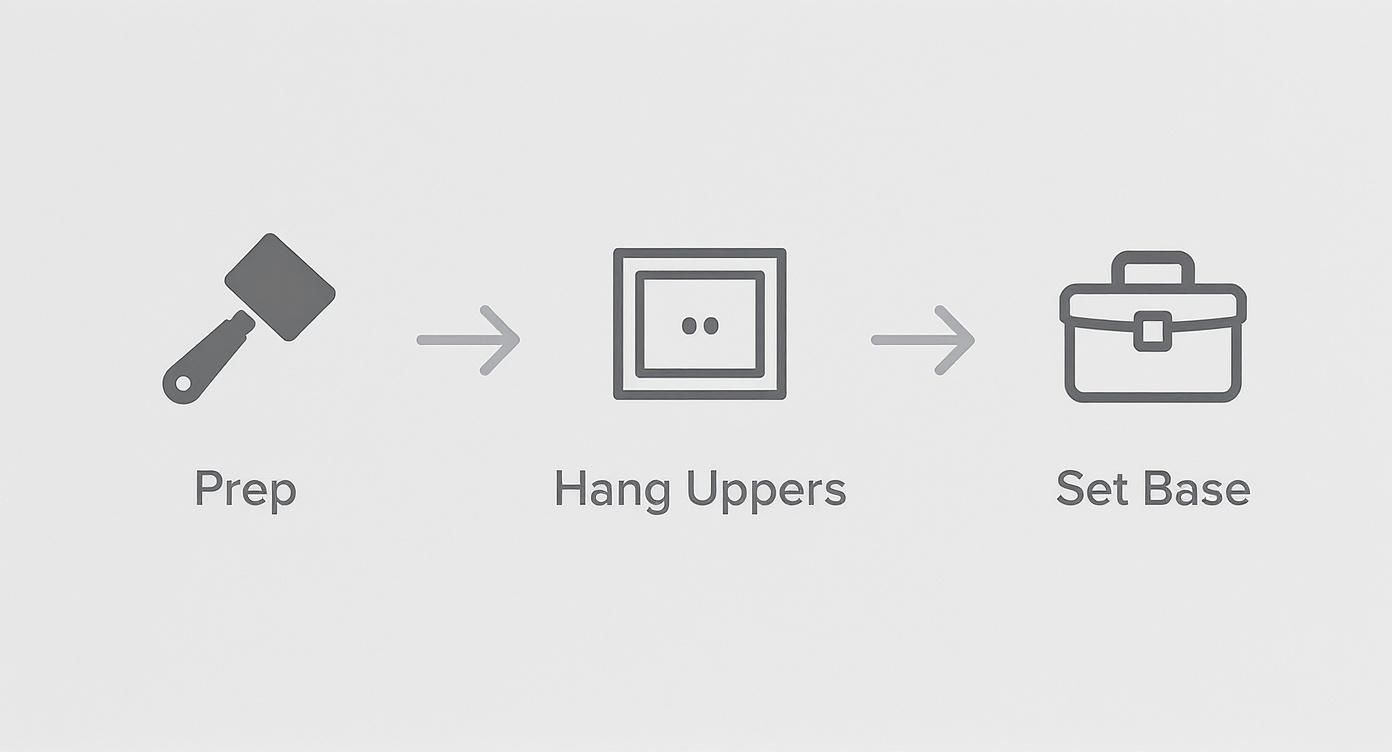
As you can see, the process is logical, moving from wall prep to hanging the uppers and finally setting the base cabinets, which builds a strong foundation for the rest of your kitchen.
The Finishing Touches That Make All the Difference
With the main cabinet boxes secured, the focus shifts to the detail work. This is where the kitchen really comes to life and the quality of the installation shines through.
This final stage involves several key steps:
- Hanging Doors and Attaching Drawer Fronts: Every door and drawer front is carefully put in place.
- Perfecting the Alignment: The installers will painstakingly adjust every hinge and drawer slide. They're aiming for perfectly even gaps—what the pros call reveals—between every single door and drawer.
- Installing Hardware and Trim: Finally, the handles and knobs are installed, along with decorative pieces like crown moulding, light valances, and toe kicks that give the kitchen its finished look.
For an average-sized kitchen, the whole process—from tear-out to the final polish—usually takes about 3 to 5 days. It can feel a bit like organized chaos, but the result is a beautiful, highly functional kitchen designed to be enjoyed for decades.
So, you’ve picked out the perfect style for your new kitchen cabinets. Fantastic. Now you’ve hit the first major fork in the road on your renovation journey: do you buy the cabinets yourself and then hunt down an installer, or do you go for an all-in-one package that includes kitchen cabinets with installation?
Each path has its own set of pros and cons, and the best choice for you really boils down to your budget, how much risk you're comfortable with, and how hands-on you want to be.
Think of it like planning a big trip. The "supply-only" route is like booking your flights, hotels, and tours all on your own. You might snag some amazing deals by piecing it all together, but you’re also the one who has to make sure everything lines up. One delayed flight could send your whole itinerary into a tailspin.
On the other hand, a "supply and install" package is your all-inclusive resort. One company handles it all, giving you a single person to call and a clear line of accountability. It might not feel as flexible, but it offers a ton of peace of mind and makes the whole process a lot smoother.
Going the Supply-Only Route
Choosing to buy your cabinets from a supplier and then hiring your own installer is usually about one thing: trying to save money. By acting as your own general contractor, you can shop around for the best price on both the cabinets and the labour, potentially trimming your overall budget. This path puts you in the driver's seat.
But with that control comes a lot of responsibility. You're not just a homeowner anymore; you're the project manager. That means you're in charge of:
- Juggling Schedules: You have to make sure your cabinet delivery date lines up perfectly with your installer’s first day on the job. No gaps, no overlaps.
- Playing Referee: If a cabinet shows up damaged or a measurement is off, it’s on you to sort it out between the supplier and the installer. Get ready for some "he said, she said."
- Preventing Miscommunication: A tiny detail lost in translation can lead to big, expensive mistakes. What if the installer isn't familiar with the specific requirements of the cabinet brand you chose?
This approach can work out great if you've done this before or have a network of trusted tradespeople. For most people, though, trying to keep all these balls in the air can become a huge source of stress and can even lead to unexpected costs when things go wrong.
The Advantage of Supply and Install
Opting for an integrated supply and install service just makes life easier. The company you buy the cabinets from is the same one that installs them, which creates a seamless chain of responsibility. The whole model is built around accountability—the team is fully invested in a perfect outcome because they're on the hook for the entire job, from the first measurement to the final knob.
This all-in-one approach dramatically cuts down your risk. The company's own experts handle the measurements, the ordering, and the installation, making sure every single piece fits and functions exactly as it should. If a door is crooked or a panel is missing, there's no finger-pointing. The company just fixes it. Simple as that.
This is especially true with modern cabinet systems. For example, ready-to-assemble (RTA) cabinets have really changed the game. These systems, with their factory pre-drilling and precision parts, can cut installation time by up to 18%. That means fewer errors on-site and a faster finish. You can get more insights into how RTA cabinets are impacting the industry on castacabinetry.com. An integrated service provider who knows these systems inside and out can make the installation incredibly smooth and efficient.
Comparing Cabinet Sourcing Options
To help you see it all at a glance, we've put together a table comparing the two approaches. It really lays out where each path shines and where the potential headaches are.
| Factor | Supply-Only (DIY or Separate Contractor) | Supply and Install (All-in-One Service) |
|---|---|---|
| Cost | Potentially lower initial cost if managed perfectly. | Often higher upfront, but provides cost certainty. |
| Risk | High. You are responsible for all coordination and errors. | Low. A single company is accountable for the entire job. |
| Time & Effort | High. Requires significant project management from you. | Low. The company handles all logistics and coordination. |
| Quality Control | Fragmented. Quality depends on two separate entities. | Unified. One standard of quality from product to finish. |
| Warranty | Separate warranties for product and labour. | Often a comprehensive warranty covering both product and workmanship. |
Ultimately, while managing the project yourself can seem appealing from a cost perspective, the value of a single, accountable partner who guarantees the work from start to finish often outweighs the potential savings. It protects your investment and, just as importantly, your sanity.
How to Budget For Your Cabinet Installation
Figuring out the cost of new kitchen cabinets with installation is one of the biggest steps in planning a renovation, and it’s smart to get a handle on it early. It’s never just about the sticker price on the cabinets themselves. Your total investment is really a mix of two things: the cost of the actual cabinets and the cost for the skilled hands that put them in place. Getting a clear breakdown of both right from the start is the best way to keep your project on track and avoid any nasty surprises down the road.
The final price can swing quite a bit depending on a few key things. Think of it like buying a car—the base model has one price, but adding leather seats, a bigger engine, and a premium sound system changes the final number. For cabinets, the main variables are the size of your kitchen, the materials you pick, and how complex your new layout is.
Breaking Down the Costs
The first thing that really moves the needle on your budget is the material. Gorgeous solid wood cabinets are a classic for a reason, but they'll naturally sit at a higher price point than, say, the clean, modern look of High-Density Fibreboard (HDF). The sheer size of your kitchen also plays a huge part. More cabinets mean more materials and more work, so the total linear footage is a major factor.
Then there’s the installation itself. A simple, straight-line galley kitchen is a much quicker job than a sprawling U-shaped kitchen complete with an island, tricky corner cabinets, and detailed crown moulding. Every extra touch, every custom feature, adds to the time and skill required, and that will be reflected in the labour cost.
Think of your final quote like this: (Cabinet Material & Style Cost x Size of Kitchen) + (Layout Complexity x Labour Time) = Your Total Investment. When you understand what goes into each part of that equation, you can make smarter choices that fit your budget.
Once you’ve settled on a quote, the payment process is usually pretty standard. Most professional installers in the Toronto area will ask for an initial deposit to get the ball rolling. This typically falls somewhere between 40% to 50% of the total project cost.
That first payment secures your materials and gets your project locked into the installer's schedule. The final balance is then usually paid once the job is done and you're happy with the results. A quick word of advice: be very cautious of any company that demands 100% payment upfront. That’s not how the industry works, and it can leave you in a vulnerable position if things don't go as planned.
It's also worth noting that the market is always shifting. We're seeing some homeowners become more budget-conscious, sometimes choosing essential upgrades over massive, down-to-the-studs remodels. The Kitchen Cabinet Manufacturers Association has seen this trend reflected in sales figures, with a bit of a dip in the super high-end custom cabinet market. You can read more about how market conditions are shaping homeowner choices here.
For anyone looking to get the most value for their money, it pays to look at different ways to buy. Cutting out the middleman by going factory-direct, for instance, can lead to some serious savings. You can learn more about the smart way to buy luxury kitchen cabinets in Toronto and how that approach can make a big difference to your bottom line. Armed with this knowledge, you can plan your renovation with confidence.
Your Checklist For Hiring The Right Installer

Let's be honest—choosing your installation partner is probably the biggest decision you'll make in this whole process. A great team makes a complicated job feel seamless. The wrong one? It can turn your dream renovation into a nightmare of delays, extra costs, and shoddy work.
To make sure you end up with a true pro, you have to go in armed with the right questions. Think of it like a job interview. You're the boss, and you're hiring for a very important role in your home. You wouldn't hire someone without checking their background, and the same rules apply here. This checklist will help you vet potential installers like an expert, so you can feel confident your investment is in good hands.
Verifying Credentials And Experience
Before you get lost in tile samples and countertop finishes, nail down the fundamentals. Any installer worth their salt will have zero issue showing you proof of their qualifications. This isn't just a formality; it's your first line of defence against liability and poor craftsmanship.
These are the non-negotiables. Don't be shy about asking for:
- Proof of Insurance: You need to see a current certificate of liability insurance. This is what protects your home from any accidental damage while the crew is working.
- WSIB Coverage: If you’re in Ontario, your contractor must have active Workplace Safety and Insurance Board (WSIB) coverage. This is huge—it protects you from being held liable if a worker gets injured on your property.
- Business Licence: A quick check to confirm they’re a legitimate business registered to operate in Toronto or Markham.
If a potential installer gets defensive or can't produce these documents right away, that's a massive red flag. Thank them for their time and move on to the next candidate.
Assessing Their Work and Reputation
Okay, they've passed the paperwork test. Now it's time to dig into the quality of their work and what past clients have to say. You need to see real, tangible proof that they can deliver on their promises.
A portfolio full of glossy photos is one thing, but an unfiltered conversation with a past client is where you get the real story. This is the step that separates the good installers from the truly great ones.
Here’s what you should be asking to get the full picture:
- Can I see your portfolio of recent, local projects? Pay close attention to kitchens that are similar in size and style to what you're planning, especially those in the Greater Toronto Area.
- Could you provide references from your last three projects? Talking to recent clients is key. It gives you the most current insight into their performance, communication, and customer service.
- What kind of warranties do you offer? You should expect two separate guarantees: a product warranty on the cabinets themselves and a workmanship warranty (usually one year) covering the installation.
For an even deeper dive, our article on how to choose the best kitchen cabinets contractor in Toronto has more insider tips. By asking these direct questions, you'll be able to confidently pick a partner you can trust to build the kitchen you've been dreaming of.
Common Cabinet Installation Questions
A kitchen reno is exciting, but it definitely brings up a lot of questions. Getting straight answers from the get-go is the best way to keep your project on time, on budget, and free of any nasty surprises. Let’s walk through some of the things homeowners ask us all the time when they're getting new kitchen cabinets installed.
Getting these details sorted out early means you can prep your home properly and line up other trades you might need, making the whole process run much more smoothly.
How Long Does Kitchen Cabinet Installation Take?
Every kitchen is a bit different, but for the most part, the actual hands-on installation of your new cabinets will take about two to four days. This happens after the old ones have been torn out (usually a day or two) and the walls have been prepped to make sure everything fits perfectly.
For a typical kitchen here in the Toronto area, you’re looking at about a week of on-site work, from demolition day to the final cabinet being hung. The biggest things that can stretch out that timeline are a really complex layout or just a very large kitchen.
Do I Need To Hire My Own Plumber or Electrician?
Almost always, yes. Cabinet installers are masters of their craft, but that craft is cabinetry. You'll need to book a licensed plumber to handle disconnecting and reconnecting your sink, faucet, and dishwasher. The same goes for an electrician if you're moving outlets, adding under-cabinet lighting, or hooking up appliances.
It's a really good idea to confirm this with your cabinet company upfront. Some full-service renovation firms might coordinate these trades for you, but usually, it's up to you to hire and schedule them. This also ensures all the plumbing and electrical work is done to code, which is non-negotiable.
What Kind of Warranty Should I Expect?
A quality cabinet project should always come with two separate warranties. This is your safety net, covering both the products themselves and the installation work.
- Product Warranty: This is from the manufacturer and covers any defects in the cabinets, doors, or hardware. The length can really vary, from a basic five-year plan all the way up to a limited lifetime guarantee.
- Workmanship Warranty: This comes from the installation crew and guarantees the quality of their work. You should never accept anything less than a one-year warranty on the labour.
Make sure you get both of these in writing before any work begins.
Can We Stay In Our Home During The Installation?
Absolutely, you can stay home. Just be ready for a bit of chaos! Your kitchen is going to be a construction zone for a few days, so you won't be able to use it. You can expect a fair amount of dust and noise while the team is there.
To make life easier, we always suggest setting up a temporary kitchen somewhere else in the house. A microwave, a mini-fridge, and the coffee maker on a folding table in the dining room can be a real lifesaver.
At MapleKing Kitchen Cabinets, we’re here to make your renovation simpler. We pair our factory-direct products with expert advice to help you get a kitchen you'll love, without all the usual headaches. Explore our custom cabinet solutions today.