

There's a reason wood kitchen cabinets have been the anchor of homes for centuries. It's more than just a place to store your pots and pans; it's the material that brings warmth, character, and a sense of permanence to the most important room in your house. Choosing wood is about investing in a foundational design element that not only sets the tone for your kitchen but can also seriously boost your home's value.
Why Wood Cabinets Remain the Heart of the Modern Kitchen
In a market flooded with all sorts of engineered materials and fast-fashion trends, you might wonder why wood still comes out on top. The answer is simple: character. Think about it—no two pieces of wood are identical. The subtle whorls in the grain, the slight shifts in colour, the way it feels to the touch… that's a kind of authenticity you just can't manufacture.
This isn't just a hunch; the numbers back it up. Even with all the new materials available, wood is what people consistently choose. In 2024, industry reports showed wood-based cabinets brought in around 60% of all industry revenue. That’s a huge slice of the pie, proving that homeowners still crave its natural beauty and the bonus of it being repairable. You can dive deeper into these kitchen cabinet trends and see the full report.
But it's not just about looks. The real magic of a quality wood kitchen cabinet is its chameleon-like ability to fit any style and its sheer staying power.
- Timeless Style: A simple, clean Shaker door made from maple can feel perfectly modern, while the same style in a rustic oak can anchor a traditional farmhouse kitchen. Wood just works, adapting as your own tastes evolve over the years.
- Customization Potential: Wood is the ultimate canvas. It can be stained to bring out its natural grain, painted any colour under the sun, or even carved with intricate details. You can truly make it your own.
- Long-Term Durability: Here's the big one. Solid wood is tough. More importantly, it’s fixable. A deep scratch on a laminate door often means a full replacement, but a wood cabinet can be sanded down, refinished, and brought back to life.
When you choose wood, you're not just buying cabinets for today. You're making a long-term investment that pays off in daily enjoyment and lasting value, creating a kitchen that will be loved for decades.
This guide is here to walk you through it all. We’ll cut through the jargon and get straight to what you need to know, from picking the right wood species and finish to figuring out your budget and getting the installation right.
A Closer Look at Wood Species and Grains
Picking the right wood for your kitchen cabinets is a bit like choosing a personality for the room. It goes far beyond just the colour; it’s about the story the grain tells, the texture you can feel, and the durability it promises for years to come. Every species of wood brings its own unique blend of character, strength, and visual flair to the heart of your home.
Think of wood grain as the material’s fingerprint. Some patterns are quiet and subtle, while others are bold and expressive. This natural, visual texture is one of the biggest reasons homeowners still gravitate toward a genuine wood kitchen cabinet over man-made alternatives.
To get a handle on what makes wood so special, this chart breaks down its value into three key pillars.
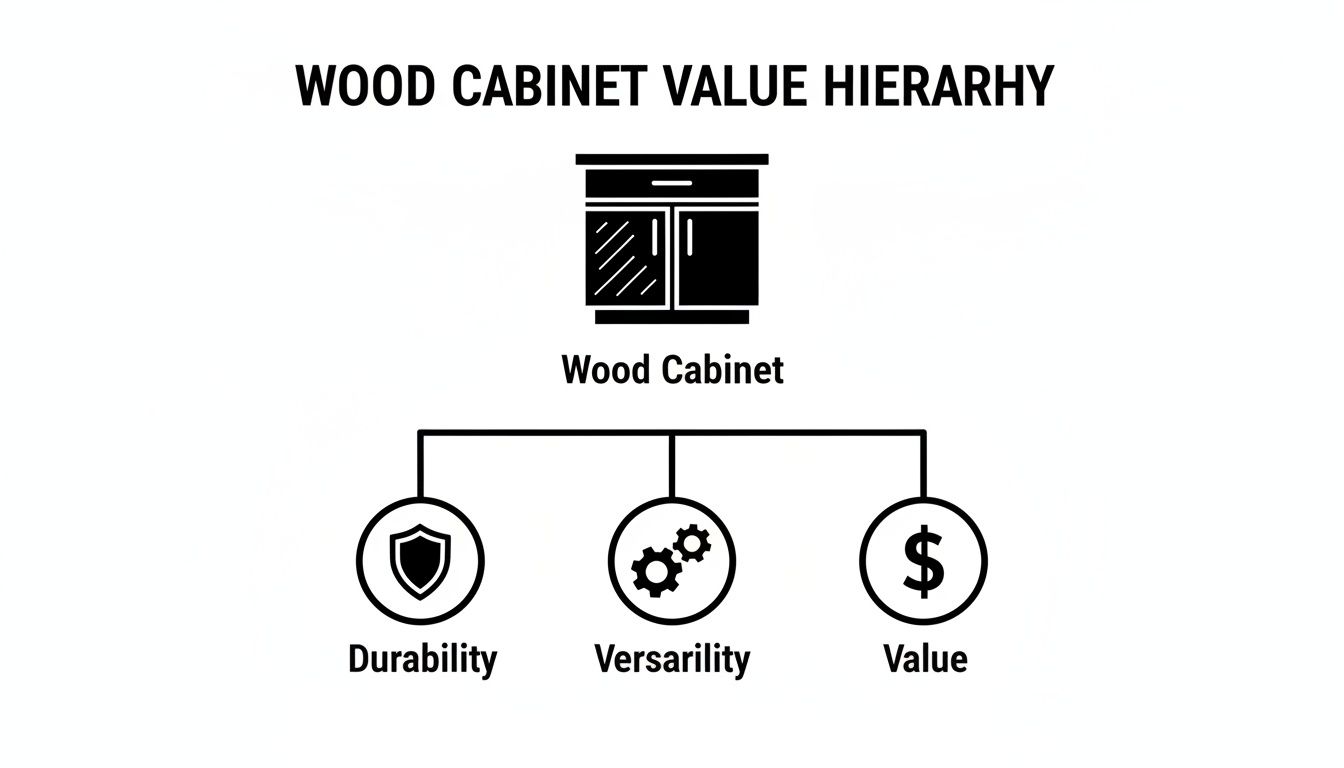
As you can see, the real value of wood isn’t just one thing. It's that sweet spot where durability, stylistic versatility, and long-term financial worth all come together, making it a solid investment in your home.
The Most Popular Wood Species for Cabinets
Once you start looking, you’ll notice a few names pop up again and again. These woods have earned their top spots for good reason, offering a fantastic balance of beauty, everyday performance, and overall value.
-
Maple: Often considered the perfect canvas, maple is a hardwood celebrated for its smooth, fine grain and creamy white colour. Its consistent surface makes it the top choice for painted finishes, as you won't see the heavy grain texture that other woods might show through the paint.
-
Oak: A timeless choice for traditional kitchens, oak is prized for its serious strength and prominent grain pattern. It has a very distinct, open grain with wavy lines that give it a warm, rustic character. Red oak tends to have pinkish undertones, while white oak leans more greyish-brown.
-
Birch: A more budget-friendly hardwood, birch has a similar look to maple with its light colouring and fine grain. However, it can sometimes feature a wavier or more varied pattern, which adds a subtle touch of visual interest. It takes both stains and paints beautifully.
-
Walnut: For a true touch of luxury, nothing beats walnut. This premium hardwood features a smooth, straight grain and ranges in colour from a light greyish-brown to deep, rich chocolate. Over time, walnut naturally lightens a bit, which only adds to its unique charm.
Choosing a wood is really about matching its inherent character to your daily life. A busy family kitchen with kids and pets might benefit from the rugged durability of oak, while a sleek, minimalist space is perfectly complemented by the smooth elegance of maple.
Decoding Wood Grains and Their Impact
So, what exactly is "grain"? It's simply the natural lines and patterns you see on the wood's surface. These patterns are formed by the tree's growth rings, and the final look all comes down to how the log is cut at the mill.
-
Straight Grain: This is a clean, linear pattern, often seen in woods like maple and quartersawn oak. It creates a calm, uniform look that’s perfect for modern or transitional designs.
-
Open or Coarse Grain: Found in woods like red oak, this grain has larger pores and a more textured, obvious pattern. It’s a fantastic way to create a rustic, traditional, or farmhouse feel.
-
Fine Grain: Woods like maple, birch, and cherry have a smooth, subtle grain with very small pores. This lends itself to a more refined and contemporary aesthetic.
Understanding these differences is key because the grain pattern directly affects how a finish will look. A dark stain, for example, will sink into the deep grooves of an open grain, making it look even more dramatic. On the other hand, a smooth painted finish is best applied to a fine-grained wood to avoid a bumpy or uneven texture.
Hardness Matters: The Janka Scale Explained
Looks are important, but the practical durability of your wood kitchen cabinet is crucial. The industry-standard way to measure this is with the Janka hardness rating, a test that measures how much force it takes to embed a small steel ball into a piece of wood.
Basically, think of it as a "dent resistance" score.
The higher the Janka number, the harder the wood and the more resistant it is to dings and scratches from dropped pots, busy kids, and general daily life. To help you choose, we’ve put together a quick comparison of the most common cabinet woods.
Comparison of Popular Wood Cabinet Species
This table gives you a snapshot of common wood types, highlighting their key characteristics to help you pick the best fit for your kitchen renovation.
| Wood Species | Grain Pattern | Typical Hardness (Janka) | Best For | Average Cost |
|---|---|---|---|---|
| Maple | Fine, subtle | 1450 | Painted finishes, high-traffic kitchens, modern or transitional styles | Moderate-High |
| White Oak | Prominent, straight | 1360 | Traditional looks, busy families, excellent resilience | Moderate-High |
| Red Oak | Wavy, open | 1290 | Classic durable cabinets, farmhouse or rustic styles | Moderate |
| Birch | Fine, can be wavy | 1260 | Budget-conscious projects, versatile for paint or stain | Low-Moderate |
| Walnut | Smooth, straight | 1010 | Luxury kitchens, lower-traffic areas, sophisticated modern designs | High-Premium |
| Cherry | Fine, smooth | 950 | Elegant designs, kitchens where careful use is the norm | High |
Just because a wood has a lower Janka rating doesn't mean it's a bad choice; walnut and cherry are premium options highly valued for their unmatched beauty. The key is to align the wood’s natural toughness with your family's lifestyle to ensure your cabinets look fantastic for decades to come.
Finishes and Materials: Bringing Your Cabinet Vision to Life
The wood species is the foundation, but the finish is what gives your cabinets their soul. It's the final touch that can either whisper elegance or shout with bold colour, ultimately defining your kitchen's entire atmosphere. Think of it as the difference between a watercolour painting that lets the texture of the paper show through and a glossy acrylic that creates a solid, vibrant surface.
Choosing a finish isn't just about looks; it's a practical decision, too. You're balancing the aesthetic you love with the durability your lifestyle demands. Let's walk through the most popular options to figure out which one tells the right story for your home.
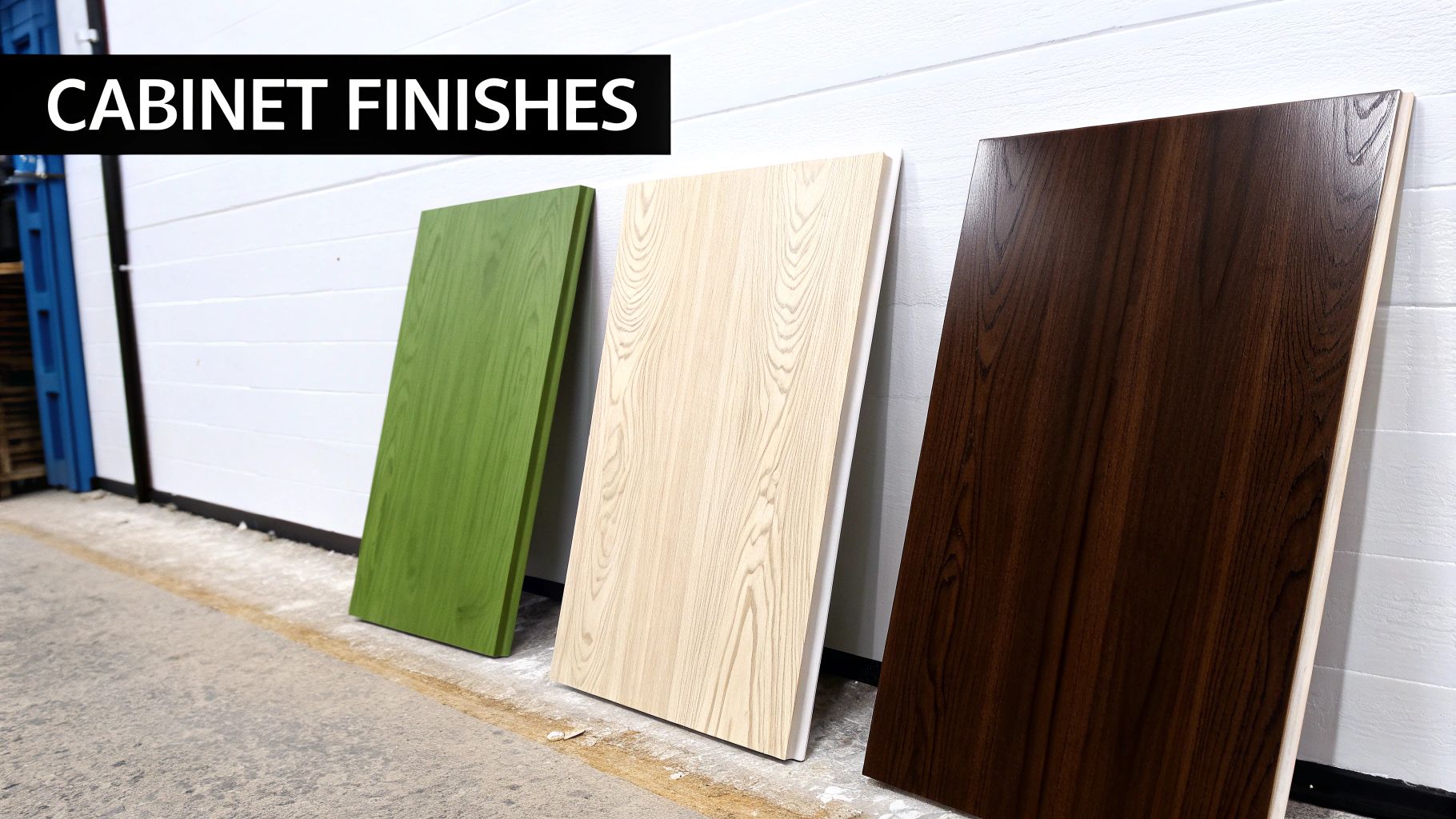
The Classic Touch of Stained Wood
For many, the whole point of wood cabinets is to see the wood itself. A stained finish is perfect for this. It doesn't sit on top of the wood like a layer of paint; it soaks right in, enhancing the natural grain and character of the species you so carefully selected.
If you’ve invested in Oak for its bold, rustic grain or Walnut for its rich, swirling patterns, a stain is the best way to make those features pop.
You've got a whole spectrum to play with:
- Light Stains: These are great for keeping a kitchen bright and airy. They add a touch of warmth to woods like maple or birch without hiding their subtle, beautiful grain.
- Medium Stains: The versatile workhorse. Rich and balanced, medium stains feel at home in almost any setting, from traditional to more transitional designs. They add depth without making the room feel dark.
- Dark Stains: For a dose of drama and sophistication, nothing beats a dark stain. Think deep espresso or luxurious cherry tones that create a truly high-end, statement look.
Painted Finishes and the Power of HDF
Want a clean, crisp white kitchen? Or maybe a bold navy blue or a soft sage green? A painted finish is your ticket.
Now, you can paint solid wood doors, but for that flawless, long-lasting finish, the industry secret is High-Density Fiberboard (HDF). HDF is an engineered wood product made by compressing wood fibres under immense pressure, resulting in a perfectly smooth and incredibly stable panel.
Think of HDF as the perfect artist's canvas. It has no grain that can ghost through the paint over time. More importantly, it doesn't expand and contract with Toronto's humidity swings like solid wood does. That stability prevents the hairline cracks you often see at the joints of older painted wood doors.
This makes HDF the go-to material for that seamless, solid colour that’s so popular in modern and classic kitchens alike. If you're thinking about refreshing your existing kitchen, this guide on painting oak cabinets has some great professional tips.
Modern Materials Built for Real Life
Beyond traditional wood and paint, today’s kitchens benefit from some amazing engineered materials. These options offer unique looks combined with fantastic performance, perfect for the hustle and bustle of a modern home.
High-Gloss and Matte Laminates
Forget what you think you know about laminate. The new generation of high-pressure laminates are sophisticated and tough. They're made by fusing layers of paper with a decorative top sheet under intense heat and pressure, then bonding it to a stable core like HDF.
- High-Gloss Laminate: Delivers that sleek, mirror-like shine you see in ultra-modern European designs. It’s a fantastic choice for smaller kitchens, as the reflective surface bounces light around and makes the space feel bigger.
- Matte Laminate: Soft, velvety, and incredibly chic. Matte finishes absorb light, giving you a subtle, high-end look. Best of all? They’re incredibly resistant to fingerprints and smudges, a lifesaver for families with kids.
Seamless and Durable Thermofoil
Thermofoil is a vinyl film that’s heat-fused and vacuum-sealed over a profiled HDF door. The real magic of this process is that it creates a perfectly seamless surface. No joints, no cracks, no seams—nowhere for dirt and grime to get trapped.
This makes thermofoil doors incredibly easy to wipe down and highly resistant to moisture. It’s a low-maintenance workhorse available in a huge range of solid colours and surprisingly realistic wood grain patterns, giving you a world of design options without the price tag of real wood.
How to Budget for Your Wood Kitchen Cabinet Project
Let’s be honest: setting a budget is the least glamorous part of a kitchen renovation, but it’s the most critical. Your cabinets will be one of the biggest investments in your new space, so understanding where the money goes is the key to getting a kitchen you love without any nasty surprises.
Think of it like buying a car. You’ve got your dependable base models, mid-range options with a few bells and whistles, and the fully-loaded, custom-built machines. Each has its place and its price point. Kitchen cabinets work the same way; the final number isn't just about the boxes, but a mix of materials, craftsmanship, and all the little details that make it your kitchen.
The Core Cost Drivers
When you get a quote, the price is really being driven by three main things. If you get a handle on these, you’ll see exactly where your budget is going and where you have some wiggle room.
-
Wood Species and Finish: This is a big one. As we've covered, premium hardwoods like Walnut will naturally have a higher price tag than go-to options like Birch or Oak. Likewise, a durable, multi-step factory-painted finish on HDF is going to be priced differently than a simple stain on solid wood.
-
Level of Customization: How much tailoring do you need? Stock cabinets are the most budget-friendly but come in set sizes. Semi-custom gives you more flexibility with dimensions and finishes. Then there's fully custom, where the cabinets are built from scratch to your exact specs—the possibilities are endless, but so is the potential cost.
-
Total Linear Feet: This is the most straightforward factor. The more cabinets you need, the more it will cost. A small galley kitchen in a Markham condo is going to have a very different bottom line than a sprawling open-concept space with a massive island.
Looking Beyond the Price Tag
A classic rookie mistake is to focus only on the cost of the cabinets themselves. But that's just part of the story. To get the job done right, you need to account for several other costs right from the start.
Remember that a successful project budget accounts for the entire scope of work, not just the product. Overlooking installation, hardware, and removal costs can quickly derail your financial planning and lead to stressful compromises down the road.
Make sure you've got these line items in your spreadsheet:
-
Hardware: Knobs and pulls are the jewelry for your cabinets. You can find simple, functional pieces for a few dollars each, but designer hardware can easily run $50 or more per piece. For an average-sized kitchen, that can add up to hundreds of dollars fast.
-
Installation: This is not a place to cut corners. Professional installation is crucial for a flawless finish. Labour costs here in the GTA typically account for 10-20% of the cabinet cost. If you're weighing your options, this guide on painting kitchen cabinets is a great resource for comparing the costs of refinishing versus a full replacement.
-
Removal and Disposal: Those old cabinets have to go somewhere. This involves the labour to carefully take them out and any fees for proper disposal.
The Factory-Direct Advantage
One of the smartest ways to stretch your budget without sacrificing quality is to work directly with a manufacturer. When you buy factory-direct, you cut out the middlemen—the distributors and big-box retailers—who all add their own markups along the way. Those savings get passed straight to you.
This approach also helps insulate you from some of the wild price swings in the market. Global supply chains can be unpredictable, and sourcing directly and locally often means more stable pricing. By removing the extra layers, you get a much clearer picture of what you're paying for and more control over your investment.
If you're looking for more guidance on navigating the local market, we've put together an extensive guide on choosing the right kitchen cabinets in Toronto that dives deeper into styles and budgeting for your home.
Designing Your Ideal Kitchen Cabinet Layout and Style
Okay, you’ve picked out your materials and finishes. Now for the fun part: bringing your vision to life. This is where we move beyond just picking out boxes and start designing a space that feels right and works with your daily rhythm. A thoughtful layout and the right style are what turn a kitchen from a collection of parts into the true heart of your home.
It all begins with the cabinet doors. The style you choose sets the entire aesthetic tone, whether you're chasing a timeless traditional look or something sleek and modern.
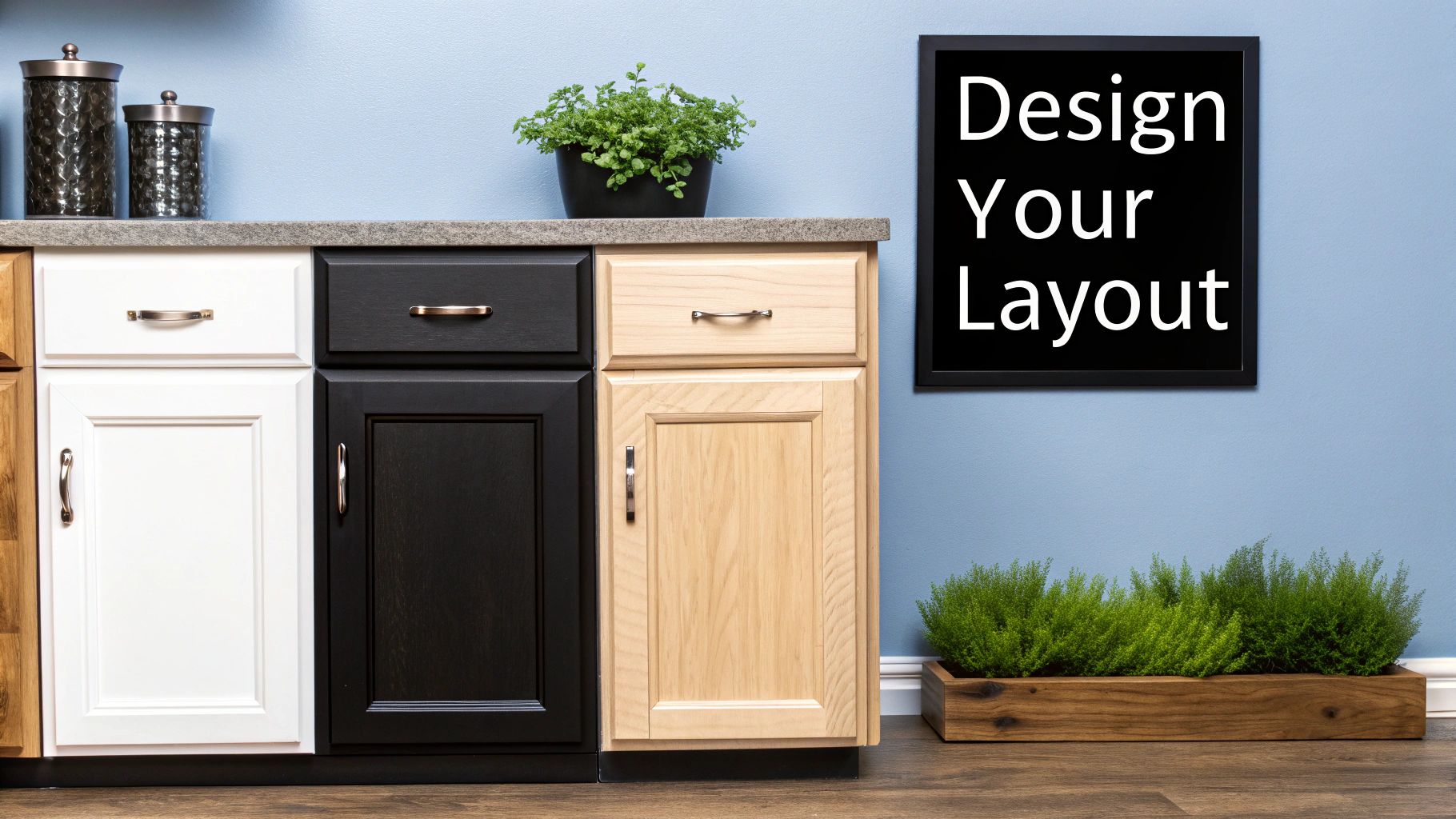
Choosing Your Timeless Cabinet Style
Trends will always come and go, but a few core cabinet door styles have stuck around for a reason—they’re versatile and just plain look good. Each one brings a distinct personality to the table.
-
Shaker Style: This is the undisputed champion of versatility. With its simple, clean design—a flat, recessed centre panel with a four-piece frame—Shaker is a true chameleon. Leave it in a natural wood finish for a warm, traditional feel. Paint it white or grey, and it instantly becomes the foundation for a modern farmhouse or transitional kitchen.
-
Slab (Flat Panel): If you're after a clean, minimalist look, nothing beats a slab door. It’s exactly what it sounds like: a single, solid flat panel with zero ornamentation. This style is perfect for contemporary spaces, creating seamless lines and putting all the focus on the cabinet’s colour, finish, or hardware.
-
Raised Panel: The classic choice for more traditional and formal kitchens. These doors have a raised centre panel that’s often carved with a decorative edge. This design adds depth and a touch of formal elegance that looks incredible with detailed crown moulding and classic hardware.
The right style does more than just look good—it enhances your home's character. A sleek slab door might feel out of place in a historic Toronto home, just as an ornate raised panel could clash with a modern Markham condo's clean lines.
Hardware: The Finishing Touch
Think of your cabinets as the outfit and the hardware as the jewellery. The knobs and pulls you select are a powerful way to inject personality and complete the look. This is your chance to make a statement, whether it's subtle and refined or bold and dramatic.
Different finishes create completely different moods:
- Brushed Nickel or Chrome: A bright, contemporary look that pairs perfectly with stainless steel appliances.
- Matte Black: Delivers a striking, modern contrast, especially against light-coloured cabinets.
- Brass or Gold Tones: Adds a touch of warmth and luxury for a more elegant, high-end feel.
The scale of your hardware matters, too. Long, linear pulls can really accentuate the clean lines of slab doors, while simple, classic knobs are a natural fit for the understated charm of Shaker cabinets.
Smart Design Strategies for Modern Living
A great kitchen is as much about function as it is about form. Smart planning can solve those little everyday annoyances and make your space work so much harder for you. This focus on thoughtful manufacturing is what drives the entire industry. For perspective, California's cabinet and vanity manufacturing sector was estimated at about $1.7 billion in 2025, showing just how big of a role it plays. You can learn more about its economic impact in this comprehensive industry analysis.
In your own kitchen, small decisions can make a huge difference. Using light-coloured cabinets, for instance, is a classic trick to make a smaller kitchen feel open and airy by reflecting more light. Integrating custom storage solutions—like deep drawers for pots and pans, a pull-out spice rack, or a hidden recycling centre—clears clutter off your countertops and makes the most of every square inch.
To see how all these pieces come together in real homes, take a look through our gallery of completed kitchen projects for some fresh ideas.
7. Protecting Your Investment: Installation and Long-Term Care
So, you’ve picked out your dream cabinets, and they’ve finally arrived. This is where the vision starts to become a reality, but the job isn't done yet. Getting the installation and after-care right is what separates a good kitchen from a great one that will stand the test of time.
Think of it this way: a high-quality wood kitchen cabinet is only as good as its installation. You can have the most beautiful doors and sturdy boxes, but if they aren't installed perfectly, you're setting yourself up for future problems. Professional installation is about much more than just hanging cabinets on a wall; it's a game of precision.
A skilled installer ensures every single cabinet is perfectly plumb (vertically straight), level (horizontally straight), and square. This meticulous work is what prevents those annoying issues down the road—doors that mysteriously swing open, drawers that jam, or uneven gaps that drive you crazy. A rock-solid installation protects the cabinets from unnecessary stress, guaranteeing they'll function as beautifully as they look for years to come.
The Homeowner's Role in a Flawless Installation
Even though you’re hiring a pro, you play a vital role in the process. Being an educated and engaged homeowner is the best form of quality control. Before a single screw goes into the wall, sit down with your contractor and have a real conversation about the details.
Here are a few sharp questions to get the ball rolling:
- How will you handle my uneven walls or floors? This is a common issue in many Toronto and Markham homes. A pro will immediately talk about using shims and a long level to create a perfectly straight line, no matter what the wall is doing.
- What kind of screws are you using to hang the cabinets? The right answer involves cabinet-specific fasteners that are long enough to bite deep into the wall studs, not just the drywall.
- What's your process for corner cabinets? Aligning corners is one of the trickiest parts of an installation. Hearing their strategy shows you they’ve thought through the complexities.
Getting on the same page from the start prevents headaches later. If you're searching for a trusted team, exploring professional kitchen cabinet installation services can connect you with installers who live and breathe these details.
A flawless installation is invisible; you only notice it when it's done wrong. Ensuring your cabinets are perfectly aligned and securely mounted from the start is the single best thing you can do to prevent future headaches like sagging doors and sticking drawers.
Simple Care for Lasting Beauty
Once your beautiful new kitchen is ready, keeping it that way is surprisingly simple. It’s all about gentle, consistent habits. You almost never need aggressive cleaners, which can often cause more harm than good.
For everyday cleaning, a soft, lint-free cloth dampened with warm water is your best tool. If you're dealing with stubborn grease from cooking, a mild solution of dish soap and water is perfect. Just be sure to wipe in the direction of the wood grain and follow up with a dry cloth to remove any moisture.
What you don't use is just as important. Stay away from these:
- Harsh chemicals, especially anything with ammonia or bleach.
- Abrasive scrubbing pads or steel wool that will scratch the finish.
- Letting water sit on the surface for any length of time.
Life happens, and in a busy kitchen, small nicks or scratches are inevitable. That's what touch-up markers are for. A quick dab from a marker supplied by your cabinet maker can make those little imperfections vanish, keeping your kitchen looking pristine.
Your Top Questions About Wood Kitchen Cabinets, Answered
Choosing new kitchen cabinets is a big decision, and naturally, a lot of questions come up along the way. I hear the same ones from homeowners all over Toronto and Markham, so let's clear up a few of the most common ones to help you feel confident in your choice.
What’s the Toughest Wood for Kitchen Cabinets?
When you’re talking about pure durability, you have to look at the hardness of the wood. For a busy kitchen that sees a lot of action, you can't go wrong with hardwoods like Maple, Hickory, or Oak. Their dense grain makes them champions at shrugging off the accidental bumps and knocks of daily life.
But the wood species is only part of the equation. Think of the finish as the cabinet's suit of armour. A professionally applied, factory-cured catalyzed varnish is what truly protects the wood, giving it a massive boost in resilience against scratches, spills, and wear.
How Many Years Should Good Cabinets Really Last?
A high-quality wood kitchen cabinet isn't a short-term purchase. With proper installation and a little bit of care, you should expect them to last 20 to 30 years—and it's not uncommon for them to look great for even longer.
What gives them that staying power? It comes down to a few key things: the quality of the wood itself, solid construction techniques like dovetail joints, and a tough, durable finish. When you invest in quality upfront, it truly pays you back for decades.
A quick note on painted cabinets: A factory-painted finish is an incredibly durable choice. It creates a hard, seamless shell that's far more resistant to chipping than anything you could do yourself. For painted doors, we often recommend HDF (High-Density Fiberboard) because it's completely stable—it won't expand or contract with humidity changes, which prevents those pesky hairline cracks you sometimes see at the joints of painted wood doors.
Working with a factory-direct supplier like us is one of the smartest moves you can make. You get to skip the retail markup, which means significant savings. You also get access to more custom options and much tighter quality control, ensuring you get exactly what you envisioned.
Ready to see what beautiful, durable cabinets can do for your kitchen? Explore the custom designs and factory-direct value at MapleKing Kitchen Cabinets and let's start building the kitchen you've always wanted. Visit us at https://maplekingkitchencabinets.com.



