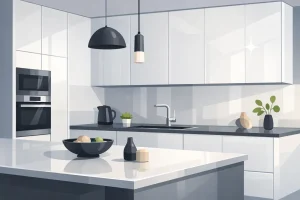

A low cabinet quote can feel like a win until you start wondering what is behind the doors. What are cheap kitchen cabinets made of? Usually, they combine engineered wood panels, an applied finish, and cost-conscious hardware or construction details. That does not automatically mean they are poor quality. The real question is whether each material is being used in the right place for your kitchen, budget, and expectations.
Affordable cabinets can deliver a polished, custom-looking kitchen when their boxes, doors, finishes, and installation are selected carefully. Knowing the difference between particleboard, MDF, HDF, plywood, laminate, and thermofoil helps you compare quotes on value rather than price alone.
What Are Cheap Kitchen Cabinets Made Of?
Most budget-friendly cabinets are not made from one material throughout. A cabinet has a box, doors and drawer fronts, shelves, a back panel, edge banding, hinges, drawer slides, and a finish. Manufacturers often use a different material for each component to balance appearance, strength, and cost.
The most common affordable cabinet construction uses particleboard or MDF for cabinet boxes, MDF or HDF for painted doors, and laminate, thermofoil, or paint for the visible surface. Better-value options may upgrade cabinet sides, shelves, or drawer boxes to plywood while keeping an economical door finish. This mix is often smarter than paying for solid wood everywhere, especially in a modern kitchen where the finish does most of the visual work.
Cabinet Box Materials: Where Budget Decisions Matter
The cabinet box is the structure attached to your wall and supporting countertops, dishes, and daily use. It is mostly hidden, but its material and assembly have a major effect on longevity.
Particleboard
Particleboard is made from small wood particles pressed together with resin. It is one of the least expensive cabinet-box materials and is commonly covered with a melamine or laminate surface. When it is properly sealed and installed, particleboard can work well in dry areas and low- to moderate-use kitchens.
Its weakness is moisture. Exposed or damaged particleboard can swell if it repeatedly absorbs water, particularly beneath a sink or near a dishwasher. It also does not hold screws as reliably after repeated removal and reinstallation. For a rental unit, a condo refresh, or a carefully managed renovation budget, particleboard cabinets can be a sensible choice. For a busy family kitchen, ask how the sink base, edges, and bottom panels are protected from moisture.
MDF
Medium-density fiberboard, or MDF, is made from fine wood fibers compressed into dense, smooth panels. It is more uniform than particleboard and creates a clean surface for painted cabinet doors and detailed profiles. MDF is also widely used in cabinet components because it cuts cleanly and does not have the grain variation of natural wood.
For cabinet boxes, MDF can be heavier than particleboard and may cost more. It still needs a durable coating and careful moisture protection. MDF is not a waterproof material, but a properly finished MDF cabinet can be an excellent choice for painted designs where a smooth, consistent look matters.
Plywood
Plywood is built from layers of wood veneer bonded together with alternating grain directions. It is generally lighter, stronger, and more moisture-resistant than particleboard or MDF, depending on the grade and finish. Plywood also offers better screw-holding strength, making it a popular upgrade for cabinet boxes, shelves, and drawer boxes.
Plywood usually raises the cabinet price, but it can be worthwhile in hard-working kitchens or for homeowners planning to stay in the home for many years. Keep in mind that “plywood construction” is not a complete quality guarantee. Ask about panel thickness, the grade of plywood, and whether the cabinet back and shelves are also built for strength.
Door and Drawer Front Materials
Doors create the kitchen’s visible personality. Affordable cabinets often save money through the door material and finish, not necessarily through the box alone.
HDF and MDF Painted Doors
High-density fiberboard, or HDF, is denser than MDF and is often used for smooth painted doors, particularly modern slab doors. Both HDF and MDF are stable engineered materials that allow for crisp paint finishes without the knots and grain movement found in natural wood.
Painted HDF or MDF cabinets can provide an upscale look at a practical price. They are especially well suited to white, gray, black, navy, and other solid-color kitchens. The quality difference comes down to the finish process. A well-applied, durable paint system resists everyday wear better than a thin coating that chips easily around handles and edges.
Thermofoil Doors
Thermofoil doors have an MDF core wrapped in a thin vinyl film that is heat-bonded to the surface. They are often chosen for their easy-clean finish, uniform color, and affordable price. Thermofoil can create a sleek white or contemporary wood-look kitchen without the cost of painted or solid wood doors.
The trade-off is heat and edge durability. Lower-quality thermofoil can peel over time, especially near ovens, dishwashers, or areas exposed to steam. Good manufacturing and proper heat shielding make a difference, but homeowners who cook heavily may prefer laminate or painted HDF doors for added peace of mind.
Laminate Doors
Laminate cabinetry uses a decorative surface bonded to an engineered wood core. Today’s laminates are available in convincing wood grains, soft matte colors, textured finishes, and high-gloss styles. They are a strong option for homeowners who want modern design, easy cleaning, and dependable scratch resistance at a controlled price.
Not all laminate is the same. Pay attention to edge treatment, thickness, and how the finish is bonded. A clean, durable edge band protects the core from moisture and makes the cabinet look more refined. Laminate is particularly practical for high-traffic homes because it does not require the upkeep associated with natural wood finishes.
Solid Wood and Wood Veneer
Some affordable cabinet lines include solid wood doors, usually made from maple, birch, oak, or similar species. Solid wood brings natural grain, warmth, and a traditional or transitional feel. It can be an excellent value when used for door frames or select design elements.
However, solid wood is not always the best material for every door style. Wood expands and contracts with humidity, which can affect paint over time. Veneer, a thin layer of real wood over an engineered core, can provide authentic wood character with greater stability and a more accessible price. For a wood-look kitchen, quality veneer or laminate may be a more budget-conscious choice than solid wood throughout.
Construction Details Can Matter More Than the Label
Two cabinets made from similar materials can perform very differently. A sturdy particleboard cabinet with a finished interior, sealed edges, reinforced mounting rails, and reliable hardware may outperform a poorly assembled cabinet marketed with a more expensive material name.
Look closely at the drawer box, drawer-slide capacity, hinge adjustability, shelf thickness, and cabinet back panel. Soft-close hardware is a worthwhile upgrade for most kitchens because it reduces slamming and improves the day-to-day feel of the space. Full-extension drawer slides also make deep cabinets more functional, helping you reach items at the back without wasted storage.
For wall cabinets, secure mounting construction is essential. For base cabinets, inspect how the legs or toe-kick system supports the cabinet and whether the box can be leveled accurately. A professional installation is equally important. Even premium materials can look poor or wear prematurely if cabinets are not properly leveled, secured, and protected around plumbing.
How to Choose Affordable Cabinets Without Buying Cheap Quality
Start with how you use your kitchen. A light-use condo kitchen may prioritize a clean laminate or thermofoil finish and efficient storage. A family kitchen with frequent cooking, children, and heavy dish storage may benefit from upgraded plywood boxes, stronger drawer slides, and durable painted HDF or laminate doors.
Then consider where it is worth spending more. Sink bases, pantry cabinets, wide drawers, and heavily used lower cabinets deserve extra attention because they face the most weight and moisture. You may be able to control the budget by choosing a simple door style, standard cabinet sizes, or a laminate finish while investing in better hardware and thoughtful layout planning.
A factory-direct cabinet partner can make these trade-offs clearer by showing you material options without adding traditional showroom markups. At MapleKing Kitchen Cabinets, the goal is not to push one material for every project. It is to help homeowners match premium-looking finishes and practical construction to the way their kitchen will actually be used.
The best affordable cabinet is not the one with the lowest sticker price. It is the one that gives your kitchen the look you want, protects the areas that work hardest, and continues to feel like a smart investment long after renovation day.