

Trying to pin down the cost of a kitchen renovation in Toronto can feel like aiming at a moving target. But to give you a ballpark idea, a simple cosmetic refresh usually lands somewhere between $13,000 and $25,000. If you're planning a more thorough, mid-range overhaul, you're likely looking at a budget of $20,000 to $65,000. For a high-end, custom kitchen, the starting line is often around $40,000 and can easily climb past $75,000.
These numbers are a great starting point, but let's unpack what they actually mean for your project.
Your Quick Guide to Toronto Kitchen Renovation Costs
Before we get into the nitty-gritty of line-item costs, it’s helpful to think about kitchen renovations in three general tiers: basic, mid-range, and high-end. Each one comes with a different scope of work and level of finishes, which is really what drives the final price tag.
Figuring out which tier your vision falls into is the first step to creating a realistic budget. It saves you from the common headache of dreaming up a high-end custom kitchen on a budget that’s better suited for a simple facelift.
Breaking Down the Renovation Tiers
A basic renovation is often called a "pull-and-replace." You’re not knocking down walls or changing the footprint of the kitchen. Instead, you're focused on high-impact cosmetic updates that breathe new life into the space.
A mid-range project is where most Toronto homeowners land. This tier gives you the flexibility to make more substantial changes, like adding an island, upgrading to quartz countertops, or installing semi-custom cabinets. It strikes a great balance between a beautiful transformation and a smart investment.
Then you have high-end renovations. This is where you go all-out with a fully custom design, top-of-the-line appliances, and major structural changes. These are complex, bespoke projects that come with a significant investment, often soaring past $100,000 in larger Toronto homes, as detailed in recent cost guides. You can dig deeper into what drives these figures by checking out this guide on renovation cost ranges on magicwindow.ca.
To make this even clearer, let's look at what you can expect within each budget level.
Toronto Kitchen Renovation Cost Tiers at a Glance
This table gives you a snapshot of what's typically included in each renovation tier and the associated costs you can expect here in the Toronto area.
| Renovation Tier | Typical Scope of Work | Estimated Cost Range (CAD) |
|---|---|---|
| Basic | Painting existing cabinets, replacing hardware, new laminate countertops, basic appliance upgrades, and a new backsplash. | $13,000 – $25,000 |
| Mid-Range | New semi-custom cabinets, quartz or granite countertops, new flooring, upgraded appliances, and minor layout changes like adding an island. | $20,000 – $65,000 |
| High-End | Full custom cabinetry, premium stone countertops, luxury appliances, major structural changes (e.g., removing walls), and designer fixtures. | $40,000 – $75,000+ |
As you can see, the scope of work is what truly separates one tier from the next.
Key Takeaway: The biggest single factor driving your renovation cost is the scope. If you want to keep your budget in check, the most effective thing you can do is stick with your kitchen's existing layout. Once you start moving plumbing and electrical, the costs add up fast.
So, Where Does Your Renovation Budget Actually Go?
It's one thing to see the price range for a Toronto kitchen renovation, but it's another thing entirely to understand where every dollar is headed. That final quote can feel a bit overwhelming, but when you break it down, each cost has a specific job. Think of your budget like a pie chart—some slices will always be bigger than others, and knowing which ones they are is the key to smart planning.
The total cost isn't some arbitrary number. It’s a careful tally of materials, specialized skills, and essential products. From the kitchen cabinets in Toronto that define the room's entire personality to the skilled hands that bring your vision to life, every single component plays a part in that final number. When you understand this financial roadmap, you can make smarter decisions, deciding where to invest for the biggest impact and where you might find a chance to save.
This chart gives you a clear visual of how kitchen renovation costs in the GTA break down by project level.
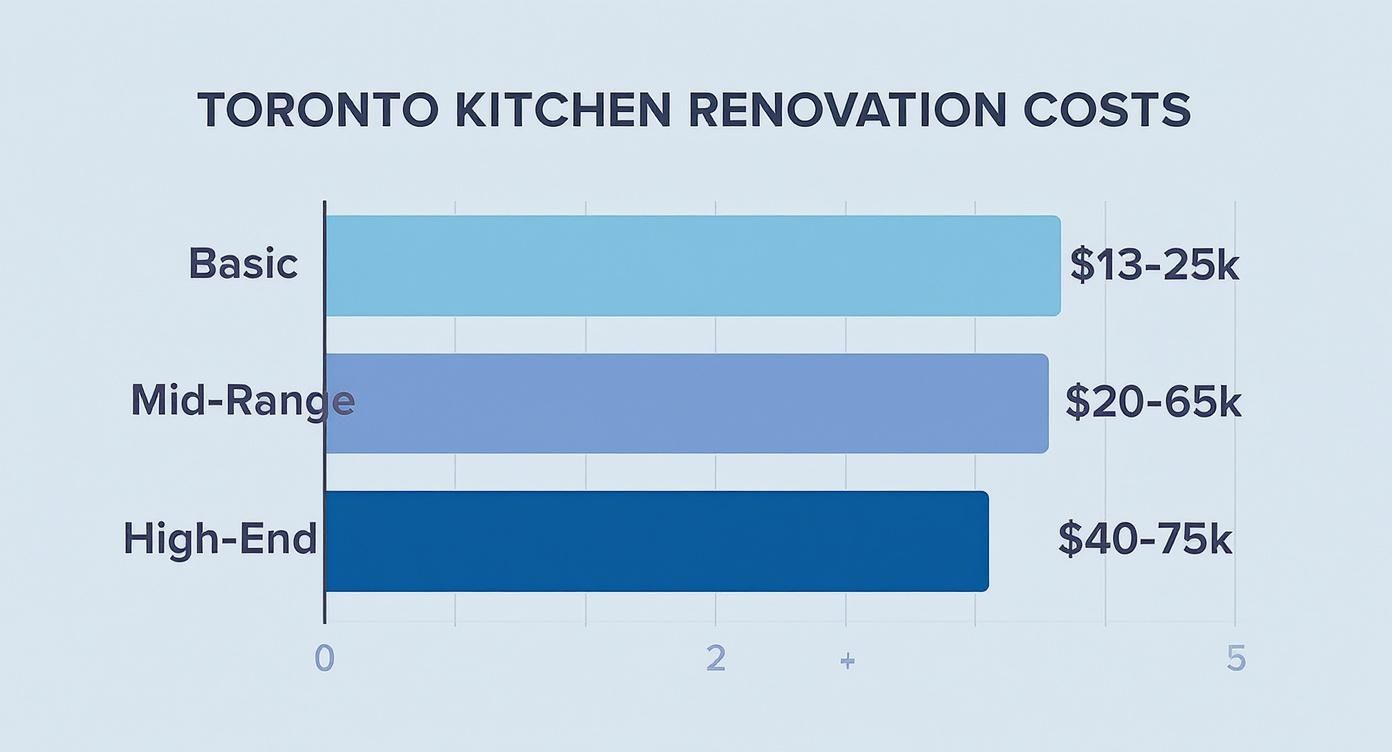
As you can see, there's a big overlap between the tiers. This really highlights how your specific choices in materials and the project's scope are what truly push a renovation from mid-range into high-end territory.
Talk to any renovation expert, and they’ll tell you the same thing. In almost every kitchen project, two categories consistently eat up the biggest chunk of the budget: cabinetry and labour. It’s not uncommon for them to account for more than half of your total spend, and for very good reason. They are the absolute foundation of your new kitchen.
Cabinetry is so much more than just a place to store your dishes; it's the furniture of your kitchen. It sets the entire aesthetic, covers the most visual real estate, and is the part of your kitchen you interact with most. So, it makes sense that it's typically the single largest material expense.
Then there's labour, the second heavyweight champ of costs. This isn't just one person's time; it’s the coordinated effort of an entire team of professionals. Carpenters, electricians, plumbers, tile setters, and installers all work together to ensure your kitchen is not just beautiful, but also perfectly functional and, most importantly, safe.
A Sample Mid-Range Toronto Kitchen Renovation Budget Allocation
Let's put this into real numbers. Here’s how a typical budget for a mid-range kitchen renovation in Toronto often gets allocated.
| Expense Category | Percentage of Total Budget | Example Cost (on a $50,000 Budget) |
|---|---|---|
| Cabinetry & Hardware | 30% | $15,000 |
| Labour & Installation | 25% | $12,500 |
| Appliances | 15% | $7,500 |
| Countertops | 10% | $5,000 |
| Flooring | 7% | $3,500 |
| Lighting & Electrical | 5% | $2,500 |
| Plumbing | 4% | $2,000 |
| Paint & Finishes | 2% | $1,000 |
| Contingency Fund (15%) | 15% (of total) | $7,500 |
| Total Project Cost | 100% | $57,500 |
This table makes it crystal clear why focusing on your cabinet choices is so critical for managing your overall budget. Even a small percentage change in that single category can mean saving—or spending—thousands of dollars. It’s the highest-impact decision you’ll make.
Why Do Cabinets Cost So Much?
So, what makes cabinetry command such a high price? It really comes down to three main factors: materials, craftsmanship, and customization. Stock cabinets are your most affordable option, but they come with limited sizes and styles. Semi-custom gives you more flexibility, but fully custom cabinets, built to your exact specifications, offer endless design possibilities—at a premium price.
This is where sourcing your cabinets smartly can be a real game-changer. By choosing a supplier that offers factory-direct pricing, you effectively cut out the middleman markup that significantly inflates the retail cost. This strategy can give you access to higher-quality materials and better construction for a fraction of what you’d expect to pay.
Ultimately, understanding exactly where your money is going is empowering. It changes your perspective from just staring at a total price to strategically putting your funds where they matter most to you. This ensures your investment in a new Toronto kitchen delivers real, lasting value and a space you’ll love for years to come.
What Really Drives Up Your Final Renovation Cost?

Ever wondered why your neighbour’s kitchen reno cost $40,000 while a nearly identical one down the street came with a $90,000 price tag? The answer isn't about the square footage. It's about the hundreds of little decisions you make along the way that cause a budget to either hold steady or skyrocket.
Getting a handle on these key cost drivers is the single most important step you can take. When you know where the big price swings happen, you can spend your money wisely and avoid that dreaded sticker shock when the final bills roll in. It almost always boils down to two things: the quality of your materials and the complexity of the job.
Material Choices: The Great Budget Multiplier
By far, the biggest influence on your final Toronto kitchen renovation cost is the materials you choose. This is where a budget for a standard 10×10 kitchen can easily double or even triple. Think of it like buying a car—a base model and a fully-loaded luxury version from the same brand might be the same size, but their prices are worlds apart.
Your choices for cabinetry and countertops, in particular, will create the most dramatic price swings. They take up the most visual real estate and define your kitchen's entire look, making them the heavy hitters in your material budget.
Let's see how this plays out with a couple of quick examples:
- Stock Cabinets vs. Custom Millwork: Basic, off-the-shelf cabinets are your most wallet-friendly option. Stepping up to semi-custom gives you more styles and sizes to work with. But if you go for fully custom millwork, you get limitless possibilities at a premium price, often starting at $15,000 and climbing from there.
- Laminate vs. Natural Stone Countertops: A modern, high-quality laminate countertop looks fantastic and keeps costs down. However, upgrading to a durable material like quartz or granite adds significant long-term value but also bumps the price per square foot substantially—from around $35 for laminate to over $140 for high-end stone.
These decisions have a ripple effect on every other element in the room, from the flooring and backsplash tile to the faucet and light fixtures. Each choice is a lever that can nudge your budget up or down.
Project Complexity: Moving Walls and Pipes
The second major factor is just how complicated the job is. A simple "pull-and-replace" renovation—where the new cabinets and appliances go right back where the old ones were—is always going to be more affordable than a project that reconfigures the entire layout.
The moment you decide to knock down a wall, relocate plumbing for a sink, or run new electrical for a kitchen island, you've introduced a whole new layer of costs. These kinds of structural and mechanical changes demand more labour, more materials, and often, more expensive permits from the City of Toronto.
A recent analysis from the 2025 Toronto Renovation Costs Index shows that a full kitchen gut and remodel in the city now typically falls between CAD $80,000 to CAD $225,000. This huge range is a direct result of the rising costs of quality cabinetry, structural changes, and a shortage of skilled labour in the GTA. You can find more details about the latest cost trends at woodsmith.ca.
Unforeseen Issues: What’s Hiding in the Walls?
Finally, there's the stuff you can't see. In many of Toronto's older homes, surprises lurking behind drywall or under old floors can quickly inflate a budget. Once demolition starts, your contractor might uncover problems that have to be fixed before anything else can happen.
Some of the most common expensive discoveries include:
- Outdated Electrical Wiring: Old knob-and-tube wiring is a common find, and it doesn't meet today's building codes. It has to be replaced by a licensed electrician.
- Hidden Water Damage: A slow, undiscovered leak from an old pipe could mean you're suddenly paying to replace rotted subfloors, framing, and drywall.
- Asbestos or Mould: Finding hazardous materials like these means bringing in a specialized (and costly) remediation team to make your home safe again.
This is exactly why a contingency fund of 15-20% of your total budget isn't just a suggestion—it's absolutely essential. It’s your financial safety net, ensuring one nasty surprise doesn't completely derail your dream kitchen. Planning for the unexpected from day one is the key to building a realistic and resilient budget.
Practical Ways to Save on Your Kitchen Renovation

A stunning new kitchen doesn't have to mean draining your savings. While Toronto kitchen renovation costs can look intimidating on paper, a smart, strategic approach can make a massive difference to the bottom line. It’s all about making deliberate choices that prioritize impact over expense, ensuring every dollar you spend is one you can see and feel.
With some careful planning, you can bring that final bill down significantly without ever compromising on quality or style. Let's dig into some real, actionable strategies that put you in control of your budget.
Preserve Your Kitchen's Existing Layout
This is it. This is the single biggest money-saving decision you can make, bar none.
It sounds almost too simple, but keeping your kitchen’s existing footprint is a financial game-changer. The moment you decide to move a sink, dishwasher, or stove, you’re not just moving boxes around. You’re opening a Pandora's box of complex, expensive mechanical work.
Relocating these services means bringing in licensed plumbers and electricians, who typically charge $70 to $150 per hour in the GTA. Those hours add up fast. Plus, it involves tearing open walls and floors, which tacks on extra costs for demolition, framing, and drywall repair. By sticking with your current layout, you free up a huge chunk of your budget for the things you'll actually notice every day, like gorgeous cabinets and durable countertops.
Make Smart Material and Cabinetry Choices
After the layout, your material selection is the next major lever you can pull to manage costs. Of course, high-end natural stone and custom millwork are beautiful, but there are countless alternatives that deliver a premium look for a fraction of the price.
This is especially true for cabinetry, which can easily eat up 40% of your entire renovation budget. Before you assume custom is the only way to get the style you want, think about these options:
- Refinish Instead of Replace: If your cabinet boxes are still in good structural shape, a professional paint job or refacing the doors can save you thousands and completely transform the look.
- Opt for High-Quality Stock or Semi-Custom: Don't underestimate today's stock cabinets. They come in a wide range of popular styles and finishes, offering a fantastic balance of quality and affordability.
- Choose Factory-Direct Suppliers: This is a huge one. Buying your cabinets directly from the manufacturer cuts out the retail middleman and their markup. This strategy lets you afford higher-end finishes and better construction without the inflated price tag. For homeowners looking to get the most for their money, exploring affordable kitchen cabinets and renovation services in North York is a great way to tap into these factory-direct savings.
Expert Insight: I always tell clients to think in terms of "high-impact" versus "low-impact" areas. It makes sense to splurge on a durable quartz countertop you'll be using constantly. But you can save big on a simple, classic backsplash tile that looks just as good as a designer version that costs five times as much.
Be Strategic with Labour and Timing
Labour is another big-ticket item, but you can be clever about how you use professional services and when you schedule your project.
First, consider some selective DIY. Leave the electrical and plumbing to the licensed pros—no exceptions. But if you’re comfortable, you can save hundreds or even thousands by handling tasks like demolition, painting, or installing a simple backsplash. Just be honest with yourself about your skill level; a DIY job gone wrong can cost more to fix than hiring a pro from the start.
Second, think about timing. The construction industry has its peak seasons, usually spring and summer when everyone wants to renovate. If you can be flexible, planning your reno for the off-season—late fall or winter—can sometimes get you better quotes from contractors looking to keep their crews busy.
Finally, bundle your purchases. When it's time to buy appliances, most big retailers offer significant package discounts if you purchase three or more major appliances from the same brand. This alone can save you 10% to 20% on a massive part of your budget. By combining these smart, practical strategies, you can pull off a high-end kitchen transformation that respects your wallet and delivers lasting value.
Hiring the Right Team for Your Toronto Renovation
You can have the most detailed budget and the most beautiful materials picked out, but without the right people to put it all together, it’s just a pile of good intentions. The success of your renovation—not to mention your sanity—really hangs on the quality of your contractor and their crew. Finding a great partner is the single most important step in turning your kitchen vision into a real, functional, and safely built space.
Trying to find a contractor in the Toronto market can feel like a huge task, but if you approach it methodically, you’ll find a pro you can trust. You're looking for someone with a solid track record, clear communication, and the specific skills your project needs. A little extra time spent on this now will save you from a world of headaches and unexpected costs later.
Vetting Your Potential Contractors
Before you even think about signing on the dotted line, you need to do your homework. Treat this like you're hiring for a critical role in your company. You need a partner who is not just technically skilled, but also professional and trustworthy. A fantastic contractor makes the whole renovation feel smooth; a bad one can turn it into an absolute nightmare.
A great starting point is asking for recommendations from friends, family, or even local design groups. Once you’ve got a shortlist, it's time to put on your investigator hat and ask some tough questions.
Here’s what you absolutely must do when vetting a contractor:
- Verify Insurance and WSIB Coverage: This is non-negotiable. Ask for a certificate showing they have liability insurance and are in good standing with the Workplace Safety and Insurance Board (WSIB). This is your protection if a worker gets injured on your property.
- Check References Thoroughly: Don’t just get a list of names—actually call them. Ask past clients about the contractor's communication, how they stuck to the schedule and budget, and—most importantly—how they handled problems when they popped up.
- Review Their Portfolio: Look through photos of their past work. Pay close attention to projects that are similar in size and style to what you’re planning. This confirms they have the right kind of experience.
Understanding the Renovation Timeline
One of the biggest sources of renovation stress comes from unrealistic timelines. A full kitchen gut is a complicated dance with a lot of moving parts. Any good contractor will give you a realistic schedule, but it helps if you already have a sense of the typical phases.
A mid-range kitchen renovation in Toronto, from the first swing of the sledgehammer to the final walkthrough, usually takes four to eight weeks. If you're planning a high-end project or making structural changes, that timeline can easily stretch to 12 weeks or more. Keep in mind, this doesn't even include the initial design and material selection phase, which can take a few weeks itself.
Here’s a rough breakdown of how a project usually flows:
- Design & Planning (2-4 weeks): This is where you finalize the layout, choose all your materials, and get long-lead items like cabinets and appliances ordered.
- Demolition & Prep (1 week): The old kitchen comes out. This is also when any framing or structural tweaks are made.
- Rough-ins (1-2 weeks): Plumbers and electricians get to work, running new pipes and wires inside the open walls.
- Installation (2-4 weeks): Things start to look like a kitchen again! Drywall goes up, followed by flooring, cabinets, countertops, and appliances.
- Finishing Touches (1 week): The final details come together—installing the backsplash, painting the walls, and putting in light fixtures and hardware.
Knowing these stages helps you understand why it’s not a weekend job and lets you track the progress more effectively. As you search for the right team, remember that many full-service firms can handle everything from start to finish. For example, you can learn more about finding the right custom kitchen cabinets and renovation experts in Toronto with MapleKing to see how having an integrated team can make this whole process a lot simpler.
Getting a Rock-Solid Quote and Finalizing Your Budget
Alright, this is where the rubber meets the road. Moving from rough estimates to a fixed, reliable budget is the most important step in your entire renovation journey. This is how you lock in your costs and make sure there are no nasty financial surprises waiting for you later.
Think of an accurate quote as your project's constitution. It protects you from budget creep and ensures everyone—you and your contractor—is working from the same playbook.
To get quotes you can actually compare, every contractor needs to be pricing out the exact same job. This is why you need to create a detailed scope of work. Get specific! List everything from the model number of the faucet you love to the precise style of cabinet door you've picked out. When every company bids on the same detailed plan, you can finally make a true apples-to-apples comparison.
What a Good Quote Actually Looks Like
A legitimate quote is never just a single number scribbled on a piece of paper. It should be a detailed, line-by-line breakdown that shows you exactly where your money is going. If a contractor hands you a vague, one-line estimate, that's a major red flag.
A professional quote should clearly spell out the costs for:
- Labour: A clear breakdown for each trade involved—carpentry, plumbing, electrical, tiling, etc.
- Materials: Itemized costs for your specific choices in cabinets, countertops, flooring, backsplash, and fixtures.
- Permits: The actual cost of pulling the required permits from the city.
- Timeline: A realistic schedule with a start date, key milestones, and a target completion date.
- Payment Schedule: A clear outline of how much is due and when, from the initial deposit to the final holdback.
This isn't just paperwork; it’s a tool for transparency. It ensures you and your contractor are completely aligned before a single hammer is swung.
Crucial Tip: You Need a Contingency Fund
I can't stress this enough: no renovation goes exactly as planned, especially in older Toronto and Markham homes. You must set aside an extra 15-20% of your total budget for the unexpected. This "rainy day" fund covers things like finding old knob-and-tube wiring behind a wall or discovering hidden water damage. It’s the financial cushion that keeps a small problem from blowing up your entire budget.
Here are some of the most common questions we hear from homeowners in Toronto as they start planning their kitchen renovation. Let's clear them up so you can move forward with confidence.
How Much Should I Set Aside for a Contingency Fund?
For any kitchen project, especially in Toronto where older homes are common, you absolutely need a contingency fund. Plan to set aside an extra 15-20% of your total budget.
This isn't "fun money" for upgrading your faucet at the last minute. It’s a crucial safety net for the surprises that often hide behind old walls and floors. Think outdated knob-and-tube wiring that needs immediate replacement, hidden water damage from a slow leak you never knew about, or even a sudden spike in material costs. On a $50,000 project, that’s an extra $7,500 to $10,000 you should have ready, just in case.
Why It Matters: Having this fund is the difference between a project that stays on track and one that gets derailed. It protects you from having to make painful compromises on your design because an unexpected issue ate up your budget.
Do I Need a Permit for My Kitchen Renovation in Toronto?
That really depends on what you're planning to do. If you’re just doing cosmetic touch-ups like painting your existing cabinets or swapping out a countertop, you generally don't need a permit.
However, the moment you start making bigger changes, the City of Toronto will require a building permit. You'll almost certainly need one if your project involves:
- Structural Changes: Taking down a wall (or even part of one) is a definite yes.
- Plumbing Relocation: Moving your sink or dishwasher to a new spot changes the plumbing layout.
- Electrical Work: Adding new outlets, running new circuits for appliances, or moving wiring around.
A good general contractor will handle the entire permit process for you. It’s their job to make sure everything is filed correctly, inspected, and signed off on.
What’s the Return on Investment for a Kitchen Renovation?
A kitchen renovation is one of the smartest investments you can make in your home. In the hot Toronto real estate market, you can realistically expect to get back 75% to 85% of what you spent when it comes time to sell.
Think about it from a buyer’s perspective. A beautiful, modern, and functional kitchen is a massive selling point. It can make your home stand out and directly increase its market value.
Ready to transform your kitchen with high-quality, affordable cabinetry? At MapleKing Kitchen Cabinets, we offer factory-direct pricing to give you a luxury look without the middleman markup. Explore our stunning designs and get a free quote.