
Thinking about a kitchen renovation in Toronto? It can feel like a huge undertaking, but let's be honest—it all starts with the cabinets. They're the single biggest decision you'll make, setting the tone for the entire space. This guide is here to cut through the confusion.
We'll walk you through everything, from finding great local suppliers in the GTA to understanding what really separates one cabinet material from another. Whether you’re working with a tight condo space downtown or a sprawling kitchen in Markham, think of this as your personal roadmap to getting it right.
Finding Your Perfect Kitchen Cabinets in Toronto
Your kitchen is the true heart of your home, and the cabinets are its backbone. They don’t just define the style and workflow; they also represent a huge chunk of your reno budget. For homeowners all over Toronto, the sheer number of options can be overwhelming. You've got everything from bespoke custom jobs to the aisles of a big-box store, and it's incredibly easy to get bogged down in the details of materials, finishes, and suppliers.
That's why we put this guide together. It's designed to give you clear, practical advice for your project. We'll tackle the real-world challenges Toronto-area homeowners face, whether it’s maximizing every square inch in a condo or creating a functional, family-friendly layout in a place like Markham.
What This Guide Will Cover
Our goal is to give you the confidence to make the right call. We're going to break down the essential elements of choosing Toronto kitchen cabinets that fit your dream design and your budget. By the time you're done reading, you'll know how to:
- Pinpoint reliable local suppliers who get the unique quirks and styles of Toronto homes.
- Grasp the real-world differences between stock, semi-custom, custom, and ready-to-assemble (RTA) options.
- Choose materials that can handle the swings in humidity we get here.
- Create a realistic budget by learning about typical costs and where those surprise expenses often hide.
A thoughtfully planned kitchen renovation does more than just make your daily life better. In a hot real estate market like Toronto's, it can seriously boost your property value. Getting the cabinetry right is the key to winning on both fronts.
A Smarter Approach to Cabinetry
We’re also going to pull back the curtain on a modern, wallet-friendly solution that’s quickly becoming a go-to for savvy homeowners: high-quality ready-to-assemble (RTA) cabinets. Now, I know what you might be thinking. "RTA" used to be a byword for cheap or flimsy, but the game has completely changed. Today's premium RTA cabinets deliver that high-end, custom look without the eye-watering price tag.
By the end of this guide, you won't just have ideas; you'll have a solid, actionable plan. You'll be ready to pick the perfect materials, lock in a practical budget, and find the right partner to make your dream kitchen a reality. Let’s get started.
Decoding Cabinet Types and Finishes
Stepping into the world of Toronto kitchen cabinets can feel a bit like learning a new language. A good way to think about it is like buying a suit: you've got off-the-rack options ready to go, bespoke tailoring for a perfect fit, and a few choices in between. Getting a handle on these main categories is the first real step to making a smart, confident choice for your home.
Each type of cabinet comes with its own unique trade-offs between cost, how much you can personalize it, and how long you'll have to wait. Understanding this landscape from the get-go helps you line up your expectations with your budget and timeline, so there are no nasty surprises later on. Let's break down the main players you'll come across.
Comparing Kitchen Cabinet Types
To help you get a clearer picture of what's out there, we've put together a simple comparison. Think of this as your cheat sheet for understanding the pros and cons of each cabinet category at a glance, from budget-friendly stock options to fully bespoke custom creations.
| Cabinet Type | Average Cost | Customization Level | Typical Lead Time | Best For |
|---|---|---|---|---|
| Stock | $ | Very Low | Immediate to 2 weeks | DIYers, rental properties, and tight budgets where standard sizes work. |
| RTA | $-$$ | Low to Medium | 1 to 4 weeks | Homeowners who want a high-quality look for less and are comfortable with assembly. |
| Semi-Custom | $$-$$$ | Medium to High | 4 to 8 weeks | Those who need more flexibility in size and style than stock offers but don't need full custom. |
| Custom | $$$-$$$$ | Extremely High | 8 to 16+ weeks | Unique kitchen layouts, specific design visions, and homeowners with a generous budget. |
Ultimately, the right choice boils down to your specific project needs. While a custom cabinet maker can build anything you can dream up, the modern RTA and semi-custom markets now offer incredible quality and style, giving you that high-end look without the eye-watering price tag.
The Four Main Cabinet Categories
Navigating your options really starts with getting the fundamental differences between stock, ready-to-assemble (RTA), semi-custom, and fully custom cabinets. Each one serves a different purpose and price point.
-
Stock Cabinets: These are your classic "off-the-rack" choice. They’re mass-produced in standard sizes and are usually sitting in a warehouse at a big-box store, ready for pickup. They’re definitely affordable, but your choices for sizes, styles, and finishes are extremely limited.
-
Ready-to-Assemble (RTA) Cabinets: Often confused with stock, today’s RTA cabinets have carved out a smart middle ground. They come pre-made in standard sizes but offer a much wider array of styles and are built with better materials, like real plywood boxes. They deliver a near-custom look for a fraction of the cost—you just have to assemble them on-site.
-
Semi-Custom Cabinets: This is like getting that off-the-rack suit tailored. You begin with a standard cabinet line but have the freedom to tweak certain dimensions, pick from a much broader palette of finishes, and integrate clever storage features.
-
Custom Cabinets: This is the full bespoke experience. Built entirely from scratch to your exact measurements and design specs, these cabinets offer truly limitless possibilities in size, material, style, and finish. Naturally, this level of personalization comes with the highest price and the longest wait time.
We're seeing a real shift in the industry. More and more, homeowners are looking for that sweet spot—something personalized that feels high-end, but without the sticker shock of going fully custom. This is especially true in a place like Toronto, where renovations are a constant.
This trend is backed up by the numbers. The North American kitchen cabinet market is booming, with semi-custom cabinetry now holding a 38.4% market share. In pricier areas like the GTA, this is even more obvious as people hunt for premium looks that find the right balance between cost and customization.
Finishes That Define Your Style
Once you’ve landed on a cabinet type, the finish is what really brings your kitchen’s personality to life. It’s that final touch that dictates the look, the feel, and even how well your cabinets will hold up over time. From the organic warmth of wood to the sleek sheen of a modern gloss, the finish truly sets the tone for the whole room.
Your choice of finish does more than just determine the colour. It also impacts maintenance, durability, and how light plays in your space. For anyone planning a renovation, getting these details right is crucial. We dive deep into this topic in our guide to the best paint finish for kitchen cabinets.
Here are some of the most popular finishes you'll see on Toronto kitchen cabinets:
-
Painted Finishes: If you want a clean, seamless look, paint is your best friend. It gives you a nearly endless spectrum of colour possibilities. For that perfectly smooth surface, it's often applied to high-density fiberboard (HDF). A quality paint job is classic and durable.
-
Stained Finishes: Stains are perfect for showing off the natural beauty of wood, enhancing its grain and texture. They come in all sorts of tones, from light and airy to rich and dark, adding a timeless warmth to any kitchen.
-
High-Gloss Finishes: Nothing says contemporary Euro-style kitchen like a high-gloss finish. Typically achieved with acrylic or lacquer over HDF, this finish creates a reflective, almost mirror-like surface that can make a space feel much bigger and brighter.
-
Thermofoil Finishes: This finish is made by heat-fusing a thin layer of vinyl onto an MDF core. The result is a seamless, durable surface that’s a breeze to clean. It’s available in a huge range of solid colours and surprisingly realistic wood grains.
Choosing Materials That Last in a Toronto Climate
When you're picking out new Toronto kitchen cabinets, the material you choose is more than just a style decision—it’s the backbone of your entire kitchen. Think of it like a house's foundation; it needs to be tough enough to handle the local climate. Here in Toronto, our seasons bring some pretty dramatic swings in humidity and temperature, so getting the material right is a big deal for making sure your investment lasts.
Your cabinets are really made of two key parts: the cabinet box (the frame) and the doors/drawer fronts. The doors get all the glory, but the box is the unsung hero that holds everything together. Let's break down the main materials used for cabinets that are built to withstand the demands of a busy Toronto home.
This little decision tree can help you picture how your personal style might steer your material and finish choices.
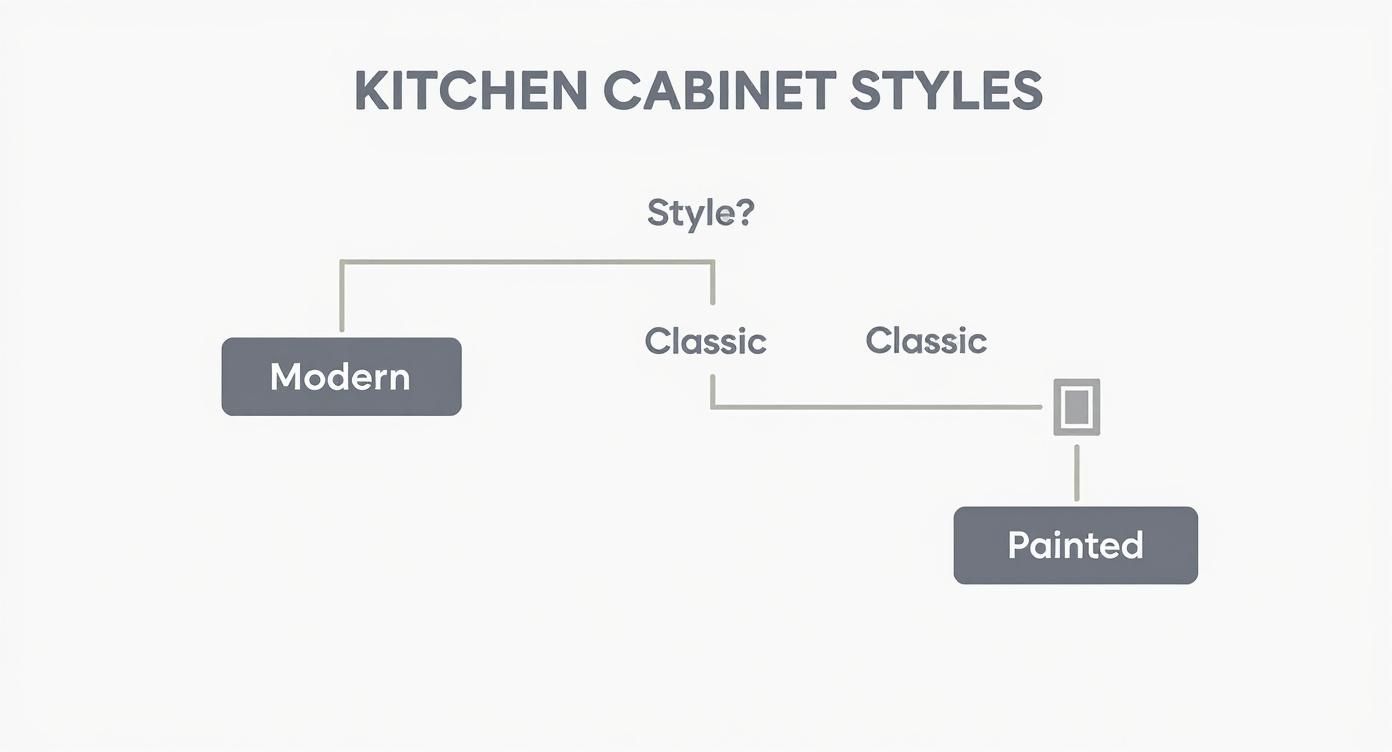
As you can see, whether you're leaning classic or have a more modern vision, there are specific finishes that will bring that look to life perfectly.
The Workhorse Materials of Cabinetry
As you start shopping around, you’ll hear four terms pop up constantly: solid wood, plywood, MDF, and particleboard. Knowing the real-world difference between them is crucial for finding that sweet spot between durability, looks, and your budget.
-
Solid Wood: This is the classic choice, loved for its natural character and strength. It's fantastic for door frames and decorative touches, but it has a tendency to warp in high-humidity areas. That makes it a less-than-ideal choice for large cabinet boxes in a typical Toronto home.
-
Plywood: For high-quality cabinet boxes, this is the gold standard. It’s made by layering thin sheets of wood veneer with the grain running in opposite directions, which makes it incredibly strong and stable. This cross-grain design gives it fantastic resistance to moisture, shrinking, and swelling—a huge plus for long-term durability.
-
Medium-Density Fibreboard (MDF): An engineered product made by compressing wood fibres with resin. MDF is super dense and has a perfectly smooth surface, which is why it’s the go-to material for painted cabinet doors. If you want a flawless painted finish on a Shaker or slab door, MDF is your best friend.
-
Particleboard: You might hear this called furniture board. It's the most budget-friendly option out there, made by pressing wood particles like sawdust and shavings together with glue. While it keeps costs down, it’s the most vulnerable to moisture damage and just doesn't have the structural integrity of plywood.
Why Plywood Boxes Are a Smart Investment
For the cabinet boxes themselves—the core structure of your kitchen—premium plywood is the clear winner for longevity, especially in our region. A particleboard box might look alright in the showroom, but it simply can’t handle the daily grind and seasonal shifts of a Toronto home the way plywood can.
Choosing cabinets with plywood boxes is like giving your kitchen a stronger skeleton. It provides better screw-holding power for hinges and hardware, superior structural integrity for supporting heavy countertops, and much greater resistance to moisture-related swelling and damage.
The Canadian kitchen cabinet manufacturing industry is a major part of our national furniture sector, pulling in an estimated $1.5 billion in annual sales. That number really speaks to the trust Canadians put in quality cabinetry as a core element of their homes.
If you're planning a reno, digging a little deeper into these materials is a smart move. Feel free to check out our detailed guide on the best materials for kitchen cabinets to explore these differences more. At the end of the day, putting your money into quality materials like plywood for your cabinet boxes is the best way to ensure your beautiful new kitchen stays functional and strong for years to come, no matter what the Toronto climate throws at it.
How to Budget for Your Kitchen Cabinet Project
Figuring out the money side of things is probably the most important—and often the most intimidating—part of any kitchen renovation. Your cabinets will almost certainly be the biggest ticket item, so getting this number right from the start is key to a successful project.
In a market like Toronto, knowing the real costs upfront helps you avoid that dreaded sticker shock and keeps your renovation from going off the rails.
The industry standard for pricing Toronto kitchen cabinets is by the linear foot. It’s a helpful way to get a ballpark idea, but that number can swing wildly depending on the materials you choose, the style you're after, and who you buy from. You always need to ask what’s included in that price—is it just the cabinet boxes and doors, or does it cover hardware and delivery too?
Breaking Down the Costs
So, what should you actually expect to spend? While every project is different, here are some general guidelines for the GTA that can help you build a realistic starting budget.
-
Stock or Basic RTA Cabinets: You're looking at about $150 to $400 per linear foot. This is the perfect price point for income properties, basement kitchens, or quick flips where keeping costs down is the main goal.
-
Mid-Range RTA or Semi-Custom Cabinets: This is where most homeowners land, with prices typically between $400 to $800 per linear foot. It’s the sweet spot, giving you a fantastic blend of quality materials (like solid plywood construction), on-trend finishes, and more design options without the custom price tag.
-
High-End Semi-Custom or Full Custom Cabinets: For a truly one-of-a-kind kitchen, costs start at $800 per linear foot and can easily climb past $1,500. Here, you get total freedom to customize every single detail—from the exact dimensions to unique materials and finishes.
A good rule of thumb is that your cabinets will eat up 40% to 50% of your total kitchen renovation budget. Nail this part of your budget, and the rest of the project will fall into place much more smoothly.
Sample Budgets for Common Toronto Kitchens
To put those numbers into perspective, let's look at what they mean for typical kitchen layouts you'd find around the GTA. These estimates are just for the cabinets themselves, but they provide a solid baseline for planning.
| Kitchen Size | Typical Linear Feet | Estimated Mid-Range Cabinet Cost |
|---|---|---|
| Small Condo Kitchen | 10-15 linear feet | $4,000 – $12,000 |
| Medium Suburban Kitchen | 20-25 linear feet | $8,000 – $20,000 |
| Large Custom Kitchen | 30+ linear feet | $12,000 – $24,000+ |
Don't Forget the "Hidden" Costs
A smart budget is one that accounts for everything, not just the obvious stuff. It’s the unexpected expenses that can really derail a renovation.
The final bill is always more than just the cost of the cabinet boxes and doors. Make sure you ask any potential supplier about these items so you know exactly what you're paying for:
- Installation Labour: This is a big one. Professional installation is worth every penny for that perfect, seamless finish, but it can easily add another 15-25% to your cabinet cost.
- Hardware: Those handles and knobs are often sold separately. While you can find budget-friendly options, premium hardware can add hundreds or even thousands of dollars to the final tally.
- Upgrades & Accessories: Things like soft-close drawers, pull-out spice racks, lazy Susans, and under-cabinet lighting are all extras that add up.
- Demolition and Disposal: Someone has to tear out the old kitchen, and that labour isn't always included in the installation quote.
- Taxes and Delivery: The two certainties in life! Always double-check that HST and delivery fees are factored into the estimate you receive.
By thinking through these extras from the beginning, you can build a budget that reflects the true, all-in cost. Making savvy choices—like opting for high-quality RTA cabinets—can free up money for those designer pulls or a professional installer, giving you a high-end look without breaking the bank.
The Cabinet Ordering and Installation Process in the GTA
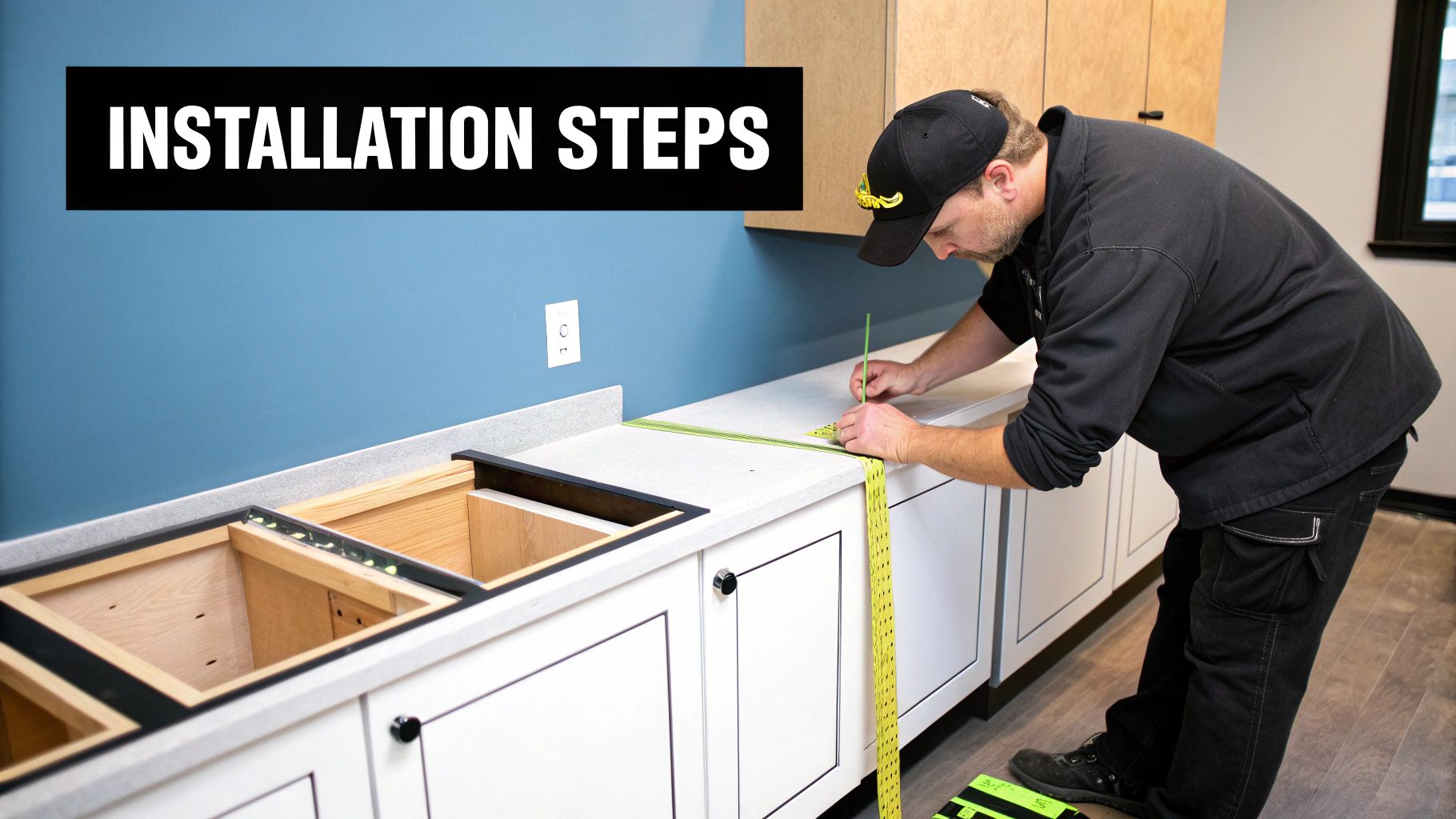
So, you’ve picked your style and you’re ready to go. But how do you get from an empty room to a fully installed kitchen? It can seem like a huge leap, but it’s really just a logical sequence of steps.
Getting a handle on this roadmap is the key to a stress-free renovation. It lets you manage your timeline and know what to expect, whether you're tackling the job yourself or bringing in the pros. This process is the backbone of every successful Toronto kitchen cabinets project, turning your big idea into the functional heart of your home.
Step 1: Accurate Measurement and Layout Planning
Everything hinges on this first step. Before you get lost in door styles and finishes, you need to know your space inside and out. We’re not just talking about the length of the walls—every window, doorway, plumbing hookup, and electrical outlet needs to be mapped with total accuracy.
Think of your detailed floor plan as the blueprint for your entire project. It determines exactly where each cabinet and appliance will live, ensuring a smart workflow. Getting this right from the start prevents those nightmare scenarios, like ordering a beautiful pantry cabinet that ends up blocking a doorway or a fridge door that can't open all the way.
Step 2: Placing Your Order and Coordinating Delivery
With a solid layout in hand, you're ready to place the order. This is the moment you'll lock in all the final details with your supplier: cabinet style, finish, materials, and any extras like soft-close hinges or a pull-out spice rack. Always get an itemized quote to make sure everyone is on the same page.
Getting your cabinets delivered in the GTA requires a bit of planning, especially if you're in a condo or a tight neighbourhood. Here's what to think about:
- Scheduling: Pin down a delivery window when you or your contractor will be there to receive and inspect everything.
- Building Rules: Many Toronto and Markham condos have strict delivery times, service elevator bookings, and loading dock rules. Always check with property management beforehand.
- Storage: Make sure you have a safe, dry place to store the boxes until installation day to protect them from damage.
It's worth noting that choosing a reliable supplier is a big part of this step. Canadian-made cabinetry has become a real point of pride. In fact, in 2018, Canada's trade balance for wood kitchen cabinets hit an impressive $511.2 million, which speaks volumes about the quality and competitiveness of our local manufacturing.
Step 3: The Installation Phase
This is when the magic happens and your vision starts to take shape. Installation can go one of two ways: you can DIY it, or you can hire a professional. Assembling ready-to-assemble (RTA) cabinets can be a fantastic project for a handy homeowner with the right tools, but for a truly flawless finish, most people bring in a pro.
Hiring an experienced installer is almost always a smart move. They know how to deal with the realities of older Toronto homes—the uneven floors, the not-so-straight walls—and have the skills to get everything perfectly level. Their efficiency can also shave a significant amount of time off your project. If you need help finding the right person, our guide on how to choose the best kitchen cabinets contractor in Toronto is packed with useful tips.
A proper installation ensures your cabinets don't just look amazing on day one, but function perfectly for years to come. From securely hanging the uppers to aligning every door and drawer, this final step is what delivers that polished, professional look you've been dreaming of.
Your Top Questions About Toronto Kitchen Cabinets Answered
Embarking on a kitchen renovation is exciting, but it naturally comes with a lot of questions. Your cabinets are usually the biggest line item on the budget, so it’s smart to get all your facts straight before you commit. We’ve pulled together the most common questions we hear from Toronto and Markham homeowners to give you the clear, straightforward answers you need.
Getting this information ironed out from the beginning is the key to a smooth project. When you know what to expect with timelines, quality, and permits, you can plan your renovation with confidence.
How Long Does It Take to Get Kitchen Cabinets?
This is almost always the first thing people ask, and for good reason! Your cabinet lead time dictates the entire project schedule. The answer really depends on what type of cabinet you choose.
-
Custom Cabinets: Since these are built completely from scratch to your exact specifications, they take the longest. You should realistically budget for 8 to 16 weeks, sometimes even longer, from the moment you sign off on the design.
-
Semi-Custom Cabinets: These offer a middle ground. They start with standard sizes that are then modified, which speeds things up a bit. Typically, you're looking at a 4 to 8 week wait.
-
Ready-to-Assemble (RTA) Cabinets: If speed is a priority, RTA is your best bet. Because they are mass-produced in standard sizes and kept in stock, they can often be on-site within 1 to 4 weeks. This is a massive advantage for anyone on a tight schedule.
Are RTA Cabinets Good Quality?
Let's clear the air on this one. There's an old myth that "ready-to-assemble" is just a nice way of saying "cheap and flimsy." That might have been true decades ago, but the RTA market today is a completely different ball game.
Modern, high-quality RTA cabinets are built to last using excellent materials. For example, many of the best options now come standard with all-plywood boxes. This is the same stuff you'd find in high-end semi-custom lines, offering fantastic structural strength and moisture resistance.
Choosing a quality RTA cabinet doesn't mean you're trading durability for a lower price. It just means you're choosing a more efficient manufacturing and distribution system—and the savings get passed on to you.
The doors and finishes are top-notch, too. You’ll find solid HDF or wood doors with durable, factory-applied paints, stains, and thermofoils that look and feel just as good as their pricier counterparts. For most Toronto renovations, they offer unbeatable value.
Do I Need a Permit for My Kitchen Renovation?
This is a critical question, and getting it wrong can cause major headaches. Whether you need a building permit in Toronto really boils down to the scope of your renovation.
The good news is that a permit is not required for simple cosmetic upgrades. If you’re just swapping out old cabinets for new ones in the same layout, painting, or replacing countertops and flooring, you’re usually in the clear.
However, the moment your plans get more ambitious, you’ll likely need to file for a permit. This includes:
- Structural Changes: Taking down a wall or even just altering one.
- Plumbing Modifications: Moving your sink or dishwasher to a new spot.
- Electrical Work: Adding new outlets or moving existing fixtures.
- HVAC Changes: Relocating or adding vents and ductwork.
When in doubt, always check with the City of Toronto’s building department before you start. It’s the only way to ensure your project is safe, up to code, and won’t cause problems when you eventually sell your home.
Ready to create a kitchen that combines style, quality, and value? At MapleKing Kitchen Cabinets, we specialize in providing premium, factory-direct cabinetry to homeowners across Toronto and Markham. Explore our gallery and get a free quote today to see how we can bring your vision to life. Learn more at https://maplekingkitchencabinets.com.
Article created using Outrank