

So, you’re thinking about giving your kitchen a facelift but want to avoid the headache and high cost of a full-blown tear-out. You’ve come to the right place. On average, a professional cabinet refacing project for a standard-sized kitchen will land somewhere between $7,000 and $12,000. It’s a game-changer, offering a massive visual upgrade for a fraction of what a complete cabinet replacement would set you back.
What Is the Real Cost of Refacing Kitchen Cabinets
Think of it this way: cabinet refacing is like giving a classic car a stunning new paint job, a modern interior, and sleek wheels, all while keeping its perfectly reliable engine. You’re not ripping out the guts of your kitchen; you’re just upgrading everything you see and touch. This approach keeps the solid framework of your cabinets—the part that’s already working just fine—and gives them a completely new look.
For many homeowners, updating the cabinetry is one of the key elements of a dreamy kitchen renovation. It's a smart, value-packed choice, especially for those in the Toronto area who are happy with their kitchen’s layout but are just craving a more modern feel.
A Closer Look at the Numbers
When you start budgeting, it helps to know how the pros tally up the costs. That final price tag isn't just an arbitrary number; it's a careful calculation based on the materials you choose, the labour involved, and the sheer size of your kitchen. The good news is that industry data consistently shows refacing is a much friendlier option for your wallet than a total replacement.
Homeowners typically invest between $4,000 and $10,000 for a complete refacing project. The sweet spot often lands around $7,230, with most jobs falling in the $4,234 to $10,226 range. If you break it down further, you're looking at roughly $150 to $450 per linear foot, with the final figure depending heavily on your choice of materials.
This kind of breakdown gives you a much clearer financial picture and helps you estimate your own investment.
Three Ways to Estimate Your Budget
To get a handle on your potential costs, it's best to look at it from a few different angles. Each one gives you a new perspective on the investment and helps you build a realistic budget from the get-go.
- Per Project: This is your all-in, big-picture number. It’s the total investment from start to finish.
- Per Linear Foot: This metric is incredibly useful for comparing quotes from different companies, as it levels the playing field based on your kitchen's size.
- Per Door/Drawer: Thinking this way helps you understand the cost on a piece-by-piece basis.
Getting familiar with these pricing structures is the first real step toward making a smart, informed decision.
Quick Guide to Cabinet Refacing Costs
To make it even simpler, here’s a table that breaks down the typical cost ranges. Think of this as a starting point for planning your renovation in the Toronto and Markham area.
| Pricing Metric | Low-End Estimate | Average Cost | High-End Estimate |
|---|---|---|---|
| Total Project | $4,000 | $7,500 | $12,000+ |
| Per Linear Foot | $150 | $300 | $450+ |
| Per Door/Drawer | $100 | $175 | $250+ |
This quick snapshot should give you a solid foundation for what to expect as you start exploring your options.
The Key Factors That Influence Your Refacing Cost
Knowing the average cost of refacing is a solid starting point, but the quote you'll get for your kitchen will be as unique as your home. It’s a lot like ordering a custom suit—the base price gets you in the door, but the final cost really depends on the fabric, the complexity of the design, and the tailor’s expertise. For cabinet refacing, the final price is shaped by four main drivers: the materials you pick, the labour involved, the size of your project, and any underlying repairs that need attention.
Each of these pieces plays a big role in your final budget. A simple material switch can move the price by thousands, and a kitchen with lots of tricky corners will naturally take more time and skill to complete. By digging into these variables, you can see exactly where your money is going and make smart choices that fit both your wallet and your vision.
Material Selection: The Heart of Your Budget
The materials you choose for your new cabinet doors and drawer fronts will have the single biggest impact on your total cost. This is where you have the most power to dial the budget up or down, finding that sweet spot between the look you want and what you're comfortable spending. The options run the gamut from tough, budget-friendly synthetics to beautiful, premium natural woods.
Here’s a quick breakdown of how common materials stack up:
- Laminates and Thermofoil: These are almost always your most cost-effective options. Don't let the price fool you, though—modern laminates and thermofoils are incredibly tough, standing up well to moisture and stains. They also come in a massive range of colours and finishes, including some surprisingly realistic wood grains.
- HDF (High-Density Fibreboard): A step up in both quality and price, HDF is the perfect canvas for a painted finish. It gives you a flawlessly smooth, stable surface that won't warp or crack with humidity changes like solid wood can. This makes it the go-to for achieving those popular sleek matte, high-gloss, or classic painted styles.
- Real Wood Veneers and Solid Wood: If you love the authentic warmth and unique character of natural wood, then veneers (a thin slice of real wood bonded to an HDF core) and solid wood doors are your top-tier choices. They come with the highest price tag, but they offer a timeless beauty and can be stained to let the natural grain shine through.
Think of your material choice as more than just a style decision—it's an investment in your kitchen's future. While laminates deliver fantastic value, a premium material like painted HDF or real wood can seriously boost your home’s resale value, often making that higher upfront cost well worth it.
Labour Costs: The Price of Precision
While materials take up a big chunk of the bill, skilled labour is the next major line item. Refacing isn't as simple as just screwing on new doors. It’s a meticulous process that demands a steady hand and an eye for detail, especially when applying veneers seamlessly and making sure every single door and drawer aligns perfectly.
A few things will influence the labour charges on your quote:
- Kitchen Complexity: A straightforward, single-wall galley kitchen is going to cost less in labour than a large, U-shaped kitchen with a big island, corner cabinets, and decorative crown moulding. Every extra angle and intricate piece adds time and requires more skill.
- Professional Expertise: You're not just paying for time; you're paying for experience. Hiring a professional, insured team is your guarantee that the job gets done right the first time. It might be tempting to find a cheaper option, but proper installation ensures veneers won’t peel in a year and your doors will hang straight for decades to come. That expertise is a critical part of the investment.
Project Scope: Size and Scale Matter
The overall size of your kitchen and how much work you want to be done have a direct impact on the bottom line. It’s simple math: the more surface area you need to reface, the more materials and labour you’ll need. A bigger kitchen will just plain cost more.
Here’s how to think about it:
- Number of Doors and Drawers: Every single cabinet door and drawer front is a custom-made piece that has to be manufactured, finished, and installed. A kitchen with 40 cabinets and drawers is going to be substantially more than a compact kitchen with 15.
- Add-ons and Upgrades: This is your chance to improve functionality. Want to add quiet soft-close hinges, stylish new handles, or handy pull-out organizers? These upgrades make your kitchen work better, but they will add to the total project cost. For anyone thinking about a major overhaul, looking at a gallery of new kitchen cabinets in Toronto can offer some great inspiration for what's possible.
Hidden Repairs: Addressing Pre-Existing Damage
Finally, the condition of your existing cabinet boxes—the "bones" of your kitchen—is a huge factor. The entire refacing process depends on these boxes being structurally sound. If they are warped, have water damage, or are falling apart, they’ll need to be fixed or reinforced before any new surfaces can be applied.
A good installer will always do a thorough inspection before giving you a final quote. If they find issues like delaminating sides or broken shelves, the cost of those repairs will be added to the total. It’s always smart to have a little buffer in your budget for these potential surprises so they don’t throw your whole project off track.
Cabinet Refacing Versus Full Replacement: A Cost Comparison
So, you’ve reached the big crossroads in your kitchen renovation journey: should you reface or completely replace your cabinets? It’s a classic dilemma. Think of it like deciding whether to give a classic car a stunning new paint job and interior or to build a new one from the frame up. One is a strategic, focused upgrade, while the other is a total overhaul. Both get you a beautiful result, but the journey—and the cost—are worlds apart.
To make the right call for your home and budget, you really need to grasp what each option entails. Refacing works with the solid "bones" of your existing kitchen, giving it a dramatic facelift. A full replacement, on the other hand, means starting from scratch. That single difference is what drives all the other distinctions in cost, timeline, and the impact on your daily life.
The Financial Bottom Line
For most people, the biggest, and often deciding, factor is the final price tag. Cabinet refacing is almost always the more wallet-friendly option. Why? Because you're skipping the most expensive and disruptive parts of a renovation: demolition, major plumbing or electrical work, and buying brand-new cabinet boxes. By keeping the core structure, you save a huge amount on both materials and labour.
A full replacement is a much bigger beast. It involves ripping everything out down to the studs, which can sometimes unearth surprise problems hiding in the walls—hello, budget overruns. While you get total freedom to redesign your layout, that blank-slate flexibility comes at a much higher price.
As a rule of thumb, you can expect the refacing cabinets cost to be 50-70% less than what you'd pay for a complete replacement. That’s a massive saving that can be put toward other high-impact upgrades, like those quartz countertops you’ve been dreaming of, a new backsplash, or better appliances.
This flowchart breaks down the key decision points that will guide you toward the right choice for your project.
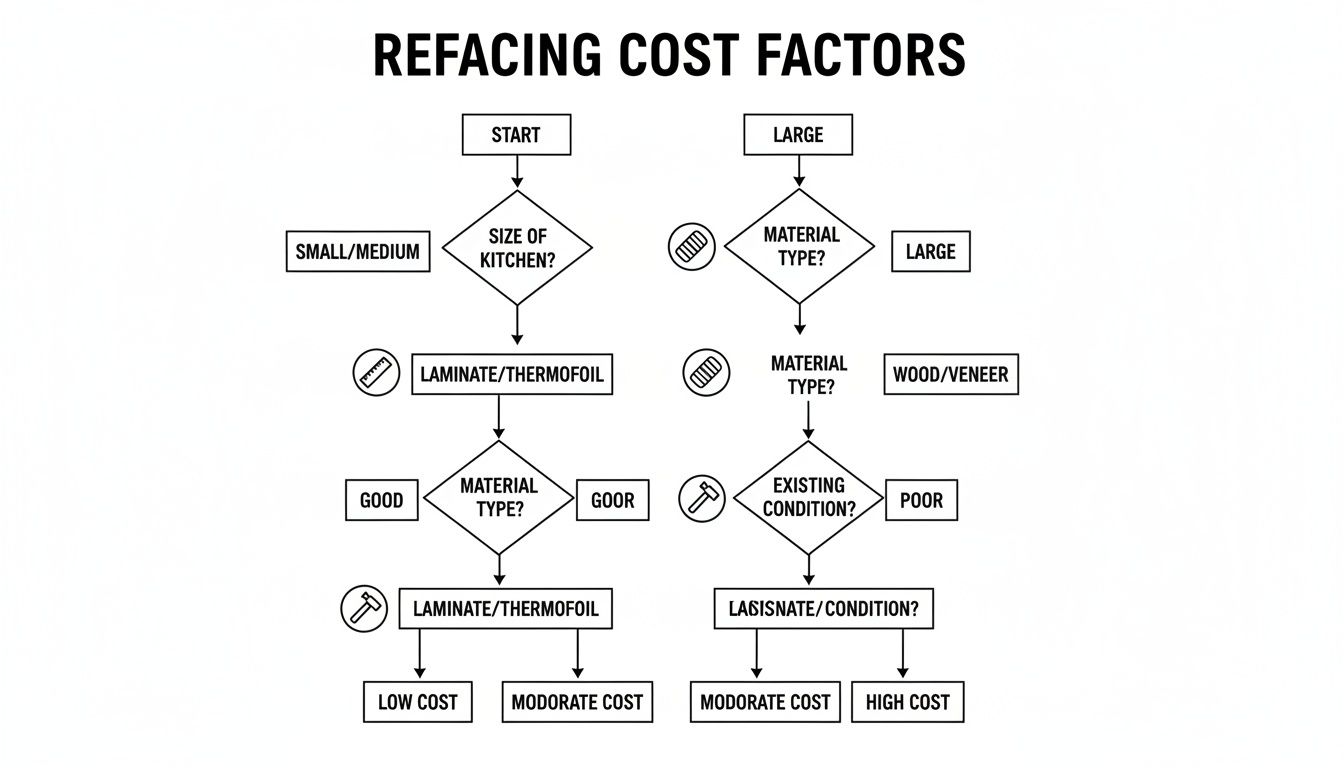
As you can see, if your cabinet boxes are structurally sound and you're happy with your kitchen’s layout, refacing is very often the smartest and most cost-effective path forward.
Time, Disruption, and Environmental Impact
Money isn't the only cost to consider. You also have to think about the "cost" to your daily life. A full cabinet replacement is a serious construction project. It can knock your kitchen out of commission for weeks, if not months, filling your home with dust, noise, and constant disruption.
Cabinet refacing, by comparison, is a much faster and tidier affair. Since the cabinet boxes stay put, the whole process is far less invasive.
- Project Timeline: A typical refacing job is wrapped up in just 3 to 5 days. A full replacement? You could be looking at 4 to 8 weeks or even longer.
- Household Disruption: With refacing, your kitchen stays mostly usable. A replacement means weeks of takeout, washing dishes in the bathroom sink, and living in a construction zone.
- Environmental Friendliness: If sustainability matters to you, refacing is the clear winner. It prevents perfectly good cabinet boxes from ending up in a landfill, significantly cutting down on waste compared to a full tear-out.
This head-to-head comparison table lays out the pros and cons to help you see which approach fits your priorities.
Refacing vs Replacement: Which Is Right for You?
| Factor | Cabinet Refacing | Full Cabinet Replacement |
|---|---|---|
| Cost | 50-70% less than replacement | The most expensive option |
| Timeline | 3-5 days | 4-8 weeks or more |
| Disruption | Minimal; kitchen remains usable | High; kitchen is out of commission |
| Layout Changes | Not possible; must keep existing layout | Complete freedom to redesign |
| Environmental Impact | Low; reuses existing cabinet boxes | High; old cabinets go to landfill |
| Best For… | Good cabinet boxes, budget-conscious updates, quick turnarounds | Damaged cabinets, changing layout, total customisation |
Ultimately, weighing these factors will help you make a confident decision. For a closer look at what's possible with a complete overhaul, you can explore our overview of custom kitchen cabinets and renovations in Toronto. Whether you choose the smart efficiency of refacing or the total transformation of a replacement, you’ll be well on your way to the kitchen you've always wanted.
Understanding Cabinet Refacing Costs in Toronto and Markham
If you've been researching cabinet refacing costs online, you've probably seen national averages thrown around. But for homeowners in the Greater Toronto Area, those numbers can be seriously misleading. It’s a bit like checking a weather forecast for all of Canada—it gives you a vague idea, but it won’t tell you whether to grab a coat for a walk in your own neighbourhood. Toronto and Markham have their own economic climate, and that directly shapes the pricing for home renovations.
Several local factors make the GTA unique. The higher cost of living means skilled tradespeople command higher wages than in smaller towns. On top of that, businesses face steeper overhead costs, from workshop rent to the simple logistics of navigating a bustling city. All these operational realities get factored into the final quote you see.
Why Local Market Dynamics Make a Difference
Getting a handle on the GTA’s specific market is the key to setting a budget that makes sense. Here, the demand for quality home renovations is always high, which has a ripple effect on everything from material availability to the booking schedules of the best installers. While that doesn't automatically mean you’ll overpay, it does mean that pricing is competitive and reflects a very different set of economic pressures.
The way local contractors market themselves also plays a role. Learning about local SEO strategies for contractors can give you a peek behind the curtain at how companies compete for your business, which can influence their pricing structures.
Just how much can location matter? A lot. Take Yolo County in California, for example, where data shows homeowners paid between $1,449 to $2,286 for refacing—a number well below the national average, thanks to local market conditions. It’s a perfect illustration of why geography is so important.
The Factory-Direct Advantage in the GTA
This is where you, as a savvy local homeowner, can find a real advantage. Big-box stores and general contractors have long supply chains, and every step adds a markup. A factory-direct supplier, however, changes the game completely. When you work with a company like MapleKing, which makes its own cabinet doors and components right here in the area, you’re cutting out the middleman entirely.
This direct-from-the-source model is your single biggest tool for managing the refacing cabinets cost in a premium market like Toronto. You get top-tier materials and craftsmanship without paying the inflated prices that come from distributors and retailers each taking their slice.
This approach gives you two clear wins:
- Better Value: Your money is invested directly into the quality of the materials and the skill of the installers, not into propping up a bloated supply chain.
- Superior Quality Control: When the company you hire is also the one making the product, they have total control over everything. From sourcing the wood to applying the final coat of paint, the quality is consistent and guaranteed.
By keeping these local dynamics in mind, you can move from just collecting quotes to making a truly informed decision and finding incredible value right in your own backyard.
Smart Budgeting Tips for Your Cabinet Refacing Project
Figuring out the budget for your cabinet refacing project shouldn't be a source of stress. With a bit of planning and a clear strategy, you can guide your project to a stunning finish without breaking the bank. It's like having a detailed road map before you start a long drive—knowing your route, and a few potential detours, makes for a much smoother journey.
This mindset puts you in the driver's seat of your renovation. When you understand the key financial checkpoints, you can sidestep common mistakes and make every dollar work harder. The whole idea is to feel confident about the numbers so you can focus on what's really exciting: watching your new kitchen take shape.
Get Detailed, Itemized Quotes
When you start gathering estimates, never settle for a single, all-in number. Any professional and transparent company should have no problem providing an itemized quote that breaks down every single cost. This level of detail is your best friend—it shows you exactly where your money is going and lets you compare different offers on an apples-to-apples basis.
A proper quote should clearly list the costs for:
- Materials: What type are they using (HDF, thermofoil, wood veneer)? What’s the cost per door and drawer front?
- Labour: How much is the installation? Does this include prep work or minor repairs?
- Hardware: A line item for new hinges, knobs, and pulls.
- Extras: Any additional services like installing crown moulding, getting rid of the old materials, and final cleanup.
A vague quote is a warning sign. A detailed one shows you're dealing with a trustworthy partner who believes in transparency.
Plan for Surprises with a Contingency Fund
Even the most perfectly planned home renovation can hit a snag. Maybe you pull off an old cabinet and find a small patch of water damage, or halfway through, you decide that under-cabinet lighting is a must-have. This is exactly what a contingency fund is for—it's your financial safety net.
As a rule of thumb, it's wise to set aside an extra 10-15% of your total project budget for these "just in case" moments. So, if your project is quoted at $8,000, your contingency fund should be somewhere between $800 and $1,200.
Having this buffer keeps a minor hiccup from becoming a major budget crisis. And if you don't end up using it? Great! You’ve got extra cash for a new small appliance or a celebratory dinner in your beautiful new kitchen.
Think About the Long-Term Value of Your Choices
It’s always tempting to go with the cheapest material to keep the initial cost down, but it's important to think about the long game. Your kitchen cabinets get more daily use than almost any other feature in your home. Investing in quality and durability now can save you a bundle on repairs or replacements later on.
Think about the trade-offs:
- Budget-Friendly Laminates: These are workhorses. They stand up well to stains and moisture, making them a fantastic, low-maintenance choice for a busy family.
- Painted HDF: This option gives you that premium, perfectly smooth finish. It's incredibly stable and won't warp, adding serious visual appeal and resale value.
- Real Wood Veneers: Nothing beats the timeless beauty of real wood. It offers a classic look that lasts and can even be refinished years down the road.
Choosing a higher-quality material almost always delivers a better return on your investment. It makes your home more attractive to potential buyers and gives you years of trouble-free enjoyment. At MapleKing, our factory-direct approach means you get premium, durable materials without the typical retail markup, giving you incredible value right from the get-go. Our no-obligation quotes give you the clear, detailed breakdown you need to make the smartest investment in your home.
See the Transformation: Real-World Project Examples
Numbers on a page are one thing, but seeing how they translate into a real-life kitchen makeover is where the magic happens. The final refacing cabinets cost really comes down to the story of your kitchen—the materials you choose, the size of your space, and what you want the finished room to feel like.
Let’s walk through a couple of recent projects we’ve completed right here in Toronto and Markham. These examples show how different budgets and styles can lead to stunningly different, yet equally beautiful, results.
The Chic Condo Kitchen Update
We see this all the time in downtown Toronto condos: a small, functional kitchen that just looks tired and dated. For one recent client, the goal was a clean, minimalist look that wouldn't break the bank. We refaced their existing cabinets with a sleek, matte white HDF.
- Scope: 18 cabinet doors and drawer fronts.
- Material: Matte HDF, which gives a beautiful, fingerprint-resistant finish.
- Approximate Cost Range: $5,500 – $7,000.
The change was immediate. The new white doors brightened the entire condo, making the kitchen feel much larger and more open. It’s a perfect example of how a smart material choice can deliver a high-end look on a very reasonable budget.
The Busy Family Kitchen Refresh
Out in a bustling Markham family home, the top priority was durability. Their original oak cabinets had seen better days, but the kitchen's layout was perfect for their busy lives. They needed a facelift that could stand up to daily chaos.
The solution? A durable thermofoil in a calming grey shaker style. This material is a workhorse—it’s incredibly easy to clean and holds up against moisture and stains, which is exactly what a high-traffic kitchen needs.
- Scope: 30 cabinet doors and drawers, plus a small pantry unit.
- Material: HDF Thermofoil in a classic shaker profile.
- Approximate Cost Range: $7,500 – $9,500.
The result was a fresh, contemporary kitchen that’s both welcoming and practical. It’s a space truly built for real life.
These examples prove you don't need a full demolition to get a stunning transformation. By working with the solid bones of your existing kitchen, we can create a dramatic new look that’s perfectly suited to your style and budget.
Ready to see what’s possible for your home? Take a look through dozens of other local projects in the MapleKing project gallery and start gathering some inspiration.
Your Top Questions About Cabinet Refacing Costs Answered
Even when you've done your homework, a few questions are bound to pop up before you dive into a kitchen project. It’s completely normal. Let's tackle some of the most common things homeowners in Toronto and Markham ask us about the cost and process of refacing cabinets.
Think of this as sitting down with an expert for a coffee. We'll get into the practical details that will give you the final bit of confidence you need to move forward with your investment.
How Long Does Cabinet Refacing Last?
This is a great question because it gets right to the heart of what makes refacing such a smart investment. A professional refacing job isn't a temporary band-aid; it's a durable, long-term upgrade. When you use quality materials and have them installed correctly, your refaced cabinets can easily last 10 to 20 years, sometimes even longer.
Honestly, the lifespan is right up there with what you’d expect from brand-new, mid-range cabinets. The longevity really comes down to a few key things:
- Quality of Materials: Higher-end materials like HDF or real wood veneers will always outlast cheaper, lower-grade options.
- The Installation: This is critical. A pro ensures the veneers are applied flawlessly and the doors are hung perfectly to prevent peeling and premature wear.
- Simple Upkeep: Just like anything else in your home, a little care goes a long way. Regular cleaning with gentle products will keep them looking great for years.
Can Any Cabinet Be Refaced?
While refacing works wonders for most kitchens, it’s not a one-size-fits-all solution. The whole project hinges on the condition of your existing cabinet boxes—they're the foundation we build upon.
If your cabinet boxes are structurally solid, you're likely a perfect candidate. But, it's probably not the best path forward if you're dealing with major issues like:
- Warping or swelling from significant water damage.
- Structural failures, like sagging shelves or broken joints.
- Damage from pests.
Any reputable professional will start with a thorough inspection to make sure your cabinet bones are good before recommending refacing.
Does Cabinet Refacing Actually Add Value to My Home?
Absolutely. A modern, updated kitchen is consistently one of the best upgrades you can make for your home's resale value. Because cabinet refacing gives you that "brand-new kitchen" look for a fraction of the cost, it often delivers a fantastic return on investment (ROI).
You're not just making your kitchen more beautiful; you're making a savvy financial move. Studies often show the ROI for cabinet refacing can climb well over 75%. For potential buyers, a stunning kitchen is a huge selling point, and refacing gets you there without breaking the bank.
What’s the Difference Between Refacing and Refinishing?
People mix these two up all the time, but they are fundamentally different processes. Knowing the distinction is key when you're looking at quotes and deciding what's right for your kitchen.
- Refacing: This is a complete facelift. We replace your old cabinet doors and drawer fronts with brand-new ones. Then, we apply a matching veneer to the exterior of the cabinet boxes so everything looks seamless.
- Refinishing: This is more of a surface treatment. Your existing doors and drawers are stripped, sanded, and then either repainted or re-stained.
The bottom line? Refacing gives you a total transformation—new style, new colour, new life. Refinishing just refreshes the look you already have.
Ready to stop wondering and start planning? The team at MapleKing Kitchen Cabinets is here to provide a clear, no-obligation quote tailored to your Toronto or Markham home. Explore our gallery and see how factory-direct pricing makes a luxury kitchen more affordable than you think. Get your free estimate today.



