

If you're planning a kitchen renovation in Canada, you’ve probably spent hours agonizing over countertops and cabinet colours. But what about the air you’ll be breathing? A great range hood isn't just another appliance; it's one of the most important systems for keeping your home clean, healthy, and beautiful.
Why Your Canadian Kitchen Deserves a Great Range Hood
Picture your brand-new kitchen. The custom cabinets are perfect, the countertops are gleaming… but the entire space still smells faintly of last night's seared salmon. A quality range hood is the unsung hero that prevents this, acting as the guardian of both your investment and your air quality.
Think about it. Without proper ventilation, everything that comes off your cooktop—grease, smoke, steam, and strong odours—has to go somewhere. It settles on every available surface, creating that sticky, yellowish film you can never quite scrub off your cabinets, walls, and ceiling. Over time, this buildup can cause permanent discolouration and damage. A powerful range hood is designed to capture all of that at the source, pulling it out of your kitchen before it has a chance to stick around.
Protecting Health and Home
But it's not just about smells and sticky surfaces. When you cook, especially on a gas stove, you're releasing pollutants like carbon monoxide and nitrogen dioxide into your home. A properly vented range hood is the only way to effectively remove these harmful gases, ensuring the air your family breathes is as clean and safe as possible. For that reason alone, it should be a non-negotiable part of any kitchen design.
With home renovations and new builds on the rise across Canada, it's clear that homeowners are investing more in creating functional, modern kitchens. In fact, recent industry analysis shows that investments in residential building construction have climbed to an impressive $15.1 billion. This boom underscores a growing awareness that effective ventilation isn't a luxury—it's a top priority. For a deeper dive into market trends, you can explore more insights on the Americas range hood industry from Grandview Research.
More Than Just an Appliance
So, it's time to stop thinking of a range hood as an afterthought and start seeing it as a core part of your kitchen's ecosystem. It actively cleans your air by pulling out smoke and airborne grease. It preserves your cabinetry by stopping moisture and grime from building up. And ultimately, it makes your kitchen a more comfortable, clean, and pleasant place to be.
This guide will walk you through exactly what you need to know to choose the right range hood for your Canadian home, from ventilation power and noise levels to local building codes and installation quirks. By the end, you'll be able to make a choice with complete confidence.
So, you’re diving into a kitchen renovation, and it's time to talk about one of the most important but often overlooked appliances: the range hood. The very first decision you'll face is a big one, as it shapes everything from installation to performance. You have to choose between a ducted or a ductless system.
Think of a ducted range hood as a one-way express route for getting kitchen air pollution out of your house. It physically captures all the smoke, grease, intense cooking smells, and steam from your cooktop and vents it directly outside through a network of ducts. It's the most effective way to keep your indoor air fresh and clean.
A ductless range hood (sometimes called a recirculating hood) works more like a water filter for your air. It pulls in all that smoky, greasy air, passes it through a series of filters designed to trap grease and odours, and then releases the cleaned air right back into your kitchen.
So, which path is right for you? A lot depends on your home's structure and how you cook. This flowchart can help you visualize the decision.
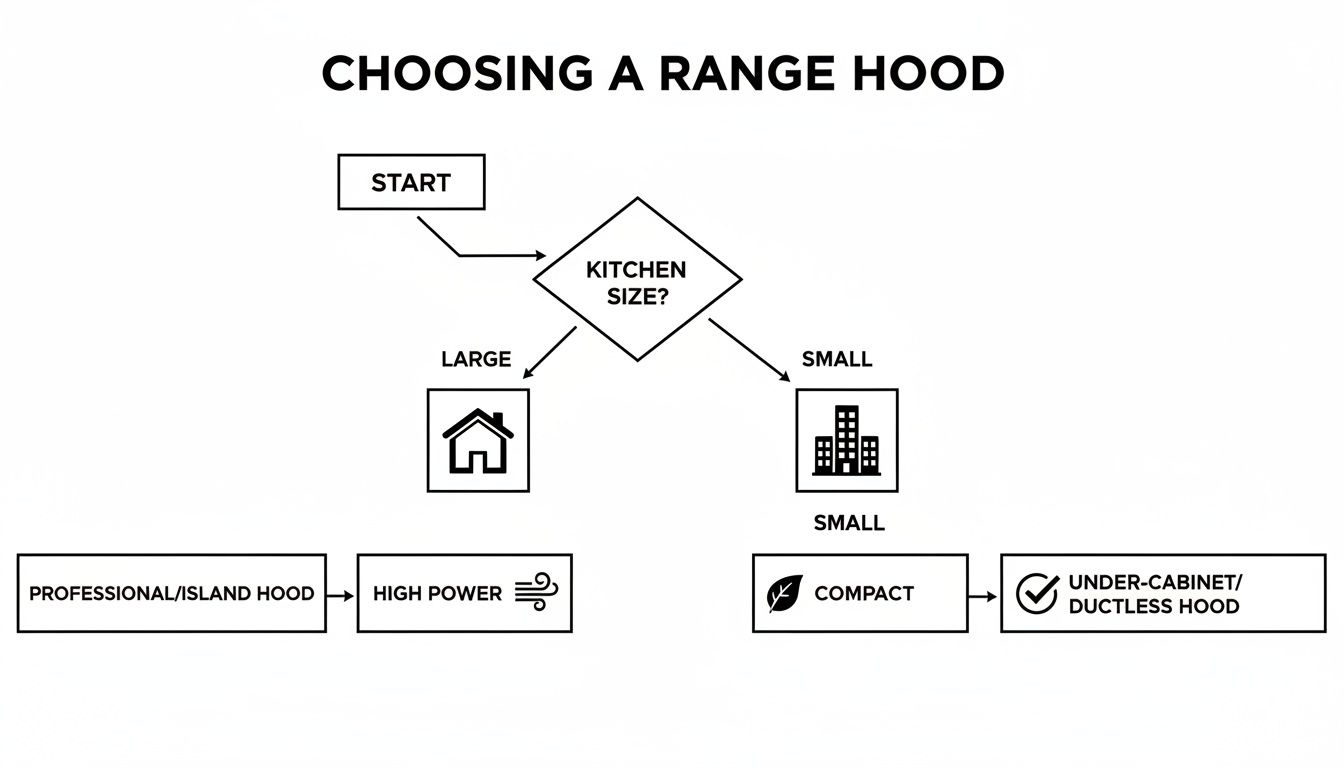
As you can see, the bigger and more ambitious your cooking goals, the more a powerful ducted system makes sense. For smaller spaces or simpler setups, like in many condos, a ductless model can be the perfect solution.
Why Go Ducted? The Gold Standard in Ventilation
When it comes to pure performance, nothing beats a ducted system. It's the gold standard for a reason. Because it completely removes contaminants from your home, it's the only real choice for anyone who does a lot of high-heat searing, wok frying, or cooking with strong spices and aromatics. If you don't want last night's salmon dinner to greet you in the morning, this is the way to go.
The main challenge, of course, is the installation. You need to have a clear, feasible path to run ductwork from above your stove to an exterior wall or through the roof. This can be relatively simple in a detached house during a reno, but it can be a massive headache—or even impossible—in a high-rise condo or apartment building.
The Convenience of Ductless Hoods
Where ducted hoods are about performance, ductless hoods are all about flexibility. Since they don't need to vent to the outdoors, you can install them pretty much anywhere. This makes them a go-to solution for apartments, condos, island cooktops in the middle of a room, or any home where adding new ductwork just isn't in the cards. They are also typically cheaper to buy and much simpler to install.
Key Takeaway: While ducted hoods offer superior air purification by expelling pollutants, ductless hoods provide a practical and flexible solution for spaces where external ventilation isn't an option.
The trade-off for that convenience comes down to performance and upkeep. Ductless hoods are only as good as their filters.
- Charcoal Filters: These are the key to odour control. To keep them working properly, you’ll need to replace them every 3 to 6 months, depending on how often you cook.
- Grease Filters: Just like with ducted hoods, these metal mesh filters trap airborne grease and need to be cleaned regularly.
- Performance Note: Remember, a ductless hood can't do anything about heat or humidity. Since it just recirculates the air, your kitchen will still get warm and steamy.
Ducted vs Ductless Range Hoods: A Quick Comparison
To make the choice a little easier, here’s a straightforward breakdown of how these two types of range hoods stack up against each other.
| Feature | Ducted Range Hood | Ductless (Recirculating) Range Hood |
|---|---|---|
| Performance | Excellent. Physically removes all smoke, steam, grease, and odours. | Good. Traps grease and odours, but recirculates heat and moisture. |
| Installation | Complex. Requires ductwork run to an exterior wall or the roof. | Simple. Can be installed almost anywhere without major construction. |
| Maintenance | Lower maintenance. Mostly just involves cleaning the grease filters. | Higher maintenance. Requires regular filter cleaning and charcoal filter replacement. |
| Best For | Serious home cooks, gas ranges, and kitchens where venting is possible. | Apartments, condos, and kitchens where running ductwork is impractical. |
Ultimately, the best range hood for your Canadian kitchen is one that fits both your cooking style and the physical realities of your home.
Decoding Power and Noise: A Practical Guide to CFM and Sones
When you start shopping for a range hood, you’ll immediately run into two terms: CFM and Sones. These aren't just technical specs to gloss over; they are the two most important numbers that tell you exactly how a hood will perform in your kitchen. Getting a handle on them is the key to picking a unit that actually clears the air without making it impossible to hold a conversation.
Think of CFM (Cubic Feet per Minute) as the raw horsepower of the fan. It’s a straightforward measurement of how much air the hood can pull out of your kitchen in one minute. A higher CFM rating means more power, which translates to clearing out smoke from a seared steak or steam from a big pot of pasta that much faster.
This metric is the gold standard for measuring airflow. If you're interested in the nitty-gritty of how this applies to your home's entire ventilation system, you can get a deeper technical look by understanding CFM in HVAC systems.
So, How Much CFM Do You Actually Need?
It’s tempting to just buy the most powerful hood you can find, but that's a common mistake. More power isn't always better. An overpowered hood can be excessively loud and energy-hungry, costing you more without any real benefit. The real goal is to match the power to your cooktop.
Here’s a reliable rule of thumb we use to estimate the minimum power needed:
For Electric Cooktops: You'll want about 100 CFM for every 10 inches of stove width. For a standard 30-inch electric range, a 300 CFM hood is your baseline.
For Gas Cooktops: Gas burns hotter and produces more exhaust, so it needs more ventilation muscle. To figure this out, add up the total BTUs of all your burners and divide by 100. A range with a total output of 50,000 BTUs would call for a hood with at least 500 CFM.
With a residential building boom across the country, more Canadian homeowners are demanding this level of performance, pushing the market toward more effective ventilation solutions.
What About the Noise? Understanding Sones
While CFM is all about power, sones tell you about the noise level. This is a much more user-friendly scale than decibels because it’s linear, making it easy to compare models.
Simply put, a lower sone rating means a quieter hood. 2 sones is literally twice as loud as 1 sone, and 4 sones is twice as loud as 2.
To give you a real-world feel for what these numbers mean:
- 1 Sone: This is incredibly quiet, about the same as the gentle hum of a new refrigerator. You'll barely notice it.
- 4 Sones: This is the level of a normal conversation in a quiet room. You can easily talk over it without raising your voice.
- 8+ Sones: Now we're getting loud. At this level, you’ll have to speak up to be heard. This is what you can expect from a very powerful hood running on its highest setting.
Ultimately, your decision comes down to finding the sweet spot. You need a hood with enough CFM to handle your cooking style, but with a sone rating that you can live with on a daily basis. A quiet, effective range hood is one of the best upgrades you can make for a more enjoyable kitchen.
Picking out a range hood involves more than just matching your appliances and chasing a high CFM rating. To do it right, you have to make sure your installation is safe and, just as importantly, up to code. Overlooking these rules, especially here in Canada, can lead to failed inspections, serious safety hazards, and a lot of money spent redoing work you thought was finished.
For anyone renovating a kitchen in Toronto or elsewhere in the province, the Ontario Building Code (OBC) is the rulebook. While it can seem a bit intimidating, its purpose is straightforward: ensure clean air in your home and prevent fire or gas-related risks, particularly as new homes become more and more airtight.
One of the biggest things the code addresses is the growing trend of installing seriously powerful range hoods.
The Importance of Make-Up Air Systems
When you fire up a high-powered ducted range hood—we're talking anything that moves over 600 CFM—you're doing more than just clearing smoke. You’re actively pulling a massive volume of air out of your house, creating negative pressure.
Think of your home as a sealed box. If you start sucking all the air out of it with a powerful fan, a vacuum is created. This vacuum desperately tries to pull air back in from anywhere it can, and that's where the danger lies. It can actually reverse the flow of your other vents, causing back-drafting in your furnace or gas water heater. Instead of venting deadly combustion gases like carbon monoxide outside, that vacuum can pull them right back into your living space.
To counteract this, the OBC often mandates a make-up air system. This isn't part of your range hood; it's a completely separate system that automatically brings fresh outside air back into your home whenever the hood is running on high. It works in tandem with your fan to keep the air pressure balanced, ensuring your home is safe and your hood can actually do its job properly.
A make-up air system isn't an afterthought. It requires its own ducting and electrical wiring, so you absolutely must bring it up with your contractor during the design phase. It will impact your budget and project timeline, and you need to plan for it from day one.
Standard Clearances and Ducting Rules
Beyond the complex issue of air pressure, building codes also get very specific about the distance between your cooktop and the bottom of your range hood. This clearance isn't an arbitrary number; it's there for two critical reasons: preventing fires and making sure the hood can effectively capture smoke and grease.
As a rule of thumb, here are the standard clearances you’ll be working with:
- For electric cooktops, you’ll generally need a gap of 20 to 24 inches.
- For gas cooktops, which burn hotter and have an open flame, the requirement is greater, usually 24 to 30 inches.
These are solid guidelines, but you should always treat the manufacturer's installation manual as your final authority and double-check with your local building office. Sticking to these measurements is non-negotiable and will directly influence your upper cabinet design. To dig deeper into this, you can read our guide on finding the ideal range hood height. Proper planning here is what separates a functional, compliant kitchen from one that just looks good.
Matching Your Range Hood With Your Kitchen Cabinets
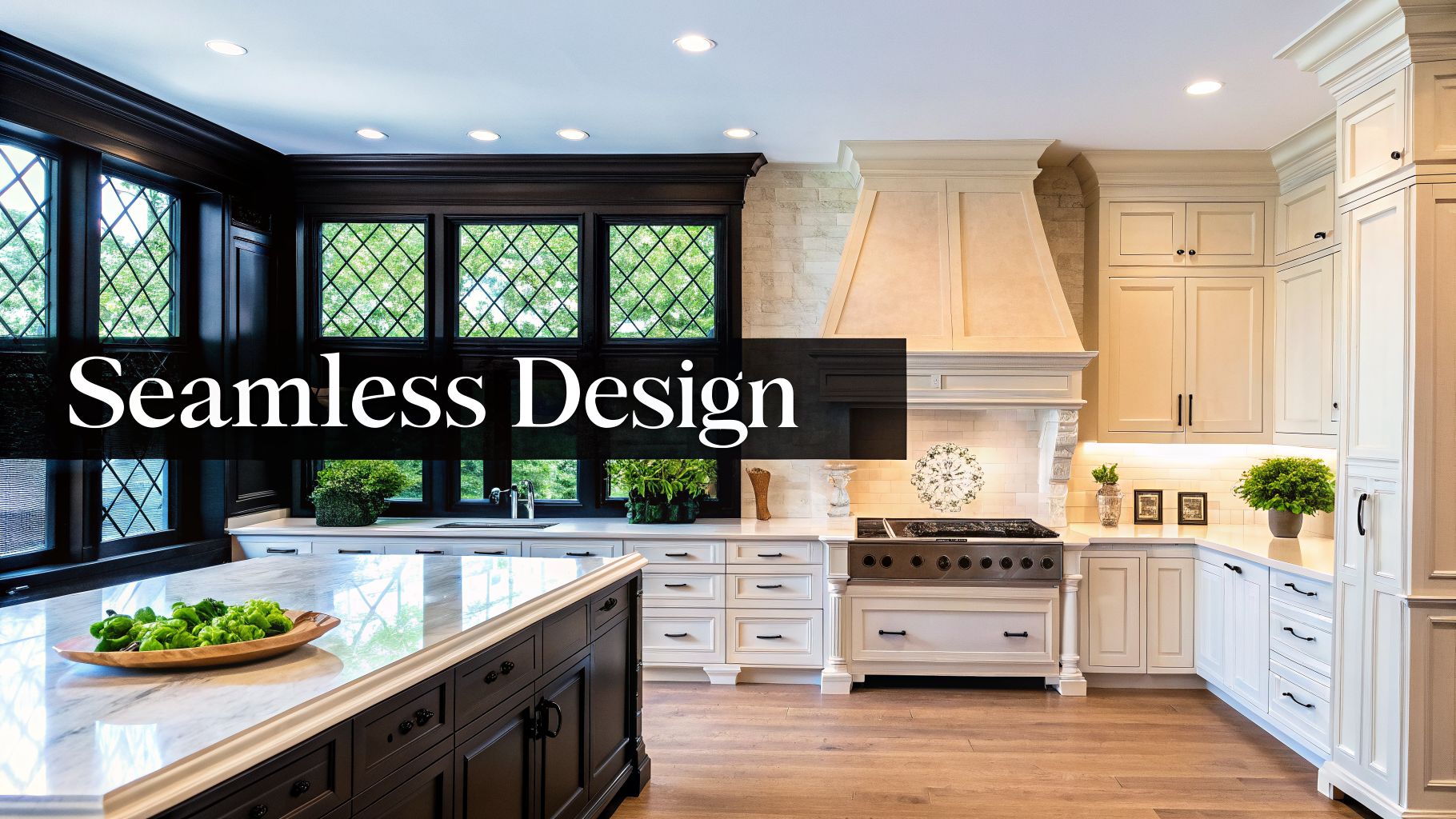
A range hood is much more than a functional appliance—it's a major visual anchor in your kitchen. When done right, it doesn’t just clear the air; it pulls the whole design together. The trick is to treat it as an integral part of your cabinetry plan from day one, not a last-minute addition.
For that truly seamless, high-end look many Canadian homeowners want, a custom hood insert is an incredible option. It’s the perfect way to get powerful, professional-style ventilation without compromising your kitchen’s aesthetic.
Think of an insert as the engine of a range hood—the fan, lights, and filter system—all contained in a compact unit. You then build a custom shell or enclosure around it that perfectly matches your cabinetry. This makes your ventilation system look like a deliberate piece of architectural millwork, rather than just another appliance.
Finding Your Perfect Finish
If a fully custom-built enclosure isn't in your plans, the finish of the hood itself becomes your most important design decision. You’re looking for a finish that complements your cabinets and reinforces the overall mood of the kitchen.
Here’s a look at how some popular choices play out:
- Stainless Steel: It’s the timeless workhorse for a reason. Stainless steel pairs beautifully with almost any cabinet style, from modern high-gloss to traditional painted shaker doors, lending a clean, professional feel.
- Matte Black: For a touch of modern drama, a matte black hood is a showstopper. It creates a bold focal point, especially against light-coloured or natural wood cabinets, and does a great job of hiding smudges and fingerprints.
- White: A white range hood is your best bet for an airy, cohesive space. It blends right in with white cabinetry, creating an unbroken visual line that can make the entire kitchen feel bigger and brighter.
A great finish bridges the gap between a utilitarian appliance and a piece of furniture. Let the existing colours and textures in your kitchen—from your counters to your backsplash—guide you toward a hood that feels like it belongs.
Positioning for Visual Balance
Just as important as the finish is where and how you place the hood. For wall-mounted chimney hoods, the key is symmetry. Centring the hood perfectly between two upper cabinets establishes a sense of order and turns your cooking area into a deliberate feature. Always leave some visual "breathing room" on either side so the hood doesn't feel wedged in.
With slim under-cabinet models, it's all about precision. The hood should be the exact same width as the cooktop below and the cabinet above, creating a crisp, uninterrupted line that strengthens a minimalist design. This requires careful measurement and planning, which is where working with experienced designers of Toronto kitchen cabinets can make all the difference.
When placement and finish come together, your range hood stops being just a necessity and becomes a stunning centrepiece.
What to Budget, How to Maintain It, and Where to Buy in Canada
Let's talk about the practical side of things: money, maintenance, and where you actually go to buy a range hood. Getting the right appliance is one thing, but planning for its cost and care from day one is what ensures it serves your kitchen well for years to come.
So, what should you expect to spend? Range hood prices in Canada run the gamut. A simple, no-fuss under-cabinet model will typically set you back $300-$600. These are great workhorses for smaller kitchens. If you're looking at more powerful wall-mount or chimney-style hoods, your budget should probably be in the $700 to $1,500 range. For the high-end stuff—think powerful island hoods or sleek custom inserts—prices can easily climb past $2,000. These models pack a serious punch in terms of performance and design.
These numbers are just one piece of the puzzle, of course. To see how a range hood fits into the bigger picture, check out our guide on kitchen renovation costs in Toronto.
A Simple Maintenance Plan is Your Best Friend
Keeping your range hood in top shape is surprisingly easy, but you have to be consistent. What you need to do really just depends on the type of filter it uses.
- Mesh & Baffle Filters: These are the metal grease traps found in almost all ducted hoods and some ductless ones. Plan to clean them every 4-6 weeks. The best part? Most are dishwasher-safe, so you can just pop them in with a regular load.
- Charcoal Filters: If you have a ductless hood, you'll have these. Their job is to neutralize cooking odours. You can't clean them, so they need to be replaced every 3 to 6 months to keep things smelling fresh.
Key Insight: Sticking to a filter cleaning schedule is the single most important thing you can do for your range hood. A clogged filter is like trying to breathe through a stuffy nose—it forces the motor to work way harder and dramatically cuts down its effectiveness and lifespan.
Where to Shop for Your Range Hood
In Canada, you've got a few solid options when you're ready to buy.
Specialty appliance stores are fantastic because they offer expert advice and carry a curated selection of higher-end models. The staff there really know their stuff.
Big-box retailers like Home Depot or Best Buy are great for browsing a wide variety of brands at competitive prices. You'll find everything from entry-level to mid-range options.
Finally, don't overlook online suppliers. You can find some excellent deals, but do your homework. Make sure you're buying from a reputable seller with clear Canadian warranty information and good customer support.
Frequently Asked Questions About Range Hoods
Once you start digging into the details of range hoods, a few common questions almost always pop up. Let's walk through some of the ones we hear most often from homeowners.
Can I Install a Range Hood Myself?
So, can you tackle a range hood installation on your own? For the simplest jobs, absolutely. If you're just replacing an old ductless or under-cabinet model with a similar one, it's often a straightforward DIY project. You’re typically just dealing with a few mounting screws and plugging it into an outlet that’s already there.
However, the moment the job involves running new ductwork, touching electrical wiring, or dealing with make-up air systems, it's time to call in a professional. Getting the ducting wrong isn't just a small mistake; it can kill your hood's performance and even lead to moisture problems down the road. This is one of those times when investing in a pro pays for itself.
How Often Should I Replace My Range Hood?
With good care, a quality range hood should easily last you 10 to 15 years. The biggest factors in its lifespan are the quality of the motor and how well you keep up with cleaning the filters.
You'll know it's time for a replacement when you notice the signs. Is it getting ridiculously loud? Has the suction power dropped off? Are you hearing grinding or whining sounds from the motor? Those are all clear indicators that it's on its last legs. And if issues pop up before then, you might need to look into professional range hood repair services.
Key Reminder: Regular cleaning is the single best thing you can do to extend your range hood’s life. A motor that's struggling to pull air through grease-clogged filters will burn out far sooner than one that can breathe easily.
What’s Better Baffle or Mesh Filters?
This debate really boils down to performance versus maintenance. Both types are designed to do the same job—trap grease—but they go about it in different ways.
- Baffle Filters: Built from sturdy, interlocking metal panels, these are the workhorses you often see in commercial kitchens. They force greasy air to change direction quickly, which causes the grease to separate and collect. They’re incredibly durable and a breeze to clean—just pop them in the dishwasher.
- Mesh Filters: These use several layers of fine aluminum mesh to catch grease particles. They work well, but getting them truly clean can be a chore. Over time, harsh scrubbing can cause them to break down or warp.
For most homeowners who value durability and low-fuss maintenance, baffle filters are the clear winner. Think of them as a smart, long-term investment in your kitchen's ventilation.
Ready to create a kitchen that is as beautiful as it is functional? At MapleKing Kitchen Cabinets, we specialize in designing custom cabinetry that perfectly integrates with your chosen appliances, including your range hood. Explore our gallery and get a free quote to start your project. https://maplekingkitchencabinets.com



