
When you're pricing out a kitchen cabinet project in Toronto, the numbers can swing wildly. You could be looking at $4,000 for a small, budget-friendly kitchen or upwards of $30,000 for a large, luxury renovation. It really all comes down to the size of your space, the quality of materials you choose, and whether you go for stock, semi-custom, or fully custom cabinets.
A Snapshot of Kitchen Cabinet Prices in Toronto
Trying to nail down the cost of kitchen cabinets can feel like hitting a moving target, but it doesn't need to be so complicated.
Think of it like buying a car. You have your practical, get-the-job-done sedans, your versatile and comfortable SUVs, and your high-performance luxury models. They all get you from A to B, but the experience, materials, features, and price tag are worlds apart. Kitchen cabinets work on a similar tiered system.
To give you a realistic starting point, let's break down the typical investment you can expect for different kitchen sizes and quality levels here in Toronto and Markham. These figures are a solid baseline for the cabinets themselves, before factoring in installation or other reno costs.
Your budget will be shaped by two main things: the square footage of your kitchen and the quality tier of the cabinets you land on. Here’s a quick guide to what that means:
- Budget-Friendly: Perfect for a quick refresh or a rental property. This tier typically uses materials like laminate or thermofoil to deliver a clean, modern look without breaking the bank.
- Mid-Range: This is the sweet spot for most homeowners. You’ll find durable materials like HDF and quality painted finishes, offering a fantastic balance of style, durability, and cost.
- Luxury: If you’re dreaming of a show-stopping, high-end kitchen, this is your tier. It’s all about premium materials like solid wood, intricate custom designs, and one-of-a-kind finishes.
To help you visualize where you might land, here’s a table outlining what you can expect to pay.
Estimated Kitchen Cabinet Costs in Toronto and Markham
This table provides a snapshot of typical price ranges for kitchen cabinets based on kitchen size and quality level, excluding installation.
| Kitchen Size | Budget-Friendly (e.g., Laminate, Thermofoil) | Mid-Range (e.g., HDF, Painted Wood) | Luxury (e.g., Custom Real Wood) |
|---|---|---|---|
| Small Kitchen (approx. 10'x10') | $4,000 – $7,000 | $8,000 – $14,000 | $15,000+ |
| Medium Kitchen (approx. 12'x15') | $6,000 – $10,000 | $12,000 – $20,000 | $22,000+ |
| Large Kitchen (approx. 15'x20'+) | $9,000 – $15,000 | $18,000 – $28,000 | $30,000+ |
Note: These are estimated costs for cabinetry only and can vary based on layout and specific selections.
As you can see, the jump between tiers is significant. A small kitchen can be outfitted for under $7,000 with budget-friendly options, but that same space could easily exceed $15,000 with high-end custom work. This table should help you anchor your expectations as you begin planning.
What Really Drives Your Cabinet Costs?
Ever wonder why one kitchen renovation quote can land at $5,000 while a seemingly similar one soars past $25,000? It’s not just one big-ticket item. Instead, it’s a whole mix of choices that add up, and knowing what they are is your key to building a smart budget.
Think of it like buying a car. A basic sedan gets you from A to B, but a luxury sports car does it with a whole different level of engineering, materials, and features. The price difference is huge, right? The exact same logic applies to kitchen cabinets. Every decision you make—from the wood to the doorknobs—shapes that final number on your quote.
The great thing is, you're in the driver's seat. Once you understand where the money goes, you can decide where to spend and where to save, making sure you get the best possible kitchen for your Toronto home.
The Foundation: Cabinet Materials and Construction
The single biggest factor in your cabinet’s price tag is the material used for the boxes and doors. This is the very chassis of your kitchen. It dictates how long your cabinets will last, how durable they are, and, of course, a huge chunk of the cost.
- Laminate/Thermofoil: These are your most budget-friendly options. A synthetic layer is heat-bonded to a substrate like particleboard or MDF. They’re easy to clean and give a clean, modern look, but they won't stand up to wear and tear like wood.
- HDF (High-Density Fibreboard): This is a fantastic mid-range choice and for good reason. As an engineered wood product, HDF is incredibly stable and won’t warp or crack with humidity changes like solid wood can, making it the perfect canvas for a flawless painted finish.
- Solid Wood: This is the premium tier. Woods like maple, oak, or cherry bring a natural warmth and strength that’s simply unmatched. They come with a higher price tag and do need to be in a stable environment to prevent movement.
It’s not just the material, but how the cabinets are built. Are they stock (mass-produced in standard sizes), semi-custom (stock boxes with more door and finish options), or fully custom (built from scratch to fit your space perfectly)? As you can imagine, the more tailored the solution, the higher the price—but the creative freedom is limitless. For professionals looking to get a truly granular breakdown of these costs, specialized tools like Exayard FFE takeoff software can be invaluable for itemizing every single component.
The Look: Door Styles and Finishes
After you’ve picked your core material, the next big cost drivers are the style of the door and the finish you put on it. This is the "bodywork" of your kitchen—it’s what everyone sees first and what defines your kitchen's entire personality.
A simple, flat-panel "slab" door is the most straightforward and cost-effective. But as you start adding beautiful details—like the clean, recessed panel of a Shaker door or the raised panel and routed edges of a traditional style—the cost goes up. Every groove and contour requires more intricate work and precision from the manufacturer.
The finish is like the final paint job, and it also plays a big role in the budget.
- Stained Finishes: Stains are generally less expensive. They’re designed to soak into the wood and enhance its natural grain, not cover it up.
- Painted Finishes: Achieving that perfect, opaque painted surface is a multi-step process involving sanding, priming, and several coats of paint. It's more labour-intensive, which is reflected in the price.
- High-Gloss or Matte Finishes: These super-sleek, contemporary looks often require special application methods and materials, pushing them toward the higher end of the cost spectrum.
The Final Touches: Hardware and Accessories
Finally, think of hardware and accessories as the "features and trim package" for your kitchen. You’d be surprised how much these small details can affect both the final price and how your kitchen actually works day-to-day.
The little things? The little things are the big things. In a kitchen, the choice of handles, the smoothness of a drawer slide, and the cleverness of an organizer are what transform a set of boxes into a truly functional and enjoyable space.
This is where you see the trends in the North American kitchen cabinets market—a market projected to hit USD 124.42 billion by 2031—really come to life. That growth is being driven by homeowners who want more from their kitchens, a sentiment we see every day in Toronto and Markham. Recent data shows a whopping 84% of renovating homeowners are upgrading their cabinets, and 94% are adding smart storage solutions. Things like pull-out spice racks (41%) or clever dividers for cookie sheets (55%) are turning standard cabinets into incredibly efficient work zones. You can dive deeper into these market trends and homeowner preferences to see what's popular.
Basic knobs can be incredibly affordable, but a set of designer pulls can easily cost hundreds more. The same goes for drawer slides; standard ones are cheap, but upgrading to full-extension, soft-close mechanisms adds a cost to every single drawer. While adding organizers like a lazy Susan, a pull-out pantry, or integrated recycling bins will increase your initial investment, the payoff in daily convenience is immeasurable.
Choosing Your Cabinet Material and Finish
Alright, once you've got a rough idea of the different pricing tiers, it's time to get into the details that really define your cabinets' cost and character: the materials and finishes. This is hands-down one of the most important decisions you'll make. It doesn't just set the price; it determines how your kitchen will look, feel, and stand up to daily life for years to come.
Think of it like choosing the engine and paint colour for a car. One dictates performance and longevity, while the other defines its entire style.
You can picture cabinet materials on a spectrum. At one end, you have practical, budget-friendly options that are perfect for a quick refresh or a rental unit. At the other, you’ll find premium, high-end choices that make a serious design statement. Your job is to find that sweet spot that fits your budget, your lifestyle, and the vision you have for your Toronto home.
Here’s a quick look at how the main cost drivers—material, style, and construction—compare.
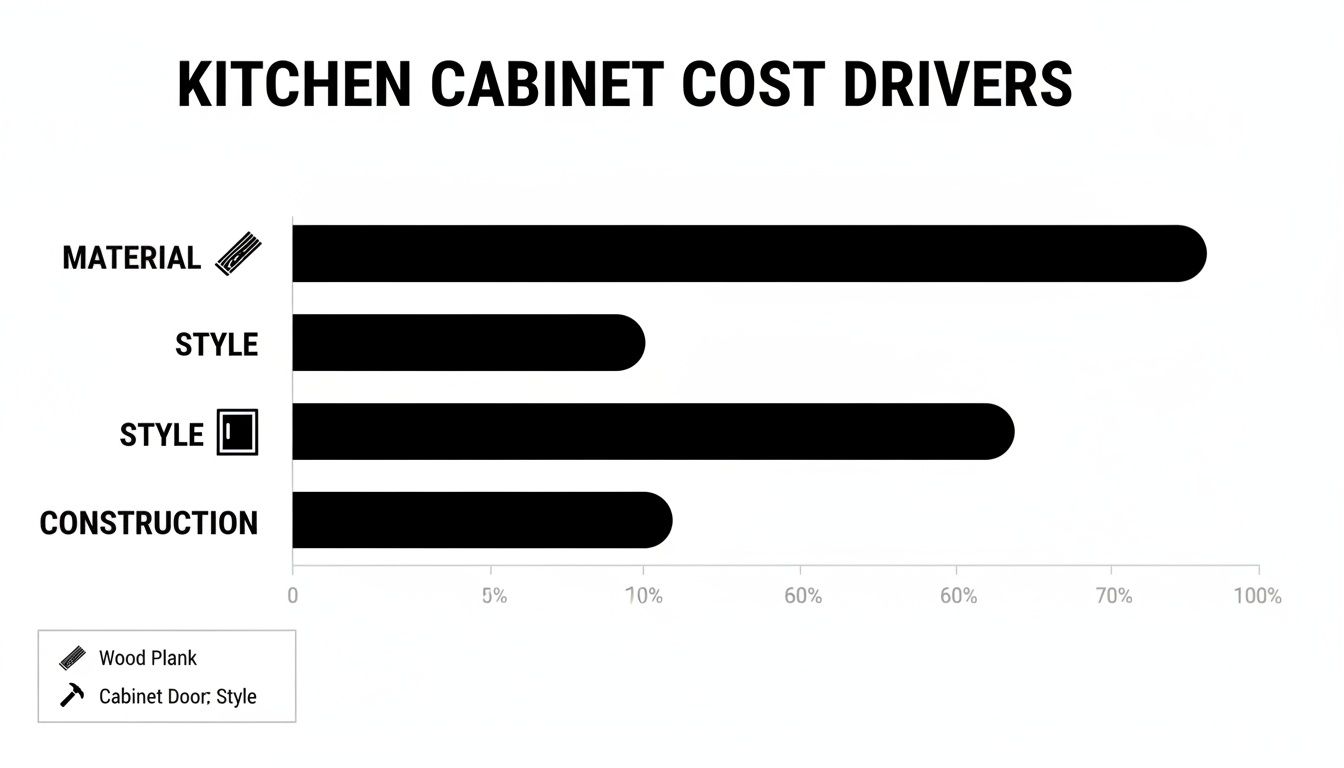
As you can see, the material you choose has the biggest impact on your total cost. That makes it the most critical piece of the budgeting puzzle.
Cabinet Material Cost and Feature Comparison
To help you navigate these choices, we've put together a simple table comparing the most common materials. It breaks down what you can expect to pay, how durable each option is, and what kind of project it’s best suited for.
| Material Type | Cost per Linear Foot (Estimate) | Durability | Best For |
|---|---|---|---|
| Thermofoil | $100 – $350 | Moderate; Seamless surface is easy to clean but can peel with high heat. | Budget-conscious renovations, rental properties, or kitchens needing a clean, uniform look. |
| Laminate | $150 – $400 | Good; Highly resistant to scratches, stains, and moisture. | Busy family kitchens, modern designs, and anyone needing a low-maintenance, durable surface. |
| Painted HDF | $250 – $700 | Excellent; Extremely stable, won't warp, and provides a flawless paint job. | Homeowners wanting a high-end painted look (like Shaker) without the risk of cracking at joints. |
| Solid Wood | $400 – $1,000+ | Very Good; Durable and repairable, but can expand/contract with humidity. | Classic and traditional kitchens where the natural beauty and unique grain of wood are desired. |
| High-Gloss/Matte | $500 – $1,200+ | Excellent; Advanced finishes on HDF offer superior durability and style. | Ultra-modern, minimalist, and luxury kitchens that require a flawless, high-impact finish. |
Ultimately, the right material balances your aesthetic goals with the practical demands of your household and budget.
Smart and Stylish Budget-Friendly Choices
If you're aiming for a fresh, modern look without breaking the bank, laminate and thermofoil are fantastic places to start. These materials have come a long way over the years, offering impressive durability and style for what they cost.
Laminate Cabinets: Think of laminate as a tough, protective shield for your cabinets. It’s made by fusing layers of paper with resin and bonding it to a particleboard core. Today’s laminates are surprisingly resilient—they fight off scratches, moisture, and stains, making them a smart pick for busy family kitchens.
Thermofoil Cabinets: This option involves vacuum-sealing a thin sheet of vinyl (the thermofoil) over an engineered wood core, typically MDF. You get a perfectly seamless and smooth surface that’s incredibly easy to wipe clean. Because it can be moulded, you’ll often see it used for Shaker-style or raised-panel doors in this price range.
The big win here is the value. You get a clean, consistent look that stands up to daily wear and tear, all while keeping the pricing for your kitchen cabinets firmly in check.
The Versatile Mid-Range: HDF and Painted Finishes
This is the sweet spot where many Toronto homeowners find their perfect cabinet solution. The mid-range is all about High-Density Fibreboard (HDF), especially when it's topped with a professional painted finish. It's a major step up in quality and feel from the entry-level options, but without the premium price tag.
HDF is an engineered wood product that we love for its incredible stability. Unlike solid wood that can swell, shrink, or even warp with Toronto’s humid summers and dry winters, HDF stays put. It’s completely inert.
This stability is exactly what makes HDF the perfect canvas for paint. Because the material doesn’t move, the paint is far less likely to get those hairline cracks at the joints over time. The result is a flawless, durable finish that looks brand new for years.
This is precisely why designers choose painted HDF when they want a clean, sophisticated look. It gives you that smooth, uniform surface that takes paint beautifully, whether you want a classic white Shaker kitchen or a splash of a bold, contemporary colour. You get the high-end aesthetic of custom cabinetry at a much more reasonable, mid-range cost.
Premium Real Woods and High-End Finishes
When your kitchen needs to be a true showpiece, the luxury tier is where you'll find what you're looking for. This is the realm of solid woods and sophisticated high-gloss or matte finishes that create an unforgettable space.
Real wood cabinets, like maple or oak, bring a natural warmth and texture that simply can’t be imitated. Every door has its own distinct grain pattern, giving your kitchen a unique character and depth. While they are more of an investment, the timeless appeal and sturdiness of solid wood are hard to argue with. If you're heading down this path, it's worth diving into a detailed guide on the best materials for kitchen cabinets to really understand the differences between wood types.
Alongside natural wood, this tier also features cutting-edge finishes on an HDF core:
High-Gloss Finishes: Created with multiple layers of lacquer and a whole lot of polishing, high-gloss cabinets have a stunning, mirror-like surface. This finish is perfect for contemporary designs, as it reflects light around the room and makes the space feel bigger and brighter.
Matte Finishes: For a softer, more understated elegance, super-matte finishes offer a velvety texture that’s great at resisting fingerprints and glare. It’s a sophisticated choice that adds a touch of quiet luxury and looks fantastic next to natural materials like stone or wood.
Choosing an option from this tier is really an investment in craftsmanship and high-impact design. These are the materials that define a luxury kitchen and become the centrepiece of your home.
Budgeting for Installation and Labour
The price you see on the cabinet sticker is a big piece of the puzzle, but it’s definitely not the whole picture. Think of it like this: you can buy the best, most beautiful flat-pack bookcase, but you still need someone with the skill and the right tools to put it together so it doesn't wobble. Professional installation is that critical, often underestimated, final step that can make or break the pricing of your kitchen cabinets.
This cost is about much more than just hanging some boxes on a wall. It's a detailed, precise process that ensures your investment not only looks incredible but also functions perfectly for years to come. Trying to cut corners with inexperienced labour can lead to a whole host of frustrating problems, like crooked doors, uneven countertops, and gaps where there shouldn't be—issues that completely undermine the quality of your brand-new kitchen.
When you budget properly for installation from the get-go, you're preparing for the full, true cost of the project and avoiding nasty surprises that can throw your entire renovation off track.
What Does Professional Installation Actually Cover?
A professional cabinet installer brings a level of expertise that goes far beyond a weekend DIY project. Their work is a combination of precision carpentry, on-the-fly problem-solving, and an artist's eye for detail. When you hire a real pro, you're paying for peace of mind and a seamless result.
Here’s a breakdown of what that typically includes:
- Demolition and Removal: They will carefully dismantle your old kitchen, taking out cabinets, countertops, and even the backsplash without wrecking your walls, floors, or the existing plumbing and electrical work.
- Site Preparation: This is where their expertise really shines. They make sure the walls are straight and perfectly level before a single cabinet goes up. This might mean patching some drywall or adding shims to create a flawless foundation.
- Precise Layout and Levelling: Using lasers and levels, they map everything out on the walls to guarantee every single cabinet is perfectly plumb and aligned. This is the single most important step to achieving that high-end, custom look.
- Secure Installation: Each cabinet box is securely anchored to the wall studs, and then fastened to its neighbours. This creates one solid, unified structure strong enough to hold the immense weight of stone countertops and all your dishes.
- Finishing Touches: The final, detailed work involves installing every door, drawer front, and piece of hardware, then meticulously adjusting them for perfect gaps and smooth, quiet operation. This stage also includes fitting custom pieces like filler strips, crown moulding, and light valances.
Estimating Labour Costs in the Greater Toronto Area
Here in the Greater Toronto Area, you can generally expect the cost for professional cabinet installation to fall somewhere between $80 to $200 per linear foot.
So, for a standard 10'x10' kitchen with roughly 20 linear feet of cabinets, you should budget for installation labour to be in the $1,600 to $4,000 range.
Of course, a few things can push that number up or down:
- Kitchen Complexity: A simple, straight-line galley kitchen is going to be cheaper to install than a more complex U-shaped layout with tricky corners.
- Custom Features: Adding special elements like tall pantries, intricate crown moulding, or custom appliance panels takes more time and skill, which adds to the cost.
- Your Home's Condition: If your house is older and the walls aren't perfectly straight or the floor isn't level, the installer has to spend extra time on prep work, and that will be reflected in the final bill.
As a solid rule of thumb, it's smart to set aside 15-25% of your total cabinet cost just for the installation. This gives you a realistic cushion and helps you avoid sticker shock when the final invoice comes in.
Coordinating with Other Tradespeople
Cabinet installation doesn't happen in a bubble. It's a central piece of a much larger project that almost always involves a plumber to handle your sink and dishwasher, and an electrician for things like under-cabinet lighting or moving outlets. Finding reliable local contractors for kitchen remodels is key to making sure all these moving parts are coordinated smoothly.
The high demand for skilled tradespeople in Toronto isn't unique. It's a trend we see in other hot housing markets, too. For instance, California's cabinet manufacturing sector is a massive $1.7 billion industry, fuelled by a boom in home renovations.
This kind of environment is where factory-direct suppliers like MapleKing can really shine. By using economies of scale and cutting out the retail middlemen, we can offer beautiful, customized cabinetry at a much more accessible price point. You can learn more about how this all works by checking out our guide to kitchen cabinets with installation.
How Factory-Direct Pricing Can Save You Thousands
When you start shopping for kitchen cabinets, you'll quickly discover that the prices are all over the map, even for styles that look almost identical. What gives? A huge piece of that puzzle is the journey those cabinets take from the factory floor to your front door. Getting a handle on this supply chain is the secret to finding major savings without compromising on quality.
The old-school way of buying cabinets involves a long line of middlemen. The manufacturer makes the cabinets and sells them to a regional distributor. That distributor sells them to a wholesaler, who then sells them to a local retail showroom. Finally, that showroom sells them to you.
Every single one of those stops adds a hefty markup. They all have their own costs to cover—warehousing, shipping, sales commissions, and of course, profit. By the time those cabinets are ready for installation in your kitchen, the price has been inflated at each stage. It's a bit like buying a tomato that's been passed between four different vendors before it even hits the grocery store; you’re the one paying for everyone's cut along the way.
Cutting Out the Middleman
Factory-direct pricing flips that entire model on its head. It gets rid of all those costly, unnecessary steps. Instead of a long, winding road, there’s a straight line from the people who build your cabinets directly to you.
It's just a much more efficient way of doing business. When you remove distributors, wholesalers, and pricey retail showrooms from the equation, all of their markups simply vanish.
It's a simple idea with a massive impact on your budget. When you strip away multiple layers of cost, the savings get passed directly to you. This often means you can get your hands on premium, custom-quality cabinets for what you'd normally pay for a standard, off-the-shelf option at a big-box store.
Making Luxury More Accessible
This direct-to-you model is what suddenly makes high-end features and materials feel attainable. Maybe you've been eyeing a beautiful painted HDF finish or a sleek, high-gloss style that seemed way out of reach through traditional retailers. When you aren't paying for all those markups, your budget can stretch a lot further than you thought.
This is how homeowners across Toronto can get a truly custom-fit look without the sky-high custom price tag. In real-world terms, here’s what that looks like:
- Better Materials: Your budget might now have room for more durable and stylish options like solid wood or top-grade HDF.
- Superior Finishes: Those sophisticated painted, matte, or high-gloss finishes are no longer just a dream.
- True Customization: You can actually invest in tailored sizes that fit your kitchen's unique layout perfectly, instead of trying to make do with standard boxes and awkward filler pieces.
At the end of the day, going factory-direct is all about getting more bang for your buck. You can get a deeper dive into the benefits and see exactly how it works in our guide on factory-direct kitchen cabinets. By choosing this smarter path, you're not just buying cabinets—you're making a strategic investment in the heart of your home.
A Practical Budgeting Checklist for Your Project

Feeling a bit overwhelmed by all the numbers? Let's cut through the noise with a straightforward checklist. Think of this as your financial roadmap for pricing kitchen cabinets, designed to make sure there are no nasty surprises down the road.
Kitchen remodels are one of the most popular home projects across North America, and here in the Toronto area, there's a huge demand for custom and semi-custom cabinets. It makes sense—homeowners in places like Markham often need smart, space-efficient designs for modern condos and townhouses. These options deliver a tailored fit without the sky-high price of fully bespoke work. You can dig deeper into the rise of custom kitchen cabinet demand to see how these trends are shaping our local market.
Use this checklist to get accurate quotes and keep a firm grip on your spending from day one.
Core Cabinetry Costs
- Cabinets: This is the main event—the total for all your upper and lower cabinet boxes and doors.
- Hardware: Don't forget the finishing touches! This includes all the knobs, pulls, and handles. The cost here can range from budget-friendly to high-end designer.
- Specialty Storage: Think about those clever solutions like pull-out pantries, corner lazy Susans, or custom drawer organizers that make life easier.
Installation and Labour Expenses
- Demolition & Removal: This covers the cost of safely tearing out your old kitchen and getting rid of the debris.
- Cabinet Installation: This is the labour for a professional to fit, level, and secure your new cabinets perfectly.
- Countertop Installation: Often billed separately from the countertop material itself, this is the fee for fitting, cutting, and sealing it.
- Plumbing & Electrical: You'll need pros to disconnect and reconnect your sink and dishwasher, plus handle any new under-cabinet lighting or outlet changes.
Here's a pro tip: Always, always have a contingency fund. Setting aside 10-15% of your total project cost is a crucial safety net for those "what if" moments, like finding hidden mould or needing to unexpectedly level a floor.
Additional Project Materials
- Countertops: The cost of the actual material, whether it's quartz, granite, or laminate.
- Backsplash: The price for the tiles and all the materials needed to install them.
- Sink & Faucet: The plumbing fixtures for your beautiful new setup.
- Flooring & Paint: If your renovation is more than just cabinets, you'll need to budget for these as well.
Your Top Questions About Cabinet Costs, Answered
As you start to zero in on the details of your kitchen cabinet project, questions are bound to pop up. Getting clear, honest answers is the best way to move forward confidently and make sure the final price tag for your new cabinets doesn't come with any surprises. Let's dig into some of the most common questions we hear from homeowners.
How Much Should I Realistically Budget for Kitchen Cabinets in Toronto?
For a standard, medium-sized kitchen in the Toronto area, a good starting point for quality, mid-range cabinets is anywhere from $12,000 to $20,000. This budget gets you into durable materials like painted HDF and strikes a fantastic balance between style, longevity, and overall value.
Of course, what’s "realistic" really hinges on the scale of your vision. If you're updating a small condo kitchen or doing a more budget-conscious refresh, you might be looking at something closer to $8,000. On the other hand, a sprawling, high-end kitchen with solid wood, custom pull-outs, and all the bells and whistles could easily push past $30,000.
A handy rule of thumb is to set aside 40-50% of your total kitchen renovation budget for the cabinets. So, if your entire reno budget is $50,000, earmarking about $20,000 to $25,000 for your cabinetry and its installation is a pretty solid plan.
What's the Most Affordable Cabinet Material That's Still Durable?
The hands-down winner for finding that sweet spot between price and durability is laminate or a high-quality thermofoil on an HDF core. Don't be fooled by old reputations—these materials have come a long way and are incredibly resilient to the wear and tear of a busy kitchen.
- Laminates are fantastic at resisting scratches, stains, and moisture, which makes them a smart choice for families. They offer a clean, modern look that's also a breeze to maintain.
- Thermofoil gives you a seamless, easy-to-clean surface that can be shaped into all sorts of door styles, including the ever-popular Shaker look.
Both of these options give you a sharp aesthetic and reliable performance without blowing your budget. They're the go-to choices for homeowners who want to make every dollar count.
Can I Actually Save Money by Installing Cabinets Myself?
Looking at the numbers, a DIY installation seems like a no-brainer. You could potentially shave $2,000 to $5,000 in labour costs right off the top. But before you grab your tool belt, it’s important to understand the risks, which can quickly turn those savings into costly mistakes.
Hanging cabinets is a job of precision. It demands the right tools and a level of experience most homeowners just don't have. One small error—a cabinet that’s a millimetre off-level—can throw everything else off. Suddenly you’re dealing with uneven countertops, crooked doors, and unsightly gaps. Fixing those problems often ends up costing more than hiring a pro in the first place.
Unless you have serious carpentry skills, the peace of mind that comes with a professional installation is almost always worth the money. An expert ensures your cabinets are secure, level, and will look and function beautifully for years to come.
How Long Does It Take for Custom Cabinets to Be Made and Installed?
Planning your renovation timeline is key, and the wait for custom or semi-custom cabinets is a big piece of that puzzle.
Typically, once you've signed off on the final design and placed your order, you can expect the manufacturing process to take about 6 to 12 weeks. This lead time covers everything from sourcing the materials to precision cutting, assembly, and applying the finish.
After the cabinets arrive at your home, the installation itself usually takes another 3 to 7 days, though this can vary depending on the size and complexity of your kitchen. All in all, it’s wise to plan for a total timeline of roughly 2 to 3 months from the day you order to the day your cabinets are fully installed.
At MapleKing Kitchen Cabinets, we streamline this process with our factory-direct model, offering beautiful, custom-fit solutions that respect your budget and timeline. Explore our collection and get a free quote today.