
Your kitchen probably works, but only if you've learned its bad habits. One drawer sticks. The corner cabinet swallows pans. The microwave interrupts the sightline. The whole room feels older than the rest of the house, even after fresh paint.
That's usually the point where homeowners start searching for modern kitchen cabinets design and get buried in inspiration photos that don't answer the essential questions. What material holds up better in a Toronto condo near the lake? What do you do with a crooked wall in a century home? Is a sleek, modern kitchen still practical if you cook every day and need serious storage?
A good modern kitchen isn't cold or showroom-stiff. It's organised, easy to clean, efficient to move through, and calm to look at. In Toronto and Markham, it also has to respond to local housing realities. Some kitchens are compact and need every inch to work harder. Others sit inside older homes where almost nothing is square.
Your Guide to Modern Kitchen Cabinets in 2026
Most first-time renovators start with finishes and colours. That's understandable, but it's backwards. Modern design works best when layout, storage, and material decisions come first. The look then follows naturally.
In practical terms, modern kitchen cabinets design means reducing visual noise while improving how the kitchen performs. Doors sit flatter. Storage gets taller and deeper where it should, or shallower where space is tight. Appliance placement becomes deliberate. Small details, such as filler panels, end gables, and integrated handles, matter more than people expect because they determine whether the final result feels clean or patched together.
What usually needs solving first
A Toronto kitchen project often begins with one of these problems:
- A condo kitchen feels cramped: Traffic jams happen around the island or galley run, and standard cabinet depth may be too aggressive for the room.
- An older house has awkward geometry: Walls drift out of square, floors slope, and ceiling lines force compromises.
- Storage is poorly matched to real life: Deep cupboards hide items, corner units waste volume, and upper cabinets stop short of the ceiling.
- The finish looks dated even when the kitchen is functional: Heavy door profiles, mixed trim details, and exposed visual clutter age the room fast.
Practical rule: If a kitchen feels dated, it's rarely just the door style. It's usually a mix of poor storage planning, broken visual lines, and finishes that don't suit the room.
What modern should feel like
A successful modern kitchen feels easier the first week you use it. Pots are where your hand expects them to be. Recycling doesn't block a walkway. Tall pantry storage replaces scattered overflow. Cleaning is simpler because there are fewer grooves, lips, and dust-catching edges.
That's the standard to judge by. Not whether the room looks trendy online, but whether it solves the daily friction you've been tolerating.
Defining the Modern Kitchen Aesthetic
Modern kitchen cabinets design gets reduced to “clean lines” too often. That phrase is correct, but incomplete. Modern kitchens are less about decoration and more about control. Control of sightlines, storage, movement, and proportion.

Clean lines mean fewer interruptions
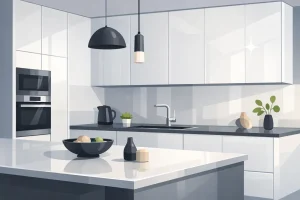
A modern cabinet run reads as one continuous composition. Appliance panels align. Crown details stay restrained or disappear altogether. Door styles are flat or minimally profiled. Hardware is either subtle, integrated, or intentionally sculptural.
That visual calm matters even more in smaller homes. When the eye isn't interrupted by ornate trim, busy rail profiles, or uneven cabinet heights, the room feels larger and more settled. If you're trying to make your kitchen look more modern, the fastest wins usually come from simplifying lines before changing every finish in the room.
Function comes before ornament
Modern design follows a simple principle. If a detail doesn't improve function or reinforce the composition, it usually shouldn't be there. That's why drawer-heavy base cabinets outperform stacks of deep cupboards in many kitchens. A full-extension drawer shows you everything at once. A door with one dark shelf behind it usually hides half your storage.
In Canada, the housing stock explains why this approach has become so relevant. According to Statistics Canada's 2021 Census, Canada had 5.9 million private dwellings and about 31.4% were built before 1971, which means a large share of kitchens sit inside older homes that need renovation rather than a light cosmetic update (housing stock and renovation context). Older layouts often come with tighter clearances, less efficient storage, and built-ins that no longer suit how families use kitchens.
Why modern works in Toronto homes
For Toronto homeowners, modern isn't a style borrowed from luxury showrooms. It's a practical response to real conditions. Full-height pantry towers reclaim vertical space. Drawer-based lowers improve access. Custom corner storage solves dead zones that standard cabinet plans waste.
A useful starting point is to study examples where the style is tied to layout logic, not just surface finishes. These modern kitchen design ideas show how minimal cabinetry can still feel warm, lived-in, and highly functional.
Less is more only works when the “less” has been planned properly.
Choosing Your Modern Cabinet Materials and Finishes
Material choice decides how your kitchen will age. Not just visually, but physically. A finish can look perfect in a photo and still be the wrong call for a basement kitchen, a lakeshore condo, or a family home where cabinets take daily impact.
Ontario adds another layer to the decision. Modern kitchen content often focuses on style, but rarely on how materials handle freeze-thaw cycles, humidity fluctuations in basement kitchens, and moisture exposure in condo units near the Lakeshore (Ontario climate durability gap). That's where material selection stops being aesthetic and starts being practical.

How the main options compare
| Material or finish | What it looks like | Where it works well | Main trade-off |
|---|---|---|---|
| Real wood painted doors | Warm, natural, slightly more character in the surface | Homes where texture matters and the design needs softness | Wood movement and finish maintenance need more care |
| HDF painted | Smooth, consistent colour and crisp profiles | Most modern kitchens, especially painted shaker or slab looks | Less natural variation if you want visible grain |
| High-gloss HDF | Reflective, sharp, contemporary | Smaller kitchens needing light bounce and a sleek look | Smudges show more readily |
| Matte HDF | Soft, low-sheen, understated | Busy family kitchens and minimalist interiors | Dark matte colours can still show residue if neglected |
| Laminate | Uniform, durable, available in many looks | High-traffic kitchens, rentals, investment properties | Edge detailing is more limited than some painted options |
| HDF thermofoil | Seamless wrapped surface, easy to wipe | Clean-lined designs where low-maintenance matters | Heat exposure needs careful planning around appliances |
What works in different Toronto conditions
In a condo, especially one where cooking moisture lingers and ventilation isn't perfect, laminate and well-specified HDF finishes are often sensible choices. They give a modern look without asking for delicate treatment. If the unit sits near the lakeshore, I'd pay close attention to any area where moisture can repeatedly settle, such as sink runs, end panels near exterior glazing, and low cabinetry close to poorly insulated walls.
In a basement kitchen or lower-level suite, stable surfaces matter even more. Basements can feel dry one month and damp the next. That doesn't mean you need to avoid painted cabinets completely, but it does mean the substrate, edge treatment, and installation quality should be taken seriously.
Material check: Don't choose a finish by colour chip alone. Ask how it handles steam, cleaning, fingerprints, edge wear, and heat near ovens or kettles.
Matching finish to lifestyle
Some choices are technical. Others are behavioural.
- You cook daily and want low fuss: Matte HDF or laminate is often easier to live with than a highly reflective surface.
- You want warmth in a modern room: Real wood painted doors can soften a minimalist kitchen without making it look traditional.
- You're renovating for resale: HDF painted finishes usually land well because they balance consistency, style, and broad buyer appeal.
- You want a smooth slab look: Thermofoil can suit that direction if heat-sensitive zones are designed carefully.
For a closer material breakdown, this guide to the best material for kitchen cabinets is useful as a decision filter.
Where people make expensive mistakes
The biggest mistake isn't picking a “bad” material. It's picking the right material for the wrong location. A glossy finish on every surface can look impressive and feel tiring to maintain. Real wood in a room with recurring moisture issues may ask for more tolerance than the homeowner has. Thermofoil too close to heat can create avoidable service issues.
Another mistake is mixing too many finishes in one small kitchen. Modern design benefits from restraint. If you want contrast, use it deliberately. One wood tone with one painted finish is usually enough.
Smart Layouts and Storage for Toronto Homes
A modern kitchen succeeds or fails in plan view. You can choose beautiful fronts and still end up with a room that feels cramped, awkward, or hard to use.

Condos and townhouses need depth discipline
In dense urban markets such as Toronto and Markham, modern kitchen cabinet planning increasingly depends on depth flexibility. Standard base cabinets are 24 inches deep, but contemporary practice can reduce depth in 3-inch intervals down to 12 inches for islands and confined spaces. This matters in 900 to 1,200 sq ft units, where shallower cabinetry can preserve ergonomic function and traffic flow (cabinet depth guide).
That doesn't mean every cabinet should be reduced. It means the kitchen should be selective. I've seen narrow condo layouts improve dramatically when an island is trimmed back, or when one run uses shallower storage for pantry goods instead of forcing full-depth cabinets where they don't belong.
Storage that earns its footprint
The most useful modern storage features in Toronto homes are usually the least flashy:
- Full-height pantry towers for dry goods, small appliances, and vertical organisation.
- Drawer-based lower cabinets so cookware and dishes are visible from above.
- Corner solutions designed for actual use, not just maximum theoretical volume.
- Appliance garages or concealed zones when counter clutter is the problem, not cabinet count.
A small kitchen can still feel generous when every cabinet has a specific job. The opposite is also true. A large kitchen can feel inefficient when the storage is vague and oversized.
Older homes need adaptation, not denial
Toronto's older homes rarely reward rigid planning. Some have non-square corners, sloped ceilings, chimney chases, bulkheads, and patched walls that reveal themselves only after demolition. Modern design still works there, but it needs tailoring.
Search results often mention awkward angles only in passing, even though Toronto and Markham have many century homes, converted Victorians, and mid-century bungalows that demand region-specific solutions. That gap is real, and it affects layout decisions from the first measurement onward.
Useful responses include custom angled base units, carefully sized filler panels, scribed end panels, and crown or light valance strategies that absorb ceiling irregularities without drawing attention to them.
Here's a helpful walkthrough on cabinet planning and visual balance in a compact kitchen:
A modern kitchen in an older house shouldn't try to pretend the structure is perfect. It should absorb imperfections so the finished room looks intentional.
Curating Your Colour Palette and Hardware
This is the stage where the kitchen starts to feel personal. Up to now, most decisions have been about function and fit. Colour and hardware shape the mood.

Colour combinations that stay current
A good modern palette doesn't need to be stark. Some of the strongest Toronto kitchens use warmth very deliberately. Light oak tones with soft painted cabinets create a modern room that still feels domestic. Deep base cabinets paired with lighter uppers can anchor the room without making it feel heavy. A painted island can also carry personality while the perimeter stays calm.
In older homes, colour can help solve architectural inconsistency. When walls and ceiling lines aren't perfectly regular, a quieter cabinet palette often works better than high contrast at every turn. That matters because many Toronto and Markham homes need design strategies adapted to century-home and bungalow realities, not generic showroom assumptions about standard corners and straight walls (awkward angle design gap).
Three different moods
A few examples show how much the cabinet palette changes the feel of the room.
- Soft greige with integrated pulls: This gives a calm, architectural look. It suits condos and transitional homes where you want modern without hardness.
- Walnut-look lower cabinets with warm white uppers: This feels grounded and inviting. It works well in open-plan main floors where the kitchen needs to relate to living and dining furniture.
- Muted green or charcoal island with a neutral perimeter: This adds character without locking the whole kitchen into a bold statement.
Hardware changes the language
Hardware is where many kitchens drift off course. The cabinet door might be modern, but the pull choice sends it backward.
A simple way to consider the options:
| Hardware style | Effect | Best use |
|---|---|---|
| Push-to-open | Very minimal, uninterrupted fronts | Households comfortable with more surface touching |
| Integrated J-pull | Clean and practical | Slab-style modern kitchens needing daily usability |
| Slim bar pull | Still modern, slightly more defined | Homes mixing modern cabinetry with warmer finishes |
Finishes matter too. Matte black sharpens contrast. Brushed brass adds warmth and a little softness. Chrome feels cleaner and cooler. None is universally right. The room decides.
If the kitchen already has strong stone movement, bold flooring, or dramatic lighting, quieter hardware usually creates better balance.
What not to combine
Some combinations fight each other. High-gloss doors with ornate pulls usually feel unresolved. Very rustic wood tones beside ultra-crisp handleless lacquer can look accidental unless the composition is tightly controlled. In a kitchen with irregular walls, too many strong finish changes also draw attention to those imperfections.
The best modern kitchens aren't the ones with the most features. They're the ones where every visible choice belongs to the same idea.
Budgeting for Quality Modern Cabinets
Kitchen budgeting gets easier when you stop thinking in terms of cheapest versus most expensive and start thinking in terms of value over time. Modern cabinets are a visible part of the room, but they're also a hard-working system. You touch them every day. You clean them constantly. You rely on them to stay aligned, durable, and easy to use.
Ontario homeowners already treat renovation that way. The Canada Mortgage and Housing Corporation reported that households in Ontario spent roughly CAD 15.7 billion on renovations in 2020, the largest provincial renovation outlay in Canada (Ontario renovation spending). That kind of spending helps explain why durable, contemporary cabinet upgrades remain central in Toronto and Markham projects.
Where it makes sense to spend more
Some parts of a kitchen return value every single day.
- Door and finish quality: This is what you see first and wear out first.
- Drawer hardware and hinges: Good motion and alignment are not luxury details. They determine whether the kitchen still feels solid later.
- Problem-solving cabinetry: Customisation is worth paying for when it fixes a bad corner, awkward soffit, or dead storage zone.
Where you can control cost without lowering the result
Savings usually come from simplification, not from cutting the wrong components.
- Standardise sizes where possible: Not every cabinet needs to be custom width if the room can be planned intelligently.
- Use one primary finish: Reducing finish changes can lower complexity and make the kitchen look more cohesive.
- Keep specialty features selective: Put custom storage where it solves a real problem, not in every cabinet.
A factory-direct route can also change the budget equation because it reduces retail layering. One example is kitchen cabinet costs, which helps homeowners compare where money goes and what choices affect the total most.
Think beyond the quote
The cheapest cabinet package can become expensive if the finish is fussy, the storage is poorly planned, or the installation needs repeated correction. By contrast, a well-scoped plan with durable materials and disciplined detailing usually feels better for longer.
That's why budgeting for modern kitchen cabinets design should include three questions. Will it hold up in your home's conditions? Will it function the way you live? Will it still look intentional once the novelty wears off?
Bringing Your Vision to Life with MapleKing
Most kitchen projects become manageable once the decisions happen in the right order. Start with layout. Then choose materials that suit your home, not just the mood board. Refine the palette and hardware once the architecture is doing its job. Budget around durability and problem-solving, not cosmetic extras.
For homeowners who haven't renovated before, seeing the kitchen before it's built helps. Detailed visual planning, including renderings and realistic views, can prevent expensive misunderstandings about proportions, finish balance, and appliance integration. If you're curious about how visualisation supports furniture decisions more broadly, this piece on creating stunning product imagery for furniture brands gives useful context.
A practical next step is to bring in your rough measurements, inspiration images, appliance list, and a short note about what frustrates you in the current kitchen. That last part matters. The design should solve those frustrations first.
MapleKing Kitchen Cabinets is one local option for Toronto and Markham projects where homeowners want customised cabinetry, factory-direct pricing, and material choices such as painted wood, HDF, laminate, matte finishes, and thermofoil. The showroom is at 270 Esna Park Dr., Markham, which makes it easier to compare finishes in person and discuss details such as cabinet depth, hardware feel, and storage accessories with real samples in front of you.
If you're still narrowing the direction, browse completed kitchens, note the cabinet combinations you keep returning to, and pay attention to what those projects are doing structurally. The strongest modern kitchens aren't built from trend pieces. They're built from clear decisions.
If you're planning a kitchen renovation in Toronto or Markham, MapleKing Kitchen Cabinets is a practical place to start. You can explore project galleries, compare cabinet materials, request a free quotation, or visit the Markham showroom to talk through layout, finishes, and storage solutions for your space.