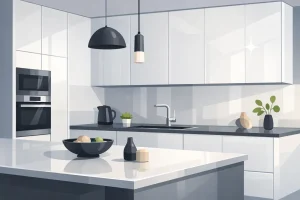

You’re probably standing in your kitchen right now, looking at doors that have seen better days, scrolling through samples, and wondering why every cabinet material seems to come with a different name. Melamine. Laminate. MDF. HDF. Painted finish. Thermofoil. Solid wood. It starts to feel less like a renovation and more like an exam you didn’t study for.
That confusion is normal, especially in Toronto and Markham where homeowners often want three things at once. A kitchen that looks current, a material that can handle real daily use, and a budget that still leaves room for counters, flooring, and appliances. Melamine in cabinets sits right in the middle of that conversation because it’s common, practical, and often misunderstood.
Some people hear “melamine” and assume it’s cheap in a bad way. Others hear it’s durable and assume all melamine products are basically the same. Neither is quite right. The truth is more useful than either extreme. Good melamine can be a smart cabinet material. Poorly made melamine, or melamine used in the wrong application, can become a headache.
Your Guide to Choosing Kitchen Cabinet Materials
A lot of homeowners I speak with start in the same place. They’ve decided the kitchen has to change, but the material choices blur together almost immediately. One sample looks like wood but isn’t wood. Another is described as “laminate” but someone else says melamine is also laminate. Then a contractor mentions HDF, and suddenly the simple question, “What should my cabinets be made of?” becomes much harder than expected.
That’s especially true in older Toronto homes and newer Markham subdivisions alike. In one house, you may be dealing with a compact kitchen that needs every dollar stretched carefully. In another, you may be planning a long-term renovation and trying to avoid shortcuts that you’ll regret later.
Practical rule: Don’t choose cabinet material by name alone. Choose it by how the cabinet is built, how the edges are finished, and how the material will behave in your kitchen.
Melamine deserves a calm, plain-language explanation because it’s one of the most common cabinet materials on the market. It’s popular for a reason. It can offer a clean look, easy maintenance, and a lower entry cost than many wood-based options. But it also has weak points, especially if moisture reaches the core or if the panels take repeated impact at exposed corners.
If you understand what melamine is, where it performs well, and where you should be cautious, the decision gets much easier. That’s the goal here. Clear answers, practical context, and no showroom jargon.
What Exactly Are Melamine Cabinets
The easiest way to understand melamine is to stop thinking of it as a solid material, and think of it as a surface bonded to a core.
A simple analogy helps. A melamine panel is a bit like a laminated ID card. The outside layer is tough, smooth, and designed to protect what’s underneath. But the strength of the whole piece still depends on the material inside. In cabinets, that inside core is usually particleboard, MDF, or HDF.

The surface and the core
The word melamine usually refers to a resin-impregnated decorative paper that is heat-fused onto a board. In everyday kitchen terms, that means you get a hard outer skin in a chosen colour, pattern, or wood-look finish, attached to a man-made panel.
That outer skin is what you touch and clean. It’s what gives the cabinet its finished appearance. The core underneath gives the panel its thickness and structure.
This is why two melamine cabinets can look similar from the front but perform differently over time. A melamine panel on basic particleboard won’t behave the same way as a melamine panel on a denser HDF core with better hardware and properly sealed edges.
What low-pressure laminate means
You may also hear melamine described as LPL, or low-pressure laminate. That sounds technical, but the idea is straightforward. It means the decorative surface is fused to the board using a lower-pressure process than high-pressure laminate products.
That manufacturing method is one reason melamine is widely used in cabinet boxes, shelving, and budget-conscious door styles. It gives a finished surface efficiently, with a broad range of colours and patterns.
Think of melamine as a factory-finished skin on an engineered panel. It’s not fake wood trying to fool you. It’s a different category of material built for a different balance of cost, look, and performance.
Why it became so common
Melamine didn’t appear out of nowhere in modern kitchen design. Its roots go back to wartime manufacturing changes. Melamine-faced particleboard saw its foundational development during World War II due to wood shortages, with first commercial production in Germany around 1941 to 1945, leading to post-war North American adoption for durable, affordable cabinetry according to this history of melamine-faced boards.
That history explains why melamine shows up so often in practical, mass-produced kitchens. It was built into cabinet making because it solved a real problem. It offered a durable finished surface at a more accessible cost than solid wood construction.
The Real Pros and Cons of Melamine in Your Kitchen
Melamine has stayed popular because it solves several everyday kitchen problems well. It also has a few weaknesses that are easy to overlook when you’re only looking at a sample door in a showroom.

Where melamine performs well
For normal household use, melamine’s biggest advantage is that the finished surface is practical. It’s smooth, easy to wipe, and available in many looks, from simple white to contemporary textured woodgrain.
It also stands up well to common kitchen abuse. The melamine surface can withstand temperatures up to 180°C without blistering and rates 4 to 6 on the Mohs hardness scale, which supports its scratch resistance in busy kitchens, as explained in this overview of melamine plywood durability. That same source notes that sealed edges are especially important in humid GTA kitchens because they help protect the substrate from steam and moisture.
In practical terms, that means melamine is well suited to:
- Busy weekday kitchens where cabinet doors get touched constantly and need easy cleaning
- Condos and rental upgrades where you want a clean, current look without moving into premium wood pricing
- Cabinet interiors and shelving because the slick surface wipes down easily after spills or pantry messes
Where homeowners get caught out
Melamine’s problems usually don’t start on the flat surfaces. They start at the vulnerable points. Corners, edges, sink-adjacent panels, hinge areas, and spots where the surface gets hit hard.
If a cabinet edge chips and the core becomes exposed, moisture can get in. Once that happens, the panel can swell or weaken. That doesn’t mean every melamine kitchen fails. It means workmanship matters. Edge banding, sink detailing, and careful installation matter more than many homeowners realise.
Here’s the short version of the trade-off:
- The surface is tough
- The edges need protection
- The core quality affects long-term performance
- Repairs are harder to hide than on painted surfaces
A melamine cabinet usually looks best for the longest time when people prevent damage, rather than trying to fix major damage later.
The honest middle ground
If you want a cabinet material that looks organised, stays easy to maintain, and keeps renovation costs under control, melamine can be a very sensible choice. If you want prominently profiled doors, undetectable repairs, or the natural grain and warmth of real wood, it may not be the best fit.
A good way to think about it is this. Melamine is excellent at being a disciplined, hardworking material. It’s less forgiving when neglected or poorly built.
Health Environmental and Air Quality Concerns
A lot of cabinet discussions focus on scratches, stains, and price. Far fewer talk about what the material may release into the air inside your home. For many Toronto and Markham homeowners, that’s becoming just as important as appearance.
The key issue is formaldehyde and VOC emissions from lower-grade engineered boards and resins. Consequently, the phrase “melamine cabinets” can be misleading, because not all melamine products are made to the same standard. The finish may look similar on the outside while the board quality underneath is very different.
Why this matters in GTA homes
Indoor air quality concerns can feel abstract until you’re living in the renovation. New cabinets are installed. The kitchen is closed up during winter. Cooking adds humidity. The house feels stuffy. That’s when material quality stops being a technical detail and starts affecting comfort.
A 2025 Toronto Public Health report noted that 28% of kitchen renovation complaints involve off-gassing. Budget melamine boards can exceed the 0.05 ppm formaldehyde limit set by CARB Phase 2 and Ontario regulations, while certified HDF and laminate alternatives can test under 0.03 ppm according to this discussion of melamine cabinet pros and cons.
That doesn’t mean melamine itself is automatically unsafe. It means homeowners shouldn’t assume all boards sold under that label are equal.
What to ask before you buy
If air quality matters to your household, ask direct questions. Don’t settle for vague reassurances.
- Ask about compliance with CARB Phase 2 or equivalent low-emission standards
- Ask what the core material is, especially whether it’s budget particleboard or a better low-emission HDF option
- Ask for clarity on the finish and substrate, not just the door style
- Ask how the installer manages ventilation after installation
If you’re also trying to improve the overall air inside the home after a renovation, it can help to look beyond the cabinetry alone. These Can Do Duct Cleaning air quality solutions give a useful homeowner-level overview of steps that support cleaner indoor air after construction dust, new materials, and seasonal HVAC use.
Cleaner cabinet materials and cleaner air systems work together. One doesn’t fully replace the other.
The important takeaway is simple. A responsible cabinet choice isn’t only about how the finish looks under the lights. It’s also about what the material adds to your home environment after the installers leave.
Melamine Compared to Other Popular Cabinet Materials
Most homeowners don’t choose melamine in isolation. They compare it against other common options and try to decide what trade-off feels reasonable. That’s the right way to do it.
A cabinet material only makes sense when you judge it against your priorities. If your main concern is budget, one answer makes sense. If you care more about impact resistance, long-term refinishing options, or a particular visual style, another answer may fit better.
Cabinet Material Comparison
| Material | Durability | Cost | Aesthetic | Lifespan |
|---|---|---|---|---|
| Melamine (LPL) | Good surface resistance, but edges can chip and lower-grade cores hold screws less securely | Lower cost. Standard melamine is 30 to 50% less expensive than plywood equivalents per this melamine cabinetry analysis | Wide range of solid colours and wood-look finishes | About 7 to 12 years on particleboard, or 15 to 20 years with HDF core and quality hardware from the same source |
| Laminate (HPL) | Generally tougher than melamine for impact-heavy use | Mid-range | Broad design flexibility, often crisp and modern | Typically strong for active households |
| Thermofoil | Easy-clean seamless surface, but can be vulnerable near heat sources | Often moderate | Smooth painted-style appearance | Depends heavily on heat exposure and door quality |
| Painted HDF | Good for stable painted finishes, though surface marks may show sooner than textured products | Mid to higher | Clean, tailored, high-end painted look | Strong option for long-term style-focused renovations |
| Solid Wood | Repairable and classic, but reacts more to environment | Higher | Natural grain and warmth | Long-lasting when maintained properly |
The biggest practical differences
Melamine’s main appeal is value. It gives you a finished, consistent look without pushing the project into premium wood pricing. But you do give up some impact resistance and some forgiveness around repairs.
By contrast, high-pressure laminate is often the better choice when a kitchen will take more abuse. Painted HDF fits homeowners who want a smoother, more custom-style painted appearance. Solid wood suits buyers who highly value authentic grain and long-term refinishing potential.
One detail many homeowners miss is the role of the core. The source above notes that particleboard-based melamine has screw-holding strength around 200 to 400 N, and that better cores plus quality hardware can substantially improve service life. In real-world terms, that affects hinges, drawer adjustments, and how solid the cabinetry feels after years of use.
A practical way to choose
If you’re weighing materials and want a broader overview, this guide to the best material for kitchen cabinets is a helpful next comparison.
Choose melamine when you want clean design, controlled cost, and sensible performance. Step up to HPL, painted HDF, or wood when your kitchen habits or style priorities justify the extra spend.
How to Maintain and Repair Melamine Cabinets
Melamine doesn’t ask for complicated care, but it does reward consistent habits. A few small maintenance choices make a big difference, especially around sink cabinets, dishwashers, and lower doors that get bumped by shoes, bags, and pet bowls.

Daily care that actually helps
The best maintenance plan is simple. Wipe spills early, especially near seams. Use a soft microfibre cloth, mild soap, and warm water. Then dry the area instead of letting moisture sit along an edge.
A few habits matter more than people expect:
- Clean gently with non-abrasive cloths and mild cleaners
- Dry around sink bases and dishwasher panels after heavy cooking or cleanup
- Check edge banding if you notice lifting, because small edge issues can become larger moisture problems
- Tighten hardware early when a hinge starts to loosen instead of waiting for the screw hole to wear further
Minor wear is manageable. Moisture intrusion is the issue you want to prevent.
What not to do
Avoid scouring pads, powdered abrasives, or harsh solvents. They can dull the finish or damage the surface layer. Also avoid flooding cabinet seams with water during deep cleaning. Melamine likes wiping, not soaking.
If the cabinets look tired but the boxes are still sound, some homeowners also consider updating the visible surfaces rather than replacing everything. This overview of cabinet kitchen refacing can help you judge whether a refresh makes more sense than a full replacement.
When repair works and when it doesn’t
Small scratches and tiny edge chips can often be disguised with colour-matched wax sticks or repair putty. Those are cosmetic fixes, not structural ones, but they can make damage less noticeable.
For loose hinges, minor door adjustments, and basic upkeep, this walkthrough is useful:
Deep chips, swollen panels, or delamination are different. Once water reaches and distorts the core, repair usually becomes a replacement conversation. That’s why prevention matters so much with melamine.
Is Melamine Right for Your Toronto Home Renovation
Melamine is right for many kitchens in the GTA. It just isn’t right for every goal.
If you’re renovating a condo, rental unit, or starter home and want the kitchen to look fresh without overspending, melamine often makes excellent sense. It gives you a wide design range, a clean finish, and a price point that leaves room for better counters or better hardware. That balance matters in real projects.
If you’re planning a long-term family kitchen and expect heavy use every day, the answer depends on where you want to invest. Melamine can still work well, especially in cabinet boxes or lower-stress areas, but some homeowners prefer to move toward tougher or more premium-looking door materials for the most visible surfaces.
Three renovation scenarios
Here’s a practical way to think about it.
Budget-focused upgrade
Melamine is often the strongest value play when appearance, easy cleaning, and cost control all matter.Mid-range family renovation
Melamine can still be a good option, but better core materials and better hardware become much more important.Forever kitchen mindset
You may prefer a mix of materials, using melamine where it performs efficiently and upgrading door or feature areas for a more custom finish.
Why melamine keeps showing up
Melamine remains popular because it continues to evolve. The global melamine board market is projected to reach $30.4 billion by 2034, and lifecycle cost analyses show modern melamine cabinets can be 40% below wood veneers while offering broad aesthetic versatility, according to this melamine market and material overview. For homeowners, that usually translates into continued product development and competitive pricing.
That matters in Toronto, where renovation budgets get stretched quickly and resale considerations are always in the background.
Choose melamine when you want strong value, not when you want the material to pretend it’s something else.
If you’re at the budgeting stage, it helps to compare cabinet material decisions against the full project spend. This breakdown of kitchen cabinet costs can help you see where melamine fits in the bigger renovation picture.
Frequently Asked Questions About Melamine Cabinets
Can you paint melamine cabinets
Yes, you can, but it’s rarely a simple weekend job. Melamine has a slick surface, so paint adhesion depends on proper cleaning, sanding, and a bonding primer made for low-porosity surfaces. If the cabinets are damaged or swollen, painting won’t solve the underlying problem.
Is melamine waterproof
No. The surface is water-resistant, which is why it wipes clean so well. But if water gets through a chip, seam, or exposed edge and reaches the core, the substrate can swell and weaken.
Is melamine good for Toronto and Markham kitchens
It can be, especially when the edges are sealed properly and the cabinet isn’t built from the lowest-grade board available. In GTA kitchens, moisture and steam make detailing around sinks, dishwashers, and corners especially important.
How does melamine compare to IKEA-style cabinets
The comparison usually comes down to core material, hardware quality, construction detail, and customisation. Two cabinets can both be called melamine and still perform differently based on how dense the core is, how well the edges are finished, and whether the hinges and drawer systems are built for long-term adjustment and daily use.
If you’re comparing cabinet materials and want help matching the right finish to your layout, budget, and renovation goals, MapleKing Kitchen Cabinets offers factory-direct cabinetry for Toronto and Markham homeowners with options ranging from durable laminates to painted HDF and real wood styles.