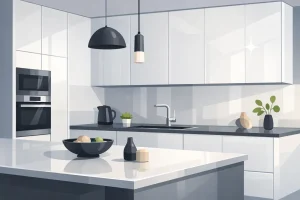

You're probably in the same spot many Toronto and Markham homeowners reach early in a kitchen renovation. You want something sharper than white shaker, warmer than a stark modern showroom, and less trendy than an all-grey kitchen that already feels dated. Matte black kitchen cabinets usually enter the conversation right there.
They can look refined, expensive, and calm at the same time. The problem is that most advice stops at “black is bold” and a gallery of dramatic all-black kitchens. That's not enough if you're choosing materials, planning lighting, thinking about upkeep, and trying to make sure the kitchen still feels inviting in five or ten years.
The better approach is quieter. Matte black works best when it anchors the room and lets wood, stone, and lighting do the softening. Done well, it doesn't feel harsh. It feels settled, refined, and built for real life.
Why Matte Black Cabinets Are Capturing Toronto Kitchens
A common renovation brief sounds like this. The old kitchen feels flat, the finishes don't relate to the rest of the house, and the homeowner wants a space that looks current without feeling like a short-lived trend. In Toronto and Markham, matte black cabinets keep showing up as the answer because they give the room definition fast.
Interest isn't incidental. Consumer interest in matte black kitchen cabinets in the CA region rose 35% year over year from 2023 to 2024, with especially strong momentum in Toronto and Markham, where homeowners favour matte finishes for their fingerprint-resistant elegance, according to the Ontario Home Design Council report referenced by this black cabinet design guide.
What I see on real projects is that people rarely want “black” for the sake of black. They want contrast. They want cabinetry that feels architectural. They want the island, pantry wall, or base cabinets to look more like furniture and less like standard millwork. Matte black does that without the glare that makes some dark kitchens feel hard or overproduced.
Why the finish lands so well locally
Toronto homes often mix old and new elements. You might have warm oak flooring, cooler condo windows, or a renovation that opens into a family room with softer textures. Matte black bridges those conditions well. It reads modern, but it also pairs naturally with brass, walnut, stone, plaster tones, and stainless appliances.
For homeowners comparing options, this is often the point where dark cabinetry starts to make more sense than another safe neutral. If you're weighing whether a dark palette suits your space, a gallery of dark kitchen cabinet ideas can help you judge how black behaves across different layouts rather than only in oversized designer kitchens.
Matte black tends to look best when it's treated as a foundation, not a stunt colour.
Choosing Your Perfect Matte Black Finish and Material
The look is only half the decision. The material behind the finish changes how the cabinets age, how they clean up, and how much maintenance they'll ask from you near the sink, cooktop, and family traffic zones.
The four material paths most homeowners compare
Below is the practical comparison I use when clients want matte black but haven't settled on the construction.
| Matte Black Cabinet Material Comparison | ||||
|---|---|---|---|---|
| Material | Aesthetic | Durability | Maintenance | Best For |
| Real wood painted doors | Rich, slightly organic, can show subtle character through the finish | Strong and repairable, but wood movement and wear show differently over time | Needs gentler care around chips and edge wear | Homeowners who want a more custom, furniture-like feel |
| HDF painted matte finish | Smooth, uniform, clean-lined | Stable and consistent for a painted look | Easier day-to-day wiping than many painted wood surfaces | Modern kitchens that want a refined painted finish |
| Laminate matte finish | Contemporary, controlled, available in very even blacks | Durable against routine kitchen use | Straightforward to clean, practical for busy households | Family kitchens, rentals, investment properties |
| Thermofoil matte finish | Seamless appearance with a neat, modern face | Good moisture resistance when properly specified | Easy to wipe, especially on slab-style doors | Budget-conscious renovations and simple modern layouts |
What performs best in busy kitchens
If your kitchen gets constant use, composite options usually make the strongest practical case. In high-humidity regions, matte black cabinets in composite HDF or thermofoil showed 40% less visible smudging after 50+ daily contact cycles than natural wood lacquers, according to testing cited in this material-specific overview.
Practical rule: If you cook often, have children, or dislike constant wiping, start your shortlist with HDF or thermofoil before you fall in love with a painted wood sample.
That same source also notes an important trade-off. Not every matte finish handles grease well near the cooking zone. Near a range or cooktop, specialized low-sheen acrylic coatings are needed to reduce deep grease penetration. That's the kind of detail many homeowners only discover after installation, when a pretty sample board has to survive oil, steam, and repeated cleaning.
How to choose based on your priorities
Some decisions are style-led. Others are lifestyle-led.
- Choose painted wood if visible craftsmanship matters more to you than perfect uniformity. This is the best route when you want matte black to feel distinctive and slightly warmer.
- Choose matte HDF if you want a clean, consistent painted appearance with fewer visual variations across doors and panels.
- Choose laminate if durability, easy maintenance, and controlled costs matter most.
- Choose thermofoil if you want an unbroken modern look and straightforward upkeep, especially in simpler slab-door kitchens.
If you're sorting through construction choices in more detail, this guide on the best material for kitchen cabinets is useful for comparing how each option behaves in actual household use.
There's also a finish coordination point people often miss. Matte black cabinets usually look best when the nearby fixtures share the same design intent, not necessarily the exact same finish. For example, a sleek instant boiling and chilled tap can work well in a contemporary kitchen where the cabinetry, faucet lines, and appliances all speak the same visual language.
The Pros and Cons of Going Dark
Dark cabinetry earns its place when the benefits line up with the room and the household. It also creates problems if the kitchen doesn't have enough light or if the finish choice was made only from photos.

Where matte black works in your favour
The strongest everyday benefit is visual forgiveness. In the CA region, homeowners report a 30% reduction in cleaning frequency compared with glossy black cabinets because matte finishes show fewer fingerprints and water stains, and renovated properties with matte black cabinets are estimated to increase home value by an average of 5.2%, based on GTAR data cited in this pros-and-cons analysis.
That combination matters. You get a finish that looks upscale, asks for less day-to-day fuss than gloss, and can support resale appeal when the rest of the renovation is designed coherently.
Other advantages are qualitative but real:
- The surface feels calmer because it doesn't bounce glare around the room.
- The cabinetry looks more architectural because shadows and door lines read cleanly.
- The palette is flexible because matte black can pair with warm woods, brushed metals, white oak floors, soft quartz, or stone.
Where people get caught off guard
Dark cabinets still show some things clearly. Dust, flour, light crumbs, and pale powder residues are more visible than they are on mid-tone cabinetry. That doesn't mean the kitchen is harder to live with. It means the mess is easier to spot.
Cleaning technique matters too. Harsh chemicals can leave streaks or dull patches on some matte surfaces. If you want to build a safe maintenance kit before install day, a supplier of professional cleaning products can give you a sense of the kinds of gentle, finish-appropriate options worth keeping on hand.
The biggest mistake isn't choosing black. It's choosing black and then under-lighting the room.
A dark cabinet finish needs support from ambient, task, and accent lighting. Without that, the room can feel flatter and smaller than it is.
Styling Your Kitchen for Quiet Luxury
The all-black minimalist kitchen had its moment. What's holding attention now is softer and more layered.

A 2026 report showed a 42% increase in CA homeowners requesting two-tone matte black plus natural wood cabinets, moving away from stark minimalist schemes. The same report says 55% of new renovations in Markham and Toronto emphasize furniture-like cabinetry with visible grain and tactile finishes, according to this Toronto kitchen trend article.
That's the shift worth paying attention to. Matte black no longer has to dominate every wall. It can anchor the room while wood and stone make it feel expensive in a quieter way.
Use the 60 30 10 balance
A practical way to avoid a heavy result is the 60/30/10 colour principle.
- 60 percent dark anchor. Matte black can feature on base cabinets, a tall pantry run, or the island.
- 30 percent lighter contrast. Think warm white walls, pale quartz, creamy backsplash tile, or a soft greige perimeter.
- 10 percent wood or warm accent. Walnut shelves, ash detailing, rift-cut oak seating, or a wood hood trim can do the job.
This balance keeps black from swallowing the kitchen. It also helps the room relate to adjacent living spaces, especially in open-concept homes where a full black perimeter can feel abrupt.
Materials that soften black without weakening it
Quiet luxury depends on restraint. The pairings matter more than the cabinet colour alone.
- Warm woods such as walnut and ash give matte black depth. Walnut is particularly effective because its brown undertone makes black feel richer, not colder.
- Warm stone or quartz helps the room feel layered. Look for cream, mushroom, taupe, or subtle veining rather than icy bright white if you want a gentler effect.
- Metal finishes should warm or refine the palette. Brushed brass adds softness. Matte nickel is cleaner and more understated.
- Textural backsplash choices such as handmade-look tile, honed stone, or softly veined slabs help break up large dark surfaces.
Black looks more luxurious beside natural texture than beside more black.
This short visual reference can help if you want to compare a few styling directions before finalizing your palette.
What to avoid
A few combinations tend to miss the mark:
- All-black everything often feels flatter in a typical GTA home than it does in editorial photography.
- Cold grey counters with black cabinets can make the room feel severe.
- Shiny hardware on very matte surfaces can look disconnected unless the rest of the kitchen is equally polished.
- Too many competing statement materials dilute the elegance. If the cabinets are black and the wood is expressive, keep the backsplash and countertop quieter.
The best matte black kitchens don't try to impress from every angle. They feel composed.
Layout Ideas and Strategic Lighting
Layout decides whether matte black feels grounded or oppressive. The same cabinet colour can look crisp in one room and heavy in another because of where it's placed and how the light hits it.
Where to place the dark cabinetry
In an open-plan kitchen, matte black often works best on the island or a single tall wall. That gives the room a focal point without turning every cabinet run into a dark mass. If the perimeter gets decent natural light, black base cabinets with lighter uppers usually create a more balanced result than a full dark wrap.
In smaller kitchens, restraint matters more than bravery. A galley kitchen can still use matte black, but it usually benefits from one of these moves:
- Base cabinets only to keep upper sightlines lighter
- A black island only if the perimeter already feels tight
- One feature wall such as pantry storage, with the rest of the cabinetry in a lighter finish
Light in layers, not in one fixture
The Ontario Home Design Council notes that matte black absorbs more light than reflective finishes, so kitchens need additional lighting to maintain visibility and balance, as referenced earlier in the opening source. That point shows up on real projects constantly. A single ceiling fixture won't rescue a dark palette.

Use three layers together:
- Ambient lighting from pot lights or recessed fixtures gives the room general brightness.
- Task lighting under upper cabinets or shelves keeps counters usable and stops the backsplash from disappearing into shadow.
- Accent lighting from pendants, toe-kick glow, or display lighting adds depth and makes matte finishes read as intentional rather than flat.
Small layout fixes that make a big difference
A few planning choices improve the result more than people expect.
- Wider aisles around a dark island help the island feel sculptural instead of bulky.
- Lighter end panels or open shelves can reduce visual weight at the edge of a cabinet run.
- Glass, metal, and stone nearby give the light more surfaces to bounce from.
- Window treatments should stay light-handed because matte black already lowers reflectivity.
If a kitchen has weak natural light, the safest move is usually not abandoning black. It's limiting where black goes and strengthening the lighting plan before cabinetry is ordered.
Budgeting and Installation in Toronto and Markham
Matte black cabinets don't belong to one price tier. The final budget depends less on colour and more on construction, door style, finish system, layout complexity, and installation conditions.
What changes the price most
Three factors usually move the number fastest.
First is material choice. A painted wood door, matte HDF door, laminate door, and thermofoil door can all deliver a matte black look, but they won't carry the same manufacturing cost, labour requirement, or repair profile.
Second is customization. Full-height pantry units, integrated panels, special storage inserts, appliance surrounds, floating shelves, and matching side panels all affect the scope more than colour alone.
Third is site complexity. Uneven walls, older homes, condo delivery restrictions, and electrical or plumbing changes can reshape the installation budget quickly.
For homeowners trying to set expectations before requesting quotes, this breakdown of kitchen cabinet costs is a practical starting point.
Where to spend and where to pull back
If the goal is a luxury-looking kitchen without wasting budget, spend where touch and visibility are highest.
- Spend on the door finish and exposed surfaces. That's what the eye reads first.
- Protect the cooking zone. A better finish specification near the range is worth it.
- Don't overspend on hidden upgrades you won't use. Internal accessories are helpful, but only if they suit your routine.
- Coordinate flooring early. Matte black cabinets can shift how wood tones read, so a guide to choosing wood flooring for your kitchen can help prevent a floor-cabinet combination that feels too yellow, too red, or too cold.
Installation decisions that affect the final look
Dark cabinetry is less forgiving of sloppy installation. Misaligned fillers, uneven reveals, crooked crown lines, and poor light placement show up fast against a matte black face.
That's why it's smart to finalize these items before production:
- Appliance model sizes
- Range hood details
- Countertop thickness
- Hardware placement
- Lighting plan
- Flooring height and transitions
A matte black kitchen can look expensive on a moderate budget if the layout is disciplined and the installation is precise. It can also look disappointing with premium materials if those details were left unresolved.
Your Matte Black Kitchen Project Checklist
If you're narrowing down decisions, keep the process simple and sequential.
Start with the look you actually want
Choose your direction first. Quiet luxury and stark minimalism both use matte black, but they produce very different kitchens. If you want warmth, decide early that wood, stone, and softer metals will be part of the plan.
Match the material to your household
Don't choose from photos alone. Compare painted wood, matte HDF, laminate, and thermofoil based on how your kitchen will really be used. Busy family kitchen and heavy cooking routine usually call for the most forgiving finish, not the most romantic sample board.
Lock the layout before the styling
Decide where black belongs. Island only, base cabinets only, one feature wall, or a larger wrap. The layout should control the visual weight before hardware and backsplash decisions begin.
Build the lighting plan at the same time
Dark cabinetry needs layered lighting. Finalize your ambient, task, and accent lighting while the cabinetry is still being designed, not after.
Choose the accent palette last
Once the black finish and layout are fixed, select the warm elements that will soften it:
- Wood accents such as walnut shelving or seating
- Countertops with warmth rather than icy contrast
- Hardware in brushed brass or matte nickel
- Backsplash materials with texture, not visual noise
This kind of visual reference helps when you're collecting ideas and comparing directions.

Bring samples together before you commit
The final review should always happen with your cabinet finish, countertop, flooring, backsplash, and hardware in the same light, ideally at the same time of day you use the kitchen most. Matte black is sensitive to context. The supporting materials decide whether it feels rich, flat, warm, or severe.
If you're ready to turn ideas into a working plan, MapleKing Kitchen Cabinets is a strong next stop for inspiration, material options, and a no-obligation quote. Their gallery can help you compare matte black styles in real kitchens, and their team can walk you through layouts, finish choices, and practical decisions for Toronto and Markham homes.