

So, how much does a kitchen renovation actually cost in Toronto? The honest answer is that it varies wildly, from a straightforward refresh for around $13,000 to a full-scale, custom remodel that can easily top $75,000. Where your project lands on that spectrum really comes down to three things: the size of your kitchen, the quality of materials you choose, and just how much work you want to do.
Setting Your Kitchen Renovation Budget In Toronto
It's easy to get swept up in the excitement of planning a new kitchen, but let's be real—the first question on everyone's mind is, "What's this going to cost me?" Getting a firm grip on the numbers is the most important first step you can take. It ensures you can create the kitchen you’ve been dreaming of without any nasty financial surprises down the road.
In a market like the GTA, costs are driven by everything from labour rates to material availability and the sheer scope of your vision. A great way to start framing your budget is to think about renovations in three distinct tiers. This approach helps you match your goals with a realistic price tag right from the get-go.
Three Tiers Of Renovation Costs
First, there's the basic or cosmetic refresh. This is your go-to if you're looking for a big visual bang for your buck without tearing down walls. Think surface-level updates that leave the kitchen's core layout intact.
Next up is the mid-range renovation, which is by far the most common type of project we see. It’s the perfect middle ground, blending aesthetic upgrades with serious functional improvements. This usually means new cabinets, countertops, and appliances, but keeping the plumbing and electrical in the same spots.
Finally, you have the high-end or full-gut renovation. This is a complete overhaul. We’re talking about reconfiguring the layout, moving walls, upgrading electrical and plumbing, and installing premium, custom materials and professional-grade appliances for a truly one-of-a-kind kitchen.
Local Toronto data shows a clear link between the scope of work and the final price tag. Basic kitchen updates typically fall between CAD $13,000 and $25,000. A mid-range project usually lands in the $20,000 to $65,000 bracket, while high-end remodels often start around $40,000 and can easily climb past $75,000. For a deeper dive, check out this complete breakdown of 2025 renovation costs from Magic Window Innovations.
To give you an even clearer picture, let's break down what you can expect at each level.
Toronto Kitchen Renovation Costs At A Glance
The table below provides a quick snapshot of the different renovation tiers, helping you see what’s possible within various budget ranges in the Toronto area.
| Renovation Level | Typical Cost Range (CAD) | Common Inclusions | Best For |
|---|---|---|---|
| Basic Refresh | $13,000 – $25,000 | Cabinet painting, new hardware, laminate countertops, basic tile backsplash, new sink/faucet, fresh paint. | Homeowners on a tight budget, rental property updates, or those preparing a home for sale with a quick facelift. |
| Mid-Range Remodel | $25,000 – $65,000 | New stock or semi-custom cabinets, quartz or granite countertops, new appliances, LVP or tile flooring, upgraded lighting. | Families wanting improved function and style without major structural changes; the most popular choice for ROI. |
| High-End Gut | $65,000+ | Custom cabinetry, luxury countertops (marble/quartzite), layout changes, structural work, high-end appliances, custom lighting. | Homeowners planning their "forever kitchen" who desire a completely personalized space with premium finishes. |
As you can see, your budget directly shapes the possibilities. Whether you're aiming for a simple facelift or a complete transformation, understanding these tiers is the key to planning a successful and financially sound renovation.
Breaking Down Where Your Renovation Dollars Go
Ever see a stunning new kitchen and wonder where a $50,000 budget actually goes? It's never just one big cheque. Instead, it's a carefully assembled puzzle of materials, skilled labour, and professional services. Getting a handle on this breakdown is the first step to planning your own kitchen renovation costs in Toronto without any nasty surprises.
Think of your budget as a pie. Each slice represents a different part of the project, and some slices are always going to be bigger than others. By understanding what those slices are, you can see exactly where your money is going and make smarter decisions on where to invest and where you might be able to save a little.
The Anatomy of a Renovation Budget
For a typical mid-range kitchen renovation in Toronto, the budget tends to get carved up in a pretty predictable way. While every single project has its own unique quirks, the percentages usually follow a similar pattern. Labour is a big one—it’s the skilled hands that bring your vision to life—but the physical materials like cabinetry and countertops are right up there, too.
Let's unpack the main components that will eat up your renovation dollars. These are the heavy hitters that form the foundation of your kitchen's new look and feel.
- Cabinetry: This is almost always the single biggest expense. Expect it to take up 25-35% of your total budget.
- Labour and Installation: This covers everything from the messy demolition day to the final, satisfying click of a cabinet door. It typically accounts for 20-30% of your costs.
- Countertops: As a major visual and functional centrepiece, countertops usually represent 10-15% of the budget.
- Appliances: Your new fridge, stove, and dishwasher can vary wildly in price, but they generally take up 10-15% of the total investment.
- Flooring: Fresh flooring can completely change the feel of the space and typically costs about 5-7% of the budget.
The rest of the pie is filled out with things like plumbing, electrical work, lighting, new fixtures, and a contingency fund for those just-in-case moments. Having this structure in mind helps you anticipate costs and keeps you in control.
A Closer Look at Cabinetry Costs
It’s no surprise that cabinetry, the most dominant feature in any kitchen, commands the largest slice of the budget. Your choice here—between stock, semi-custom, or fully custom cabinets—will have the biggest impact on your kitchen renovation costs in Toronto.
Stock cabinets are easy on the wallet but offer very little in the way of styles and sizes. On the other end, custom cabinets give you endless freedom but come with a hefty price tag. For many homeowners, the sweet spot is semi-custom or factory-direct options. They offer a great deal of personalization without the sky-high cost of a fully bespoke build. If you're after that high-end look, it pays to learn how to buy luxury kitchen cabinets in Toronto by sourcing them directly from the factory, which can really maximize your savings.
A deep dive into mid-range Toronto kitchen renovations shows some clear cost patterns. Semi-custom cabinetry often lands between $10,000 and $20,000. Quartz or granite countertops typically range from $3,000 to $8,000, and new flooring can add another $2,000 to $5,000. These are solid investments, too—homeowners can often expect a return of 75% to 100% on their renovation.
Demystifying Labour and Professional Fees
Beyond the boxes of materials, it’s the cost of skilled labour that truly builds your kitchen. This isn't just one flat fee; it’s a collection of charges for all the different tradespeople whose expertise is essential to getting the job done right.
Demolition, framing, drywall, plumbing, and electrical work all require licensed pros. Their experience ensures your kitchen is not only beautiful but also safe and up to code, which is completely non-negotiable. The precise installation of your cabinets, countertops, and flooring also requires a skilled hand. These costs are often bundled into a general contractor's fee, but knowing what they represent helps you appreciate the value of quality workmanship.
To see how all these pieces fit together in the real world, here is a sample budget for a typical mid-range project.
Sample Mid-Range Kitchen Budget Breakdown ($50,000 Project)
This table shows how a $50,000 budget for a mid-range kitchen renovation might be allocated in Toronto. It gives you a clear picture of where the money goes, both in dollars and as a percentage of the total.
| Cost Category | Estimated Cost (CAD) | Percentage of Budget |
|---|---|---|
| Cabinetry & Hardware | $15,000 | 30% |
| Labour & Installation | $12,500 | 25% |
| Appliances | $7,500 | 15% |
| Countertops | $6,000 | 12% |
| Flooring | $2,500 | 5% |
| Plumbing & Electrical | $2,500 | 5% |
| Lighting & Fixtures | $1,500 | 3% |
| Permits & Contingency | $2,500 | 5% |
Seeing it laid out like this makes it much easier to understand how a budget works. It empowers you to invest strategically in the areas that matter most to you and your family's lifestyle.
The Hidden Factors That Drive Up Your Renovation Cost
Ever browse through photos of two stunning Toronto kitchen renovations, see that they look almost identical, yet one cost $40,000 while the other blew past $75,000? It’s a common question, and the answer almost always comes down to the hidden factors that quietly inflate a budget.
Beyond the obvious choices like cabinets and countertops, a handful of crucial variables really determine the final bill. Getting a handle on these drivers is the key to mastering your kitchen renovation costs in Toronto. It's what separates a project that feels under control from one that spirals into a financial headache. These factors often work behind the scenes, tied to the very bones of your home and the unique challenges of building in a city like ours.
Kitchen Size and Structural Changes
Let’s start with the most obvious one: the size of your kitchen. A bigger space simply requires more of everything—more flooring, more countertop, more cabinets—and more labour to put it all together. The connection between square footage and cost is direct and powerful.
But it’s not just about size; it’s about changing the size or shape. Think of your kitchen's current layout as the most cost-effective blueprint you have.
- Keeping the Layout: If you can keep your sink, stove, and fridge in their current spots, you avoid the high cost of moving plumbing and electrical lines.
- Changing the Layout: The moment you start shifting appliances, you’re calling in licensed tradespeople to reroute pipes and wires. This alone can add thousands to your labour costs.
- Removing a Wall: That dream of an open-concept kitchen? It's a major budget item. Knocking down a wall involves structural assessments, maybe a new support beam, and then all the patchwork for drywall, electrical, and flooring. This one move can easily add $5,000 to $15,000 or more to your project.
When you're budgeting, you need to think in local terms. Here in Toronto, a small kitchen renovation can run anywhere from CAD $200 to $450 per square foot, while larger, more complex projects can easily top $500 per square foot. Add in contractor rates of $50 to $140 per hour and permit fees that can reach $950, and you can see how quickly the costs stack up. For a deeper dive, you can explore a full 2026 cost guide to see how these numbers play out.
This visual gives you a great snapshot of where your money typically goes.
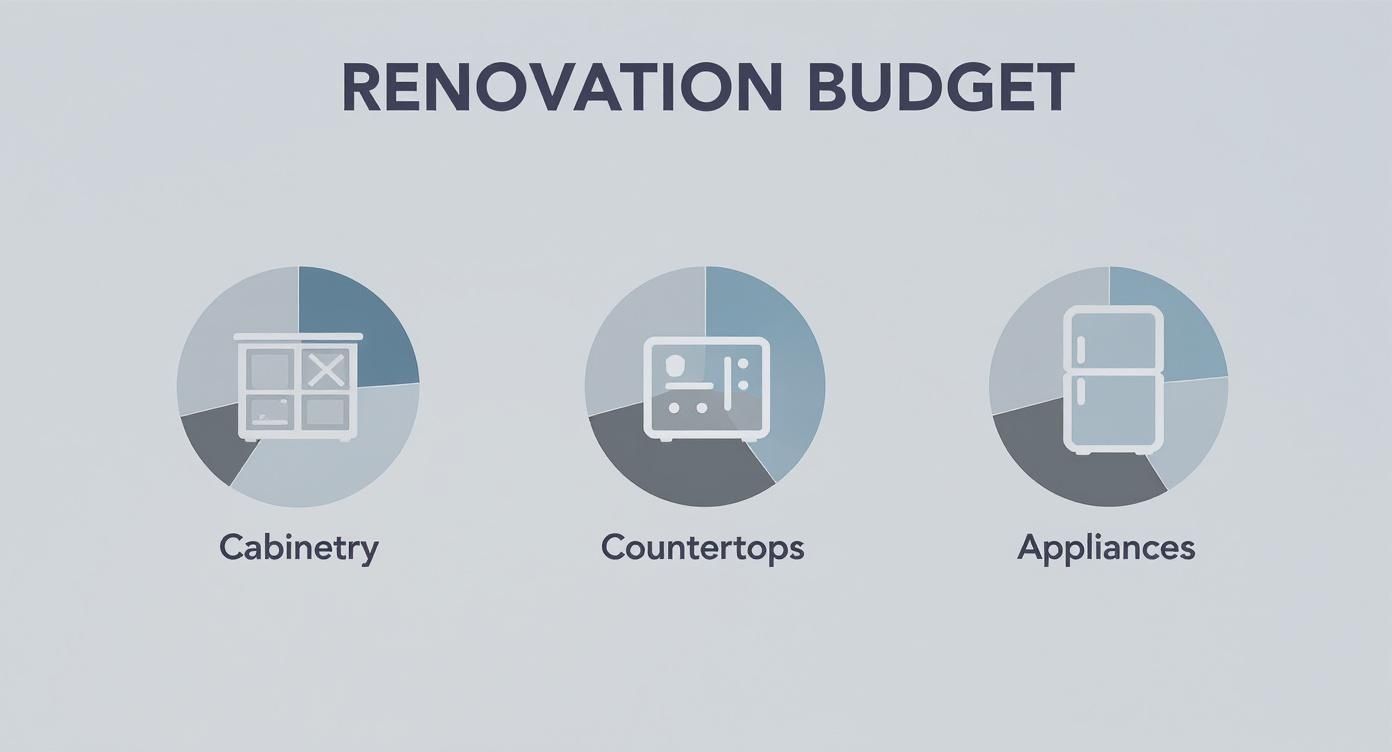
As you can see, cabinets, countertops, and appliances are the big three. The choices you make here will have the biggest impact on your bottom line.
Material Quality and Finish Selections
This is where you have the most direct control over your budget. Think of it as a sliding scale, from practical and budget-friendly to absolute luxury. Every single decision has a price tag attached.
For instance, a standard laminate countertop might only set you back $40 per square foot. But if your heart is set on a high-end quartzite slab, you could be looking at $200 per square foot or even more.
This same principle applies to every single item in your kitchen:
- Cabinetry: You can go with affordable in-stock laminate cabinets or make a serious investment in custom-built solid wood cabinetry.
- Flooring: Luxury vinyl plank (LVP) is a fantastic, durable, and cost-effective option, while imported porcelain tile or refinished hardwood sit at the higher end of the price spectrum.
- Fixtures: There's a huge price difference between a basic chrome faucet from a big-box store and a designer-brand, solid brass model with a specialty finish.
Toronto-Specific Renovation Challenges
Renovating in the GTA comes with its own unique set of hurdles that can catch you off guard if you aren't prepared. The city's mix of housing styles and strict building codes means you can't just assume your project will be straightforward.
First, tackling a reno in a condo is a completely different world than working on a detached house. You'll be dealing with condo board rules that dictate everything from working hours and noise levels to how you use the elevator for removing debris. It adds a whole layer of paperwork, planning, and cost.
Second, so many of Toronto's beautiful older homes come with a few surprises hiding in the walls. It’s not uncommon to uncover outdated knob-and-tube wiring, old galvanized plumbing, or even asbestos during demolition. These discoveries require specialized (and expensive) professionals to bring everything up to code. This is exactly why a healthy contingency fund of 15-20% isn’t just a nice-to-have—it’s absolutely essential for a stress-free renovation in this city.
Smart Ways To Renovate Without Breaking The Bank
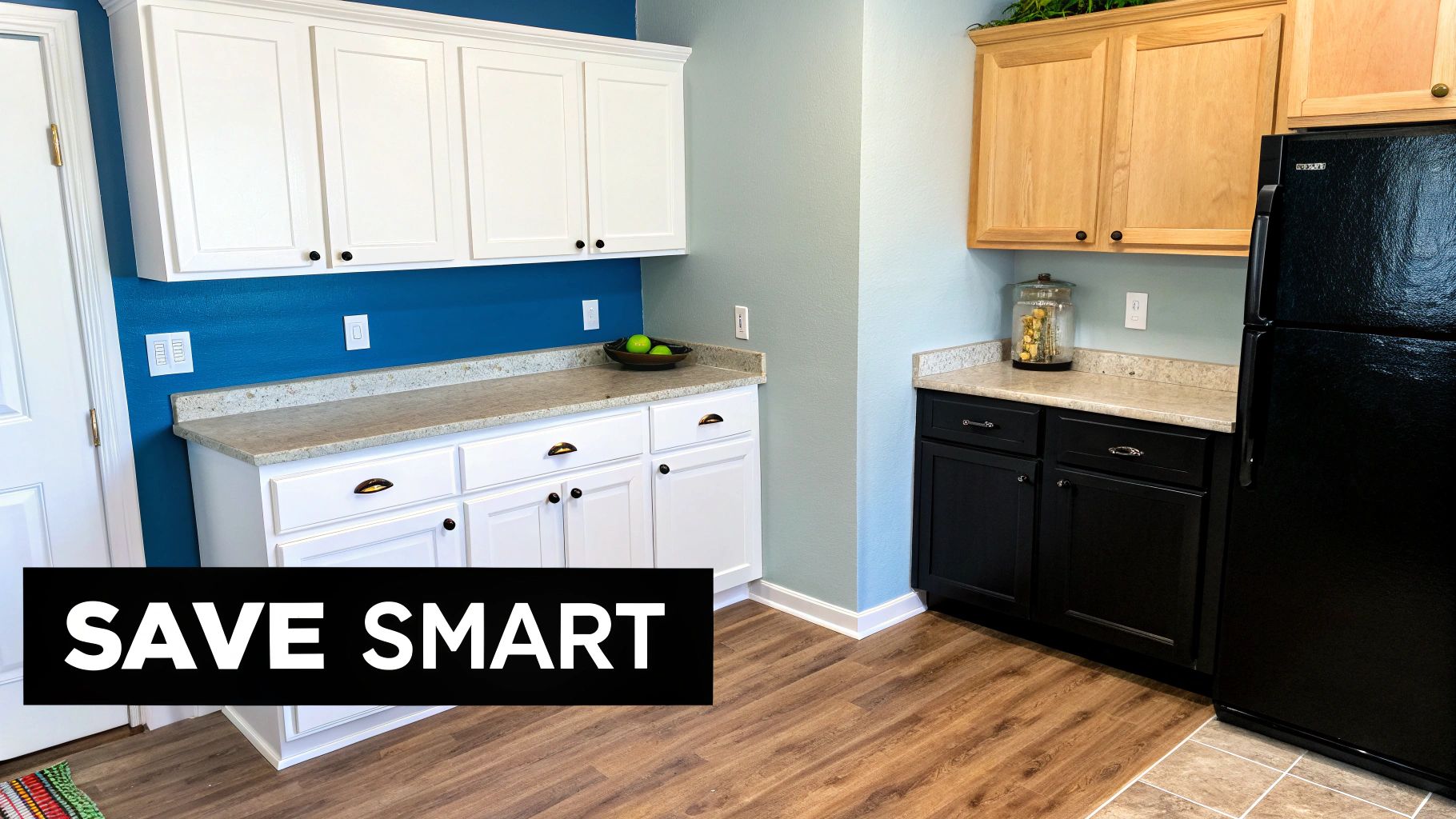
Getting that stunning kitchen you've been dreaming of doesn't have to mean signing up for a financial nightmare. With a bit of smart planning and a few strategic decisions, you can keep your kitchen renovation costs in Toronto well under control and still end up with a high-end look. It’s not about cutting corners; it's about making savvy choices that get the most out of every dollar.
The secret to an affordable reno starts way before anyone picks up a hammer. It all comes down to careful planning and building a realistic budget. And I don't mean just a ballpark number—I mean a detailed plan that considers every possible expense, plus a contingency fund of 15-20%. Think of this as your safety net for those little surprises that always seem to pop up, especially when you're working on older Toronto homes.
Plan Meticulously And Keep Your Layout
If there’s one golden rule for controlling your renovation budget, it's this: work with the kitchen layout you already have. Your plumbing, electrical, and gas lines are like the deep, stubborn roots of an old tree—trying to move them is a massive, expensive job. It’s almost always cheaper to work around them.
When you keep your sink, dishwasher, and stove right where they are, you sidestep the hefty costs of hiring licensed plumbers and electricians to open up walls and reroute all those essential services. This single decision can literally save you thousands of dollars, freeing up that cash for the things you’ll actually see and touch every day, like gorgeous countertops or new appliances.
Sticking to your existing footprint is the cornerstone of a budget-savvy renovation. It minimizes labour costs, reduces the need for expensive permits, and simplifies the entire project, allowing you to focus your spending on the finishes that truly define your kitchen's style.
Another crucial part of planning is getting honest about your "must-haves" versus your "nice-to-haves." Making a clear list forces you to prioritize what's actually important for your family's lifestyle, ensuring your money goes toward features that will bring you the most value and daily joy.
Make Smart Material And Sourcing Swaps
You absolutely don't need a luxury price tag to get a luxury look. The market today is full of incredible materials that look just like their expensive cousins but are way more durable and affordable. Making these smart swaps is how you can really stretch your budget without sacrificing an ounce of style.
Here are a few high-impact substitutions to consider:
- Flooring: Instead of pricey hardwood or porcelain, check out high-quality Luxury Vinyl Plank (LVP). Modern LVP offers incredibly realistic wood and stone textures, it's waterproof, and it’s much friendlier on the wallet.
- Countertops: Everyone loves the look of marble, but it’s porous and comes with a hefty price. A great-quality laminate or quartz countertop can give you a similar vibe with far better durability for a fraction of the cost.
- Backsplash: You can create a show-stopping feature with classic, affordable subway tile. To give it a custom feel, just ask your installer to lay it in a unique pattern, like a herringbone or vertical stack. Simple, but so effective.
Here’s another game-changer: rethink where you buy your cabinets. Heading to a big-box store means paying extra for middlemen. By looking into a low-cost kitchen renovation strategy like sourcing your cabinets factory-direct, you can often get better-quality, semi-custom cabinets for what you'd pay for basic stock options. It's the best way to get more style, better materials, and longer-lasting quality for your money.
Embrace Strategic DIY And Phased Renovations
While you should always leave things like plumbing and electrical work to the licensed pros, there are plenty of tasks where you can safely roll up your sleeves to save on labour costs. Taking on a few DIY projects isn't just economical—it's also incredibly empowering.
Consider tackling jobs like:
- Demolition: With a bit of care, you can remove old cabinets, countertops, and flooring yourself and save a few hundred dollars.
- Painting: Nothing transforms a room faster or cheaper than a fresh coat of paint. This is the perfect weekend DIY project.
- Hardware Installation: Swapping out old knobs and drawer pulls is a quick and easy job that instantly modernizes your cabinets.
If the total budget feels overwhelming, remember you don't have to do it all at once. Breaking the project into phases can make it much more manageable. You could start with the essentials—like new cabinets and countertops—and then tackle the new appliances or a fancy backsplash next year. This approach lets you start enjoying your updated kitchen sooner while spreading out the cost, making that dream space a completely achievable reality.
How To Get Accurate Quotes And Choose The Right Contractor
Getting quotes for a kitchen renovation can feel like you're comparing apples to oranges. One quote is a single number on a page, another is a multi-page document, and a third might be missing key details entirely. To make a smart decision and find a partner you can trust, you need a solid game plan.
The secret is giving every potential contractor the exact same, detailed information. This way, every quote you get back is based on the same playbook.
It all starts before you even pick up the phone. Your first step is to create a detailed project scope document. This doesn't have to be an official blueprint, but it should be a clear outline of your vision. Think of it as your project's wish list, including everything from your ideal layout and appliance placement to the specific types of materials you're leaning towards (like "quartz countertops," "shaker-style cabinets," or "luxury vinyl plank flooring"). The more detail you put in, the sharper their pencils will be when they write your estimate.
What A Trustworthy Quote Must Include
A vague, one-page quote is a massive red flag. A true professional will give you a detailed proposal that breaks everything down, leaving no room for doubt or surprise costs later. Learning to spot a good quote is one of the most important parts of protecting your investment.
Here’s what you should demand to see in any quote you're seriously considering:
- A Detailed Scope of Work: The quote needs to clearly spell out every single task, from the first swing of the sledgehammer during demolition to the final brushstroke of paint.
- Line-Item Cost Breakdown: It should clearly separate the costs for materials, labour, permits, and any work being done by subcontractors.
- Specific Material Allowances: For items you haven't picked out yet, like backsplash tile or pendant lights, the quote should include a specific budget amount, known as an allowance.
- Clear Payment Schedule: This tells you exactly when payments are due at different project milestones (e.g., deposit on signing, after demolition, once cabinets are installed).
- Projected Timeline: A professional will always provide an estimated start and completion date, mapping out the key phases of the project.
- Proof of Insurance and WSIB: Never, ever hire a contractor who can't immediately provide proof of liability insurance and Workplace Safety and Insurance Board (WSIB) coverage.
A detailed quote isn't just about the price. It’s a direct reflection of a contractor's professionalism and transparency. This document becomes the bedrock of your contract, preventing misunderstandings and those dreaded "surprises" down the road.
Vetting Contractors In The Toronto Market
Once you have a few detailed quotes in hand, the real work begins. Your goal is to find a contractor with a proven history of quality work, great communication, and a solid reputation right here in the GTA. Don't be tempted by the lowest bid—the cheapest quote often ends up causing the most expensive headaches.
Start by checking their references, but do it strategically. Ask to speak with their two most recent clients and one client whose project was finished over a year ago. This gives you a complete picture: you’ll see their current quality of work and also how well their projects stand the test of time. It's also worth taking the time to learn how to choose the best kitchen cabinets contractor in Toronto, since their skill is so central to the project's success. A good contractor will have these references ready and waiting for you.
Finally, read the contract carefully before you sign anything. This is a legally binding document that should perfectly mirror the detailed quote. Make sure it includes clauses for how to handle changes (called "change orders"), a process for resolving disputes, and lien waivers. Taking these steps ensures you're partnering with a reliable pro who will bring your dream kitchen to life—on time and on budget.
Your Top Kitchen Renovation Questions Answered
When you start planning a kitchen renovation in Toronto, the numbers are important, but they're only half the story. You probably have a ton of other questions about how the whole process actually works. What's realistic? What's worth it?
Let's tackle some of the most common questions we hear from homeowners across the GTA. Getting these answers straight will help you plan your project with your eyes wide open.
How Long Does a Kitchen Renovation Actually Take?
This is the big one, and the honest answer is: it really depends on what you’re doing. The timeline can vary wildly based on the scope of your project.
A simple cosmetic refresh—think painting cabinets, putting in a new backsplash, and swapping out the countertop—is relatively quick. You’re likely looking at 1 to 3 weeks from start to finish.
If you're planning a more typical mid-range renovation with all-new cabinets, flooring, and appliances, you should set aside 4 to 8 weeks. For a full gut job that involves moving walls, changing the layout, or adding custom features, be prepared for a longer haul. These projects can easily take 8 to 12 weeks or even more, especially once you factor in design, permits, and city inspections.
Is It Worth the Money to Hire an Interior Designer?
Hiring a designer can feel like an extra expense, but it’s often one of the smartest moves you can make. A great designer does so much more than pick paint colours. They are experts in space planning, understand the technical side of materials, and know how to manage a project from A to Z. Their experience can save you from huge, costly mistakes—like ordering the wrong size cabinets or choosing a countertop that can't handle your family's daily chaos.
Plus, designers have access to trade-only discounts on everything from tile to fixtures, which homeowners can't get. Often, these savings can cover a good chunk of their fees. Most importantly, they take the stress out of the endless decisions, saving you time and giving you a much better final result.
While a designer might add 5% to 15% to your total project cost, their ability to maximize your budget, create a truly functional layout, and boost your home's resale value often means the investment more than pays for itself.
What Kind of Return on Investment Can I Expect?
In a hot real estate market like Toronto's, a thoughtful kitchen renovation is one of the most reliable ways to add value to your home. It consistently delivers a fantastic return on investment (ROI).
On average, homeowners in the GTA can expect to get back 75% to 100% of what they spend on a kitchen remodel when they sell. A beautiful, modern, and functional kitchen is a massive selling feature that makes your home jump off the page for potential buyers. It can lead to a quicker sale and a better final price. The trick is to choose classic, appealing finishes that won't feel dated in a few years.
Ready to transform your kitchen with beautiful, high-quality cabinetry that fits your budget? At MapleKing Kitchen Cabinets, we offer factory-direct pricing to bring you luxury, custom designs without the middleman markup. Get your free quotation today and start building your dream kitchen.