
A kitchen range hood made of wood is much more than just a box that hides a fan. Think of it as a custom-built piece of furniture for your kitchen, designed to perfectly match your cabinetry while housing a high-performance ventilation system. It’s where raw function meets beautiful form, turning a workhorse appliance into a stunning statement piece.
Why Wood Range Hoods Are the Centrepiece of Modern Kitchens
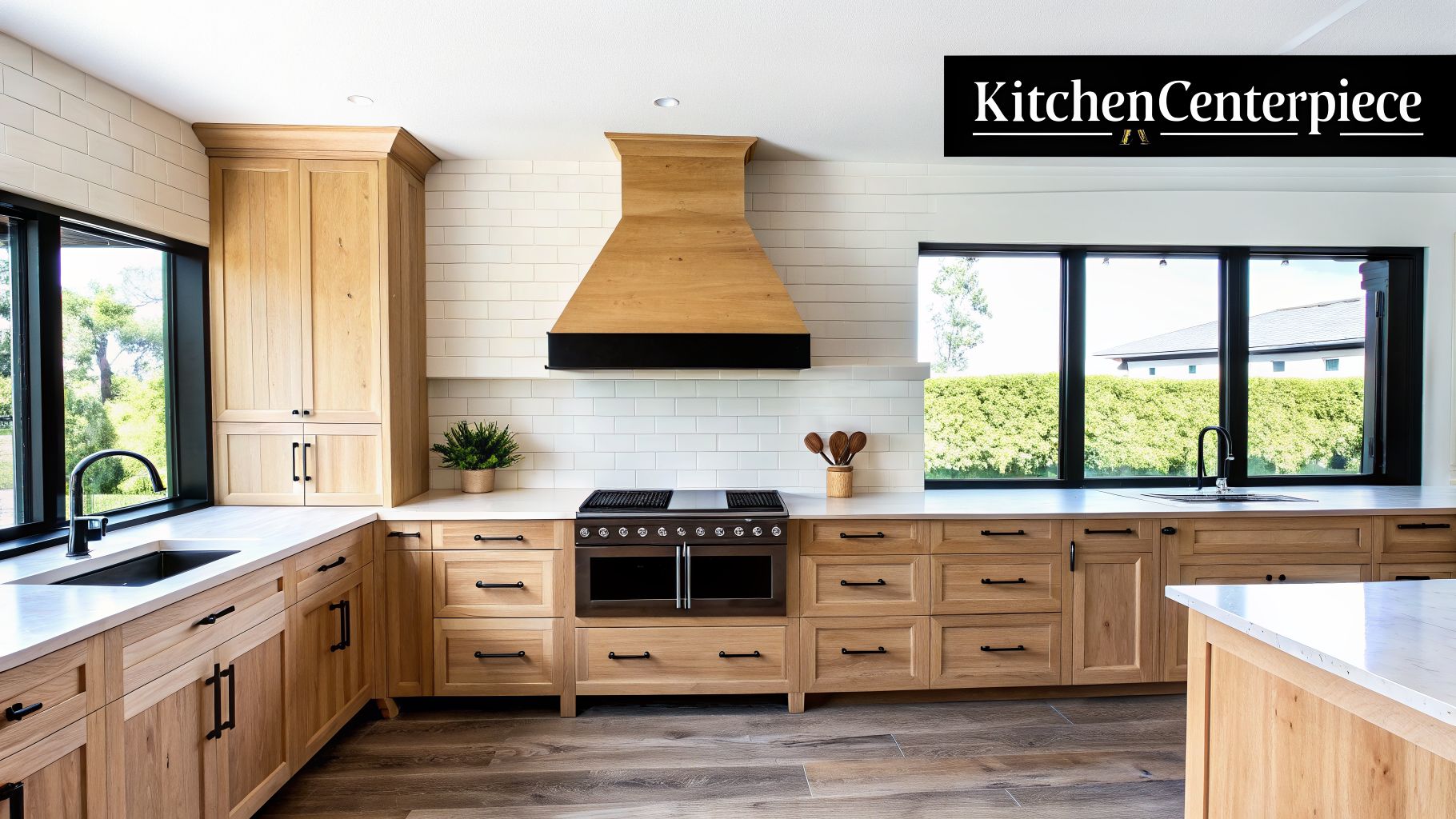
In today's kitchen design, the range hood is no longer just an afterthought. It has earned its place as the architectural heart of the room. A well-designed wood range hood acts as the crowning touch that pulls your cabinetry, countertops, and backsplash together into one cohesive look.
It’s less of an appliance and more like a piece of custom millwork. Unlike a standard stainless steel unit that stands apart, a wood hood becomes part of your kitchen's story. This deep level of personalization is why they’ve become so popular, especially in design-savvy areas where homeowners want a truly custom feel.
Unifying Design and Function
At its core, a wood range hood is a clever way to hide the nuts and bolts of a ventilation system behind a gorgeous exterior. The result is a seamless, built-in look that feels completely intentional. It transforms something purely practical into a deliberate design choice, which is why you’ll find them in styles from modern farmhouse to transitional luxury.
A great wood hood can:
- Create a powerful focal point: Its sheer presence and custom details naturally draw your eye, establishing the cooktop as the true heart of the kitchen.
- Add warmth and texture: The natural grain of wood brings an organic, tactile quality that softens the hard, cool surfaces of stone and tile.
- Offer unmatched customization: From the species of wood and finish to the specific trim and moulding, every single detail can be tailored to your exact vision.
A custom wood hood is the ultimate expression of a bespoke kitchen. It signals a move away from off-the-shelf solutions toward a space that is both deeply personal and timelessly elegant. This is where real craftsmanship and everyday practicality meet.
A Smart Investment in Your Home
As more people look for personalized living spaces, features that deliver on both style and function add serious value. A beautiful wood range hood is a perfect example of an upgrade that provides instant visual gratification while making your daily cooking routine better.
When you choose a design that complements your home's character—like a painted maple hood to perfectly match your MapleKing cabinets—you create a high-end, fully integrated look. That kind of thoughtful detail doesn't just make you love your space more; it also boosts your home's appeal on the market. It’s an investment that’s as wise as it is beautiful.
Understanding Your Wood Range Hood's Core Components
I find it helps to think of a wood range hood as two distinct parts working together: the beautiful handcrafted body and the powerful engine hidden inside. One gives your kitchen its stunning look, while the other does all the heavy lifting. To choose the right hood, you really need to understand both pieces of the puzzle.
What you see first is the decorative wood shell. This is the part that makes kitchen range hoods wood so appealing—a custom-built exterior that hides all the mechanical bits and creates a truly integrated look with your cabinetry.
Think of the shell as a beautiful piece of custom furniture for your kitchen. We can build it from woods like maple or oak and then finish it to perfectly match your design. Whether you want a painted finish to go with your HDF cabinets or a rich stain that lets the wood grain shine, the shell is where your style comes to life.
The Powerhouse: The Ventilation Insert
Tucked away inside that gorgeous wood shell is the real workhorse: the ventilation insert. This is the "engine" of your range hood, and it's responsible for pulling all the smoke, grease, steam, and cooking odours out of your air. An insert is a complete metal unit containing the fan (also called a blower), lights, and filters.
An insert's power is measured in Cubic Feet per Minute (CFM), which is just a number telling you how much air it can move. A simple electric cooktop might only need a 300 CFM insert. But if you have a high-output professional gas range, you could easily need 900 CFM or even more to keep your kitchen air clean and fresh. Without the right insert, even the most beautiful wood hood is just a decorative box.
The wood shell provides the style, but the ventilation insert delivers the performance. A successful wood range hood installation requires a perfect marriage of both—one is incomplete without the other. This ensures your kitchen remains a clean, safe, and beautiful space for years to come.
Why Both Components Are Critical
You can't really have one without the other. The shell is what protects the mechanical parts and pulls your kitchen's entire design together, while the insert is what protects your home and family from airborne grease and pollutants. If you focus on one and neglect the other, you're bound to run into problems.
For example, installing a powerful insert without a properly built and lined wood shell is just asking for trouble. On the flip side, a stunning wood shell with an underpowered insert won't be able to keep up with cooking fumes, leaving you with greasy surfaces and smells that just won't go away. When you choose a wood range hood, you're actually selecting two systems that have to work together perfectly. Getting this balance right ensures your investment is not only beautiful but practical, too.
Choosing the Right Materials and Finishes
The shell of a kitchen range hood made of wood is where its personality truly comes to life. Your choice of material and finish will decide if your hood feels rustic and warm, sleek and modern, or classic and elegant. Let's break down the options so you can find the perfect match for your kitchen's style, durability needs, and budget.
At its core, the decision really boils down to two main paths: a stained real wood finish or a painted one. Each has its own distinct beauty and practical considerations.
Natural Wood Species
For anyone who loves the authentic, organic character of wood, choosing a specific species is the way to go. This lets the natural grain become a standout feature in your kitchen design.
- Maple: With its smooth, fine grain, maple is a real chameleon. It takes stains beautifully and evenly, giving you a clean, polished look that works in almost any setting.
- Oak: Oak, on the other hand, has a much more pronounced and open grain. This gives it a traditional, sturdy feel that’s absolutely perfect for farmhouse, rustic, or craftsman-style kitchens.
When you're choosing a natural wood, the source and grade really matter. To get a better feel for what separates the good from the great, it’s worth understanding what makes for quality lumber for your wood range hood.
This handy chart can help you visualize the choices you'll make for the hood's body and the separate ventilation system inside.
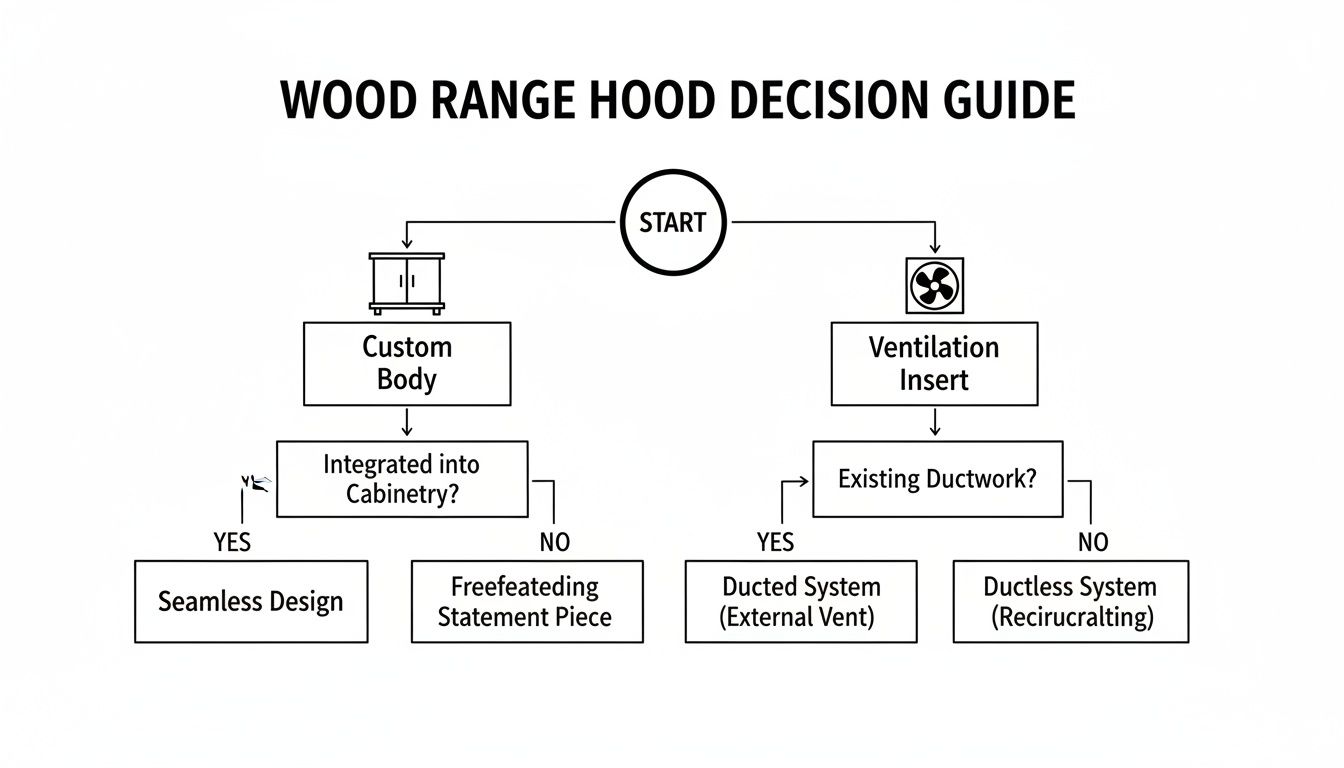
As you can see, you’re really making two key decisions: one for the beautiful outer shell and another for the hardworking mechanics that keep your air clean.
Versatile Painted Finishes
A painted finish opens up a world of endless colour possibilities, giving you the power to create a perfectly seamless or dramatically contrasting look. This is a fantastic approach when you want your wood hood to blend in with cabinets made from different materials.
Here’s a look at how different materials and finishes stack up.
Comparing Wood Range Hood Materials and Finishes
| Material or Finish | Aesthetic Qualities | Durability and Maintenance | Best Suited For |
|---|---|---|---|
| Stained Maple | Smooth, subtle grain. Provides a clean, refined, and versatile look. | Very durable. Resists dents well. Requires occasional cleaning with wood-safe products. | Transitional, modern, and traditional kitchens where a clean wood look is desired. |
| Stained Oak | Pronounced, open grain. Offers a traditional, rustic, or craftsman character. | Extremely durable and heavy. Hides minor wear well. Needs standard wood care. | Farmhouse, rustic, and traditional designs that call for a strong, textured wood presence. |
| Painted Finish (on Maple) | Smooth, uniform surface. Offers unlimited colour options for a custom look. | A professional-grade finish is very durable and easy to wipe clean. Can chip under heavy impact. | Matching non-wood cabinets (like HDF), creating a bold focal point, or achieving a seamless, modern look. |
Ultimately, your choice depends on whether you want the natural grain of the wood to be the star, or if you prefer a smooth, custom-coloured surface.
We see this a lot, and it works beautifully: using a solid maple hood shell with a professional-grade painted finish. This lets you colour-match it perfectly to High-Density Fibreboard (HDF) cabinets, creating an identical look while benefiting from the strength of a real wood structure.
This strategy gives you the best of both worlds. You get the structural integrity that only real wood can offer, combined with the flawless, consistent colour of a modern painted cabinet. You can go bold with a striking accent colour or choose a shade that blends in perfectly. If you're leaning this way, our guide to white kitchen range hoods has plenty of great ideas.
No matter which finish you choose, make absolutely sure it’s made for the kitchen. You need professional-grade paints and sealants that are designed to stand up to heat, moisture, and grease. For a fixture that sits right above your cooktop, that kind of durability isn't just a nice-to-have—it's essential.
How Proper Venting Protects Your Family's Health
A beautiful wood range hood is more than just a centrepiece for your kitchen. Behind that gorgeous facade is a powerful ventilation system, and its job is one of the most important in your home: keeping your family healthy. This isn't just about whisking away the smell of burnt toast; it’s about actively removing harmful pollutants from the air you breathe.
Every time you cook—whether you're searing a steak, frying up some bacon, or even just boiling a pot of pasta—you release a surprising amount of grease, steam, and chemical compounds into your home. If you have a gas cooktop, the situation is even more critical. Gas flames produce by-products like nitrogen dioxide (NO2) and carbon monoxide (CO), both of which are known to irritate the respiratory system.
Without proper ventilation, these airborne particles don't just vanish. They settle on your cabinets, walls, and furniture, leaving behind a sticky, greasy film and stubborn odours. More importantly, they linger in the air, compromising the air quality inside your home day after day.
The Hidden Dangers of Poor Air Quality
The health risks tied to cooking emissions are serious and well-documented. In fact, research has shown that a shocking 60% of homes with gas stoves have indoor air pollution that exceeds the legal outdoor limits on a weekly basis. This alarming statistic is a major reason why high-performance ventilation has become a non-negotiable feature in modern kitchen design. You can see more details in the research on range hood statistics from ProlineRangeHoods.com.
This is exactly why a ducted range hood is always the best choice. A ducted system is one that vents all those pollutants directly outside your house. In contrast, a ductless (or recirculating) model just pulls air through a charcoal filter and pushes it right back into your kitchen.
Think of it this way: a ducted hood takes the garbage all the way out of the house. A ductless hood is like just spraying air freshener on the bin and leaving it in the kitchen. One permanently solves the problem, while the other only masks it temporarily.
Understanding CFM and Vent Power
To make sure your wood range hood works as good as it looks, you need to choose the right "engine" to go inside it—the vent insert. The power of this insert is measured in Cubic Feet per Minute (CFM). It’s a simple metric that tells you how many cubic feet of air the fan can move in one minute. The higher the CFM, the more powerful the fan.
Matching the CFM to your cooktop is key. An underpowered hood will struggle to capture all the smoke and steam, defeating its purpose. On the other hand, a wildly overpowered one can be excessively noisy and waste energy.
So, how much power do you actually need? Here are some solid guidelines to follow:
- Electric Cooktops: For a standard electric or induction stove, a vent insert with 300-400 CFM is usually a great starting point.
- Gas Cooktops: Gas produces more heat and emissions, so it needs more power. The rule of thumb is to have at least 100 CFM for every 10,000 BTUs your cooktop produces. For many pro-style gas ranges, this means you'll need an insert in the 600-1200 CFM range.
By selecting an insert with the right CFM, you're ensuring your wood hood isn't just a design feature. It becomes an essential appliance that actively protects your home’s air and your family's well-being. To see what options are available, feel free to browse our complete collection of range hoods in Canada.
Sizing Your Hood for Perfect Visual Balance and Function
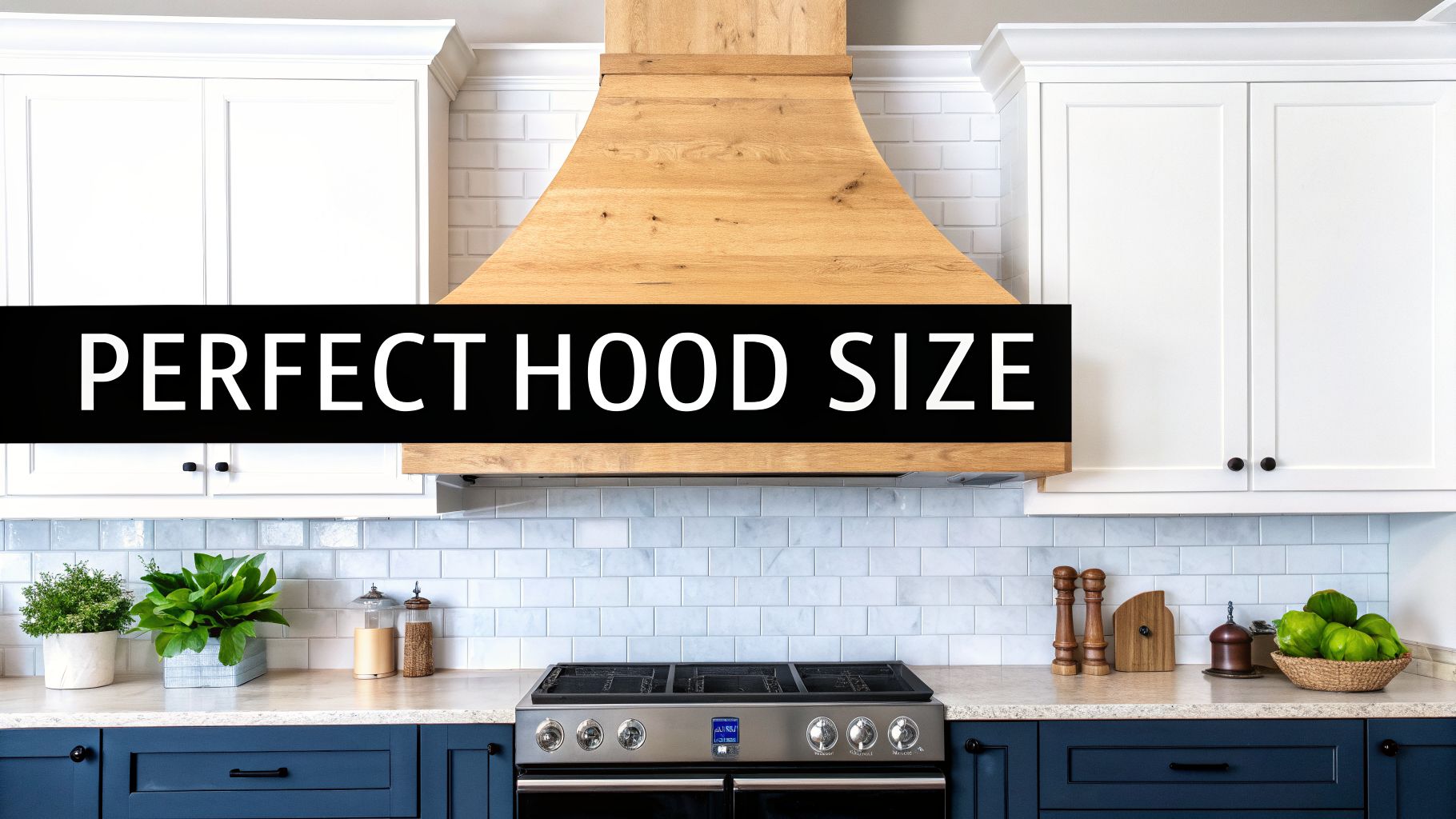
When it comes to choosing a kitchen range hood made of wood, getting the size right is probably the most important decision you'll make. It’s about more than just looks—it directly affects how well the hood actually does its job. A hood that’s too small will never keep up with smoke and cooking odours, while one that’s too big can throw off the entire visual flow of your kitchen.
The goal is to hit that sweet spot where form and function meet. I always tell my clients to think of their cooktop as the main stage. The range hood’s job is to act like a curtain, catching everything that rises from that stage. For that to work, the curtain simply has to be big enough.
The Width Rule
The most basic rule of thumb is that your wood range hood must be at least as wide as your cooktop. So, if you have a 30-inch cooktop, your range hood needs to be a minimum of 30 inches wide. This makes sure its "capture area" is wide enough to grab most of the steam and smoke.
But if you want truly great performance, it’s best to go a little bigger.
- Optimal Width: We recommend choosing a hood that is 3 to 6 inches wider than your cooktop. A 36-inch hood over a 30-inch range is a classic, effective pairing.
- Benefits: That extra overhang creates a much more effective capture zone. It catches the smoke and steam that naturally drift outwards, pulling them into the vent before they can escape into your kitchen.
That extra width doesn't just work better, it also looks better. It gives the range hood a strong, intentional presence, turning it into a beautiful visual centrepiece for the room.
The Height Rule
Where you hang the hood is just as crucial as its width. Mount it too low, and it becomes a clumsy obstacle and a potential fire hazard. Mount it too high, and its power to pull in smoke drops dramatically.
The sweet spot for mounting a wood range hood is between 30 and 36 inches above the cooking surface. This height offers the best combination of safety, comfortable headroom, and effective ventilation.
Making sure these dimensions work with your surrounding cabinets is the final piece of the puzzle. When the height and width are right, your wood range hood will look like it was custom-made for the space, without any strange gaps or misalignments. For a more detailed breakdown, you can learn more about the specifics of range hood height in our dedicated guide.
When you're mapping out a kitchen renovation, it’s natural for your mind to jump straight to the big-ticket items like cabinetry and countertops. But we’re seeing a major shift in what homeowners are prioritizing, and it’s happening right above the stove. The humble range hood is no longer an afterthought—it's become a central piece of the puzzle.
The numbers don't lie. During a kitchen overhaul, a whopping 61% of homeowners now upgrade their range hood, which makes it the fifth most-replaced appliance. This isn't just a random trend; it’s a clear sign that people are catching on to how crucial a good hood really is for a modern, functional kitchen. You can dig deeper into these kitchen appliance trends from Fortune Business Insights to see the full picture.
It’s Not Just an Appliance, It’s a Centrepiece
So, why the sudden focus on range hoods? It’s simple: people now get that a high-quality hood does more than just look good. It works hard every day to protect your home from lingering cooking smells and airborne grease, keeping your indoor air cleaner and healthier. At the same time, it can completely transform the look of your kitchen.
Choosing the right model, especially a kitchen range hoods wood design, is less of an expense and more of a long-term investment in your home. It’s what gives a kitchen that custom, high-end feel.
Think about it. A beautiful wood hood that matches or complements your cabinetry doesn’t just blend in; it elevates the entire room. It’s one of those details that signals true quality and thoughtful design, something future buyers will definitely notice.
This is one of the few upgrades that pays you back in two ways: it makes cooking more enjoyable day-to-day while also boosting your home's value. By putting the range hood high on your renovation list, you're making a smart move for your family's health and your property's future.
Common Questions About Wood Range Hoods
Even after getting all the details, it's normal to have a few more questions pop up. A custom wood range hood is a significant part of a kitchen renovation, so you want to be sure. Let's walk through some of the most common queries we get from homeowners, so you can feel completely confident in your choice.
It’s no surprise these questions are coming up more often. The demand for high-quality kitchen ventilation is on the rise across the country. In fact, Canada’s range hood market is growing quickly, thanks to the popularity of open-concept kitchens and a renewed focus on healthy indoor air. We see this trend firsthand in busy areas like Toronto and Markham, where kitchen renovations are a constant.
Are Wood Range Hoods Safe Over a Gas Cooktop?
This is a great question, and the answer is a definite yes—when they're installed properly. It’s not just a wooden box; there's a system in place. A protective metal liner fits inside the wood canopy, acting as a heat shield. This liner houses a powerful ventilation insert that’s matched to your stove’s output.
Finally, the entire hood must be mounted at the correct height, which is usually between 30 to 36 inches from the cooking surface. With these three elements working together, you get the beautiful look of kitchen range hoods wood without any safety trade-offs, even over a powerful gas range.
How Do I Clean and Maintain a Wood Range Hood?
You’ll be happy to hear that caring for a wood hood is pretty straightforward—it’s very similar to looking after your cabinets.
- The Wood Exterior: Simply wipe it down with a soft, clean cloth and a gentle cleaner that’s safe for wood finishes.
- The Vents Inside: The real workhorse is the metal filter (either baffle or mesh) inside the vent insert. These catch all the grease. Most can be popped right into the dishwasher and should be cleaned every 1 to 3 months, depending on how often you cook.
Following this simple routine is all it takes to keep grease from building up and ensure your ventilation system works like new.
The beauty of a wood range hood is that it’s designed to be a durable part of your kitchen, not a delicate decoration. With basic care, it will look and perform beautifully for many years.
Can a New Wood Hood Match My Existing Cabinets?
Absolutely. This is actually one of the biggest reasons people choose a custom wood hood. A good cabinet maker can create a perfect match for the wood species, door profile, and exact paint colour of your current cabinetry.
All you need to do is provide a sample, like a drawer front or a spare door. From there, your new hood can be finished to look like it was always part of the original design. It’s the key to achieving that seamless, high-end look that’s almost impossible to get with a standard metal hood from a big-box store.
Ready to find the perfect wood range hood that complements your cabinetry and elevates your kitchen's design? The experts at MapleKing Kitchen Cabinets can help you create a custom piece that combines stunning aesthetics with powerful function. Explore our gallery and get your free quote at https://maplekingkitchencabinets.com.