

Starting the hunt for new kitchen cabinets in Toronto can feel like a huge undertaking. Really, though, it all comes down to finding the sweet spot between three things: your personal style, how you actually use your kitchen day-to-day, and what your budget can handle. Think of this guide as your roadmap to making smart choices you’ll be happy with for years to come.
Your Toronto Kitchen Cabinet Journey Starts Here
A kitchen reno is easily one of the most satisfying home projects you can tackle. It completely changes the feel of your home's central hub. But let's be honest—the sheer volume of choices across the GTA, from slick downtown condo kitchens to sprawling Markham family homes, can make your head spin.
Getting a handle on the local market is the first real step to a project you'll love. This guide is designed to cut through the noise and focus on what really counts when you're choosing kitchen cabinets in Toronto. We're here to make sure your investment pays off in both value and daily enjoyment.
What We’ll Cover
We’ve laid this guide out to walk you through the process one step at a time, turning what seems complicated into a series of clear decisions. Here’s a peek at the essential topics every Toronto-area homeowner needs to think about:
- Cabinet Types & Materials: We'll break down the real differences between stock, semi-custom, and fully custom cabinets and help you pick materials that can stand up to your family's lifestyle.
- Local Pricing & Budgeting: Get a realistic picture of what things cost in the GTA. We’ll look at materials, installation, and all those little expenses that can sneak up on you.
- Layouts & Customization: Learn how to make your kitchen work smarter, not harder. We'll explore ideas for maximizing flow and storage, no matter how much (or how little) space you have.
- Installation & Timelines: Find out what to expect for lead times so you can plan your renovation without any last-minute surprises.
At the end of the day, picking cabinets is about creating a space that’s uniquely yours. It’s where good looks meet everyday practicality. Once you nail down the basics, you can sidestep the common headaches and find a solution that fits your vision and your wallet.
Our goal is to give you the confidence to move forward. We'll also look at how factory-direct cabinet solutions can be a savvy alternative to the big box stores. By going straight to the source, you can often get better quality and more customization for your money.
Let’s get started on building the kitchen you’ve been dreaming of.
Picking out new kitchen cabinets can feel a lot like buying a new suit. You can grab one right off the rack, have one tailored for a better fit, or commission a completely custom-made piece from scratch. Each approach offers a different mix of cost, personalization, and waiting time, and figuring out these differences is your first big step to finding the perfect match for your Toronto home.
Ultimately, your decision will come down to the three pillars every successful renovation is built on: style, function, and budget.
This infographic breaks down these core elements that will guide every choice you make.
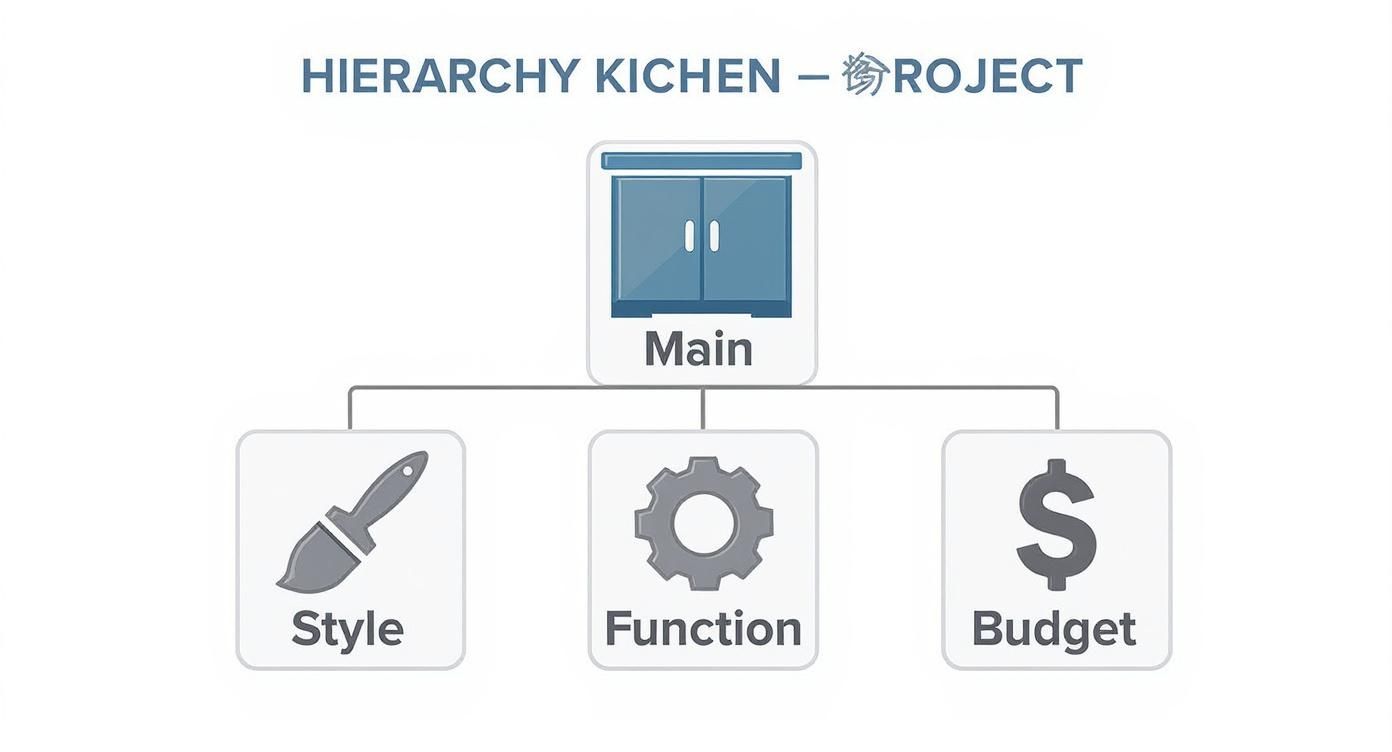
The real secret to a kitchen you'll love for years is finding the sweet spot where your aesthetic vision, day-to-day needs, and financial plan all meet. This simple framework will help you make clear, confident decisions as you shop for kitchen cabinets in Toronto.
The Three Tiers Of Cabinetry Explained
First things first, let's break down the main categories you'll find out there. Just like with the suit analogy, each one is designed for a different need and price point.
- Stock Cabinets (The Off-the-Rack Suit): These are the ready-to-wear option. They're mass-produced in standard sizes and a limited range of finishes. They are by far the most affordable choice and have the shortest lead times—you can often get them immediately. The trade-off? Your options for sizes, colours, and styles are pretty restricted.
- Semi-Custom Cabinets (The Tailored Suit): This is the popular middle ground. You start with a standard cabinet foundation but get access to a much wider array of modifications. Think different door styles, a broader palette of finishes, and more clever storage features. This option gives you a fantastic blend of personalization and value.
- Fully Custom Cabinets (The Bespoke Suit): If you can dream it, you can build it. These cabinets are made from the ground up to your exact specifications, offering limitless possibilities in size, material, style, and finish. They're the perfect solution for tricky, unconventional kitchen layouts or for creating a truly one-of-a-kind look. Naturally, they also come with the highest price tag and the longest production time.
The table below offers a quick comparison to help you weigh your options based on what matters most to your project.
Comparing Cabinet Construction Types
| Cabinet Type | Customization Level | Typical Cost Range | Best For |
|---|---|---|---|
| Stock | Low | $–$$ | Budget-conscious projects, standard layouts, quick turnarounds. |
| Semi-Custom | Medium | $$–$$$ | Homeowners wanting more style choices and a better fit without a full custom budget. |
| Fully Custom | High | $$$–$$$$ | Unique layouts, specific design visions, and homeowners who want total control. |
Choosing between these tiers is a classic balancing act. It all comes down to how much you value unique design versus how tight your budget and timeline are. For many homeowners in the GTA, a factory-direct solution hits that perfect sweet spot, delivering custom-level quality and flexibility without the steep bespoke price.
Popular Cabinet Styles In Toronto Homes
From modern condos in Liberty Village to classic family homes in North York, a few cabinet styles have really become local favourites because they just work. They're versatile, timeless, and look great in almost any setting.
The undisputed champion is the Shaker cabinet. It’s defined by its simple, clean lines—a classic five-piece door with a recessed centre panel—and it has an incredible ability to bridge the gap between traditional and contemporary design. Its minimalist look makes it the perfect canvas for all kinds of hardware and colour choices.
For a sleeker, more modern aesthetic, flat-panel or slab doors are the go-to. Their single, unadorned surface creates a smooth, seamless appearance that’s ideal for minimalist kitchens. This style really puts the focus on the material and finish, whether that’s a high-gloss white for a futuristic feel or a warm, textured wood laminate for a touch of organic modernism.
It's a big business, too. The kitchen cabinet manufacturing industry in Canada is a major economic player, generating around CAD 1.5 billion in annual sales, largely driven by residential projects in hot markets like Toronto.
Choosing The Right Materials and Finishes
The material you choose for your cabinets is more than just a look; it dictates their durability and how they feel to the touch. Solid wood is, of course, a timeless choice loved for its natural beauty and strength, but today’s engineered materials offer incredible performance and value.
Modern, durable options like high-density fibreboard (HDF) and high-quality laminates are exceptionally resistant to the daily grind of a busy kitchen. Thermofoil, which is a vinyl laminate that’s heat-sealed over an HDF core, is another fantastic choice. It creates a seamless, non-porous surface that’s a breeze to clean and stands up beautifully to moisture.
For a deeper dive into what might work best for your home, check out our guide on the best materials for kitchen cabinets to see how they stack up.
Budgeting for Kitchen Cabinets in the GTA
Before you even think about door styles or colours, the first and most important step is figuring out your budget. When it comes to kitchen cabinets in Toronto, Ontario, the price range is huge. Getting a handle on what drives those costs will save you from major sticker shock later on.
Your budget is your roadmap. It’ll guide every single choice you make, from the materials you pick to the fancy pull-out pantry you've been dreaming of.
A huge chunk of your budget will come down to the type of cabinet you choose. As we've covered, stock cabinets are your most wallet-friendly option, while fully custom cabinetry sits at the top end of the price scale. Semi-custom cabinets often hit that sweet spot in the middle, giving you a good dose of personalization without the bespoke price tag.
Naturally, the size of your kitchen—measured in linear feet—is another big factor. More kitchen means more cabinets, which means more material and labour. It's a simple equation, and it’s why getting accurate measurements is non-negotiable before you start calling around for quotes.
Understanding the Main Cost Drivers
Beyond the basics of cabinet type and kitchen size, a few other key details can really move the needle on your final bill. Knowing what they are lets you decide where you want to save and where you feel it's worth it to splurge.
- Material Selection: The material you choose creates a wide cost spectrum. You could go for HDF, thermofoil, laminate, or solid wood, and each has a different price point. While many people automatically think solid wood is best, modern materials like high-quality HDF offer incredible durability and a perfect finish at a much more accessible price.
- Finish and Style: The more complex the finish, the higher the cost. Think about multi-step glazes or a super high-gloss look—these require more time and specialized work. The same goes for door styles. An intricate door with lots of detailed moulding will cost more than a clean, simple Shaker or slab door.
- Hardware and Accessories: Think of hardware as the jewellery for your cabinets. You can find basic, affordable knobs, or you can opt for high-end designer pulls that can add hundreds, if not thousands, to your total. Don’t forget the inside, either. Things like pull-out pantries, lazy Susans, and custom drawer organizers add to the cost but make a world of difference in how your kitchen functions.
The demand for quality kitchen upgrades isn't slowing down. The North American kitchen cabinet and countertop market is massive, valued at USD 394 billion and on track to hit USD 408 billion, mostly thanks to residential remodelling. This just goes to show how much homeowners are willing to invest in their kitchens. You can dive deeper into these market trends and projections.
Uncovering the Hidden Costs
The number you see on an initial quote is rarely the final number you'll pay. A smart budget plans for all the "hidden" expenses that are essential to actually getting the job done. Forgetting these can throw your finances off track fast.
Always ask potential suppliers for a detailed breakdown of what is—and what is not—included in their estimate. Clarity upfront prevents costly surprises down the road.
Make sure your budget has room for these potential add-ons:
- Demolition and Removal: You have to get rid of the old before you can bring in the new. Tearing out and hauling away your old cabinets isn't always part of the deal and can cost anywhere from a few hundred to over a thousand dollars.
- Professional Installation: This is a big one, often adding up to 10-20% of your total cabinet cost. While a DIY installation might seem tempting, pros ensure everything is perfectly level and aligned, and their work usually comes with a warranty.
- Taxes and Delivery: Don't forget to add HST to your calculations! Delivery fees can also add up, especially if you have a large order or live in a tricky-to-access spot like a downtown condo.
- Related Renovations: New cabinets often have a domino effect. You might suddenly need a plumber to move a pipe, an electrician for under-cabinet lighting, or some drywall patching. Each of these trades comes with its own bill.
Smart Layouts for Modern Toronto Kitchens
Beautiful cabinets are one thing, but their real magic is unlocked by a smart layout. An intelligent design can make your kitchen feel bigger, flow better, and just be a more enjoyable place to be. If you're looking for kitchen cabinets in Toronto, Ontario, thinking about workflow right from the start is the secret to a renovation that actually works for your life.
Whether you're in a sprawling Markham house or a tight downtown Toronto condo, the right layout turns daily chores into effortless activities.
Mastering Popular Kitchen Layouts
The heart of any great kitchen design is the "work triangle"—the path between your sink, stove, and fridge. Different layouts handle this triangle in unique ways, and each one has its pros and cons depending on your space and cooking style.
- The L-Shape Layout: A true classic. This layout runs cabinets and appliances along two adjacent walls. It’s perfect for open-concept homes because it naturally opens up the kitchen to a dining or living area, leaving plenty of room for an island or table.
- The U-Shape Layout: Need storage and counter space? The U-shape uses three walls to give you a ton of both. It's a dream for serious cooks who want everything at their fingertips, but be warned—it can feel a bit boxed-in if the room is too narrow.
- The Galley Layout: You'll see this a lot in condos and older, smaller homes. It's essentially two parallel rows of cabinets that create an efficient corridor. It might be compact, but it's a powerhouse of efficiency, minimizing the steps you take while cooking.
So, which one is for you? It really comes down to your home's footprint. An L-shape won't fit a long, narrow room, and a U-shape can be overkill for a small household. The goal is always to match the layout to your space and how you actually live.
Clever Storage for City Living
In a place like Toronto, every square foot matters. That's why smart storage isn't just a nice-to-have; it's a necessity. Modern cabinetry has moved way beyond simple shelves. Today, it’s all about using clever hardware to squeeze function out of every last centimetre.
Think of it this way: a standard cabinet is like an empty room, but a cabinet with built-in organizers is like a fully furnished, functional space. The difference is night and day.
Smart storage is what keeps your kitchen uncluttered and efficient. It transforms those awkward, hard-to-reach corners and deep cabinets into genuinely useful assets.
Here are a few game-changers to consider for your cabinet design:
- Pull-Out Pantries: These tall, skinny units slide out to reveal all your dry goods at a glance. They pack a ton of storage into a tiny footprint.
- Lazy Susans or Magic Corners: Finally, a solution for the dreaded corner cabinet! These brilliant mechanisms swing, slide, or spin to bring everything from the back right out to you.
- Integrated Recycling Centres: Keep your bins hidden away inside a cabinet on smooth pull-out sliders. It keeps the kitchen looking clean and makes sorting a breeze.
- Deep Drawers: Forget digging around in lower cabinets. Deep, wide drawers are far better for storing pots, pans, and even small appliances, giving you a top-down view of everything inside.
The Rise of the Smart Kitchen
Beyond the physical layout, today's kitchens are getting a tech upgrade. Smart features are no longer sci-fi—they're practical additions that make daily life easier. This is especially true here in Toronto, where technology is quickly reshaping what people expect from their homes. For example, adding smart connectivity can tack on a 10-15% premium to appliance costs, which often means an extra CAD 300 to CAD 800 per unit. You can get a deeper look into these appliance pricing trends in Toronto's market.
Even the cabinets themselves are getting smarter. You can now get built-in charging stations tucked away in drawers to banish counter clutter, or motion-activated LED lighting that illuminates the inside of a cabinet the moment you open it. These thoughtful touches elevate your kitchen from a simple workspace to a responsive, highly functional environment built for modern life.
Choosing Sustainable Materials and Planning Your Timeline
Once you’ve wrestled with layouts and finishes, there are two big-picture items that can make or break your kitchen renovation: the materials you choose and the realism of your timeline. For a growing number of homeowners looking for new kitchen cabinets in Toronto, Ontario, building an eco-conscious space is just as important as how it looks. On the flip side, nothing derails a project faster than a timeline that was never realistic to begin with.
Tackling these two things early on is your best defense against some of the most common renovation headaches. It helps ensure your new kitchen not only feels good to be in but was built with integrity—and without those maddening, unexpected delays.
Embracing Eco-Friendly Cabinetry
What does "sustainable" cabinetry even mean? It’s not just about using recycled wood. It’s a bigger idea focused on creating a healthier home and supporting manufacturers who do things the right way. The goal is to choose materials that are kinder to the planet and, just as importantly, improve the air your family breathes.
A huge part of this comes down to low-VOC (Volatile Organic Compound) finishes. VOCs are chemicals in many paints, stains, and lacquers that "off-gas" into your home, impacting air quality. Simply choosing a low-VOC or zero-VOC option is a major step toward a healthier kitchen.
Choosing sustainable materials is an investment in your home's long-term well-being. It means selecting products that are durable, non-toxic, and sourced with care, contributing to a space you can feel genuinely good about.
Here are a few popular green options to bring up with your cabinet supplier:
- FSC-Certified Wood: The Forest Stewardship Council (FSC) stamp of approval is a big deal. It guarantees the wood for your cabinets was harvested from a responsibly managed forest, which helps protect wildlife and support local communities.
- Bamboo: It looks like wood, but it’s actually a type of grass that grows incredibly fast. This makes it a fantastic renewable resource. Plus, it’s surprisingly strong and durable, offering a clean, modern aesthetic.
- Engineered Wood Products: Don’t dismiss engineered wood. High-quality options like certain grades of HDF (High-Density Fibreboard) are a smart, eco-friendly choice when they’re made from recycled wood fibres and bonded with low-emission glues.
Mapping Out Your Renovation Timeline
Ask anyone who has renovated a kitchen, and they’ll tell you that timeline blowouts are the number one cause of stress. To avoid this, you need a firm grasp on the typical lead times for kitchen cabinets right here in the Toronto market. This knowledge is your key to lining up your contractor, plumber, and electrician without chaos.
The waiting period almost always comes down to the type of cabinet you order. Each level of customization has its own production schedule. If you want to dive deeper into how good planning prevents problems, you can read our thoughts on how perfect practice makes perfect in any major project.
Here’s a realistic guide to what you can expect in the GTA:
- Stock Cabinets: This is your fast track. Because they're already built and sitting in a warehouse, you can often get them almost immediately. Lead times usually range from immediate pickup to about 2 weeks.
- Semi-Custom Cabinets: As the happy medium, these offer some personalization, but that means they need to be assembled or modified to your order. Plan for a lead time of roughly 6 to 10 weeks.
- Fully Custom Cabinets: Built entirely from scratch just for you, these require the most patience. The typical wait for custom kitchen cabinets in Toronto, Ontario is anywhere from 8 to 14 weeks, and it can stretch even longer during the busy spring and fall seasons.
Before you sign on the dotted line, get that timeline confirmed in writing from your supplier. Factoring this wait into your master plan from the very beginning is the secret to preventing a domino effect of delays down the line.
How to Get Accurate Quotes and Avoid Common Pitfalls
Getting quotes for new kitchen cabinets in Toronto, Ontario, can feel like the most stressful part of a renovation. This is where the budget gets real, and it’s your best chance to avoid nasty surprises down the road. A good quote isn't just a number; it’s a detailed blueprint for your project, spelling out exactly what you get, what it costs, and who handles what.
To get a quote you can actually rely on, you need to give potential suppliers solid information to work with. Vague requests will only get you vague estimates. A little prep work from you goes a long way.

Preparing for Your Quote Request
Before you even think about picking up the phone, pull together the essentials. You're basically creating a project package that ensures every company is quoting on the very same kitchen. This is the only way to compare apples to apples later.
Your package should include:
- Accurate Measurements: Sketch out your kitchen’s layout. Get precise wall measurements, mark where windows and doors are, and note the ceiling height. Don't forget to show where your current plumbing and electrical outlets are.
- Inspiration Photos: A picture really is worth a thousand words here. Share photos of kitchens you’ve found online that capture the style, colour, and overall vibe you’re after.
- A Wish List: Get specific about your must-haves. Do you dream of a pull-out pantry? Are deep pot-and-pan drawers a non-negotiable? Need an integrated recycling centre? Make a clear list of your priorities.
With this information ready, you can approach suppliers with confidence, knowing you’ve done your homework.
Critical Questions to Ask Every Supplier
Trust me, not all quotes are built the same. A low price can be tempting, but it often means they've left out key services or are quoting lower-quality materials. To really understand what you’re being offered, you need to ask every single supplier the same set of pointed questions.
A detailed, written quote protects both you and the supplier. It sets clear expectations from day one. If a company is cagey about putting specifics in writing, that’s a huge red flag.
Make sure every quote you get spells out the answers to these questions:
- What material are the cabinet boxes made from? (Is it plywood or particleboard/MDF?)
- And what about the doors and drawer fronts? (Are they solid wood, HDF, thermofoil?)
- Are installation and delivery costs baked into this price? If not, what are those charges?
- What kind of hardware is included? (Are we talking standard or soft-close hinges and drawer slides?)
- What’s the warranty on the cabinets themselves and on the installation work?
- Does this price include tearing out and getting rid of my old cabinets?
- What’s the real lead time from the day I order to the day of delivery?
Asking these questions helps you see the true value behind the price tag. You'll quickly learn that finding the right partner is about more than just the bottom line; it's about clear communication and trust. For more tips on this, check out our guide on how to choose the best kitchen cabinets contractor in Toronto.
Vendor Quote Comparison Checklist
To make this even easier, use this checklist. It will help you see everything side-by-side and ensure you're making a fair, informed comparison.
| Checklist Item | Vendor A | Vendor B | Vendor C |
|---|---|---|---|
| Total Project Cost | |||
| Cabinet Box Material | |||
| Door/Drawer Front Material | |||
| Hardware Type (Soft-Close?) | |||
| Delivery Cost Included? | |||
| Installation Cost Included? | |||
| Old Cabinet Removal/Disposal? | |||
| Countertop Installation? | |||
| Cabinet Warranty (Years) | |||
| Installation Warranty (Years) | |||
| Estimated Lead Time |
By filling this out for each quote, you'll get a crystal-clear picture of which offer provides the best overall value for your specific project.
Common Pitfalls to Avoid
Even with great quotes in hand, homeowners can easily stumble into a few common traps. The single biggest mistake? Not getting physical samples. A colour you love on a website can look completely different under the actual lights in your home. Always bring door samples home and look at them at different times of the day.
Another classic oversight is not clarifying the installation plan. You have to know who is responsible for coordinating with other trades, like your plumber or electrician. A smooth installation depends on a well-managed schedule, and you need to know if that falls to you or your cabinet supplier. By being proactive and asking these questions upfront, you set yourself up for a much smoother journey from quote to completed kitchen.
Your Top Questions About Toronto Kitchen Cabinets Answered
When you're renovating a kitchen in the GTA, you've got questions. And not just any questions—ones specific to our city, our climate, and our homes. What's a realistic timeline? Do I really need a permit for that? Let's clear up some of the most common questions we hear from homeowners just like you.
Think of this as your go-to cheat sheet for navigating the nitty-gritty details of your kitchen project.
What’s the Average Wait Time for Custom Kitchen Cabinets in Ontario?
For fully custom kitchen cabinets in Toronto, you’re typically looking at a lead time of 8 to 14 weeks from the moment you sign off on the final design. This window can shift a bit depending on how busy your chosen manufacturer is and if the materials you’ve selected are readily available.
Need them a bit faster? Semi-custom cabinets can be a great compromise, often landing in the 6 to 10 week range. And if you're in a real time crunch, in-stock cabinets can sometimes be ready for pickup almost immediately or within a week or two. The key takeaway? Always get a firm delivery date in writing from your supplier before you commit.
Do I Need a Permit to Replace My Kitchen Cabinets in Toronto?
Probably not, if it's a straightforward swap. If you're simply replacing old cabinets with new ones in the exact same spot without changing the kitchen's footprint, the City of Toronto generally doesn't require a permit.
But here’s the catch: the second your project touches structural, plumbing, or major electrical work, you'll need to get a permit. Thinking of knocking down a wall, moving the sink, or adding new outlets for under-cabinet lighting? You'll almost certainly need to file for a permit first.
When in doubt, it’s always best to make a quick call to the city’s building department to be sure. It's a small step that can save you a massive headache down the road.
Is Plywood Really Better Than Particleboard for Cabinet Boxes?
In a word, yes. Plywood is hands-down the superior choice for cabinet boxes, especially when you're thinking long-term. It's built from thin layers of wood veneer glued together, which creates a box that’s incredibly strong, surprisingly light, and much better at handling moisture. In a steamy, hardworking kitchen, that matters.
Particleboard (which includes its cousin, MDF) is made from compressed wood bits and resin. It’s certainly a more budget-friendly option, but it comes with trade-offs. It's heavy, and more importantly, it's like a sponge around water. If it gets wet, it can swell up and fall apart. For the cabinets around your sink and dishwasher, plywood isn't just an upgrade—it's peace of mind.
Ready to bring your dream kitchen to life with cabinetry that perfectly balances quality, customization, and cost? At MapleKing Kitchen Cabinets, we skip the middleman, offering factory-direct pricing on premium, made-to-order solutions for your Toronto or Markham home.
Explore our stunning collections and get your free, no-obligation quote today!



