

Kicking off a kitchen renovation is one of the most exciting projects you can take on. But let's be honest, staring down the long list of potential kitchen cabinet manufacturers can feel like a monumental task. This guide is designed to be your clear, straightforward roadmap. We'll cut through the noise and explain the real differences between the big-box stores, local craftspeople, and factory-direct suppliers so you can find a partner who truly gets your vision and delivers on craftsmanship, quality, and fair pricing.
Finding the Right Kitchen Cabinet Manufacturer
Choosing your kitchen cabinet manufacturer is hands-down the most critical decision you'll make for your renovation. It’s the choice that sets the tone for everything else, from the look and feel of your space to your budget and project timeline. Think of it less like a purchase and more like picking a business partner. The right one makes the entire process feel seamless and rewarding, while the wrong one can cause endless headaches.
We've created this guide to give you an insider's perspective on the cabinet industry. Our goal is to demystify the options so you can confidently pick a manufacturer that aligns perfectly with what you want to create. A smart choice from the get-go is the surest way to turn that dream kitchen in your head into a beautiful, functional reality, without the common nightmares of blown budgets and delayed timelines.
Setting the Stage for Success
The first step is realizing that no two manufacturers are the same. Their business models, how they build their cabinets, and the level of service they provide can be worlds apart. Once you grasp these differences, you’ll be in a much better position to ask the right questions and properly weigh your options.
- Big-Box Retailers: They offer convenience and a predictable range of choices, but you might find they can't accommodate truly custom or unique design ideas.
- Local Artisans: You’ll get unparalleled craftsmanship and a highly personal experience, but that bespoke quality often comes with a premium price tag.
- Factory-Direct Suppliers: This model cuts out the middlemen, often creating a sweet spot that balances custom design, direct quality control, and better overall value—a powerful mix for any homeowner.
The real goal here is to find a partner who can take your ideas and turn them into a solid, high-quality product. That means looking past the initial price quote to consider the long-term value, the durability of the materials, and the quality of service you’ll get.
Why Your Choice Matters
The ripple effect of your manufacturer choice goes far beyond the cabinets themselves. A reputable partner ensures materials are sourced with care, project timelines are respected, and the final installation is done to a professional standard. For homeowners in the Greater Toronto Area, finding cabinet companies near you can bring added benefits, like quicker service and a team that already understands local design tastes and building codes. This guide will give you the framework to navigate it all with confidence, making sure your investment is one you’ll be happy with for years.
Where Do Kitchen Cabinets Actually Come From? A Buyer's Guide
Figuring out who to buy your kitchen cabinets from can feel overwhelming. To make sense of it all, let’s compare it to buying a suit. You’ve got different paths depending on your budget, how fast you need it, and whether you want a perfect, tailored fit or something that just works.
Each type of manufacturer offers a different trade-off between speed, cost, and personalization. Once you understand the landscape, you can confidently pick the right path for your project. The options range from grab-and-go solutions to completely bespoke creations, with some newer approaches offering a smart mix of both.
Stock Cabinets: The Off-the-Rack Solution
Think of stock cabinets as the ready-to-wear suit you’d find at a department store. They’re mass-produced in standard sizes, styles, and a limited range of finishes. You’ll find them at big-box home improvement stores, ready for immediate pickup or quick delivery.
Their main draw is affordability and speed. If your renovation is on a tight deadline or an even tighter budget, stock cabinets are often the default choice. But that convenience comes with trade-offs. You're stuck with the sizes they offer, which often means awkward gaps and wasted space if your kitchen isn't perfectly standard.
- Best For: Quick flips, rental properties, and anyone needing a kitchen done yesterday.
- Drawback: Limited customization, often basic quality, and a reliance on unsightly filler strips to close gaps.
Semi-Custom Cabinets: A Tailored Approach
Semi-custom cabinets are the next step up. This is like buying a good quality suit off the rack and then having a tailor alter it for a much better fit. You start with a standard cabinet footprint but get way more say in the final product. We’re talking a wider selection of door styles, finishes, hardware, and clever storage add-ons.
This middle path gives you a lot more design freedom. For instance, you might be able to change a cabinet's depth to fit a shallow wall or choose from a much larger palette of paint colours. That extra touch of personalization helps create a more polished, integrated look without jumping to the premium cost of full custom work.
Custom Cabinets: The Bespoke Experience
This is the pinnacle—the equivalent of a truly bespoke, made-to-measure suit. With custom cabinets, every single piece is built from the ground up to your exact vision. There are no "standard" sizes to worry about. If you can imagine it, a custom cabinet maker can bring it to life. This is the realm of rare wood species, handcrafted details, and solutions designed to fit seamlessly into any nook, cranny, or architectural quirk.
The real magic of custom work is total creative freedom. You have complete control over materials, dimensions, style, and finish, guaranteeing a kitchen that is uniquely yours. Of course, this level of artistry takes more time and requires a significantly larger investment.
It's clear that more and more homeowners are choosing this route. The global market for custom cabinets is expected to grow from USD 7.36 billion in 2026 to USD 10.53 billion by 2035. This trend shows a real shift toward wanting unique, high-quality spaces. You can dive deeper into these market trends and projections in the full research report.
Factory-Direct: The Modern Alternative
A new model is shaking up these traditional categories: the factory-direct kitchen cabinet manufacturer. This approach cuts out the middlemen—the distributors, showrooms, and retailers—and connects you straight to the source. That direct line of communication with the people actually building your cabinets is a huge advantage.
By eliminating a few layers of markups, factory-direct workshops can often deliver a custom-quality product at a much more accessible price point. It’s a smart blend that gives you the tailored feel of custom work without the typical sticker shock. For homeowners here in Toronto and Markham, it means getting a bespoke, beautifully crafted kitchen is more achievable than you might think.
A Practical Guide to Cabinet Materials and Finishes
Choosing the right material for your kitchen cabinets is where the room's character really comes to life. It’s so much more than just picking a colour; you're deciding on texture, long-term durability, and even how the morning light will play across the surfaces. Think of it like choosing the right fabric for a custom piece of furniture—the material dictates the look, how it ages, and how it feels every single day.
This decision impacts everything from your cleaning routine to the future value of your home. A bustling family with kids needs something that can stand up to scratches and wipe clean in a second. On the other hand, a sleek, modern condo might call for a flawless, high-gloss finish to complete its minimalist look.
Let's walk through the most popular options you'll find from top-tier kitchen cabinet manufacturers.
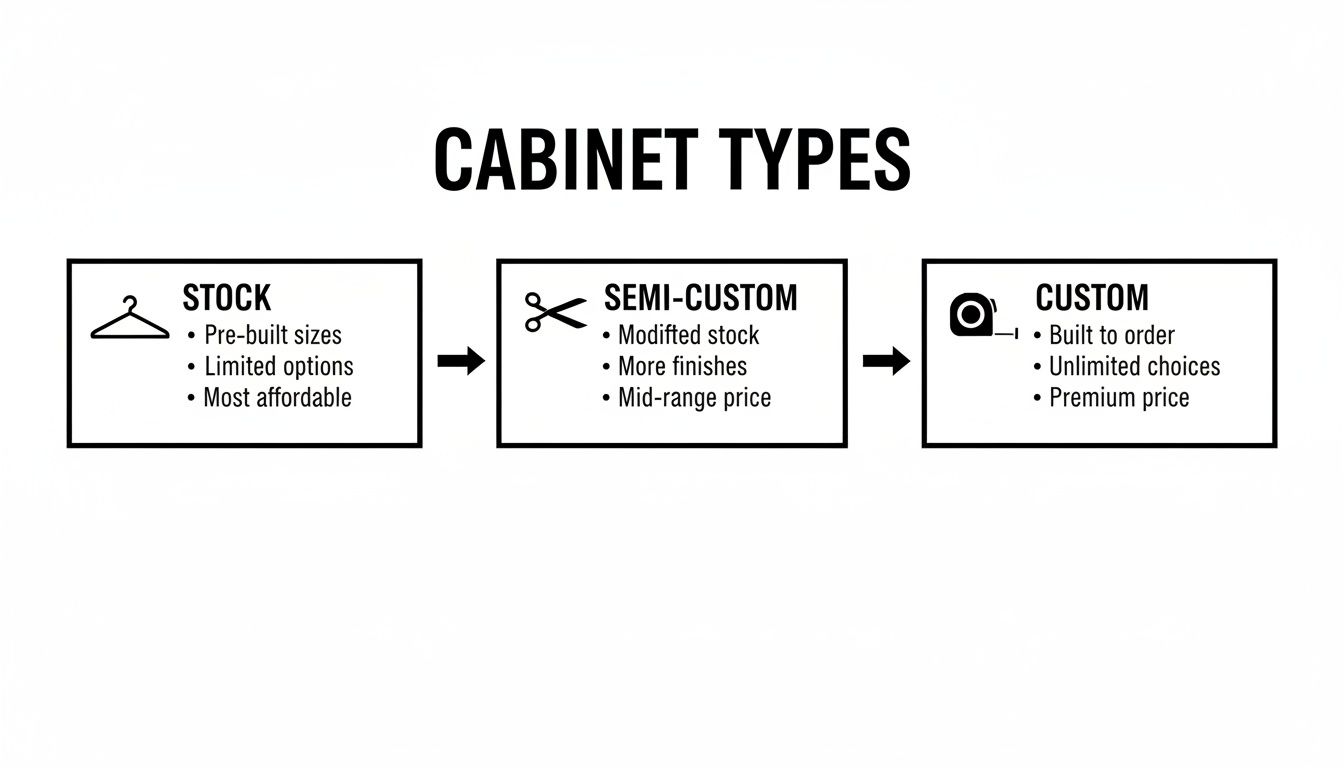
As you can see, each approach offers a different blend of cost, lead time, and personalization. Knowing these categories helps you find a manufacturer that perfectly aligns with your project's goals.
Real Wood: The Timeless Classic
There's just an undeniable warmth and authenticity that you get with real wood cabinets. Every piece has a unique grain, ensuring your kitchen is truly one-of-a-kind. Woods like maple, oak, and cherry are perennial favourites, and each brings its own distinct personality. Maple, for instance, has a fine, uniform grain that takes paint beautifully, resulting in a buttery-smooth finish.
But remember, wood is a natural material. It breathes—expanding and contracting with humidity changes. This can sometimes lead to hairline cracks in the paint at the joints over time. For many, that's part of its living charm, but it does require a bit more awareness compared to its engineered counterparts.
Painted HDF: A Flawlessly Smooth Finish
If you love the crisp look of painted cabinets but crave perfect uniformity, High-Density Fibreboard (HDF) is the absolute best-in-class choice. HDF is an engineered wood product, created by compressing wood fibres under immense pressure. The result is a dense, stable, and incredibly smooth surface that’s ideal for painting.
Because HDF is a single, stable panel without the joints or grain of solid wood, it won't expand or contract. This means a painted HDF door will resist cracking and keep its flawless finish for years, even in the humid environment of a kitchen.
Whether you're dreaming of a classic shaker style or a clean flat-panel door, painted HDF gives you a pristine canvas for any colour imaginable. It’s especially popular in contemporary designs where clean lines are everything. You can dive deeper into the pros and cons in our guide to the best materials for kitchen cabinets.
High-Gloss and Matte Finishes: The Contemporary Edge
So much of modern kitchen design comes down to the finish. High-gloss finishes, usually applied over an HDF core, create a sleek, mirror-like surface. They do an amazing job of reflecting light, which can make a smaller kitchen feel much larger and brighter. It’s the go-to look for minimalist, European-inspired spaces.
At the other end of the spectrum, matte finishes offer a soft, velvety texture that absorbs light, giving off a more subdued and sophisticated vibe. One of the biggest practical perks? Matte surfaces are fantastic at hiding fingerprints and smudges—a true game-changer in a busy family kitchen.
Laminate and Thermofoil: The Durable Workhorses
When durability and easy maintenance are at the very top of your list, laminate and thermofoil are tough to beat. And forget the plasticky laminates of the past; today’s technology has made them both stylish and incredibly resilient.
- Laminate: Made by fusing layers of paper and plastic resin, modern laminate is highly resistant to scratches, moisture, and stains. It comes in a huge range of colours and patterns, including some surprisingly convincing wood grains.
- Thermofoil: This is a vinyl film that’s heat-fused onto an HDF or MDF core. The process wraps the door seamlessly, creating a smooth surface that’s exceptionally easy to clean and holds up beautifully against daily wear and tear.
Both are budget-friendly choices that offer consistent colour and finish, making them a smart pick for high-traffic kitchens or rental properties. They are often the materials of choice for Ready-to-Assemble (RTA) cabinets, which have seen a surge in popularity as homeowners look for quick and cost-effective solutions. By going with a factory-direct manufacturer, you can often get these durable materials in a custom-fit design, giving you the best of both worlds.
Choosing the right cabinet material is a balancing act between aesthetics, lifestyle, and budget. This table breaks down the most common options to help you see which one might be the best fit for your home.
Cabinet Material and Finish Comparison Guide
| Material Type | Key Benefits | Best For | Maintenance Level |
|---|---|---|---|
| Solid Wood | Authentic, warm, unique grain, can be refinished | Traditional, transitional, and farmhouse kitchens; longevity | Moderate |
| Painted HDF | Flawless smooth finish, no cracking, stable, versatile | Modern, contemporary, and shaker styles; painted finishes | Low |
| High-Gloss | Reflects light, modern, easy to wipe clean, sleek look | Minimalist and European-style kitchens; small or dark spaces | Moderate |
| Matte Finish | Hides fingerprints, soft look, sophisticated, durable | High-traffic family kitchens; contemporary and industrial designs | Low |
| Laminate | Very durable, scratch-resistant, wide variety of colours | Budget-conscious projects, high-traffic areas, rental properties | Very Low |
| Thermofoil | Seamless finish, easy to clean, moisture-resistant | Laundry rooms, bathrooms, and busy kitchens; consistent colour | Very Low |
Ultimately, the best material is the one that not only looks great on day one but also stands up to the demands of your household for years to come. Take time to feel samples and envision how each surface will function in your daily life.
Let's be honest: this is often the most stressful part of any kitchen renovation. When you start getting quotes from different kitchen cabinet manufacturers, the numbers and timelines can feel all over the map. It’s tough to know what’s reasonable.
The key is to understand what actually drives those figures. Think of it like buying a car. There's a base price, but every feature—from the engine to the leather seats—changes the final number. Cabinetry is exactly the same. Your final price tag isn't just one big number; it's a reflection of all the small, important decisions you make along the way.
Decoding Your Cabinet Quote
So, what are the big levers that move the price up or down? When you look at an estimate, it’s really just a breakdown of your choices. Each one affects not only the cost but also how long it will take to get your new kitchen built.
Here’s what you’re really paying for:
- Material Selection: As we’ve covered, solid wood is going to be more of an investment than painted HDF or laminate. If you fall in love with a rare wood species or a specialty finish, that will naturally nudge the price higher.
- Level of Customization: Are you picking standard-sized cabinets off a shelf, or do you need something built to a very specific, unique dimension? The more bespoke the work, the more labour and precision are involved, and that’s reflected in the cost.
- Finish Complexity: A simple, single-colour paint job is fairly straightforward. A multi-step glazed finish or a high-gloss lacquer that needs days of buffing and polishing? That's a different story and a different price point.
- Hardware and Accessories: Those beautiful pulls, the whisper-quiet soft-close hinges, and clever interior organizers like pull-out pantries are all individual items that add up.
A good rule of thumb is to set aside 40% to 50% of your entire kitchen reno budget just for the cabinetry. It’s the biggest and most impactful piece of the puzzle, so you want to get it right.
Understanding Project Timelines
Once your design is locked in and you’ve given the green light, the clock starts ticking. A cabinet project has a few distinct phases, and knowing what they are helps manage expectations and keep your own schedule on track.
Demand in the home renovation sector can have a real impact on how long things take. In bustling markets, lead times can stretch out. For instance, in California, the Cabinet & Vanity Manufacturing industry hit a market size of $1.7 billion in 2026, a clear sign of a booming residential market. When demand is that high, you want to partner with a manufacturer who runs a tight ship. You can read more about the cabinet manufacturing industry's growth on ibisworld.com.
A typical project timeline usually breaks down like this:
- Design & Consultation (1-4 weeks): This is the creative phase where you nail down layouts, materials, and finishes with your designer.
- Manufacturing (4-12 weeks): Here’s the biggest variable. Stock cabinets might be ready almost immediately, while fully custom work is built from scratch and can take a few months.
- Delivery & Installation (3-7 days): Once your cabinets arrive, the pros get to work. Depending on the size of your kitchen, this can take anywhere from a few days to a full week.
The Factory-Direct Advantage
This is where working directly with the people who actually make your cabinets can be a game-changer. A factory-direct manufacturer cuts out the middleman—the retail showroom—and that has a massive impact on both your budget and your timeline.
By removing that retail markup, the savings are passed straight to you. It often means you can afford higher-quality materials or that extra bit of customization you thought was out of reach.
Even better, a direct line of communication streamlines everything. There are no miscommunications or delays passed down a long supply chain. The manufacturer controls the schedule from raw lumber to finished cabinet, which means more reliable lead times and a far smoother renovation experience for you.
For anyone planning a project in the Toronto or Markham area, this local, direct-to-factory approach can make a world of difference. To get a better handle on your own numbers, take a look at our detailed guide on what kitchen cabinets cost.
Essential Questions to Ask a Cabinet Manufacturer
Choosing the right partner for your kitchen renovation is a huge decision. To feel good about your choice, you need to look past the initial price quote. Asking the right questions is how you peel back the layers and really understand who you’re getting into business with.
Think of it like an interview for a critical role on your reno team—because that's exactly what it is. Their answers will tell you everything about their commitment to quality, how transparent they are, and whether they genuinely care about their customers. A great manufacturer will welcome your questions and give you straight answers.
Understanding Their Process and Materials
The first thing to dig into is the heart of their operation: how and where your cabinets are actually made. This speaks volumes about their quality control and how reliable their timelines are. If you get vague answers here, it could be a red flag for potential delays or inconsistent quality down the line.
Start with these basics:
- Where are your cabinets actually manufactured? A local facility, say, right here in the Greater Toronto Area, often means better oversight and much faster turnaround times if something needs to be remade. It also means you know exactly who is accountable.
- What is your typical lead time from final design approval to delivery? This is a make-or-break question for your contractor's schedule. A trustworthy manufacturer will give you a realistic timeline, not just the one they think you want to hear.
- Can you walk me through your construction process and joinery methods? You're listening for words like dovetail joints for drawers and solid box construction. These are signs of cabinets built to last.
- Where do you source your core materials like HDF and wood? A manufacturer who’s proud of their product will be happy to tell you where their materials come from, especially if they’re using sustainable, high-quality sources.
The key takeaway here is to listen for confidence and detail. A manufacturer that controls its own production, from sourcing the raw materials to the final assembly, has a much tighter grip on quality and can offer far more reliable timelines.
Clarifying Warranty and Service Policies
A warranty isn't just a piece of paper; it’s a direct measure of the manufacturer's confidence in their own work. A solid warranty shows they build cabinets to last and are ready to stand behind them for years to come. Don't be shy about getting into the nitty-gritty.
Here’s what to ask about their after-sale support:
- What does your warranty cover, and for how long? Get specific. Ask about the finishes, the hardware (like hinges and drawer slides), and the cabinet boxes themselves.
- What’s the process for a warranty claim if a door warps or a finish starts to peel? A clear, easy-to-follow process is the sign of a company that puts its customers first.
- Who handles the installation? Do they have their own trusted team, or do they hire subcontractors? An in-house team usually means a higher, more consistent standard of work.
To help you keep everything organized, we've put together a simple checklist. Think of it as your cheat sheet for vetting potential partners.
Manufacturer Vetting Checklist
Use this table during your consultations to compare manufacturers apples-to-apples. A good partner will have no trouble providing clear, confident answers to every one of these questions.
| Category | Question to Ask | What to Look For in the Answer |
|---|---|---|
| Manufacturing & Sourcing | Where are the cabinets fabricated? | Local manufacturing (e.g., in the GTA) for better quality control and faster service. |
| What are your typical lead times? | A specific, realistic timeframe (e.g., 6-8 weeks) and transparency about potential delays. | |
| Can you describe your joinery methods? | Durable techniques like dovetail or dowel joints, not just staples or glue. | |
| Where do you source your HDF, wood, and hardware? | A clear supply chain, with bonus points for sustainable or North American sourcing. | |
| Quality & Durability | What materials do you use for cabinet boxes vs. doors? | High-density materials for durability; consistency between samples and final product. |
| What kind of hardware (hinges, slides) do you use? | Reputable brands (like Blum or Hettich) known for their lifetime performance. | |
| What is your finishing process like? | Multi-step processes (e.g., catalyzed conversion varnish) for a tougher, longer-lasting finish. | |
| Warranty & Support | Can I see a copy of your full warranty? | A comprehensive warranty that clearly covers defects in materials and workmanship. |
| What is the process for making a claim? | A straightforward, customer-friendly process without a lot of hoops to jump through. | |
| Who will be installing the cabinets? | An experienced, in-house installation team is ideal for accountability. |
Asking these questions helps you measure the true, long-term value of your investment. A reputable kitchen cabinet manufacturer knows this is a partnership, not just a sale. This kind of proactive approach ensures you find a reliable partner who will not only bring your vision to life but also be there to support you long after the project is finished.
Your Next Steps to a New Kitchen
You’ve done the homework. By now, you should have a solid grasp of the different kitchen cabinet manufacturers out there, a feel for the materials that catch your eye, and a realistic budget in mind. You're ready to take those initial sparks of inspiration and turn them into a concrete plan, equipped with the right questions for any supplier you meet.
It's also clear why going with a local, factory-direct manufacturer can be such a game-changer. That direct line to the people actually making your cabinets often means more personalized design, tighter quality control, and better value for your money. It’s a smart way to get a custom-built kitchen without the layers of middlemen and their markups.
From Planning to Action
Now for the exciting part: moving from research to reality. This is where you start to bring your vision to life.
Here's a simple checklist to get you started:
- Gather Your Inspiration: Start a collection of images, colour swatches, and layouts that you absolutely love. Think of it as your personal mood board—it’s the single best tool for communicating your vision to a designer.
- Visit a Showroom: There’s simply no substitute for seeing and touching the materials yourself. You can’t get a true sense of a matte finish or the deep lustre of high-gloss from a screen. This step makes your choices real.
- Schedule a Consultation: Book a one-on-one meeting to dive into the details of your project. This is your chance to share all that inspiration, ask your list of questions, and get an expert’s take on what’s possible in your space.
Taking these steps transforms what can feel like a massive undertaking into a series of manageable, even enjoyable, tasks. You’re no longer just dreaming about a new kitchen—you’re actively building it, step by step.
Once you’ve landed on the perfect cabinets, it's worth thinking about the bigger picture, especially if you have resale value on your mind. Understanding the art of staging in a kitchen can make a huge difference in how the finished space is perceived.
A Few Common Questions About Kitchen Cabinets
Stepping into the world of kitchen cabinets can feel a bit overwhelming. Let's clear up some of the most common questions homeowners run into so you can feel more confident about your renovation.
What’s the Real Difference Between Custom and Semi-Custom?
Think of it this way: semi-custom cabinets are like buying a great suit off the rack and having it tailored. You’re starting with standard sizes and designs but get to choose from a pretty wide menu of door styles, finishes, and hardware to make it your own. It’s a fantastic way to get a personalized feel without the price tag of a fully bespoke project.
Fully custom cabinets, on the other hand, are the sartorial equivalent of having a suit made just for you, from scratch. There are no "standard" sizes. Every single cabinet is built to the exact dimensions of your space, maximizing every inch. This is the perfect route for kitchens with quirky layouts or for anyone with a very precise vision. Naturally, this level of personalization means a higher cost and longer wait. A factory-direct manufacturer can often blend these two worlds, giving you that custom fit and finish at a more competitive price point.
Why Does Local Manufacturing Matter?
Choosing a manufacturer who builds their cabinets right here in the Greater Toronto Area comes with some serious perks. For starters, logistics and communication are a breeze. If a measurement is slightly off or a panel gets damaged during installation, the fix is just a short drive away—not sitting in a shipping container on the other side of the country. This simple fact can save you from massive delays.
More importantly, local production means a hands-on approach to quality. When a company controls the entire process in their own shop—from cutting the first piece of HDF to spraying the final coat of paint—they have total authority over the craftsmanship and durability of your investment.
What Should I Actually Look for in a Cabinet Warranty?
A warranty tells you a lot about how much a manufacturer stands behind their work. Don’t just look at the number of years; dig into the details of what’s covered.
A solid warranty will always specify its coverage for:
- Workmanship and Materials: This is your protection against any defects in the cabinet's construction or the raw materials themselves.
- Hardware: Hinges and drawer slides do all the heavy lifting. Look for brands that offer a lifetime guarantee on these moving parts.
- Finish: The warranty should cover problems like peeling, bubbling, or yellowing that are a result of a manufacturing flaw, not just everyday wear and tear.
Always get the warranty in writing. A manufacturer who is proud of their product will have no problem giving you a clear, transparent document that guarantees your peace of mind. As you gather ideas, browsing different kitchen projects can also spark some great inspiration for your own space.
Ready to create a kitchen that perfectly fits your style and budget? The team at MapleKing Kitchen Cabinets offers bespoke, factory-direct solutions for homeowners across Toronto and Markham, combining premium quality with unbeatable value. Schedule your free design consultation today!



