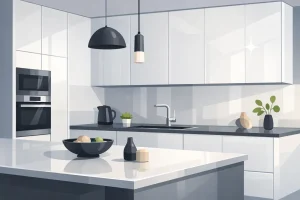

At its heart, a kitchen cabinet manufacturer is the company that designs, builds, and gets those beautiful cabinets into your home. They can be anything from a massive factory pumping out flat-pack boxes for big-box stores to a small, local workshop where artisans craft every piece by hand. Who you choose to work with will shape everything about your new kitchen, from the quality and cost to how much you can truly make it your own.
Understanding Your Kitchen Cabinet Options
Diving into the world of cabinetry can feel a bit overwhelming. You'll hear terms like "stock," "semi-custom," and "bespoke" thrown around, and it’s not always obvious what they mean for your actual kitchen renovation. Getting a handle on these different tiers of cabinet manufacturing is the most important first step you can take.
Let’s think about it like buying a suit. You’ve got three main paths you can go down, and each one comes with its own set of pros and cons. The right choice really just depends on your budget, your timeline, and the final look you're going for.
The Three Tiers of Cabinetry
Comparing cabinet makers to suit shopping is a surprisingly good way to picture what you get at each level.
Stock Cabinets (The Off-the-Rack Suit): These are the mass-produced cabinets you’ll see stacked high at the big home improvement centres. Just like an off-the-rack suit, they come in standard sizes and a pretty limited menu of styles and colours. They're available right away and are easily the most affordable option, making them a solid choice for quick flips or projects on a very tight budget.
Semi-Custom Cabinets (The Tailored Suit): This option is the happy medium. A semi-custom manufacturer works from a set of standard cabinet sizes but gives you way more room to play. You’ll have a much wider selection of door styles, finishes, and clever storage add-ons. It’s like buying a good suit off the rack and then having a tailor take in the waist and adjust the sleeves—you get a much better fit and a more personal look, but you’re still starting with a standard template.
Bespoke Cabinets (The Custom-Made Suit): This is the pinnacle of craftsmanship and personalization. A bespoke (or custom) cabinet maker builds everything from scratch, just for you. Every detail—materials, dimensions, style, colour, and hardware—is yours to decide. This is the equivalent of a fully custom-made suit, measured and cut to fit you and only you. The result is unmatched quality and a kitchen that is truly one-of-a-kind.
Choosing a cabinet manufacturer isn’t just about picking a product; it’s about choosing a process. Do you need something cheap and fast, a good balance of options and cost, or a completely unique creation built to last a lifetime?
Each of these tiers leads to a very different kind of kitchen. Stock cabinets are great for a rental property or a quick, budget-friendly update. Semi-custom is perfect for homeowners who want to put their own stamp on things without the cost of a fully custom job.
But for those in competitive markets like Toronto and Markham, a bespoke kitchen often delivers the best long-term value. A factory-direct manufacturer, for example, can blend the incredible personalization of bespoke work with more accessible pricing. This gives you a kitchen that not only fits your family perfectly but also becomes a significant asset, boosting your home’s value. Knowing where your project fits on this spectrum is the key to making a choice you'll be happy with for years to come.
Understanding Stock, Semi-Custom, and Bespoke Cabinets
Trying to choose a kitchen cabinet manufacturer can feel a lot like deciding where to eat. You've got your fast-food options, a nice sit-down chain restaurant, and the exclusive five-star bistro. Each one offers a completely different experience, price point, and level of personalization.
Getting a handle on the three main tiers—stock, semi-custom, and bespoke—is the first real step in any successful kitchen renovation. Each one is built for a different need, budget, and timeline, so let’s dig into what you actually get with each.
Stock and Ready-to-Assemble (RTA) Cabinets
Think of stock cabinets as the "off-the-rack" suit of the kitchen world. They're mass-produced in standard sizes, styles, and colours, ready to be picked up from a big-box store or delivered within days.
A huge part of this market is Ready-to-Assemble (RTA) cabinetry. Just like the name says, these arrive flat-packed, waiting for you or your contractor to build them on-site. This simple difference dramatically cuts down on shipping and storage costs.
The big appeal here is affordability and speed. Because they’re made in huge batches, the price is low, and since they’re already made, the lead time is almost non-existent. The trade-off? You get zero customization. What you see is exactly what you get.
Semi-Custom Cabinets
This is the happy medium, the sweet spot where you get a good dose of personalization without a massive price jump. Manufacturers here start with standard cabinet box sizes but open the door to a much wider range of modifications.
It’s like ordering from a menu that lets you pick your main protein, then choose from a dozen different sauces and sides. You can't ask the chef to invent a new dish for you, but you can definitely put together a meal that feels like your own.
With semi-custom, you can typically:
- Tweak cabinet depths or widths in small increments.
- Select from a much larger library of door styles, materials, and paint colours.
- Add functional upgrades, like pull-out pantries or glass-front doors.
This tier is perfect if you want a kitchen with more personality than stock options allow but don't quite need or have the budget for a completely custom job.
Bespoke or Fully Custom Cabinets
Bespoke is the pinnacle. It's where your imagination (and your budget) are the only real limits. Working with a bespoke manufacturer is like commissioning a piece of art—every single element is designed and built from the ground up, just for your space.
A bespoke kitchen isn’t about picking options from a catalogue; it’s about creating a catalogue of one. Every cabinet is meticulously crafted to the exact millimetre, ensuring a flawless fit and a truly one-of-a-kind result.
This is the only way to go for kitchens with quirky layouts, historic homes with wonky walls, or for anyone with a design vision that simply can't be compromised. While this level of quality comes with the longest lead times and the highest price, working with a factory-direct manufacturer can change the equation. It often provides that same bespoke-level detail without the traditional retail and showroom markups.
This decision tree gives you a good visual for how your priorities will steer you toward the right type of cabinet.
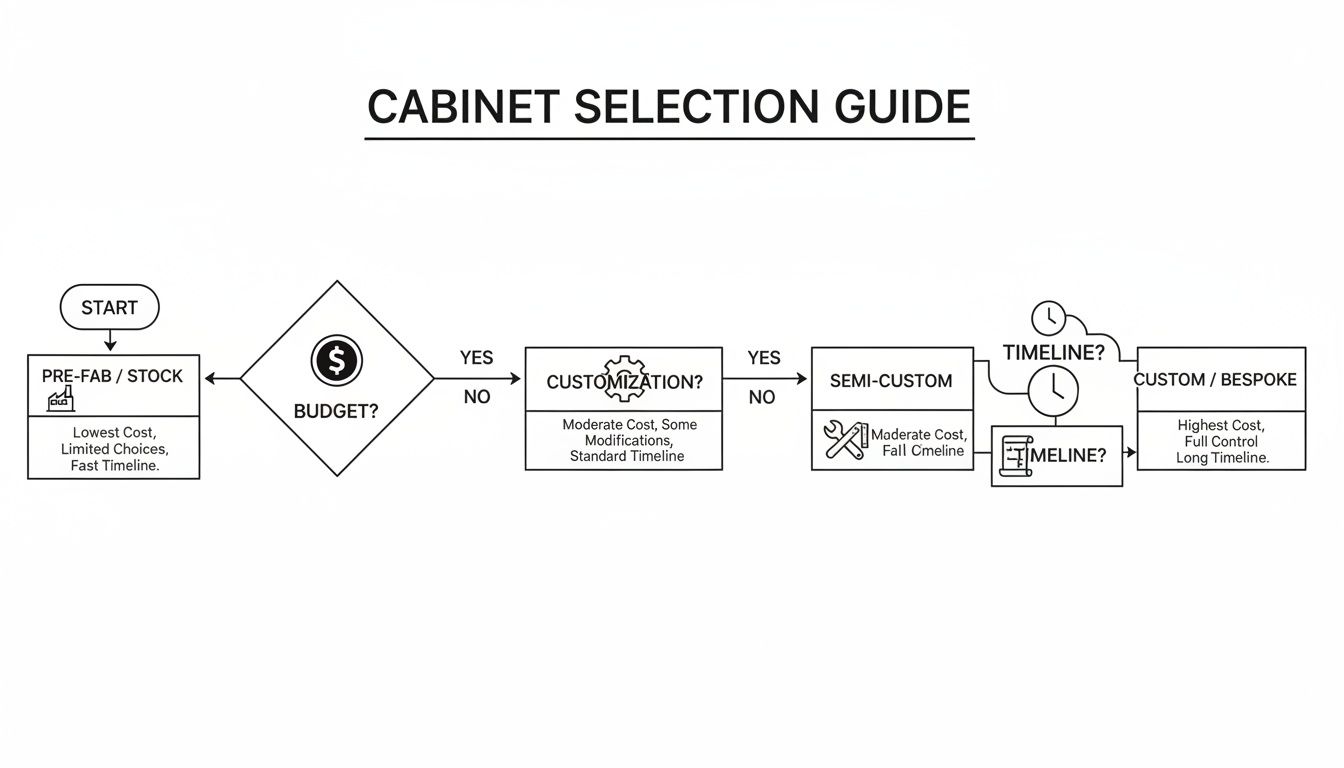
To make this even clearer, let's lay it all out side-by-side.
Comparing Cabinet Manufacturing Tiers
This table breaks down the key differences between the three main tiers, helping you see at a glance where your project might fit best.
| Attribute | Stock/RTA Cabinets | Semi-Custom Cabinets | Bespoke/Custom Cabinets |
|---|---|---|---|
| Customization | Very limited; fixed sizes, styles, and colours. | Moderate; standard sizes with options to modify dimensions, finishes, and accessories. | Unlimited; built from scratch to any size, style, or finish imaginable. |
| Lead Time | Shortest (days to 2 weeks). | Medium (4-8 weeks). | Longest (8-16+ weeks). |
| Budget | $ | $$ | $$$ – $$$$ |
| Best For | DIY projects, budget renovations, rental properties, and fast turnarounds. | Homeowners who want a personalized look without a fully custom budget; standard kitchens with some unique needs. | Unique spaces, historical homes, high-end designs, and homeowners with a specific, uncompromising vision. |
| Quality | Varies, but generally uses lower-cost materials like particleboard and thermofoil. | Good to excellent; often uses a mix of materials like plywood boxes and solid wood or HDF doors. | Highest quality; premium materials and craftsmanship tailored to exact specifications. |
Ultimately, the right choice depends entirely on your project's unique balance of cost, creativity, and patience. Each tier offers a valid path to a beautiful kitchen.
Choosing the Right Cabinet Materials and Finishes
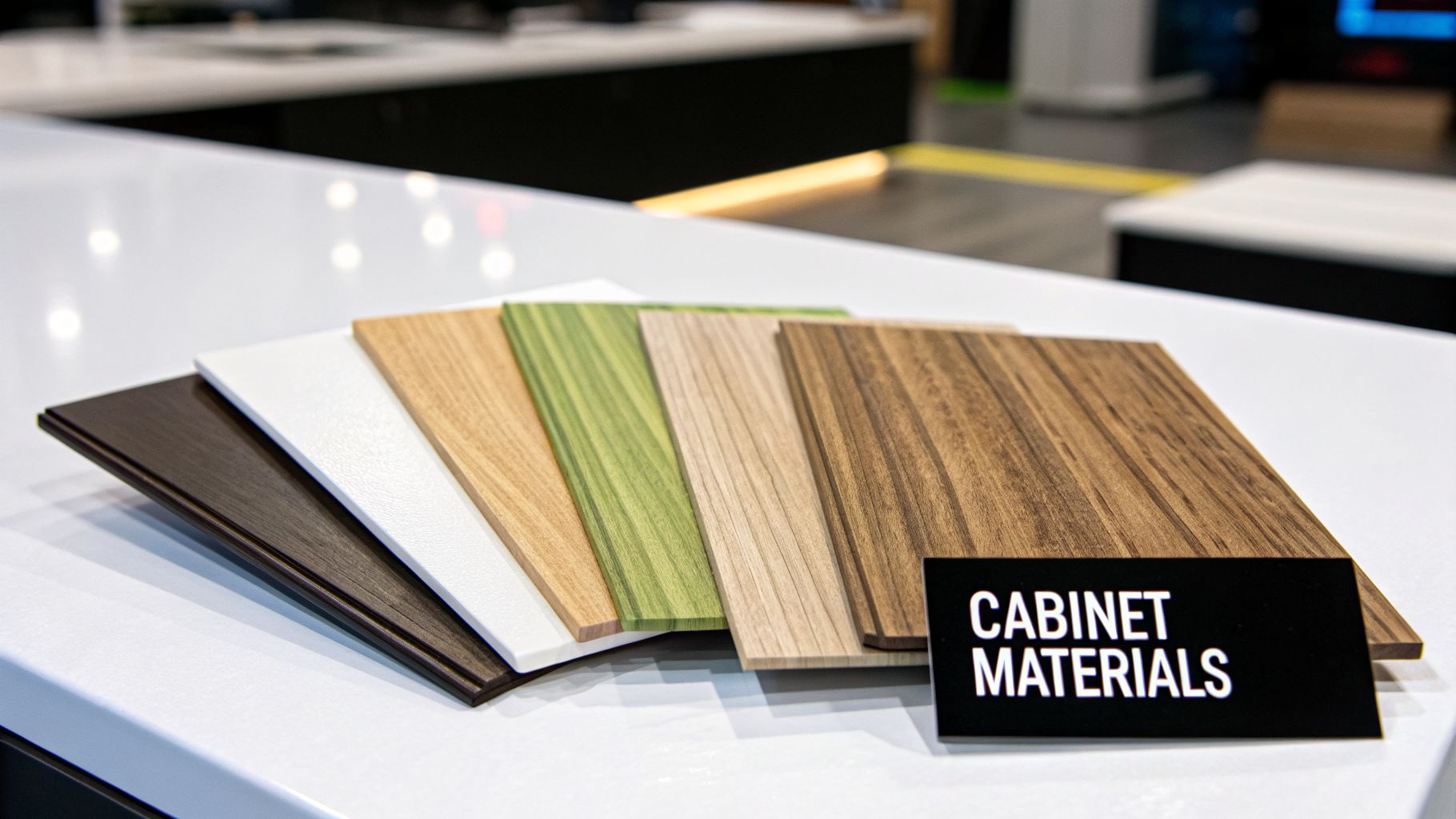
The materials you pick for your kitchen cabinets are so much more than just a pretty face. They’re the very heart of your kitchen’s durability, its feel, and how it performs day in and day out. Getting to know the options—from the classic warmth of real wood to the flawless look of modern engineered materials—is the key to a space that not only looks incredible but also holds up to the rigours of daily life.
It's clear that homeowners are increasingly looking for quality and personalization. The custom cabinet market is on track to grow from USD 7,359 million in 2026 to an estimated USD 10,529 million by 2035. This isn't just a number; it shows a real shift toward wanting kitchens that are built to last and perfectly suited to our lives.
The Timeless Character of Real Wood
There’s just something about real wood, isn't there? Each species, whether it's the bright, clean look of maple or the deep, rich tones of cherry, brings its own unique personality and grain pattern to your kitchen. No two doors will ever be identical, and that’s the point. You get a one-of-a-kind, organic character that simply can’t be faked.
Real wood is a natural fit for traditional, transitional, or farmhouse kitchens—styles that celebrate texture and authenticity. While it’s true that wood can react to humidity, modern finishing techniques have come a long way in minimizing any expansion or contraction. For anyone who values true craftsmanship, the subtle variations in a wood grain are a beautiful feature, not a flaw.
High-Density Fibreboard: The Perfect Canvas for Paint
If your vision is a kitchen with a perfectly smooth, uniform painted finish, then High-Density Fibreboard (HDF) is your best friend. Picture HDF as the ultimate artist's canvas. It’s an engineered wood product made by compressing wood fibres with resin under immense pressure. The result is an incredibly dense, stable, and flawless surface.
Unlike solid wood, HDF has no grain and doesn’t swell or shrink with changes in temperature or humidity. This stability is precisely why it’s the best choice for painted cabinets—it resists the tiny hairline cracks that can sometimes appear at the joints of painted wood doors. It’s the secret weapon behind those pristine, durable finishes you see in high-end shaker and contemporary kitchens.
HDF delivers a clean, unbroken surface that lets paint cure into a tough, beautiful shell. This is exactly why many top-tier kitchen cabinet manufacturers prefer it for any finish that isn't a natural wood grain, from a sophisticated matte to a brilliant high-gloss.
Laminates and Thermofoil: Resilient and Family-Friendly
For busy homes, durability and easy cleanup are non-negotiable. This is where materials like laminate and thermofoil really step up, offering tough-as-nails performance without compromising on style.
Laminates: Made by fusing layers of paper and plastic resins, these surfaces are built to resist scratches, stains, and moisture. Today's laminates are available in a huge range of colours and surprisingly realistic wood-grain patterns.
Thermofoil: This involves vacuum-sealing a vinyl film onto an HDF core. The process creates a seamless, non-porous surface that is incredibly easy to wipe down, making it a fantastic and cost-effective choice for families.
Both options give you consistent colour and finish from one cabinet door to the next, guaranteeing a clean, uniform look. If you want to dive deeper into these options, our guide on the https://maplekingkitchencabinets.com/best-materials-for-kitchen-cabinets/ has you covered.
Remember, your cabinets don't exist in a vacuum. Thinking about them in the context of high-end home finishes—like your countertops, backsplash, and flooring—helps create a cohesive, polished look. The right material choice isn't just about aesthetics; it’s about making sure your kitchen functions beautifully for your lifestyle.
How to Budget for Your Kitchen Cabinets

When it comes to a kitchen renovation, your budget really boils down to two things: how much it will cost and how long it will take. Every decision you make, from choosing simple particleboard boxes to splurging on real wood veneers, will pull on both of these levers.
Compare Cost Structures
Let's talk numbers. Stock cabinets can be found for as little as $60 per linear foot, while semi-custom options typically start around $120. If you're going for a truly bespoke kitchen, expect to pay $300 or more per linear foot. Keep in mind that design fees and labour will add another 10–20% to that final bill.
But the sticker price is just the beginning of the story. You also need to look out for:
- Showroom mark-ups, which can easily inflate the price by 30–50%.
- Complex designs, like intricate door profiles or clever hidden pull-outs, which add more labour hours.
- Specialty finishes, such as durable UV-cured paints, that come with a premium price tag.
Uncover the Market Reality
Here’s a tip straight from the pros: working with factory-direct kitchen cabinet manufacturers can dramatically cut your costs by eliminating the middlemen. Homeowners right here in Toronto and Markham, for example, often save up to 50% on designs that would cost a fortune at a traditional retail showroom. This trend isn't just local; high-end demand is surging elsewhere, too. In California, the Cabinet & Vanity Manufacturing industry is projected to hit $1.7 billion by 2026, which shows a strong appetite for quality craftsmanship.
Spot the Hidden Cost Factors
Beyond the obvious material choices, other factors can sneak up on your budget. Be mindful of:
- Design complexity: Curved cabinets and angled islands look stunning, but they take more time and skill to build.
- Hardware grade: High-end stainless steel hinges with soft-close mechanisms cost more per unit than standard ones.
- Installation timeline: If you’re on a tight deadline, you might end up paying overtime rates for weekend crews.
A well-planned budget from the start is your best defence against surprise costs down the road.
Leverage Factory-Direct Savings
Choosing a manufacturer that builds and installs their own products is one of the smartest moves you can make. The process is straightforward:
- Start by defining your project scope and the tier of materials you want.
- Get quotes directly from the factory for the cabinet boxes and doors.
- Compare these numbers to what you'd pay at a retail store and negotiate from a position of power.
- Always confirm your finish samples before the full production run begins.
Plan for Realistic Lead Times
Patience is a virtue in renovations. Here’s a rough guide for what to expect:
- Stock/RTA: 1–3 weeks
- Semi-custom: 4–8 weeks
- Fully bespoke: 10–16 weeks
Remember, these timelines can stretch if you select custom laminates or specific eco-friendly, low-VOC paints that require special ordering or longer curing times.
When planning your budget for kitchen cabinets, it's essential to consider the overall cost of the project, including installation and other renovation elements. For a comprehensive overview of costs involved in transforming your space, exploring professional kitchen renovation services can be highly beneficial.
As a final word of advice, always build a buffer of 10% into both your budget and your schedule. This will give you breathing room for any unexpected surprises. To get even more granular, check out our guide on kitchen cabinet costs in detail. It’s packed with tools and a framework to help you compare quotes and make confident decisions.
How MapleKing Offers a Budget Advantage
When you partner with a factory-direct manufacturer like MapleKing, you're cutting out the expensive middlemen and showroom overhead. This means you get bespoke designs, access to eco-friendly materials, and transparent pricing that lets you see exactly where every dollar is going.
Quick Tips for Staying on Budget
- Prioritize your must-haves. Fancy add-ons can always wait for a future upgrade.
- Consolidate orders to minimize shipping and handling fees.
- Get it in writing. Lock in your prices with a detailed quote before you pay a deposit.
- Confirm finishes early to avoid the cost and delay of reordering.
- Build in a 5–10% contingency fund for small upgrades or unforeseen issues.
Local Considerations for Toronto & Markham
For those of us in Ontario, budgeting means factoring in HST, potential import duties, and local installer rates. This is where choosing a nearby factory-direct supplier really pays off, as it slashes delivery fees and makes any onsite adjustments much faster.
- In Markham, you can expect delivery fees to be 15–20% lower compared to other GTA zones.
- Many Toronto projects under 200 sq. ft. can even qualify for free white-glove delivery service.
Think of your budget plan as the roadmap for your renovation journey. It keeps you on track and ensures a smooth ride.
Spotting Quality Craftsmanship and Sustainable Practices
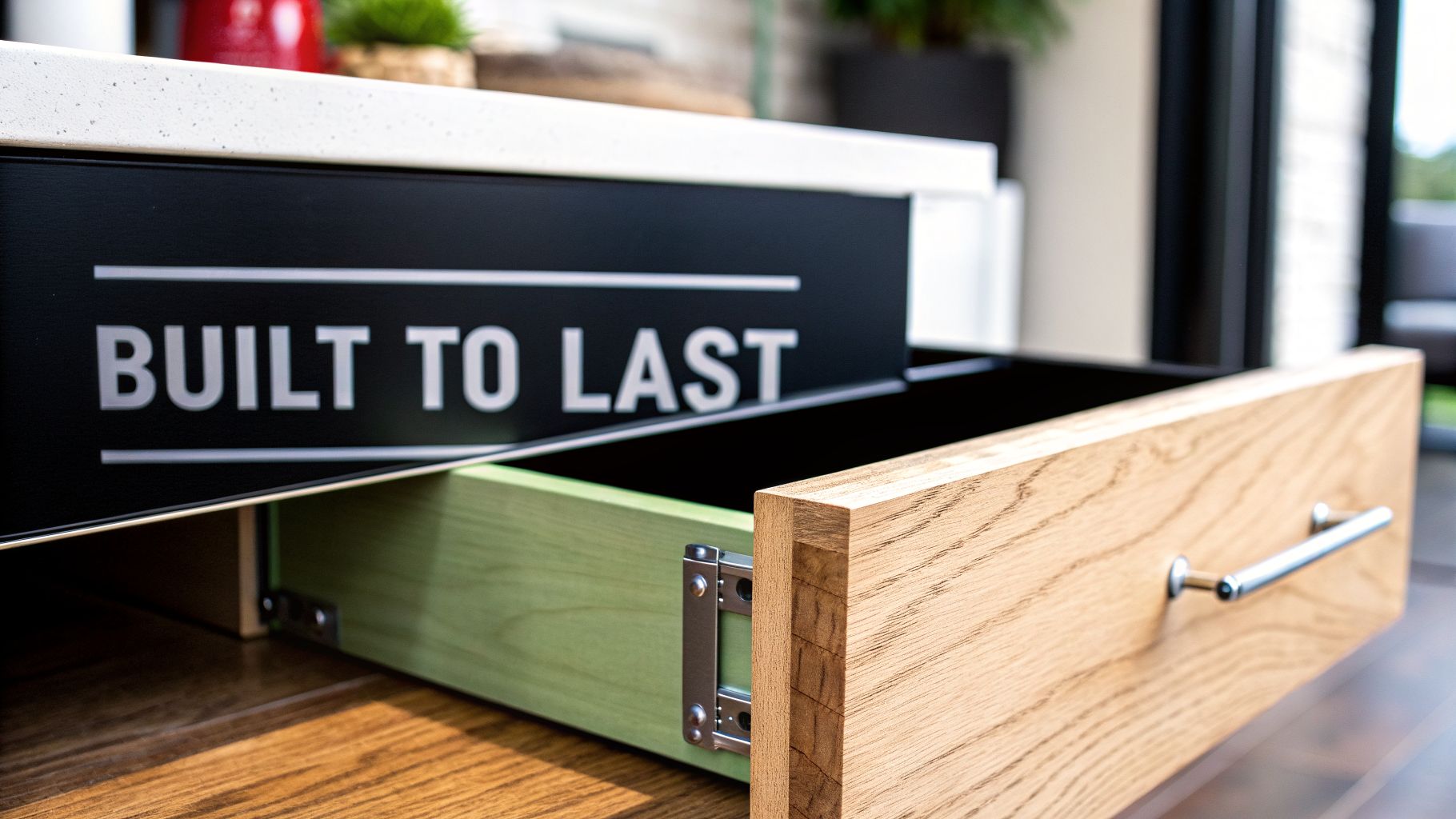
Beyond the beautiful finish and stylish hardware, how can you really tell if a cabinet is built to last? The secret is in the details—the construction methods and material choices that separate a quick fix from a true long-term investment. Learning to spot these markers of quality will help you look past the showroom shine and understand the real value of what you’re buying.
Think of it like inspecting a car. You don't just look at the paint colour; you pop the hood. For cabinets, this means looking at the joinery, the hardware, and the sturdiness of the box itself.
Construction Quality Checklist
When you’re comparing options from different kitchen cabinet manufacturers, get hands-on. Pull out a drawer, swing open a door, and feel the difference. Here’s exactly what you should be looking for:
Dovetail Joints: Check the corners of the drawer boxes. High-quality manufacturers use dovetail joinery, an age-old technique where interlocking "pins" and "tails" create an incredibly strong bond that resists being pulled apart. It's a classic, unmistakable sign of real craftsmanship.
Soft-Close Hardware: Pay attention to the hinges and drawer slides. Are they smooth and silent? Reputable brands like Blum provide soft-close mechanisms that prevent slamming, which dramatically reduces wear and tear on the cabinet frames and doors. This isn't just a fancy feature; it’s a key indicator of longevity.
Full Plywood Boxes: Ask what the cabinet box (the carcass) is made of. While particleboard is common in budget-friendly lines, all-plywood construction offers far better structural integrity and moisture resistance. It also holds screws much more securely over time, which is especially critical for hardworking base cabinets that support heavy countertops.
These aren't just minor technical points. They're tangible proof that a manufacturer cares about building a product designed to stand up to decades of daily use, not just a few years.
Understanding Sustainable and Eco-Friendly Practices
These days, a well-made cabinet should also be a responsibly made one. "Eco-friendly" can feel like a vague marketing term, but in the world of cabinetry, it points to specific, measurable practices that are better for the planet and for the air inside your home.
True sustainability in cabinetry isn't just about using recycled materials. It's about a holistic approach that includes sourcing responsibly, minimizing harmful emissions, and building a product so durable it won't need replacing for a generation.
When you're vetting a manufacturer's green credentials, it pays to ask the right questions. Focus on these key areas:
Low-VOC Finishes: Ask if they use low-VOC (Volatile Organic Compound) paints, stains, and lacquers. VOCs are chemicals that can "off-gas" into your home's air, impacting its quality. Responsible makers prioritize finishes that keep your indoor environment healthy.
Responsible Sourcing: Where does the wood come from? Materials sourced from sustainably managed forests ensure that precious ecosystems are protected and that the wood is harvested in a way that allows forests to regenerate.
Manufacturing Waste: A factory-direct, bespoke approach naturally cuts down on waste. By building cabinets to precise, custom dimensions, manufacturers can avoid the overproduction and landfill-bound surplus that often comes with mass-market, one-size-fits-all models.
Choosing a manufacturer that champions these practices means you’re investing in a healthier home and a more sustainable future—a decision that adds value far beyond the price tag.
Walking into a consultation without a plan is like going grocery shopping while you're starving—you're almost guaranteed to make some impulse buys you'll regret later. To make sure you team up with the right kitchen cabinet manufacturer for your project, you need to be the one leading the conversation. Showing up prepared with a sharp set of questions instantly shifts you from a passive customer to an empowered project manager.
This isn't just about getting a price. This framework is designed to help you peel back the layers of a sales pitch, so you can truly compare apples to apples. It's how you spot genuine craftsmanship and find a partner who gets what you're looking for in terms of both quality and long-term value.
Design and Customization Questions
First things first, you need to figure out their creative and technical boundaries. Don't just ask if they offer "custom" cabinets; you need to probe what that word actually means to them. Some companies offer "semi-custom," which really just means picking from a limited menu of modifications. A truly bespoke manufacturer can build practically anything you can dream up.
Here's how to get to the bottom of it:
- Can I see a 3D rendering of my kitchen design before I have to commit? This is a must. A detailed rendering makes sure everyone is on the same page and helps you spot layout problems before it's too late.
- What are your limitations on cabinet sizes, styles, and finishes? This single question is brilliant for separating a semi-custom operation from a genuine, factory-direct manufacturer who can build to any spec you need.
- How do you handle tricky layouts, like angled walls or ceilings that aren't a standard height? Their answer here will tell you everything you need to know about their problem-solving skills and actual manufacturing muscle.
Materials and Construction Questions
The real secret to a kitchen that lasts for decades lies in the guts of the cabinets—the materials and how they're put together. Any manufacturer worth their salt will be completely open about where their materials come from and how they build their boxes. In fact, they should be proud to tell you what makes their product stand out.
A manufacturer’s willingness to openly discuss their suppliers, joinery techniques, and hardware choices is a direct reflection of the confidence they have in their product. Vague answers are a significant red flag.
Get specific about how things are made and what they guarantee:
- Where do you source your HDF, wood, and other core materials? This is crucial, especially if you're looking for proof of eco-friendly practices.
- What kind of joinery do you use for your drawer boxes? You're hoping to hear answers like "dovetail joints," which are a hallmark of high-quality, durable construction.
- What brand of hardware—like hinges and drawer slides—comes standard, and what are my upgrade options? The inclusion of premium hardware from brands like Blum is a dead giveaway that you're looking at a cabinet built to last.
To get a better feel for how different teams work, you might want to check out our guide on finding the best cabinet companies near you, which gets into more of the local details. Armed with these questions, you’re more than ready to confidently walk into any showroom and find the perfect partner for your project.
Answering Your Top Questions About Kitchen Cabinet Makers
When you're diving into a kitchen renovation, a few key questions always seem to pop up. You're trying to compare quotes, figure out which materials make sense, and generally make the best choice for your home. Let's tackle some of the most common queries we hear from homeowners to help you move forward with confidence.
What’s the Real Benefit of Going Factory-Direct?
The main advantage is simple: you get more for your money. By cutting out the retail middleman—the big-box store or the showroom distributor—you can often save a significant amount, sometimes up to 50%, on high-quality, custom-built cabinetry. You're buying straight from the source.
But it's not just about cost. This direct connection means you're talking to the people who are actually building your cabinets. This opens the door for a level of customization and control you just can't get off the shelf. You're not limited to a catalogue; you can collaborate with the makers to design a kitchen that’s a true reflection of your style and needs.
How Do I Choose Between Real Wood and HDF?
This decision really hinges on the look you're after and your home's environment. Real wood doors have that timeless, natural appeal. Each door has a unique grain, bringing a warmth and organic character to the space that many people love. The only thing to keep in mind is that solid wood can react to shifts in humidity over time.
On the other hand, High-Density Fibreboard (HDF) is an engineered wood product known for its incredible stability. It provides a perfectly smooth, uniform surface that's the absolute best base for a painted finish. If you’re dreaming of that flawless, contemporary look—whether it's a sleek high-gloss or a sophisticated matte—HDF is the superior material. It won't warp or crack, ensuring your painted finish stays pristine.
What makes a cabinet maker "eco-friendly"? It's about their entire process. It means they're sourcing materials from responsibly managed forests, using low-VOC (Volatile Organic Compound) finishes for better indoor air quality, and running their workshop in a way that minimizes waste.
Is It Better to Work with a Local Manufacturer?
Working with local kitchen cabinet manufacturers, particularly here in the Toronto and Markham area, has some major perks. For one, communication is just easier. It also means faster lead times and gives you the chance to visit their workshop, see the materials for yourself, and get a real feel for the quality of their work before you sign anything.
Plus, if any adjustments are needed after the installation, having your cabinet maker nearby makes getting things sorted out quick and painless. It’s also a great feeling to know you’re supporting a local business and contributing to your community's economy. A quick visit to a local maker's showroom can tell you everything you need to know about their commitment to craftsmanship.
Ready to bring your vision to life with cabinets that perfectly blend quality, style, and value? At MapleKing Kitchen Cabinets, we specialize in factory-direct, bespoke cabinetry crafted with eco-friendly materials right here in Markham. Explore our custom cabinet solutions and start your project today.