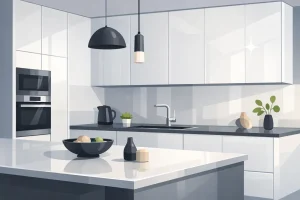

You've probably got a browser full of tabs right now. One tab has local cabinet shops. Another has inspiration photos. A third has a note from your contractor asking for cabinet sizes, appliance specs, or a decision on painted versus wood grain doors.
That search for kitchen cabinet makers near me usually starts as a quick lookup. Then it turns into a high-stakes decision. Cabinets shape the layout, storage, finish quality, and day-to-day feel of the kitchen more than almost anything else.
In the GTA, this isn't a niche purchase. Kitchen cabinetry sits inside a very active renovation market. Canadians spent $81.8 billion on home renovations in 2021, up from $80.1 billion in 2019, and Ontario accounts for roughly 38% of Canadian households, which helps explain why Toronto and Markham homeowners have so many cabinet options to sort through (Canadian renovation spending and Ontario household share).
A bigger market gives you more choice. It also gives you more noise. Some companies are true custom shops. Some are installers selling modified box systems. Some produce strong-looking marketing and mediocre finishing. The difference usually doesn't show up in a nice showroom photo. It shows up months later in swollen toe kicks, cracking paint, poor drawer alignment, and service calls nobody wants to answer.
Your Kitchen Renovation Starts Here
Most homeowners begin with the wrong question. They search for who is nearby before they decide what kind of cabinet project they need.
That matters because cabinet work isn't one category. A full custom kitchen for a detached home in Markham is different from a condo refresh in downtown Toronto. A rental turnover needs durable materials and predictable lead times. A family kitchen with heavy daily use needs better interior planning, better hinges, and smarter finish choices around the sink, range, and dishwasher.
Why local search isn't enough
Typing kitchen cabinet makers near me into Google will give you a list. It won't tell you which company is suited to your project type, your budget range, or the finish standard you expect.
A better approach is to treat the search like a procurement process. You are not just buying doors and boxes. You are hiring a design, fabrication, finishing, delivery, and installation partner. If one part fails, the entire kitchen suffers.
A beautiful rendering can hide weak materials, vague scope, and a finish system that won't hold up through two Toronto winters.
The smart move is to build a framework before you contact anyone. That framework should cover four things:
- Project type: replacement, refacing, repair, or a layout change
- Performance needs: moisture resistance, easy cleaning, scratch tolerance, family wear
- Aesthetic direction: slab, shaker, wood grain, painted, matte, high gloss
- Decision criteria: quote detail, finish quality, communication, and after-install support
What protects your investment
The homeowners who get the smoothest cabinet projects usually do one thing well. They make it easy for a good cabinet maker to quote accurately.
If you can explain your kitchen clearly, ask the right technical questions, and compare proposals line by line, you'll avoid most of the expensive mistakes people make when they hire on price or photos alone.
Define Your Project Before You Search
Before you contact a single shop, define the job. Otherwise you'll get vague pricing, mismatched recommendations, and a lot of time wasted discussing options that don't fit your kitchen.

Start with the scope
There are usually four realistic paths:
Repair
This makes sense when the cabinet boxes are sound and the problem is isolated. Think damaged hinges, broken drawer slides, loose doors, or a few worn panels.Reface
This is often the overlooked middle ground. In Ontario, where many homes are older, refacing can be the smarter option for cost, disruption, and waste reduction, especially when the cabinet carcasses are still solid and the layout works. That approach also lines up with the province's push toward circular-economy thinking and keeping building materials out of landfill, which matters in condos and buildings with tighter renovation rules (Ontario refacing and waste reduction context).Replace within the same layout
This fits kitchens where storage, proportions, and appliance fit need improvement, but the plumbing and core layout can stay.Full redesign
Choose this when circulation is poor, storage is inefficient, or the kitchen never worked well in the first place.
Build a simple design brief
Don't overcomplicate this. A one-page brief is enough if it's clear.
Include:
- Room basics: width, length, ceiling height, soffits, bulkheads, windows
- Appliances: existing or planned sizes, especially fridge depth and hood style
- Storage priorities: pantry pull-outs, drawer banks, tray storage, garbage pull-out
- Style notes: painted shaker, flat slab, wood-look laminate, high-gloss HDF
- Pain points: poor corner access, lack of drawers, messy small-appliance storage
Bring photos too. Wide shots are useful, but close-ups matter more. Show fillers, side panels, inside corners, and the condition of current cabinet boxes if you're considering refacing.
Decide where to spend and where to simplify
A lot of cabinet budgets get stretched by the wrong upgrades. Homeowners often spend heavily on visible door style and colour, then compromise on drawer hardware, internal storage, or finish quality. That's backwards.
A more practical way to allocate your budget is:
- Spend on function first: drawer systems, organisation, hardware, usable storage
- Protect the wet zones: sink base, dishwasher side, garbage area, toe kicks
- Be selective on custom details: glass doors, decorative end panels, floating shelves
- Match finish to lifestyle: busy homes need surfaces that clean easily and hide wear
Practical rule: If the layout works and the cabinet boxes are sound, ask whether refacing or selective replacement can deliver the result you want with less mess and less waste.
When you finally search for kitchen cabinet makers near you, you'll be doing it with a clear brief instead of a vague wish list. That changes the quality of every conversation that follows.
How to Find and Shortlist Local Cabinet Makers
Once the project is defined, the search gets much easier. You're no longer browsing randomly. You're screening for fit.

Use more than one discovery channel
Relying on one platform is a mistake. Some excellent cabinet shops have modest websites. Some polished websites belong to companies that outsource most of the work.
Build your shortlist from several sources:
- Search platforms: Google, Houzz, local directories, and map listings
- Trade referrals: designers, countertop fabricators, flooring installers, and contractors
- Neighbourhood observation: renovation signs, condo renovation referrals, local community groups
- Showroom visits: especially helpful if you need to compare painted finishes and hardware feel
If you want a local starting point for comparing providers in the GTA, this roundup of cabinet companies near Toronto and Markham is useful because it frames the search around service type rather than just map proximity.
What to look for online
Don't just ask whether the work looks nice. Ask whether the portfolio tells you anything meaningful.
Look for clues such as:
- Consistent style execution: not one good project and ten generic ones
- Interior details shown clearly: drawer boxes, pull-outs, pantry fittings, fillers
- Installed photos, not only renderings: renderings can't prove craftsmanship
- Material range: painted doors, laminate options, thermofoil, wood-grain finishes
- Project descriptions: did they solve awkward spaces, condo constraints, or storage issues?
A cabinet company's own presentation matters too. If the photos of their team, showroom, or project managers look rushed or inconsistent, it can affect trust before the first call. For smaller firms updating their website or profile pages, thoughtful visuals matter more than people think. A practical resource on cost-effective headshot solutions is a good reminder that professional presentation supports credibility when clients are comparing service providers online.
Why a showroom visit changes your shortlist
Photos flatten everything. In person, you can spot details quickly:
- edge quality on doors
- consistency between painted samples
- hinge movement
- drawer glide feel
- sheen differences between matte, satin, and gloss
- laminate seam quality
- thermofoil wrapping at corners
For Toronto and Markham homeowners, a local showroom visit is especially useful when you're torn between finishes that look similar on screen but behave very differently in real kitchens.
A video walkthrough can also help you sharpen your eye before visiting shops:
Keep the shortlist tight
Three to five candidates is the sweet spot. Fewer than that and you may not see enough variation in process and pricing. More than that and the comparison gets muddy.
By the end of this step, each shortlisted company should have earned its place for a specific reason. Not just because it appeared near the top of a search for kitchen cabinet makers near me.
Vetting Your Candidates The Smart Way
Most bad hires could have been avoided. A company can have attractive photos, quick email replies, and a polished sales process, yet still deliver weak finishing or sloppy installation.

Ask questions that expose process
A serious cabinet maker should be able to answer practical questions without sounding defensive or vague.
Ask things like:
- Who measures the kitchen? The salesperson, installer, or production team?
- Who creates shop drawings? You want accountability here.
- Who installs the cabinets? In-house crews and subcontracted installers are not the same thing.
- How are problems handled on site? Out-of-plumb walls, uneven floors, and appliance changes happen often.
- What happens after installation? Door alignment, hardware adjustment, and touch-ups should already be part of the process.
The quality of the answer matters as much as the answer itself. Skilled shops usually explain sequence clearly. Weak ones jump straight to price or dodge details.
Read portfolios like a practitioner
Don't evaluate a project the way social media does. Style is only one layer.
Look for:
- Tight filler logic: awkward filler pieces often reveal weak planning
- Clean panel transitions: especially around integrated appliances
- Consistent reveals: door and drawer gaps should look intentional
- Good proportion: oversized rails, shallow drawers, and cramped uppers usually signal compromise
- Real-world problem solving: bulkheads, corners, uneven walls, condo constraints
If the company only shows glamour shots from one angle, ask for more complete project photos. A confident shop won't hesitate.
Reviews are useful, but context matters
Online reviews help, but they should never be your only screening tool. Read them for patterns, not emotion. Are clients mentioning communication, scheduling, problem resolution, and service after installation?
This is also why understanding how companies handle review visibility is useful. A guide to managing Google reviews for home services can help you read review profiles more critically, especially when one business has very polished review activity and another has fewer but more detailed client comments.
Reviews tell you how a company manages reputation. Your interview tells you how they manage work.
Use finishing questions to separate pros from average shops
This is the test many homeowners never ask, and it's one of the best filters available.
A professional cabinet maker should be able to describe finishing quality control in concrete terms. According to industry finishing guidance, poor surface preparation accounts for about 35% of finishing failures, and proper application conditions matter. Ask whether the shop controls climate in the 65–75°F and 40–60% humidity range, and whether they monitor coating thickness to stay under a 5 mil total film build that can lead to cracking later (cabinet finishing quality control guidance).
That gives you a practical interview checklist:
- Surface prep: sanding, degreasing, dust removal, inspection before coating
- Shop conditions: temperature and humidity control during finishing
- Coating system: what finish is being applied to which substrate
- Film build control: how they avoid over-application
- Cure time: whether the finish is being rushed before delivery or installation
If a shop says, “We just spray and let it dry,” keep looking.
A local example of what to compare
In the Toronto market, some companies offer broad finish ranges while also fabricating for local conditions and layouts. For example, custom cabinetry in Toronto can include painted wood doors, HDF options, matte and gloss finishes, laminates, and thermofoil. That doesn't make one shop automatically right for you, but it does show the kind of material breadth and specification detail worth comparing during vetting.
Check references with targeted questions
Don't ask, “Were you happy?” Many will say yes or no and leave it there.
Ask:
- Did the final cabinets match the approved drawings?
- Were there surprises in material upgrades or change orders?
- How did the company handle adjustments after installation?
- Would you hire them again for another kitchen?
Those questions usually reveal more in five minutes than twenty online reviews.
Understanding Cabinet Materials and Finishes
Cabinet material decisions shouldn't be driven by trend photos alone. In Ontario kitchens, performance matters just as much as appearance. Material choice should balance style with humidity swings and daily use, and homeowners need clear guidance on when HDF outperforms solid wood for painted fronts, how thermofoil behaves near heat and steam, and which finishes resist fingerprints, scratches, and moisture in busy homes and condos (Ontario cabinet material performance guidance).
How to think about materials in real life
A detached family home, a downtown condo, and a rental unit don't need the same cabinet package.
Solid wood appeals to many homeowners because it feels substantial and authentic. It can be a good fit when you want visible grain, a warmer furniture-style look, or natural variation. But for painted doors, wood movement can create issues that some clients don't expect. That's why many cabinet makers recommend engineered substrates for painted finishes.
HDF is often the practical answer for painted fronts because it gives a smoother, more uniform surface. If your goal is a crisp painted shaker or slab door, HDF often produces the cleaner result. It can also be easier to keep visually consistent across larger projects.
Thermofoil has a role, but it needs honest discussion. It offers a uniform, easy-clean surface and can suit lower-maintenance projects. The caution is heat and steam. Near ovens, dishwashers, and poorly vented cooking zones, it may not be the best fit.
Laminates are often underrated. Good laminate options can be durable, moisture-resistant, and easy to maintain. For rentals, secondary kitchens, or contemporary spaces, they can make a lot of sense.
Kitchen Cabinet Material Comparison
| Material | Durability | Average Cost | Maintenance Level | Best For |
|---|---|---|---|---|
| Solid wood | Strong, but can react to environmental changes | Higher | Moderate | Natural grain, stained finishes, furniture-style kitchens |
| HDF painted doors | Very good for stable painted surfaces | Mid-range | Low to moderate | Painted shaker or slab doors in family homes and condos |
| Laminate | Strong surface durability in many applications | Budget to mid-range | Low | Rentals, modern kitchens, easy-clean surfaces |
| Thermofoil | Easy-care surface, but needs caution near heat and steam | Budget to mid-range | Low | Lower-maintenance projects with careful placement |
| High-gloss HDF | Good when properly specified and maintained | Mid to higher | Moderate | Contemporary kitchens and sleek condo designs |
| Matte HDF | Practical for daily use and often more forgiving visually | Mid-range | Low | Busy households, fingerprint-conscious buyers |
Match the finish to the room, not the trend
The finish should fit how the kitchen is used.
- Busy family kitchen: matte painted surfaces or durable laminates usually make day-to-day cleaning easier
- Condo kitchen: space-saving layouts benefit from clean slab fronts and lower-visual-noise finishes
- Rental or resale project: durable, neutral, easy-to-maintain finishes often age better than highly specific design choices
- Showpiece kitchen: real wood and carefully selected painted finishes can justify the added attention
If you cook often, have kids, or don't want to wipe down cabinet fronts constantly, choose finishes that forgive fingerprints and minor wear.
A company with a wide finish menu can be helpful here. If you're comparing substrates and painted options, this guide on the best material for kitchen cabinets is useful because it frames the choice around use conditions rather than just appearance.
What works and what doesn't
What works is matching substrate and finish to the actual room conditions. What doesn't is choosing a material because it looked good under showroom lighting without asking how it handles steam, cleaning, impact, and long-term wear.
That conversation should happen before the quote is final, not after production starts.
How to Compare Quotes and Make the Final Hire
The cheapest quote usually wins for one of three reasons. Something is missing. Something is underspecified. Or the company is pricing the job to secure the deposit and sort out the details later.
None of those outcomes help the homeowner.
Compare scope before price
Lay the quotes side by side and check whether they are pricing the same project. One proposal may include installation, touch-ups, and site measurement. Another may not. One may specify drawer hardware and interior accessories clearly. Another may bury them under vague allowances.
Look closely at:
- Cabinet box material
- Door and drawer front material
- Finish type
- Hardware brand or grade
- Crown, fillers, panels, and trim
- Delivery and installation
- Removal of existing cabinets
- Post-install adjustments
- Warranty language
If one quote is thin on detail, don't reward that with trust. Ask for clarification in writing.
Watch for red flags in wording
Certain proposal habits usually lead to problems:
- Vague descriptions: “custom cabinets as discussed”
- Missing finish specification: no substrate or coating details
- No mention of drawings: nothing tied to approved plans
- Unclear exclusions: backsplash removal, electrical prep, handles, touch-ups
- Push to sign fast: especially before measurements or design approval are complete
A good quote makes the project feel more understandable. A weak quote makes the project feel cheaper than it really is.
Value includes service after install
Cabinets rarely end on installation day. Doors settle. Fillers may need adjustment. Hardware may need tuning. Touch-up work may be necessary after counters, paint, or backsplash trades finish around the cabinets.
That's why the final hire should account for more than total price. Strong communication, precise documentation, and a clear service process are often worth paying for. If a company has been careful in discovery, clear in drawings, and technically sound in finishing and materials, that usually shows up in the final product.
Choose the partner who reduces risk, not the one who produces the lowest number.
Frequently Asked Questions
Do I need an interior designer if I already have a cabinet maker
Not always. If your layout is straightforward and you're confident about finishes, a capable cabinet maker can often handle measurement, shop drawings, and material selection. A designer becomes more valuable when the kitchen needs layout rethinking, coordinated finishes across multiple rooms, or tighter visual planning with flooring, counters, lighting, and wall treatments.
How long does a custom cabinet project usually take
It depends on design complexity, approvals, shop capacity, and installation conditions. Older Toronto homes, condos with booking rules, and projects that involve appliance changes usually take more coordination than homeowners expect. The safest approach is to ask each candidate for a process timeline tied to milestones such as site measure, drawing approval, production, delivery, installation, and service follow-up.
What's the difference between stock, semi-custom, and fully custom cabinets
Stock cabinets come in fixed sizes and limited finish choices. They can work for simple layouts but leave less room to solve awkward spaces cleanly.
Semi-custom cabinets allow some sizing and finish flexibility. They suit many renovation projects where the homeowner wants a more personalized result without going fully bespoke.
Fully custom cabinets are built around your exact room, storage needs, and design intent. This is usually the right route when you're dealing with unusual dimensions, premium finish expectations, integrated appliances, or a kitchen where every inch needs to work hard.
If you've been searching for kitchen cabinet makers near you, that distinction matters. Some companies market themselves as custom but are really selling modified standard systems. Ask directly how much of the cabinet is built to your kitchen, and how much is selected from preset sizes.
If you want help turning your ideas, measurements, and inspiration photos into a practical cabinet plan, MapleKing Kitchen Cabinets is one local option for Toronto and Markham homeowners. They provide custom kitchen cabinetry, material and finish options across painted wood, HDF, laminate, matte, gloss, and thermofoil surfaces, plus consultation and quotations for renovations, new builds, and kitchen upgrades.