

Figuring out the cost of new kitchen cabinets can feel a bit like guesswork, but it's actually pretty straightforward once you break it down. Here in the Greater Toronto Area, you could be looking at anything from $75 per linear foot for simple, ready-made options to well over $1,000 per linear foot for a completely bespoke design. The final number on the invoice really comes down to your choices in materials, style, and how much you want to personalize things.
Your Quick Guide To Toronto Kitchen Cabinet Costs
I like to compare choosing kitchen cabinets to buying a car. You’ve got your different classes, each designed for a specific budget and purpose—from the reliable daily driver to the handcrafted luxury model. Getting a handle on these different tiers is the first step to setting a budget that makes sense for your renovation.
Each level—stock, semi-custom, and custom—strikes a different balance between price, personalization, and overall quality. What you choose will define not just the final cost, but the look, feel, and function of your kitchen for a long time to come.
Cabinet Tiers Explained
Let's unpack the three main categories you'll come across while shopping for cabinets in Toronto and Markham.
- Stock Cabinets: Think of these as the "off-the-rack" option. They are mass-produced in standard sizes with a limited selection of styles, making them the most wallet-friendly choice for a quick and simple kitchen update.
- Semi-Custom Cabinets: This is your happy medium. They start out as stock cabinets, but you get to make certain modifications. You might tweak the dimensions or pick from a much wider range of finishes and door styles, giving you more creative control without the full custom price tag.
- Custom Cabinets: This is the top-of-the-line choice, where your cabinets are built from the ground up just for you. You call all the shots—materials, size, finish, and special features—for a kitchen that is truly one-of-a-kind.
You'll hear the term "linear foot" a lot. It's the industry standard for estimating cabinet costs. To get a ballpark figure for your own kitchen, just measure the length of the walls where you'll be installing cabinets.
Here in Ontario, the bustling renovation market definitely has a say in cabinet pricing. Local cost guides for the GTA show that basic stock cabinets usually start around $75–$150 per linear foot (that includes installation). Mid-range semi-custom options typically land in the $200–$450 per linear foot range, while fully custom cabinetry can easily soar past $500–$1,000+ per linear foot, especially in sought-after areas.
For anyone living in Markham, knowing these local price points is crucial for smart budgeting. If you want to dive deeper, you can learn more about finding the right kitchen cabinets in Markham that will complement your home's style and value.
To make things even clearer, let's put those numbers into a simple table.
Estimated Kitchen Cabinet Cost Per Linear Foot in the GTA
This table gives you a quick snapshot of what you can expect to invest per linear foot for the three main types of cabinets, helping you frame your initial budget.
| Cabinet Type | Average Cost Per Linear Foot (Installed) | Best For |
|---|---|---|
| Stock | $75 – $150 | Budget-conscious projects, rental properties, and quick updates. |
| Semi-Custom | $200 – $450 | Homeowners wanting more design flexibility without a full custom budget. |
| Custom | $500 – $1,000+ | Unique kitchen layouts, specific design visions, and high-end homes. |
As you can see, the gap between basic and high-end is pretty significant. This gives you a great starting point for deciding which path is the right one for your project's scope and budget.
What Really Drives Your Final Cabinet Price
Trying to pin down the cost of kitchen cabinets is a bit like commissioning a custom suit. The basic fabric sets a starting price, but it’s the little things—the quality of the thread, the style of the lapel, the choice of buttons—that really define the final garment and its cost. It’s the exact same story with your cabinets; the price goes way beyond the basic box.
Every single choice you make, from the wood you pick to the handle you'll touch every day, adds its own layer of cost and character to the project. The key to getting a kitchen you love without breaking the bank is understanding these individual cost drivers. It's all about knowing where to invest for maximum impact and where you can be a little more practical.
This visual guide breaks down the main tiers of cabinetry, from ready-to-go stock options to fully bespoke, one-of-a-kind designs.
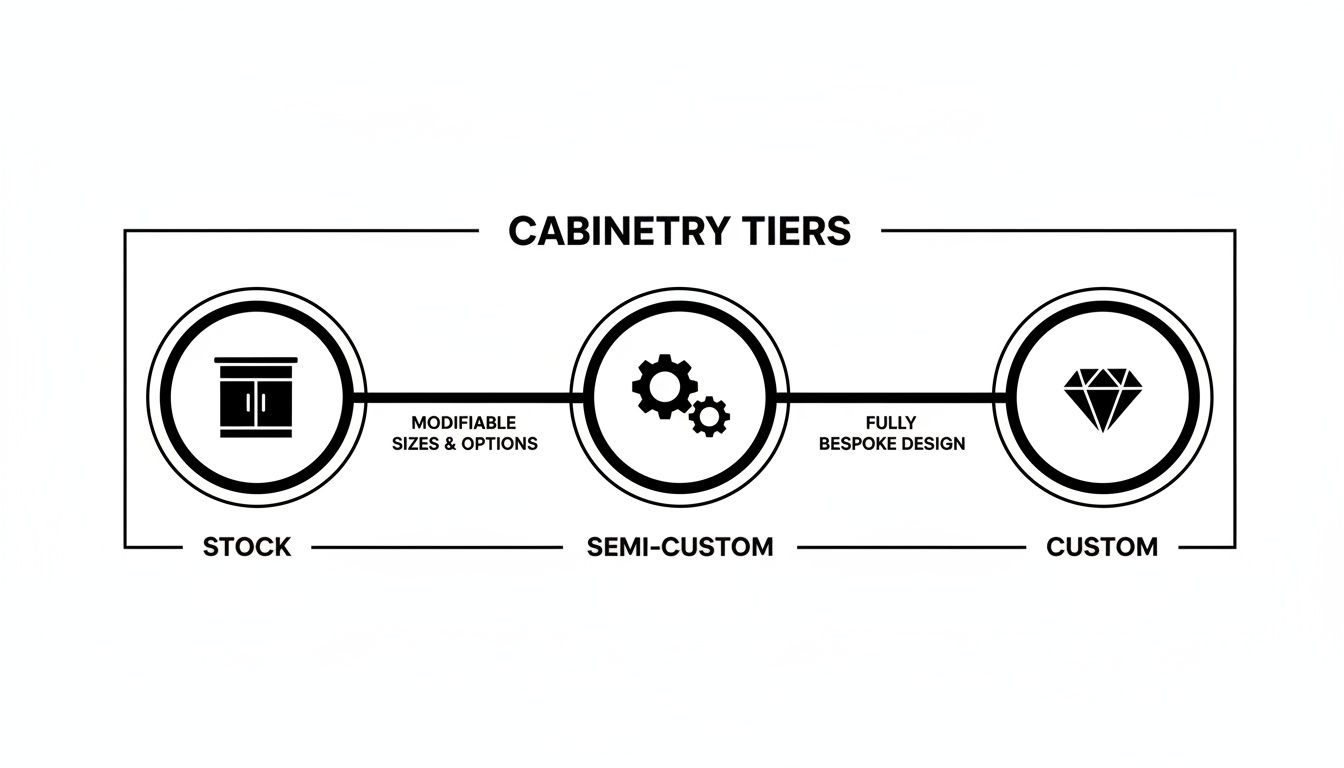
As you move up each tier, you unlock a lot more room for customization, but that freedom comes with a higher price point reflecting the extra design work and higher-grade materials.
Material: The Heart of Your Cabinet Cost
The single biggest factor that will influence your kitchen cabinet cost is the material you choose for the doors and cabinet boxes. This decision doesn't just set the look and feel; it determines how well your kitchen will stand up to daily life for years to come.
Take High-Density Fibreboard (HDF), for example. It's an incredibly popular and versatile option because it gives us a perfectly smooth, stable base for painted finishes. The result is a clean, consistent look that’s hard to beat. On the other hand, solid wood brings a natural warmth and unique grain that many people love, but that premium, organic aesthetic definitely comes at a higher price.
When you're starting to budget, the material you choose really sets the tone for the entire project. It's a critical decision for homeowners in Toronto and Markham. Entry-level laminate cabinets can be 20–40% cheaper than painted HDF, while solid wood doors often cost 30–60% more than a standard HDF door.
Here's a quick comparison of the materials we work with most often to help you see how your choice impacts the bottom line.
How Your Cabinet Material Choice Impacts Your Budget
| Material Type | Relative Cost | Key Benefits | Ideal Aesthetic |
|---|---|---|---|
| Laminates & Thermofoil | $ | Highly durable, moisture/scratch resistant, huge range of colours and textures. | Modern, minimalist, or budget-conscious projects. |
| HDF (Painted) | $$ | Flawless, uniform finish. More stable than wood (no warping/cracking). | Contemporary, transitional, and classic shaker styles. |
| Solid Wood | $$$ | Timeless natural beauty, unique grain patterns, can be refinished. | Traditional, farmhouse, and high-end luxury kitchens. |
While a beautiful solid oak door is a fantastic investment, a high-quality painted HDF door can deliver a very similar high-end look for a fraction of the price. It’s all about balancing your vision with your budget.
Finishes and Door Styles: The Visual Impact
Once you’ve landed on a material, the finish and door style add the next layer to your kitchen cabinet cost. Think of this as the final tailoring of that suit—the details that everyone will notice first.
A simple, flat-panelled shaker door is a cost-effective classic that never goes out of style. But if you start looking at more intricate designs with raised panels or detailed moulding, you’re adding more labour and materials, which bumps up the price.
The finish itself is also a major cost driver. A standard matte paint is one thing. Opting for a high-gloss, mirror-like finish or a specialty fingerprint-resistant matte surface involves a much more complex, multi-step process. These premium finishes, which are incredibly popular in modern Toronto homes, can add 10–25% to the cost of your cabinet doors alone.
Hardware and Construction: The Functional Details
Finally, it’s the things you don't always see—the construction quality and the hardware—that play a massive role in how your kitchen functions. The way a cabinet is built directly affects its strength and how long it will last. Dovetail joints in drawer boxes, for instance, are a true hallmark of quality craftsmanship, but they are more labour-intensive to produce than simpler methods.
Hardware is the finishing touch. While standard hinges and drawer slides get the job done, upgrading to soft-close mechanisms is pretty much an expectation these days. They prevent slamming, which is great, but they also reduce wear and tear over the long run.
Then you have the handles and pulls. These can vary wildly in price, from just a few dollars each to over a hundred for a single piece. In a large kitchen, that difference adds up fast. This is where getting advice from custom kitchen renovation experts in Toronto can help you find that perfect balance between style, function, and what you want to spend.
What Goes Into Labour and Installation Costs in the GTA?
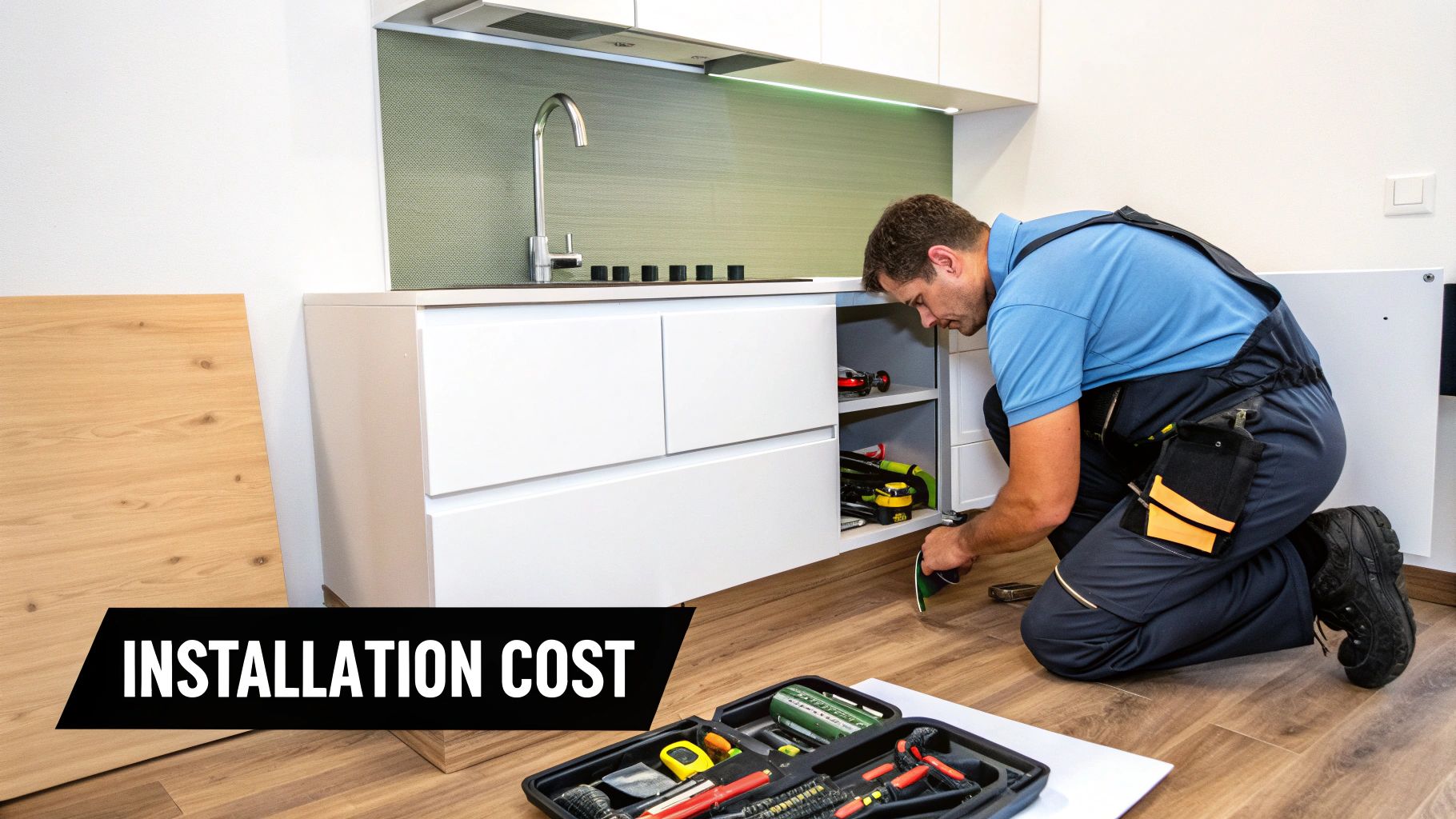
The price tag on your beautiful new cabinets is just the starting point. You also have to consider the human element—the skilled hands that bring your kitchen vision to life. This is a crucial part of your total budget. Think of it like buying high-end paint and a canvas; you still need the artist to create the masterpiece.
Professional installation is so much more than just hanging boxes on a wall. It’s a craft. It involves precise assembly, laser-perfect levelling, and secure mounting so that every door hangs straight and every drawer glides like silk. Investing in that expertise is how you get a flawless, durable finish that will look great for years.
The Team Behind Your New Kitchen
When you're putting together your budget, it helps to know who will be doing the heavy lifting. In the GTA, you generally have a couple of options, and they come with different price points.
- Specialized Cabinet Installers: These pros are the cabinet gurus. They do this all day, every day. They have the right tools and the know-how to get a perfect fit and finish, usually working more efficiently than someone who does a bit of everything.
- General Contractors (GCs): If you're doing a full-gut renovation, a GC is your project manager. They coordinate all the trades, from plumbers to electricians. While this is super convenient, their rates for the cabinet portion might be higher because they're managing the entire job.
Picking the right pro makes all the difference. If your project is just about the cabinets, a specialized team often delivers better value and a cleaner result. That’s why it’s so important to understand the full scope of professional kitchen cabinet installation services when you're planning your costs.
Looking Beyond the Basic Install
A proper quote for labour should cover more than just putting up the new cabinets. There are a handful of other tasks that add to the final cost, and they’re easy to overlook when you’re just starting out. Forgetting about these can lead to some unpleasant surprises when the final bill arrives.
These "extra" labour costs are a totally normal part of any reno. They ensure the job is done safely, cleanly, and correctly. Always ask your installer if these services are part of their initial quote.
Key Takeaway: Think of skilled labour as insurance for your cabinet investment. A pro installation protects your cabinets from damage, makes sure they work properly, and gives you that high-end, polished look that lasts.
Common Additional Labour Costs
So, what else might be on the bill? Here are a few of the most common tasks that will factor into your overall labour budget:
- Demolition and Removal: Before the new can go in, the old has to come out. This means carefully taking down your existing cabinets, countertops, and maybe a backsplash, all without wrecking the walls.
- Debris Disposal: Your old kitchen won't just vanish. You'll need to pay for responsible disposal, which often means renting a disposal bin or paying for a hauling service.
- Site Preparation: This is about getting the canvas ready. It can involve patching drywall, making sure the walls are perfectly vertical (plumb), and prepping the floor.
- Plumbing and Electrical Work: Want to move the sink or add some slick under-cabinet lighting? You’ll need licensed plumbers and electricians, and their fees are separate from the cabinet installer's.
Here in the Toronto market, you can expect to pay anywhere from $70 to $150 per hour for each professional installer. For a typical kitchen, that often works out to a total installation cost of $2,000 to $5,000. The final number really depends on how complex your layout is and how many of those extra tasks are needed. It's the price you pay to make sure your new kitchen doesn't just look amazing, but works perfectly for its entire lifespan.
How Factory-Direct Pricing Unlocks Better Value
We've already walked through the core costs of a kitchen cabinet project—the materials, the finishes, the labour. Now, let’s talk about a game-changing way to get more for your money without cutting corners: buying factory-direct.
Think of it like buying produce. You can go to a fancy grocery store, where the apples have passed through a distributor and a wholesaler before hitting the shelf. Or, you can go to the farmer's market and buy directly from the person who grew them. Which one do you think offers better value? The same logic applies to cabinets.
Cutting Out the Middleman
The traditional route for buying cabinets involves a surprisingly long chain of people. The manufacturer sells to a distributor, who sells to a retailer (like a big-box store or a local showroom), who finally sells to you. Each one of those steps adds a markup to the price. It's just business.
The problem is, by the time those cabinets are ready for your kitchen, the price has been inflated at every turn.
The factory-direct model completely sidesteps this. We connect you straight to the source, eliminating those extra layers and their markups. It’s a simpler, more direct path from our workshop to your home.
At MapleKing, our factory-direct approach means the price you pay is much closer to the actual manufacturing cost. This efficiency allows you to afford higher-quality materials and customization that might otherwise be out of reach, essentially getting a semi-custom or custom experience for a price closer to stock cabinets.
This isn’t just about saving a few dollars; it’s about fundamentally changing what's possible for your budget and giving you far more control over the final product.
The Double Advantage: Affordability and Customization
The biggest, most immediate win with factory-direct is, of course, the savings. By cutting out the distributor and retailer markups, our clients often save 30-50% on their cabinets compared to what they’d pay through traditional channels. For anyone renovating in a competitive market like Toronto or Markham, that’s a massive chunk of your budget freed up.
But the real magic happens beyond the price tag. When you’re dealing directly with the people who actually build the cabinets, you unlock a level of personalization that’s usually reserved for ultra-high-end projects.
Here’s what that direct relationship really means for you:
- Wider Selection of Finishes: You're not stuck with the limited options a retailer decided to stock for the season. You get access to our entire catalogue of materials, colours, and finishes.
- Tailored Sizing: Got a weirdly shaped corner or an appliance that’s just a bit off-standard? No problem. We can build cabinets to your exact measurements, which means no more clunky, awkward filler strips.
- Expert Guidance: You’re talking to the experts who know these cabinets inside and out. We can give you practical advice on how different materials hold up, explain the finer points of construction, and help you find the perfect fit for your vision.
In short, the factory-direct model makes custom-quality cabinetry accessible. It allows you to invest your money into a better-built, longer-lasting kitchen that is truly designed for you, not just picked from a catalogue.
Connecting Cabinet Quality to Your Home’s Resale Value
When you’re staring at spreadsheets and swatches, it’s easy to get tunnel vision and see your new kitchen cabinets as just another line item on a long list of expenses. But that's not the whole story. A better way to look at it is as a direct investment in your home’s future marketability.
Think about it: a stunning, well-designed kitchen is a major draw for potential buyers. And what’s the first thing you notice when you walk into a kitchen? The cabinets. They set the entire mood, communicating quality, style, and how well a home has been kept up. Dated, scuffed-up cabinets can immediately signal a costly renovation project to a buyer, which can lead to lowball offers or have them walking away entirely.
On the flip side, fresh, modern, and high-quality cabinetry makes an instant positive impression. It helps buyers picture themselves in the space—making breakfast, hosting dinner parties, and building a life there. That emotional connection is pure gold in a competitive real estate market like Toronto or Markham.
The Real Return on Your Cabinet Investment
This isn't just about creating a space you love; there’s a real financial return at stake. The trick is to choose a style and quality that will appeal to a wide audience of future buyers. Timeless designs, durable materials, and thoughtful features like soft-close doors don’t just feel premium—they add tangible value.
Real estate studies in Ontario back this up, consistently showing that a smart kitchen renovation can recoup 60–80% of its cost when you sell. In hot markets like the GTA, that percentage is often even higher. Homes marketed with a "new" or "updated" kitchen regularly sell for 10–15% more than comparable properties. And since cabinets are the visual backbone of the kitchen, they're responsible for about half of that "new kitchen" feeling.
Your cabinet choice isn't a sunk cost. It's an investment that directly builds your home's equity.
Cabinets as a Strategic Upgrade
The smartest approach is to find the sweet spot between your personal style and what future buyers will be looking for. Here’s how to think strategically about your cabinet choices to maximize their impact on resale value:
- Stick to Timeless Colours: A bold, trendy colour might be fun for you, but classic neutrals like white, grey, or natural wood tones have much broader appeal and won't look dated in five years.
- Insist on Quality Construction: Home inspectors—and savvy buyers—can tell the difference between solid craftsmanship and flimsy particleboard. Well-built cabinets with quality hardware send a strong message that the home has been properly cared for.
- Make Functionality a Priority: A kitchen that works well is a kitchen that sells well. A smart layout, clever storage solutions like pull-out pantries, and organized drawers make a kitchen feel incredibly luxurious and practical.
By looking at your renovation through a future buyer’s eyes, you stop seeing it as just spending money. Instead, it becomes a calculated move. The right cabinets won’t just make your daily life better; they’ll work to grow your property's value, paving the way for a faster sale and a better price down the road.
Investing in quality kitchen cabinets can significantly boost your home's appeal and market worth. To understand the broader strategies involved, explore more on how to increase property value.
So, What's Next on the Path to Your Dream Kitchen?
You've made it through the maze of kitchen cabinet costs. From the price-per-linear-foot to the nitty-gritty of materials, finishes, and labour, you now have a real handle on what goes into the final number. The goal was to arm you with the right knowledge so you can budget smart and choose with confidence.
Now it’s time to take that knowledge and apply it to your own space. After all, your kitchen has its own unique layout, your home has its own style, and you have a specific budget to work with. The last piece of the puzzle is getting a precise quote that pulls all those personal details together.
Getting Ready for Your Consultation
To get the most accurate quote right from the start, a little bit of prep work on your end makes a huge difference. Pulling a few things together beforehand helps our designers see your vision clearly, which means we can create a quote that truly reflects what you want, without any surprises later on.
- Photos for Inspiration: Start a collection of kitchen pictures you absolutely love. This is the best way to show us the style, colour scheme, and overall vibe you're aiming for.
- Rough Measurements: Don't worry about being a pro. A simple sketch of your kitchen's layout with some basic wall lengths and the ceiling height is a fantastic starting point.
- List of Appliances: Knowing the size of your fridge, stove, and dishwasher is crucial for designing cabinets that fit perfectly around them.
- A Budget in Mind: Having a general price range helps us guide you toward the best materials and options that will give you the most bang for your buck.
Let's Talk – Get Your Free, No-Strings-Attached Quote
Once you have this info handy, you’re ready for the most exciting part: scheduling a free consultation with our team here at MapleKing. We'll sit down with you, look at your ideas, walk you through different materials, and show you how our factory-direct approach helps you get that high-end look for less. We're all about transparency, so we make sure our quotes are detailed and straightforward.
Our job is to empower you. We'll give you a clear, itemized quote that breaks down every single cost. You'll see exactly where your money is going—no hidden fees, just honest pricing and expert advice.
To keep your entire kitchen renovation budget on track, it's a good idea to use planning tools for every element. For instance, you can find a helpful tile cost calculator and budget guide to map out other key expenses.
That beautiful, functional, and affordable kitchen you've been dreaming of is much closer than you think. Swing by our Markham showroom or give us a call today to book your free design consultation and get started!
Answering Your Top Questions About Cabinet Costs
Diving into a kitchen renovation always stirs up a lot of questions, especially when it comes to how long it will take and what it will really cost. Getting a handle on the process and knowing what to look out for is the secret to a project that runs smoothly, without any nasty surprises.
We've pulled together the questions we hear most often to give you clear, honest answers. The idea is to clear up any lingering doubts so you can move ahead with your plans feeling informed and confident.
How Long Does a Cabinet Project Actually Take?
This is probably the number one question on every homeowner's mind. While every kitchen has its own quirks, most cabinet projects follow a pretty standard sequence of events from start to finish.
Think of it in three main stages:
- Design and Consultation (1-2 weeks): This is the fun part where you meet with our designers. We’ll nail down the layout, and you'll choose all your materials, styles, and finishes.
- Production and Fabrication (4-8 weeks): Once you give the final design the green light, our team gets to work building your cabinets right here in our factory. The timeline here depends on how complex your design is and the materials you’ve selected.
- Installation (3-7 days): This is where it all comes together. Our installers will remove your old cabinetry, prep the space, and fit your beautiful new cabinets perfectly.
All in, you're typically looking at a total timeline of about 6 to 11 weeks, from our first chat to you walking into your finished kitchen.
What Are the "Hidden" Costs I Should Watch Out For?
When you’re setting a budget, the price of the cabinets themselves is just one piece of the puzzle. A few other costs can pop up if you don’t plan for them right from the get-go. Knowing about these potential expenses ahead of time is the best way to keep your budget from spiraling.
Don't let surprise fees derail your project. A good quote from a transparent partner should cover everything—not just the cabinets. Always ask what’s specifically included in the installation price to avoid any misunderstandings down the road.
Here are a few common extras to keep on your radar:
- Structural Changes: Thinking of moving a wall or changing the plumbing and electrical layout? That work requires licensed tradespeople and will definitely add to your bottom line.
- New Appliances: Sometimes a new layout or cabinet style means your old appliances just won't fit or look right. This is a separate cost to factor in.
- Flooring and Backsplash Touch-Ups: When old cabinets come out, they can sometimes leave behind damaged drywall or flooring. You may need to budget for some patching or replacement.
- Older Home Surprises: Especially in older Toronto homes, you might uncover things like outdated wiring or old water damage that have to be fixed before the new cabinets can go in.
How Do I Compare Quotes from Different Cabinet Suppliers?
When you start getting quotes, it's so important to make sure you're comparing apples to apples. A lower price tag might look great at first glance, but it could be a sign of lower-quality materials, flimsy construction, or a service package that leaves a lot of work on your plate.
To make the right call, dig into the details of each quote. Look for specifics on the materials used for both the cabinet boxes and the doors. Find out if hardware, like soft-close hinges and drawer slides, is part of the package or if it's considered an upgrade.
Most importantly, get crystal clear on what the installation covers. Does their price include tearing out the old cabinets, hauling away the debris, and getting the site ready? A quote that seems a bit higher might actually be the better value because it’s all-inclusive, giving you a seamless and stress-free experience.
Ready to stop dreaming and start planning? The team at MapleKing Kitchen Cabinets is here to give you a clear, detailed quote for your project, with no strings attached. Stop by our showroom or get in touch today to get started.



