

Choosing the right hood range in Canada is about so much more than just looks. It’s one of the most important decisions you'll make for your home's air quality. I always tell my clients to think of a range hood as the lungs of your kitchen—it’s absolutely vital for keeping your space clean, healthy, and smelling fresh.
Your Introduction to Canadian Kitchen Ventilation
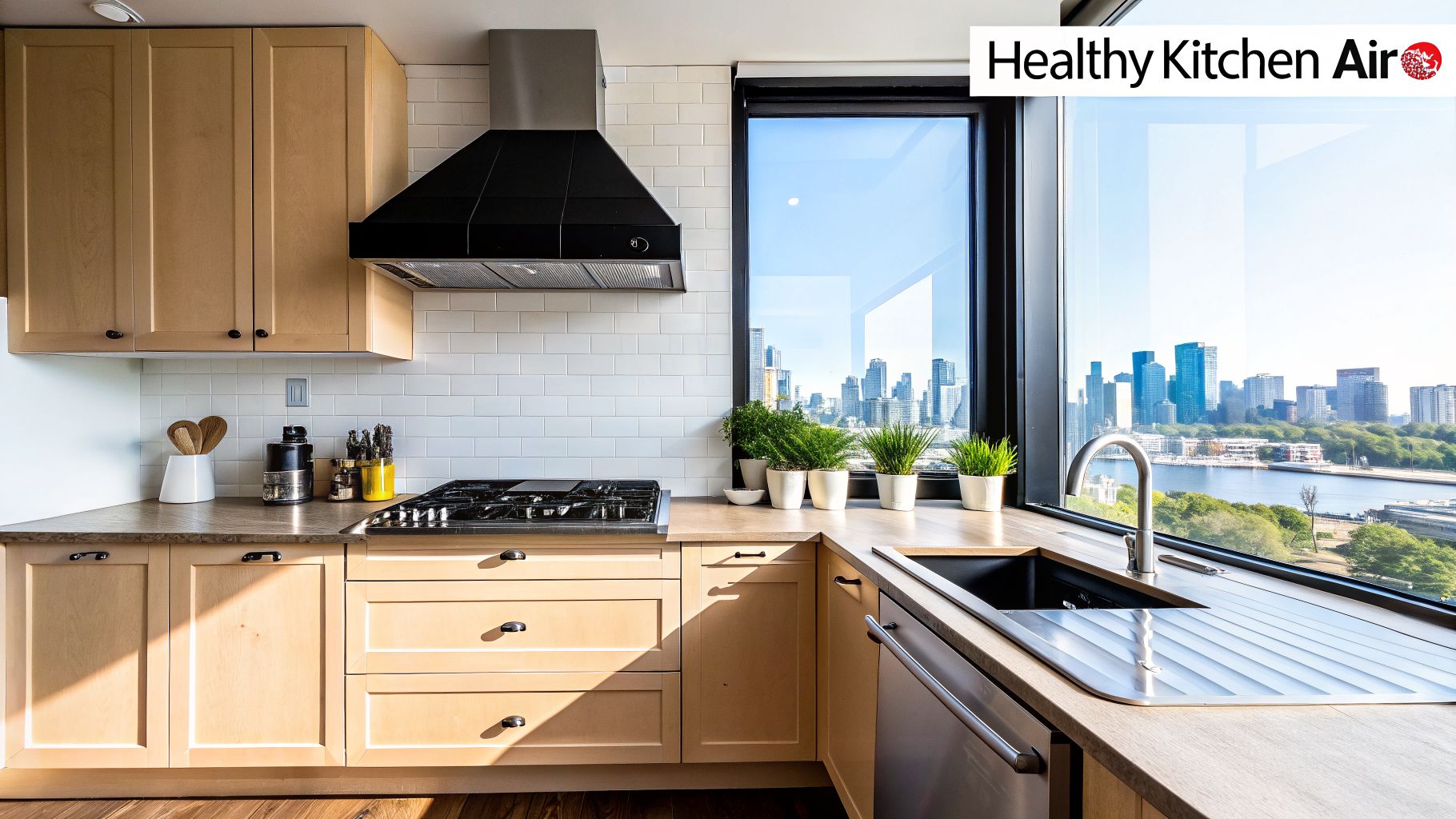
A good quality range hood is simply non-negotiable in any kitchen renovation. It’s a silent workhorse, capturing grease, smoke, strong odours, and even harmful pollutants before they have a chance to coat your surfaces or drift through your home. This is especially true in Canadian households, where we love to cook everything from fragrant curries to sizzling bacon.
Without proper ventilation, you're asking for trouble. That lingering steam can lead to mould and mildew, while airborne grease forms a sticky, grimy film on your brand-new cabinets, walls, and ceilings. Not only is it a nightmare to clean, but it can permanently damage your finishes and cheapen the look of your expensive renovation.
Why a Quality Hood Range Should Be a Priority
Putting a good chunk of your budget towards an effective ventilation system pays off in ways you might not expect. It’s not just for when you accidentally burn the toast; a well-chosen hood is a cornerstone of a kitchen that's built to last.
Here's what you're really getting:
- A Healthier Home: It pulls harmful contaminants out of the air you breathe, like carbon monoxide from gas ranges, creating a safer environment for your family.
- Protection for Your Investment: By grabbing grease and moisture right at the source, a range hood protects your cabinetry, paint, and backsplash from damage and ugly discolouration.
- More Comfort: It stops strong cooking smells—think pan-seared fish or deep-fried anything—from taking over your entire house for days.
Before you dive deep into ventilation specs, getting a broader view with some general kitchen remodeling tips can help you see how everything fits together.
A powerful, properly installed range hood is one of the single most important appliances for maintaining indoor air quality and preserving the beauty of your kitchen finishes, particularly in dense urban environments like Toronto and Markham.
This guide is designed to give you the confidence to make a smart purchase—one that perfectly matches your cooking style, your kitchen's design, and your home's needs.
Decoding Range Hood Types and Styles
It’s easy to get lost in the sheer number of range hoods on the market. But here’s the secret: choosing the right one isn't just about looks. It’s a practical decision that hinges on your kitchen’s layout, how you cook, and the overall style you’re aiming for.
Think of it as picking the right tool for the job. You wouldn't use a tiny hammer for a major demolition, and a sledgehammer is just ridiculous for hanging a picture. In the same way, the different hood ranges Canada has to offer are each built for a specific purpose, both functionally and visually.
Let's walk through the main players on the field so you can find that perfect match for your kitchen.
To help you see the options at a glance, we've put together a quick comparison of the most common range hood types found in Canadian kitchens.
Comparing Range Hood Types for Canadian Kitchens
| Hood Type | Ideal Kitchen Layout | Pros | Cons | Best Paired With |
|---|---|---|---|---|
| Under-Cabinet | Standard layouts with upper cabinets above the stove (Galley, L-Shape). | Space-efficient, budget-friendly, easy to integrate. | Less of a design statement, performance can vary. | Classic shaker or slab-door cabinets, like our Cambridge or Verona styles. |
| Wall-Mount | Cooktop is against an open wall with no cabinets directly above. | Powerful ventilation, creates a strong visual focal point. | Requires dedicated wall space, installation is more involved. | Modern, minimalist, or industrial kitchens. Pairs well with flat-panel doors. |
| Island | Kitchens with a cooktop on a central island in an open-concept space. | Designed to be a centerpiece, offers powerful venting for large areas. | More expensive, complex ceiling installation, can obstruct sightlines. | Open-concept kitchens with high ceilings and a grand island feature. |
| Hood Insert | Any layout where a custom, integrated look is the primary goal. | Complete design freedom, seamless integration, invisible ventilation. | Requires custom cabinetry/surround, higher overall cost. | High-end custom kitchens. Perfect for creating a matching surround with any MapleKing cabinet style. |
Each type has its place, and the best choice really depends on the unique demands and design of your space.
Under-Cabinet Hoods: The Space-Saving Workhorse
For most kitchens in places like Toronto and Markham, the under-cabinet range hood is the undisputed champion. As the name suggests, these compact units fit neatly underneath your upper cabinets, sitting directly over the cooktop. They’re efficient, straightforward, and generally the kindest on your wallet.
If your kitchen maximizes every inch with cabinetry—think a classic galley or an L-shaped layout—this is your most practical bet. It gets the job done, capturing smoke and odours without needing a full-scale redesign of your space.
Under-cabinet hoods are the quiet heroes of kitchen ventilation. They provide a powerful, no-fuss solution that slips right into most existing layouts, making them a go-to for many renovations.
While they don't scream for attention like other styles, their strength is their subtlety. They work hard behind the scenes, letting your beautiful cabinetry and backsplash be the star of the show.
Wall-Mount Hoods: The Stylish Focal Point
What if your range sits against a wall with no cabinets above it? That open space is the perfect stage for a wall-mount hood to make a design statement. People often call them "chimney hoods" because a sleek metal chimney hides the ductwork as it runs up to the ceiling.
A wall-mount hood instantly becomes a focal point. They’re available in a staggering variety of designs, from clean, professional-looking stainless steel to dramatic, sculptural shapes that command attention.
Consider a wall-mount hood if:
- You’re chasing a modern, pro-kitchen, or even an industrial vibe.
- Your cooktop is on an exterior or interior wall with open space above.
- You want your ventilation system to be a core part of the kitchen's design.
These models often pack a serious punch in terms of ventilation power, making them a fantastic choice for anyone who loves high-heat searing or wok cooking. The visible chimney also draws the eye upward, giving the whole room a taller, more open feel.
Island Hoods: For Open-Concept Living
When your cooktop is the star of a central island, an island range hood is non-negotiable. These are mounted directly to the ceiling and are finished on all four sides since they’re visible from every angle. Their prominent position makes them a make-or-break design element in any open-concept home.
An island hood is truly the centerpiece of the kitchen. It has to be powerful enough to clear the air in a large, open area without sounding like a jet engine taking off. Because of their complex installation and all-around finish, they are typically larger and carry a higher price tag than other types, but for an island cooktop, they are essential.
Hood Inserts: The Secret to Custom Design
For the ultimate in seamless design, nothing beats a hood insert. This is the guts of the range hood—the blower, lights, and controls—packaged into a single unit that you install inside a custom-built enclosure or "hood surround."
This is where your creativity can really shine. You can build a surround that perfectly matches your MapleKing cabinets, creating a flawless, unified look. Or, you could design something totally unique using materials like plaster, aged copper, or reclaimed wood. The hood itself becomes completely invisible, integrated directly into your kitchen’s architecture. This is the top choice for discerning homeowners building a high-end, truly custom kitchen.
Calculating CFM Sizing and Placement
Alright, you've picked a style. Now comes the real workhorse of your kitchen ventilation system: the motor. We need to talk about its power, which is measured in Cubic Feet per Minute (CFM). Getting this number right is probably the single most important technical decision you'll make for your new range hood.
Think of CFM as the suction power of your range hood. If it's too weak, it’ll struggle to clear out smoke and cooking odours. If it's unnecessarily powerful, you're paying for performance you don't need. The goal is to find that sweet spot for your specific stove and how you cook.
This diagram helps put the different hood types we've discussed into perspective, showing how they fit into the overall kitchen layout.
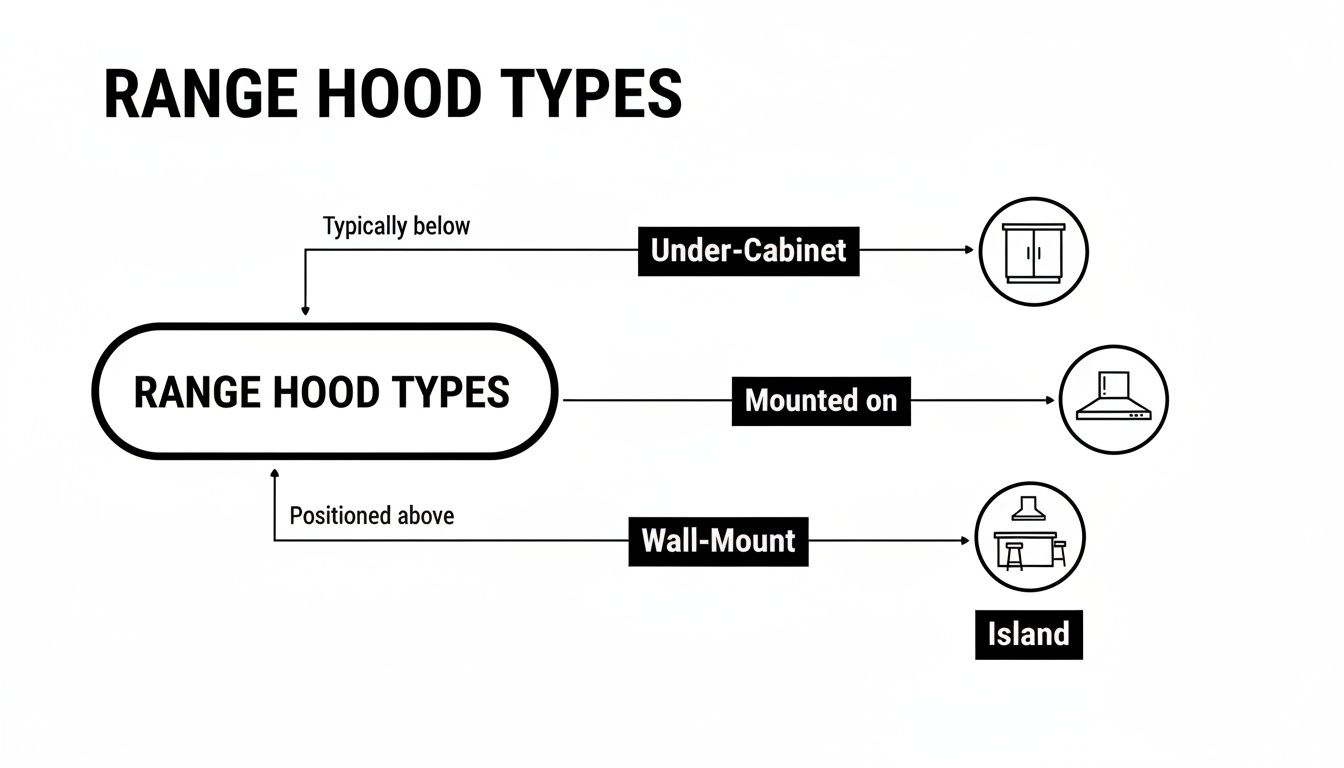
As you can see, the physical form of each hood—whether it's tucked under a cabinet, mounted to a wall, or suspended over an island—shapes its installation and how it moves air.
How to Calculate Your Minimum CFM Needs
Don't worry, you won't need a calculator for advanced physics. There’s a simple rule of thumb for figuring out your minimum CFM, and it all depends on whether you have an electric or a gas range.
For Electric Stoves:
With electric cooktops, the math is all about size. The standard guideline is to provide 10 CFM for every inch of your cooktop's width.
- Example: For a common 30-inch electric stove.
- Calculation: 30 inches x 10 = 300 CFM
- So, for a standard electric stove, you'll want to start your search with hoods that offer at least 300 CFM.
For Gas Stoves:
Gas ranges burn hotter and produce more exhaust, so the calculation is based on their total heat output, measured in British Thermal Units (BTUs).
First, you'll need to find the total BTU output for your stove by adding up the BTUs of all the burners (check your appliance manual for these numbers). Then, you just divide that total by 100.
- Example: A gas range has a combined output of 45,000 BTU.
- Calculation: 45,000 BTU / 100 = 450 CFM
- In this scenario, a hood with 450 CFM is the minimum you should consider.
Here's a pro tip: always aim for a CFM rating a bit higher than your calculated minimum. That extra power is a lifesaver when you’re searing a steak or have multiple pots going at once.
The Importance of Correct Placement
A powerful motor is useless if the hood isn't in the right spot. Proper placement is just as crucial as CFM for effective ventilation. There are two measurements you have to get right: width and height.
1. Hood Width Should Match or Exceed Cooktop Width
Smoke and steam don't rise in a neat column; they billow outwards. To capture it all, your range hood needs to be at least as wide as your cooktop. For the best capture, especially with powerful gas ranges or island setups, we recommend a hood that extends 3 inches past the cooktop on each side.
2. Optimal Height Above the Cooktop
The gap between the bottom of your hood and the cooking surface is a critical dimension.
- Too High: The fan won’t be close enough to grab the fumes before they escape into your kitchen.
- Too Low: It gets in your way, blocks your view of the backburners, and can even become a fire hazard.
For most residential hood ranges in Canada, the ideal height is somewhere between 24 and 30 inches above the cooktop. Because gas stoves produce more intense heat, they often need a little more clearance, typically in the 27 to 30-inch range. For a more detailed breakdown, we’ve put together a full guide on ideal range hood height. But always, always double-check the manufacturer’s installation manual—their specs are the final word.
Choosing Between Vented and Ductless Hoods
One of the first big forks in the road you’ll face when picking a range hood is whether to go with a ducted (vented) or ductless (recirculating) system. Honestly, the right answer comes down to your home’s layout, how you cook, and what your renovation budget looks like. It’s the classic trade-off between raw performance and everyday practicality.
I always tell clients to think of it like this: a ducted hood is like cracking a window open on a breezy day. It physically grabs all that greasy, steamy, smelly air from your kitchen and sends it packing right outside. It's gone for good. A ductless hood, on the other hand, is more like a powerful air purifier stationed right above your cooktop. It sucks in the air, scrubs it clean through filters, and then sends it back into the room.
The Power of Vented Hoods
When it comes to pure performance, a vented or ducted system is the undisputed champion. Because it vents everything straight outside, it completely eliminates smoke, steam, grease, and those lingering cooking odours from your home. If you're a serious home chef—someone who loves to sear steaks, deep-fry, or cook with fragrant spices—a vented hood is almost always the way to go.
The performance edge is clear:
- Superior Air Quality: Nothing beats physically removing airborne contaminants and moisture from the room.
- Higher Power: These models are built to handle higher CFM ratings, making them the perfect partner for a high-output gas cooktop.
- Simpler Maintenance: They typically use baffle or mesh filters that you can just pop in the dishwasher, which saves you money on replacements down the line.
The big catch, though, is the installation. Snaking ductwork through your walls and ceilings to an outside wall or up through the roof can get complicated and expensive. For some homes, like a high-rise Toronto condo, building rules might make it completely impossible.
The Flexibility of Ductless Hoods
Ductless hoods are the saving grace for situations where venting just isn't in the cards. Their biggest selling point is flexibility. Since there's no need for external ductwork, you can install one almost anywhere. This makes them ideal for apartments, condos, or even a finished basement kitchen where tearing into walls is a non-starter.
A ductless system is the problem-solver for modern living. While a ducted hood is ideal, the practical reality of many Canadian homes, especially in dense urban centres, makes ductless a necessary and effective alternative.
These models work their magic by pulling air through a charcoal filter, which is specifically designed to trap grease particles and neutralize odours before recirculating the air. While they won't do anything about heat or humidity, a high-quality ductless unit can still do a surprisingly good job of clearing the air for most day-to-day cooking.
Of course, there are trade-offs in performance and upkeep. Those charcoal filters need to be replaced regularly—usually every 3-6 months, depending on your cooking habits—which adds an ongoing cost. They also just can't handle heavy-duty smoke and steam as effectively as their vented cousins. If you go this route, finding high-quality hood ranges in Canada with strong ductless performance is crucial.
So, how do you decide? If your home's structure allows for it and your budget can handle the installation, a vented hood will always give you the best results. But if you’re renovating a space in a Markham townhouse with no existing ducts or setting up a kitchen in a downtown apartment, a top-notch ductless hood is a fantastic and practical choice that will still make a huge difference in your kitchen environment.
Integrating Your Hood Range With Custom Cabinetry
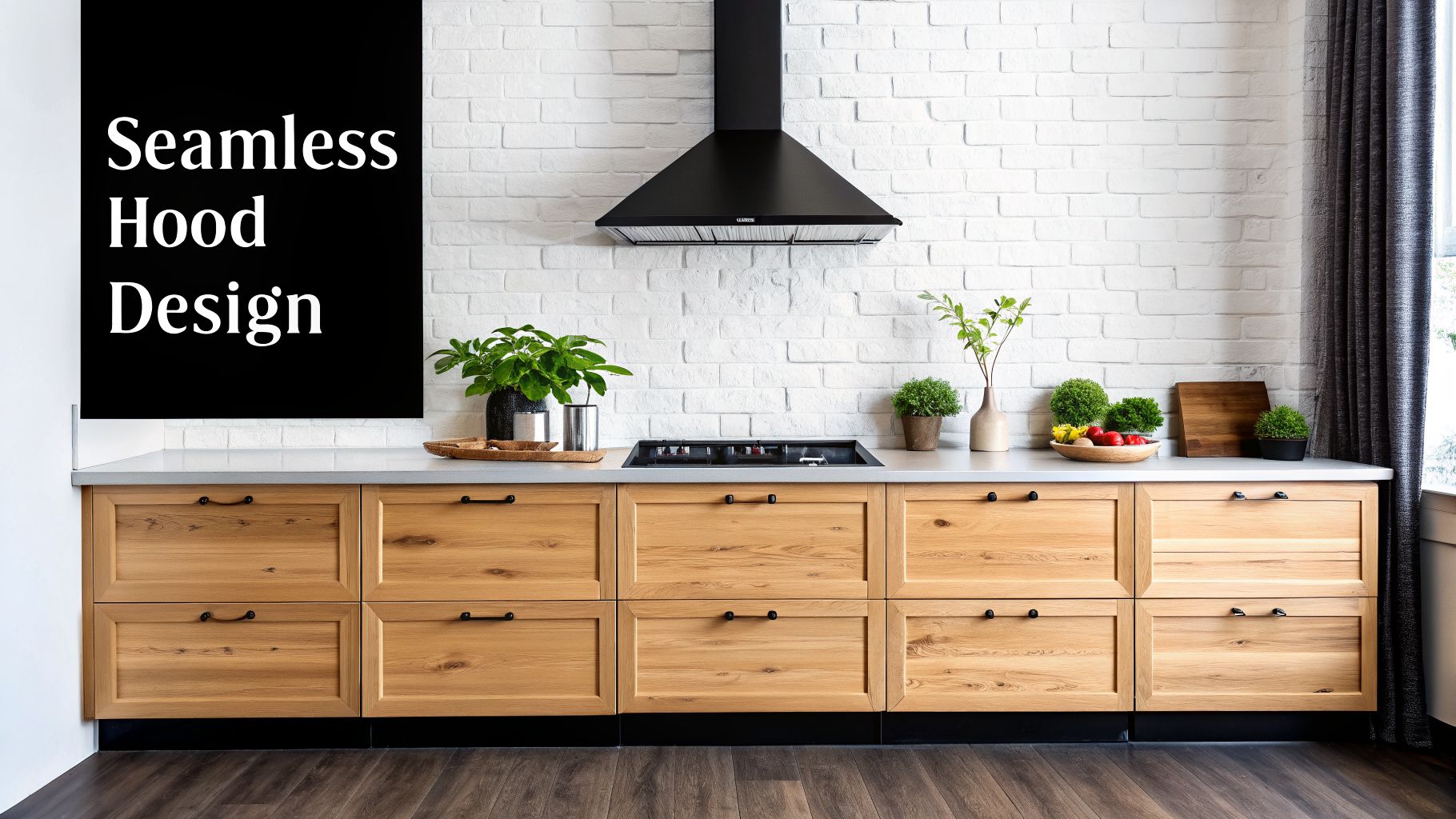
A truly stunning kitchen design is all about the details, and one of the biggest tells of a high-end, custom job is how the range hood is handled. Instead of looking like a separate appliance tacked onto the wall, the best designs treat the hood as an integral part of the cabinetry itself. This small shift in thinking elevates a functional necessity into a beautiful architectural feature.
It’s the difference between buying a suit off the rack and having one custom-tailored. Both do the job, but the custom piece is made just for you, flowing perfectly with your own lines. Integrating your range hood with custom cabinetry gives you that same flawless, cohesive finish.
The secret to pulling this off? A hood insert. This is the workhorse—the fan, filter, and lights—that gets tucked away inside a custom-built shell. Using an insert gives you complete creative freedom over the exterior, letting the ventilation system blend seamlessly into your kitchen's design.
Matching Hood Surrounds to Cabinet Styles
The beauty of a custom hood surround is that it can be designed to match literally any cabinet style you choose, from the classic warmth of traditional wood to the clean, sharp lines of modern minimalism. This is how you get that cohesive, thoughtfully planned look.
Here are a few ways we see this done beautifully:
- Traditional Elegance: For a timeless, furniture-like feel, the surround is often built using the same door style and finish as the cabinets. A custom hood painted to match our real wood grain doors creates a sophisticated focal point that anchors the whole room.
- Modern and Minimalist: Sleek and contemporary kitchens call for a simple, clean-lined surround. You can paint it to match the wall colour, making the hood almost disappear, or use a material like our high-gloss HDF for a striking, reflective statement piece.
- Transitional Charm: To bridge the gap between classic and modern, a simple shaker-style panel on the hood surround works wonders. This look pairs perfectly with our popular shaker-style HDF painted doors, giving you a design that feels both current and enduring.
As you plan your cabinetry, getting familiar with the different types of wood for custom cabinetry is time well spent. It helps you choose materials that not only look incredible but are also tough enough to handle the heat and moisture of a busy kitchen.
The real secret to a professional-grade kitchen is planning for the hood integration right from the start. When your designer and cabinet maker are in the loop from day one, they can account for ducting, electrical, and exact measurements, saving you from expensive headaches down the road.
This kind of forward-thinking is more important than ever, especially in the Greater Toronto Area. With CMHC projecting a major slowdown in new housing starts, many homeowners are choosing to invest in their current properties instead of moving. A spectacular kitchen with integrated, high-end features is one of the smartest renovations you can make for both enjoyment and resale value.
Creating a Bespoke Kitchen with MapleKing
A thoughtfully designed hood surround is a true hallmark of a custom kitchen. It shows an incredible attention to detail and takes the entire space from standard to spectacular. Whether you want a grand, ornate centrepiece or a discreet, hidden system, integrating your ventilation is a move that pays off in both style and function.
For homeowners and builders in Toronto and Markham, our expertise in custom cabinetry in Toronto is a huge asset. We can help you design a hood surround that perfectly complements the cabinet style you’ve fallen in love with, ensuring a completely unified and luxurious finish.
Here’s how we make it happen:
- Design Consultation: We start by working with you to understand your vision, incorporating the hood insert right into the initial cabinetry layout.
- Material Matching: We use the exact same materials and finishes—whether it’s painted HDF, durable laminate, or real wood—for your surround to guarantee a perfect match.
- Precise Craftsmanship: Our team builds the surround to the exact specifications of your chosen hood insert, ensuring a snug, professional, and flawless fit.
Ultimately, integrating your range hood is about creating a kitchen that feels intentional. It’s a design choice that signals quality and craftsmanship, turning a necessary appliance into a beautiful, seamless part of your home’s story.
Local Installation Tips for Toronto and Markham
Installing a range hood in the Greater Toronto Area isn't quite the same as in other parts of the country. Anyone who’s worked on homes here knows that Toronto and Markham have their own distinct interpretations of the Ontario Building Code, which can trip up even experienced DIYers.
Think of it less as a simple appliance swap and more as a small-scale construction project. Every detail, from the diameter and length of your ductwork to where it exits your home, is regulated. Getting these things right from the start is the only way to ensure your kitchen is safe, functional, and up to code.
The type of home you live in is probably the biggest factor. Are you working with a century-old brick-and-beam loft in downtown Toronto? You're going to face some real challenges figuring out how to vent outside without compromising the structure. It’s a completely different puzzle than a modern townhouse in Markham, which might offer a clearer path for ducting.
But even those newer builds have their own hurdles. Condo boards, for example, often have strict rules against punching new holes in the exterior walls. This is exactly why a one-size-fits-all approach just doesn’t fly in the GTA; your home’s age, style, and location dictate the entire plan.
This is non-negotiable: hire a qualified, licensed, and insured installer who works in your municipality regularly. They’ll know the local quirks, like when a make-up air system is mandatory for a high-CFM hood. This expertise saves you from costly fixes and failed inspections down the road.
The GTA Market and Your Renovation
It’s also worth looking at the bigger picture. The Greater Toronto Area's real estate market has seen some shifts, with the national sales-to-new listings ratio recently hitting 45%. According to the Canadian Real Estate Association, this points to more balanced conditions, which means sellers need to work harder to make their properties shine.
For homeowners in Toronto and Markham, this is a perfect time to invest in a kitchen that truly stands out. A professionally installed, powerful range hood paired with beautiful, modern cabinetry is a major selling point that adds real value and appeal. It's why so many homeowners are looking for end-to-end guidance on their Toronto kitchen renovation to make sure every component works together perfectly.
Key Takeaways for a Successful GTA Installation
To keep your project on track, here are a few final tips from the field:
- Verify Installer Credentials: Always ask for proof of license and liability insurance. More importantly, ask if they’ve recently completed projects in your specific city, whether it's Toronto or Markham.
- Plan for Your Housing Type: Before you even buy a hood, have a detailed talk with your contractor about the specific challenges of your home—high-rise, semi-detached, or new construction.
- Don't Guess on Codes: Rules change. Your installer should be the one responsible for pulling any permits and ensuring every part of the installation is compliant with today's local codes. Don’t assume anything.
Common Questions About Hood Ranges in Canada
Alright, so you've got the basics down. Now it's time to get into the nitty-gritty details that will help you pick the perfect range hood from all the options available in Canada. Let's tackle some of the most common questions we get from clients, covering everything from noise levels to keeping your new appliance in top shape.
How Noisy Are Modern Range Hoods?
Nobody wants a range hood that sounds like a jet engine taking off in their kitchen. The noise level of a hood is measured in a unit called sones—the lower the sone number, the quieter the operation.
It helps to have a real-world comparison:
- A quiet fridge hums along at about 1 sone.
- A normal conversation between two people is roughly 4 sones.
- A high-powered hood on its maximum setting can hit 7-8 sones, but that's really only for intense searing or frying.
When you're shopping, pay close attention to the sone rating. A good quality hood will operate between 1.5 to 3 sones on its lower, everyday settings. This gives you whisper-quiet performance for simple tasks like simmering a sauce, while still having that high-power (and louder) boost ready when you need it.
How Often Should I Clean My Hood Filters?
This is a big one, and the answer depends entirely on the type of filter in your hood. Keeping them clean is the single most important thing you can do for performance and longevity.
For ducted systems that use stainless steel baffle or mesh filters, you should plan on cleaning them every 1-3 months. Thankfully, most of these filters are dishwasher-safe, which makes it a surprisingly easy task.
If you have a ductless system, you're relying on activated charcoal filters to trap smoke and odours. These can't be washed. They need to be completely replaced every 3-6 months. If you put this off, your hood simply won't be able to do its job effectively.
Can I Install a Professional-Grade Hood at Home?
You absolutely can, but it’s not a simple swap-out. Putting a commercial-style, high-power hood in a residential kitchen requires some serious planning. These units often pull 1200+ CFM, and that kind of power has some knock-on effects.
You’ll need much larger ductwork—think 8-10 inches in diameter instead of the standard 6 inches. More importantly, you will almost certainly need a make-up air system. This is a requirement in many local building codes, including Toronto's, to prevent negative air pressure by replacing the air your powerful hood is exhausting. Before you even think about buying, have an HVAC professional assess your home.
This kind of upgrade is becoming a popular move for property investors, too. With a slowdown in rent growth predicted by 2026, many landlords in Toronto and Markham are renovating to make their properties stand out. Investing in a durable, properly installed range hood and quality finishes is a smart play. You can read more on how housing dynamics are shaping the renovation scene in this Canadian housing market outlook.
Ready to create a kitchen that perfectly blends style, function, and value? At MapleKing Kitchen Cabinets, we specialize in designing custom cabinetry solutions that integrate seamlessly with your chosen appliances. Explore our gallery and start your free design consultation today at https://maplekingkitchencabinets.com.