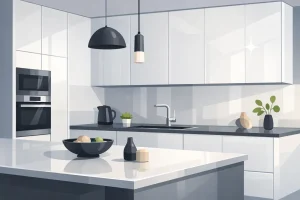

You're probably in the same spot most first-time renovation clients are in when they call me. You have a clear picture of how you want the room to feel, cleaner kitchen, better storage, warmer lighting, a home that finally looks finished, and then the practical question lands: what should the home decorating budget be?
In Toronto and Markham, that question matters early. Costs don't drift because homeowners buy one expensive lamp. Budgets go off course because people start with inspiration photos, skip the scope work, and only price the obvious items. Then freight, installation, storage, layout changes, and upgraded finishes start stacking up.
A good budget doesn't limit your project. It gives it structure. It tells you what you can do now, what should wait, and where one smart decision can protect the rest of the plan. In many GTA projects, that one decision is cabinetry.
Starting Your Decorating Journey The Right Way
The first mistake most homeowners make is treating the budget as a ceiling instead of a roadmap. They ask for one total number, hoping that number will settle the whole plan. It won't. A useful home decorating budget tells you how the money is allocated, which parts are fixed, and which parts can move.
That matters even more in this market. Homeowners across Canada have been spending more on furnishings and household upgrades. The average annual expenditure on household furnishings and equipment per consumer unit reached CAD 2,605.82 in 2022, up about 24.1% from 2019, according to Canadian home décor spending data. In the GTA, that shows up in real projects as bigger expectations around storage, finishes, organisation, and custom details.

Start with the room that drives the budget
If you're refreshing a condo living room, the biggest risks may be furniture scale, delivery access, and lighting. If you're touching a kitchen, the budget gets more technical fast. Cabinetry, layout, trades, and finish coordination turn a decorating plan into a renovation plan.
That's why I tell clients to identify the anchor room first. In many homes, it's the kitchen. Once that room is defined, the rest of the decorating budget becomes easier to control.
A practical first step is to look at similar local renovation scopes before you shop. If you're planning work in York Region, browsing home renovations in Markham helps you understand how quickly a simple visual update can turn into a broader construction project.
Practical rule: If the room needs better function, not just a new look, budget it like a renovation from day one.
What works and what doesn't
Here's what works in real projects:
- Define the project intent early. Is this for resale, long-term living, or fixing a room that doesn't function?
- Separate visual goals from functional goals. New stools and paint are one thing. New pantry storage and a better prep layout are another.
- Treat cabinetry and built-ins as core scope. They affect storage, workflow, and finish selections across the room.
What doesn't work:
- Starting with accessories before deciding on fixed elements.
- Assuming décor is the inexpensive part. It often isn't once window coverings, built-ins, and upgraded surfaces are included.
- Using a single all-in number with no category breakdown.
If you want your home decorating budget to feel manageable, don't ask “How much will this cost?” Ask, “What am I trying to solve, and which decisions will shape the rest of the spend?”
What Do You Really Want to Accomplish
A budget usually fails before any money is spent. It fails when the scope is vague.
Clients often say they want a kitchen “update.” That can mean repainting walls and replacing light fixtures, or it can mean new cabinet doors, new storage, a revised layout, and finish changes that affect every trade on site. Those are completely different projects, even if the room is the same.
Use a three-level priority list
The easiest way to control a home decorating budget is to sort every idea into three buckets:
- Must-have
- Should-have
- Could-have
For a kitchen, a must-have might be more usable storage, better drawer access, or cabinets that fit the room properly. A should-have could be a cleaner door style or upgraded hardware. A could-have might be open shelving, decorative glass inserts, or a feature wall that looks nice but doesn't solve a real problem.

Why this matters more now
Homeowners are seeing more product options, more styling content, and more layered finish packages than ever. That's one reason budgets expand so easily. A 2024 market reference projects the global home decor market to grow at a 9.4% CAGR from 2025 to 2030, and notes that decorative categories are expected to expand, which is a good reminder that even modest design changes can absorb budget quickly once cabinets, surfaces, and accessories are involved, as noted in these home décor market projections.
That doesn't mean you should scale back every idea. It means you need to decide what the room must do before you decide how you want it to look.
If you can't explain why an item belongs in the project, it probably belongs on the future list.
A kitchen example that keeps scope under control
Let's say you're planning a Markham kitchen facelift. Write the list like this:
Must-have
More pantry storage, easier-to-clean cabinet fronts, improved lower cabinet access, lighting that supports prep work.Should-have
A more modern colour palette, better visual continuity with the flooring, upgraded handles, a cleaner island face.Could-have
Statement pendants, decorative end panels, floating shelves, seasonal styling items.
This method forces trade-offs before emotion takes over. That's the point. Once a client falls in love with five different finishes and three add-ons, it becomes much harder to cut anything calmly.
Questions worth answering before you price anything
Use these with a partner or designer before requesting quotes:
- What problem are we solving first. Storage, flow, resale appeal, or wear and tear?
- What are we keeping. Existing flooring, appliances, backsplash, or wall layout?
- What would disappoint us if we skipped it. That's usually a must-have.
- What would be nice but not necessary. That belongs lower on the list.
A decorating budget becomes realistic when the project has a firm edge. Without that edge, every new idea looks reasonable, and that's how scope creep starts.
How to Research and Estimate Real-World Costs
The strongest budgets I see are built from line items, not guesses. That's the only reliable way to price a GTA project because the final spend isn't just materials. It's delivery timing, access conditions, installation labour, disposal, storage, and the cost of changing your mind after orders are placed.
Regional interior-design guidance recommends building a renovation budget from line items and setting aside 10–20% for unforeseen expenses, especially where freight, storage, and installation can materially affect the total, as explained in this guide to interior design budget planning.
Build the budget in categories, not by room mood
If you put “kitchen refresh” on one line of a spreadsheet, you won't learn anything useful. Break the project into separate cost buckets so you can see what's driving the spend.
Use categories like these:
Design and planning
Measuring, drawings, consultations, revisions, permit-related coordination where needed.Removal and disposal
Demolition, haul-away, bin costs, protection of adjacent areas.Materials
Cabinetry, hardware, paint, tile, lighting, trim, shelving, accessories.Logistics
Shipping, receiving, temporary storage, delivery scheduling, condo elevator bookings if applicable.Installation and finishing
Cabinet install, touch-ups, electrical, plumbing, paint correction, cleanup.Contingency
Funds reserved for hidden conditions, substitutions, or approved scope changes.
A planning template you can actually use
The table below is a structure template, not a price list. It shows how to organise your home decorating budget by project scale without pretending one fixed number fits every Toronto or Markham home.
| Expense Category | Small Project (One Room Refresh) | Medium Project (Kitchen Facelift) | Large Project (Full Kitchen Gut Reno) |
|---|---|---|---|
| Design and consultant fees | Limited planning, finish selections, measurements | Design support, cabinet planning, finish coordination | Full planning, revisions, detailed layout work |
| Demolition and disposal | Minimal removal | Selective removal of old finishes or cabinet components | Full tear-out, disposal, site protection |
| Materials | Paint, lighting, furnishings, décor | Cabinet doors or cabinetry, hardware, surfaces, lighting | Full cabinetry, finishes, surfaces, fixtures, lighting |
| Shipping, receiving, storage | Basic delivery | Delivery plus possible storage and staged receiving | Coordinated receiving, staged delivery, possible storage |
| Installation | Painter, handyman, light fixture install | Cabinet install, hardware, paint, trade touch-ups | Multi-trade installation, sequencing, finishing work |
| Contingency reserve | Required | Required | Required and closely monitored |
Where homeowners underestimate most often
Cabinetry gets attention. The support costs around cabinetry are what people miss.
Freight, receiving delays, and installation complexity can change the total even when the cabinet price stays the same. Flooring creates similar surprises. If your project includes wood floors, it helps to review a practical resource on understanding hardwood floor renewal budgets so you can compare refinishing versus replacement logic before you finalise adjacent room decisions.
A budget is only honest when logistics are priced alongside materials.
Another smart step is to compare room-by-room planning against broader renovation context. If you're trying to understand how one kitchen decision fits inside a larger property update, this overview of full home renovation cost is a useful reference point.
What a solid spreadsheet should show
Your spreadsheet should record four separate columns for each line item:
- Estimated cost
- Quoted cost
- Approved cost
- Actual paid
That structure changes behaviour. It forces decisions to be documented. It also shows when an attractive idea is pushing out something more important.
If you don't track at that level, the budget starts feeling emotional. When you do track it, the budget becomes operational.
Stretching Your Budget Without Sacrificing Style
If you want the biggest impact from your home decorating budget, start with the items that shape the room every day. In kitchens, that usually means cabinetry. Not because it's glamorous, but because it affects storage, layout, visual weight, cleaning effort, and the finish standard for everything around it.
Many homeowners try to save money by cutting cabinet quality first and spending later on decorative upgrades. That usually backfires. Cheap cabinet choices are visible every day. Decorative swaps can happen later.

Why cabinetry is the biggest budget lever
Cabinet choices affect far more than the cabinet line itself. They influence:
- Layout efficiency. Better storage can eliminate the need for extra furniture or overflow pieces.
- Finish coordination. Door style, sheen, and colour drive countertop, backsplash, and hardware decisions.
- Installation complexity. Customisation can solve awkward walls and reduce clumsy filler solutions.
- Long-term maintenance. Some finishes show wear faster, hold fingerprints, or require more care.
This is where material selection matters. A painted HDF door gives a cleaner, more uniform finish when you want consistency. Real wood painted doors show natural grain, which suits clients who prefer texture and variation. Laminates are often a practical fit when durability, moisture resistance, and easy maintenance are higher priorities than grain expression. Matte HDF tends to work well in busy family kitchens because it keeps the look refined without leaning too glossy.
One cabinetry supplier Toronto and Markham homeowners often consider is MapleKing Kitchen Cabinets, which offers factory-direct cabinetry in options such as real wood painted doors, HDF painted finishes, matte and high-gloss HDF, laminates, and thermofoil. When you're comparing quotes, that kind of product mix helps you match the material to the room instead of forcing every project into one finish type.
Smart savings are selective, not random
You don't need to make every item inexpensive. You need to choose where quality matters most.
A good budget strategy often looks like this:
Spend on cabinet function
Drawer storage, practical internals, and a door finish suited to the room's use will usually outperform decorative add-ons.Hold back on trend-heavy accents
Pendants, stools, and seasonal accessories are easier to upgrade later.Keep what still works
If existing flooring, appliances, or backsplash can stay, your budget becomes much more flexible.Use styling as the final layer
Lower-cost updates can still shift the room dramatically. For homeowners looking beyond the kitchen, these inexpensive fall decor ideas are a practical reminder that not every visual refresh has to come from major construction.
Here's a quick visual walkthrough that reinforces the same principle: spend carefully on what anchors the room, then style around it.
What usually wastes money
The worst budget decisions tend to have one thing in common. They look cheaper at the moment of purchase, but they create more spending later.
Buy the finish that suits how you live, not the one that only looks good in the sample.
Common examples include replacing decent cabinets with poor-quality ones just to say the room was “redone,” choosing delicate finishes in high-touch family kitchens, or paying for decorative layers before the storage plan is solved.
If you need to stretch your budget, simplify the extras first. Protect the cabinetry decision. In most kitchens, that's the move that keeps the whole project coherent.
Managing Your Budget from Start to Finish
A budget only works if you manage it during the job, not just before it starts, a common pitfall for many self-managed projects. Ontario-area budgeting guidance recommends keeping a formal contingency fund of 5–15% for unforeseen expenses, and notes that 58% of homeowners report spending more than anticipated on DIY or self-managed projects, according to this review of budgeting mistakes to avoid when remodelling.
That should change how you think about contingency. It isn't spare money. It's a control tool.

A simple phase-by-phase method
Use a checklist that follows the life of the project.
| Phase | What to track |
|---|---|
| Planning | Final scope, priority list, approved finish direction |
| Quoting | Multiple bids, inclusions, exclusions, lead times |
| Ordering | Deposits, change approvals, shipping expectations |
| Site work | Demolition issues, hidden conditions, trade extras |
| Installation | Labour changes, missing items, touch-ups |
| Closeout | Final invoices, holdbacks if applicable, post-project adjustments |
When to use contingency and when not to
Use contingency for real surprises or approved changes that improve the project materially. Hidden wall damage, uneven surfaces that affect installation, or revised storage details after field measurement all fit that category.
Don't use contingency to cover impulse purchases. If you suddenly want different bar stools, upgraded decorative pendants, or a feature wallpaper that wasn't in the approved scope, that should come from savings elsewhere, not from the risk reserve.
Habits that protect the budget
These are the project controls I recommend most often:
Approve changes in writing
Even small upgrades need a cost note before anyone orders anything.Review totals at each milestone
Don't wait until the end of the month. Check after demolition, after ordering, and after installation starts.Track actuals immediately
Receipts and invoices should go into the spreadsheet the same day.Keep one decision-maker
Projects become expensive when too many people can add scope casually.
A calm project usually isn't the one with no issues. It's the one where the client knows what changed, why it changed, and what line item is carrying the cost.
Turning Your Dream Home into a Reality
A workable home decorating budget comes down to five moves. Define the room clearly. Separate needs from wants. Build the estimate from real line items. Protect the categories that matter most. Then manage the spend as the project unfolds.
That process sounds simple, but it changes everything. It stops the vague overspending that makes renovations stressful. It gives you a way to make solid trade-offs without feeling like you're losing the design. It helps you spend where the room will perform better, not just where the photos will look better.
In Toronto and Markham, cabinetry is often the point where the budget either stabilises or starts slipping. When the cabinet plan is vague, everything around it becomes harder to price. When the cabinet plan is clear, your layout, finish schedule, installation scope, and styling decisions all become easier to manage.
If you're planning a kitchen update, start there. Get a proper cabinetry quote. Compare material options carefully. Ask what's included, what isn't, and how the selection affects the rest of the room. That one step gives your decorating budget a solid centre.
A home doesn't need to be finished all at once to feel well planned. The best projects are organised, not rushed. If you approach the budget with discipline, you can make the room better now and still leave space for future upgrades without regret.
If you're ready to anchor your budget with a real cabinetry number, MapleKing Kitchen Cabinets is a practical place to start. Their Markham team offers consultations and free quotations for Toronto and GTA homeowners, which can help you price cabinet options before the rest of your decorating decisions start drifting.