

So, you’re thinking about a full home renovation in Toronto. The big question on everyone’s mind is always: what’s it going to cost? The honest answer is that it varies wildly. In the Toronto area, you’re generally looking at a range of $100 to over $400 per square foot, but that’s just a starting point.
For a typical 2,000 sq. ft. house, a basic cosmetic update might start around $200,000. If you’re planning a full gut job with high-end finishes, that number could easily climb past $800,000. These figures aren't set in stone; they're shaped by your vision, your choice of materials, and the hidden surprises your home might have in store.
Planning a renovation budget is a bit like packing for a trip—you need to know where you're going to figure out what to bring. A simple refresh with new paint and lighting is like a weekend getaway; it's relatively straightforward and light on the wallet. But moving walls, re-routing plumbing, and overhauling the electrical? That's a month-long trek through the mountains, requiring serious planning and a much bigger budget.
The single biggest driver of your final cost will always be the scope of the project. Are you just sprucing things up on the surface, or are you tearing down walls and starting from scratch? The more demolition, structural work, and system upgrades involved, the faster your costs will escalate.
Understanding Renovation Tiers
To make budgeting a little less abstract, it helps to think in terms of "tiers." Each one represents a different level of work and quality of materials, which directly ties back to your total spending.
- Cosmetic Refresh (Budget-Friendly): This is all about getting the most bang for your buck. We're talking high-impact visual changes that don't touch the home's layout—a fresh coat of paint, new light fixtures, refinishing floors, or swapping out old cabinet handles.
- Mid-Range Remodel (Standard Quality): This is where most renovations land. It’s a deeper dive that often includes a full kitchen and bathroom gut, maybe even moving a non-load-bearing wall. You're looking at quality appliances, durable materials, and a real transformation. Many homeowners explore different services to strike that perfect balance between quality and cost.
- High-End Gut Renovation (Luxury): This is the full works. You're stripping the house back to its bones—the studs and subfloor. This tier involves reconfiguring layouts, adding custom millwork, installing premium materials like marble and hardwood, and finishing with top-of-the-line appliances and fixtures.
Even for a simple refresh, getting a handle on individual costs is key. For example, knowing the cost to paint a house in Toronto can help you budget for one of the most common and impactful updates.
To put it all together, here’s a quick overview of what you can expect to spend in the Greater Toronto Area.
Toronto Full Home Renovation Cost at a Glance
| Renovation Tier | Average Cost Per Square Foot (Toronto/GTA) | Estimated Cost for a 2,000 Sq. Ft. Home |
|---|---|---|
| Cosmetic Refresh | $100 – $175 | $200,000 – $350,000 |
| Mid-Range Remodel | $175 – $300 | $350,000 – $600,000 |
| High-End Gut Renovation | $300 – $400+ | $600,000 – $800,000+ |
Remember, these are ballpark figures to help you get started. Your final cost will depend on the specific contractor, materials, and complexity of your project.
The Five Big Things That Drive Your Renovation Budget
When you first see a quote for a full home renovation, that bottom-line number can be a bit of a shock. But it's not just one giant, mysterious expense. It’s actually a mix of several key costs all bundled together. Think of it like a recipe—understanding each ingredient is the first step to controlling the final flavour (and cost) of your project.
Let's pull back the curtain on the five major drivers that make up almost every renovation bill. Once you know what they are and why they cost what they do, you'll be in a much better position to make smart decisions with your money.
1. Labour: The People Who Make It Happen
This is almost always the biggest chunk of your budget, typically eating up 40% to 50% of the total cost. Labour isn't just one person with a hammer; it’s an entire team of skilled tradespeople who physically build your vision.
This cost covers the hands-on expertise needed to make sure your home is beautiful, works perfectly, and, most importantly, is safe. You’re paying the plumber to ensure your new bathroom doesn't leak into the living room, the electrician to wire everything to code, and the carpenter to get those custom built-ins just right.
You're paying for:
- A General Contractor: The project quarterback who manages everyone, orders materials, and keeps the train on the tracks.
- Skilled Trades: This is your crew of specialists—electricians, plumbers, HVAC technicians, tilers, painters, and flooring installers.
- Demolition and Framing Crews: The folks who handle the teardown and build the new skeleton of your space.
Trying to save a few bucks on labour is a risky game. Poor craftsmanship can lead to expensive fixes and serious safety hazards down the road. Think of good labour as an investment in your home's future.
2. Materials: From Bare Studs to Shiny Finishes
Next up are the materials, which can easily account for 30% to 40% of your final bill. This category covers a huge range of items, from the stuff you'll never see again (like drywall and insulation) to the beautiful finishes you’ll be looking at every single day.
It helps to split materials into two camps. First, you have the structural necessities—the lumber, wiring, pipes, and insulation that form the bones of your house. Then you have the aesthetic finishes, which is where your personal style really shines through: the flooring, tiles, countertops, light fixtures, and paint colours.
Here's a key insight: Your choice of finishes will have the single biggest impact on your material costs. Choosing marble countertops over laminate, or solid hardwood floors over luxury vinyl, will dramatically swing your budget one way or the other.
3. Permits and Fees: The Official Green Light
Before anyone can even think about swinging a hammer, you need the city's permission. In Toronto and Markham, getting the right permits is a non-negotiable step for any significant renovation. These fees aren't massive compared to labour or materials, but they're absolutely essential and can run from hundreds to several thousand dollars.
Permits are there to protect you. They ensure that all the work—structural, plumbing, electrical, HVAC—is done according to the local building code. If you skip this step, you risk facing huge fines and could even be ordered to tear out perfectly good work.
4. Design and Planning: The Blueprint for Success
A great renovation doesn’t just happen—it starts with a well-thought-out plan. This is where your ideas get translated into actual blueprints that a contractor can build from. Depending on how complex your project is, this phase can account for 5% to 15% of your total budget.
This cost might cover:
- An Architect or Architectural Technologist: Crucial for creating detailed drawings, especially if you're knocking down walls or changing the home's structure.
- An Interior Designer: A pro who helps with laying out the space, choosing materials, and pulling the whole look together.
- An Engineer: Necessary if your project involves any structural changes that need a professional assessment.
Spending money on good design up front can feel like an extra cost, but it almost always saves you money in the long run by preventing expensive on-the-fly changes and mistakes.
5. The Contingency Fund: Your "Just in Case" Money
Finally, every single renovation budget needs a safety net. This is your contingency fund—a reserve of money, usually 10% to 20% of your total project cost, that you set aside for complete surprises. And trust me, in renovations, surprises are practically guaranteed.
This is the fund that saves the day when you open a wall and find mould, discover ancient knob-and-tube wiring, or run into an unexpected structural issue. Without it, these problems can bring your entire project to a screeching halt. A contingency fund is the most important part of your budget that you truly hope you never have to touch.
Breaking Down Renovation Costs Room By Room
Getting a handle on the big-picture cost drivers is a great start, but if you really want to nail down your full home renovation budget, you need to zoom in. Not all square footage is created equal; a square foot in your kitchen carries a much heavier price tag than one in your bedroom. That’s why a room-by-room breakdown is so critical for accurate planning.
Think of your home as a collection of different zones. Some, like the living room, are relatively straightforward. But others, like kitchens and bathrooms, are complex hubs packed with plumbing, electrical systems, and specialized finishes. By looking at each space on its own, you can be much smarter about where your money goes and prioritize the areas that will give you the biggest bang for your buck.
This chart gives you a clear picture of where the money typically goes, showing just how much of the budget is eaten up by labour and materials.
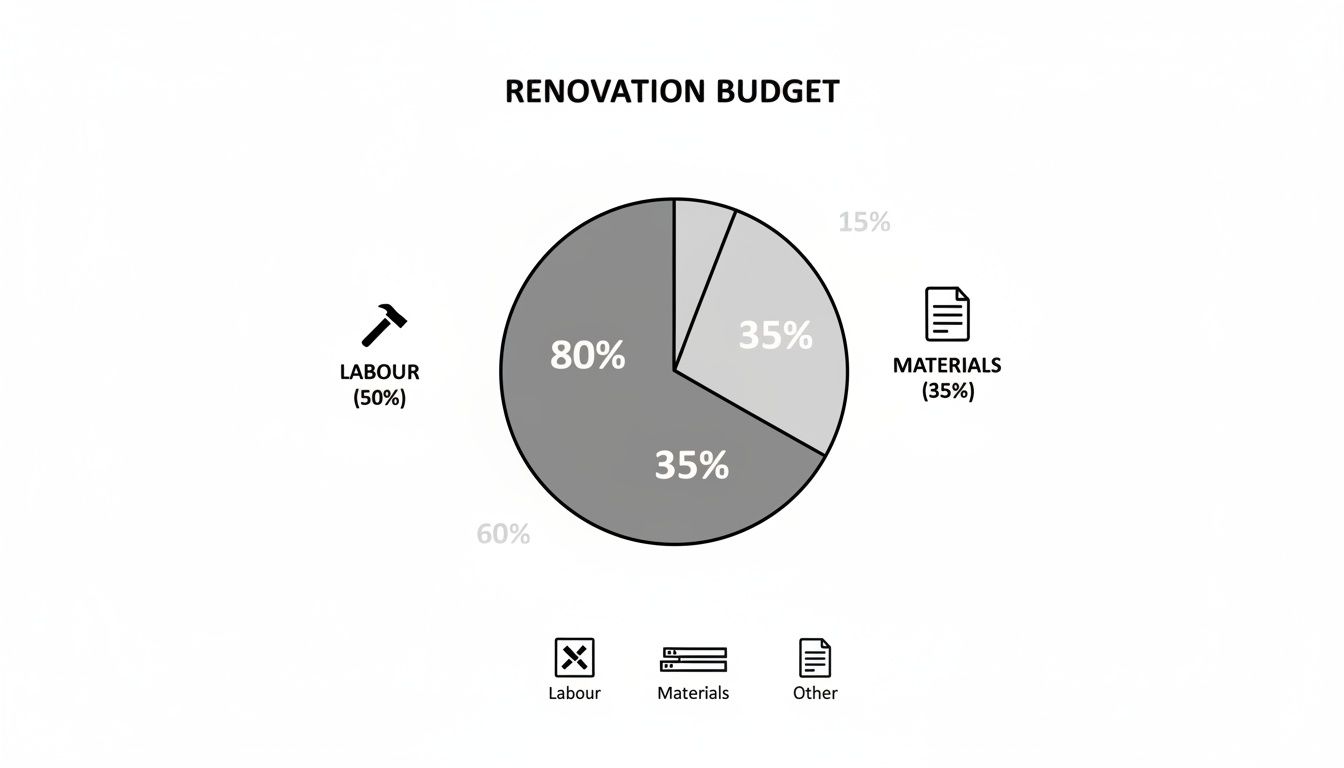
As you can see, the skilled hands of your tradespeople and the physical parts and pieces of your reno will consume the lion's share of your funds.
To give you a clearer idea of what to expect in the Greater Toronto Area, here’s a look at some typical cost ranges for different rooms and renovation levels.
| Estimated Renovation Costs Per Room in the GTA |
| :— | :— | :— | :— |
| Room | Budget-Friendly Refresh | Mid-Range Remodel | High-End Luxury Remodel |
| Kitchen | $20,000 – $35,000 | $40,000 – $75,000 | $80,000+ |
| Bathroom (Full) | $12,000 – $20,000 | $20,000 – $35,000 | $40,000+ |
| Basement | $25,000 – $40,000 | $45,000 – $70,000 | $75,000+ |
| Living/Bedroom | $3,000 – $7,000 | $8,000 – $15,000 | $20,000+ |
Keep in mind these are just ballpark figures. The final invoice will always depend on the size of your space, the quality of materials you choose, and how much structural work is involved.
The Kitchen: The Heart Of Your Home and Budget
The kitchen almost always ends up being the most expensive room to tackle, and it’s no surprise why. It's the functional and social core of a modern home, needing a perfect marriage of durability, practicality, and beautiful design. A solid mid-range kitchen reno in the Toronto area can easily run you $30,000 to $75,000+, all depending on the size and your taste in finishes. If you want to dive deeper into the specifics, you can learn more about the real cost of renovating a kitchen in Toronto.
So, what’s driving those numbers?
- Cabinetry: This is often the biggest line item. Your cabinets define the entire look and workflow of the kitchen.
- Appliances: A new fridge, stove, dishwasher, and microwave can add up faster than you think.
- Countertops: Premium materials like quartz, granite, or marble are a major investment.
- Plumbing & Electrical: Moving a sink, adding an island outlet, or installing pot lights requires hiring expensive, specialized trades.
This is exactly where making smart choices can save you a fortune without sacrificing that high-end look. One of the best opportunities is with your cabinetry. By going with a factory-direct supplier, you can often get beautiful, well-made cabinets for a fraction of what you’d pay at a big-box store or a custom shop. This strategy cuts out the middleman markup, making luxury affordable. For example, you can find a huge selection of quality, factory-direct kitchen cabinets in Toronto that deliver both style and value.
Bathrooms: The High Cost Of Wet Rooms
Running a close second to the kitchen in cost-per-square-foot are the bathrooms. These small spaces are deceptively expensive, often costing $15,000 to $35,000+ for a complete overhaul. The reason is simple: they’re “wet rooms.”
Bathrooms are complex mini-ecosystems within your home. They require intricate plumbing, specialized electrical work for safety, and extensive waterproofing to prevent costly water damage—all packed into a very small footprint.
This concentration of skilled labour and moisture-proof materials is what jacks up the price. All the tiling, waterproofing membranes, ventilation, and fixtures add up to a much higher starting cost. A simple powder room will be on the lower end, while a primary ensuite with a custom walk-in shower and double vanity will easily push your budget toward the higher end of the scale.
Living Rooms And Bedrooms: The Flexible Dry Rooms
Finally, we get to the “dry rooms”—living rooms, bedrooms, hallways, and home offices. These are the spaces where you have the most wiggle room in your renovation budget. Because you’re not dealing with complex plumbing or a dense cluster of fixtures, the costs here are mostly about the finishes. A simple refresh with a new coat of paint and some updated light fixtures might only set you back a few thousand dollars.
A more involved remodel in these rooms could include things like:
- New flooring (hardwood, laminate, or carpet)
- Custom built-in shelving or closets
- An updated lighting plan
- Plaster repair and fresh paint
The cost difference between wet and dry rooms is a universal rule in renovations. Whether you're in Toronto or California, where wet rooms can approach $400 per square foot while dry rooms are on the lower end of the $125 to $500+ range, the principle holds true. The complexity of the room's function, not its size, is the real cost driver. By understanding this, you can allocate your money more strategically—splurging on the high-impact kitchens and baths while making savvy, budget-friendly choices everywhere else.
Putting the Numbers into Perspective: Three Real-World Renovation Scenarios
All these percentages and per-square-foot estimates can feel a bit abstract. The best way to truly understand what a full home renovation costs is to see how the budget plays out in real life.
Let’s walk through three different renovation stories. Each one reflects a common path for homeowners in the Toronto area, showing how different goals and priorities shape the final price tag. You’ll probably see a bit of your own project in one of them.
Scenario 1: The Cosmetic Refresh
First, meet Sarah and Tom. They just bought a 1,500 sq. ft. townhouse in Markham. Structurally, the house was in great shape, but the finishes felt stuck in another decade. Their goal was simple: get the most visual impact for their money to make the space feel bright, modern, and like theirs. No walls were coming down for this one.
Their entire project focused on surface-level upgrades.
- Scope of Work: The biggest job was repainting the entire interior. After that, they ripped out all the old, tired carpeting and replaced it with durable luxury vinyl plank (LVP) flooring. To finish the look, they swapped every dated light fixture, doorknob, and faucet for sleek matte black versions.
- Budget Strategy: Sarah and Tom were laser-focused on aesthetics. They kept the existing kitchen cabinets and bathroom vanities but gave them a new lease on life with fresh paint and new hardware. That decision alone saved them a small fortune.
Sample Budget Breakdown:
| Item | Estimated Cost | Percentage of Budget |
|---|---|---|
| Painting (Labour & Materials) | $9,000 | 30% |
| LVP Flooring & Installation | $11,000 | 37% |
| Light Fixtures & Hardware | $4,000 | 13% |
| Plumber & Electrician | $3,000 | 10% |
| Contingency Fund (10%) | $3,000 | 10% |
| Total Project Cost | $30,000 | 100% |
This scenario is a perfect example of how a strategic, finish-focused investment can completely change the feel of a home. It's a brilliant approach when the "bones" of the house are already good.
Scenario 2: The Mid-Range Family Overhaul
Next up is the Chen family. They live in a 2,200 sq. ft. detached house in Toronto. With two growing kids, their closed-off kitchen and the single, aging bathroom just weren't cutting it anymore. They wanted to open up the main floor for a more connected family life and bring the essential spaces into the modern era.
This project was a bigger undertaking, involving some light demolition and rethinking how key rooms worked.
This mid-range project is the bread and butter of home renovations. It’s all about balancing major functional upgrades with smart material choices to get the biggest improvement in day-to-day life without breaking the bank.
The Chens needed a wider range of trades on site.
- Scope of Work: Their biggest move was taking down a non-load-bearing wall between the kitchen and dining room. This opened the door for a complete kitchen gut, complete with new semi-custom cabinets, quartz countertops, and a big island for homework and casual meals. The main family bathroom was also fully renovated.
- Budget Strategy: To keep costs in check, they decided against replacing the hardwood floors in the living areas, opting instead to have them professionally refinished. For the heart of their home, they chose factory-direct cabinets to get that high-end look without the custom price. Seeing a gallery of completed kitchen projects helped them lock in their design choices.
Sample Budget Breakdown:
| Item | Estimated Cost | Percentage of Budget |
|---|---|---|
| Kitchen Renovation | $60,000 | 48% |
| Bathroom Renovation | $25,000 | 20% |
| Demolition & Structural | $8,000 | 6% |
| Flooring Refinishing | $7,000 | 6% |
| Design & Permits | $10,000 | 8% |
| Contingency Fund (15%) | $15,000 | 12% |
| Total Project Cost | $125,000 | 100% |
The Chens' project shows how a mid-range budget can deliver transformative results, turning a dysfunctional layout into a home that truly works for a modern family.
Scenario 3: The Luxury Gut Renovation
Our final story involves a full-scale gut renovation of a 2,800 sq. ft. character home in a sought-after Toronto neighbourhood. The new owners fell in love with the home's historic exterior but wanted to blend that charm with modern luxury, high-performance systems, and an entirely new floor plan inside.
This is the top end of the full home renovation cost spectrum. We’re talking extensive structural work and premium materials from floor to ceiling.
- Scope of Work: The interior was stripped right back to the studs. The project involved moving the staircase, taking out several load-bearing walls (which meant engineering and installing new support beams), and completely reconfiguring the second floor to create a luxurious primary suite. Every inch of plumbing, electrical, and HVAC was replaced.
- Finishes & Features: This was a no-compromise renovation. It featured custom millwork, marble countertops throughout, wide-plank white oak flooring, high-end Miele appliances, and a fully integrated smart home system.
Sample Budget Breakdown:
| Item | Estimated Cost | Percentage of Budget |
|---|---|---|
| Architectural Design & Permits | $45,000 | 9% |
| Structural Work & Framing | $80,000 | 16% |
| New Electrical, Plumbing & HVAC | $90,000 | 18% |
| High-End Kitchen & Appliances | $120,000 | 24% |
| Three Luxury Bathrooms | $90,000 | 18% |
| Custom Finishes & Flooring | $75,000 | 15% |
| Total Project Cost | $500,000 | 100% |
A quick but important note: For a project of this complexity, a 20% contingency fund (or $100,000) would be non-negotiable, bringing the real-world budget closer to $600,000.
This luxury renovation shows just how quickly costs can climb when you get into major structural changes, full system replacements, and premium materials. While the investment is huge, the result is a truly bespoke home, rebuilt from the inside out to the owner's exact vision.
How to Reduce Your Renovation Costs Without Sacrificing Quality
Figuring out the numbers for a full home renovation is one thing. Actually finding ways to shrink that final bill—without cheaping out and regretting it later—is a whole different challenge. It's a tricky balancing act, but with some smart planning, you can make every dollar go further.
This isn't about cutting corners on the stuff that really matters. It’s about making savvy choices that deliver the best value, letting you put your money where it will make the biggest difference in your day-to-day life and your home's future worth.
Plan and Get Quotes Strategically
Your first chance to save money happens long before a single hammer swings. Honestly, jumping into a project without a solid plan is the fastest way to blow your budget. A detailed plan and a disciplined quoting process are your best friends in the fight against surprise costs.
- Plan During the Off-Season: Contractors are swamped in the spring and summer. If you can line up your renovation for the fall or winter, you might find that skilled trades are more available and even a bit more competitive with their pricing.
- Get at Least Three Quotes: Don't ever just go with the first estimate. Getting quotes from at least three different reputable general contractors gives you a realistic feel for the market rate. It also helps you flag any bids that seem way too high or, just as importantly, suspiciously low.
A good quote is more than just a number; it's a roadmap for your project. It should clearly break down the costs for labour, materials, and permits, leaving no room for hidden fees. That kind of transparency is what you need to compare your options properly.
Master Your Material and Labour Choices
The lion's share of your budget will be eaten up by two things: materials and the skilled people who install them. This is where a few key decisions can literally save you thousands, freeing up cash you can redirect for a bigger impact elsewhere.
Take the kitchen, for example—it's almost always the most expensive room to tackle. Cabinets alone can easily swallow 40% or more of a kitchen budget. This is where a factory-direct supplier like MapleKing can be a game-changer. By cutting out the retail middleman, you get high-quality, solid cabinets for a fraction of what you'd pay elsewhere.
That one move can free up a huge chunk of your budget. Suddenly, that money you saved could be used to upgrade your countertops from laminate to quartz or to invest in better, more energy-efficient appliances. Those are the kinds of upgrades that add real, tangible value you’ll appreciate every single day.
Know When to DIY and When to Call a Pro
The pull of saving on labour by doing it yourself is strong, but you have to be brutally honest about your skills. A botched DIY job can end up costing you far more to fix than it would have to just hire a professional in the first place.
Good DIY Projects:
- Painting interior walls
- Demolition (like tearing out old cabinets or ripping up flooring)
- Installing simple things like new light fixtures or cabinet hardware
Leave These to the Pros:
- Electrical Work: Always, always hire a licensed electrician. Mistakes here aren't just costly; they're a serious fire hazard.
- Plumbing: One leaky pipe installed incorrectly can lead to catastrophic water damage that costs a fortune to repair.
- Structural Changes: Any job that involves moving or altering load-bearing walls needs an engineer and experienced framers. No exceptions.
Splurge Where It Counts for Long-Term Value
At the end of the day, lowering your renovation cost isn't just about spending less—it's about spending smarter. Some parts of your home work a lot harder than others, and putting your money into quality here will pay you back for years.
Focus your "splurge" money on the things that are a massive pain (and expense) to replace later on. We're talking about durable flooring in high-traffic zones, high-quality windows that slash your energy bills, and top-notch waterproofing in bathrooms. After the kitchen, bathrooms are often the next major investment. In some markets, a master bathroom remodel can hit $45,000-$60,000 or more, largely because of the complex work involved. You can learn more about how these specialized jobs impact a budget from the experts at GreatBuildz.com.
By saving money on aesthetic elements like your kitchen cabinets, you give yourself the financial breathing room to invest in these foundational pieces, ensuring your beautiful new space is truly built to last.
Answering Your Top Renovation Questions
Even with the best-laid plans, a home renovation is a journey filled with questions. As you get closer to demo day, a few key uncertainties tend to pop up for almost every homeowner in Toronto and Markham.
Think of this section as a quick chat with an experienced pro, designed to clear up those nagging questions, reinforce what we've already covered, and give you a solid footing before you dive in.
How Much Should I Really Set Aside for a Contingency Fund?
Let's be blunt: this isn't a suggestion, it's a necessity. Your contingency fund is the financial buffer that stands between a minor hiccup and a full-blown project disaster. It’s for the surprises that are almost guaranteed to be lurking behind your walls.
For most renovations, a contingency fund of 10% to 15% of your total project cost is the industry standard. But this isn't a one-size-fits-all number. The age and condition of your home are the real deciding factors.
- For newer homes or light cosmetic work: You can often get by with a 10% fund. The chances of discovering major electrical or plumbing nightmares are simply lower.
- For older homes or a full gut job: You'll want to bump that up to 15% to 20%. Older homes are notorious for hiding surprises—think outdated knob-and-tube wiring, slow leaks that caused hidden rot, or a quirky structural issue that now needs a proper fix.
Your contingency fund is the one part of your budget you hope you never touch. But not having it is the single fastest way to derail a project or force you to compromise on the finishes you’ve been dreaming of.
How Long Does a Full Home Renovation Actually Take in Toronto?
Just like the cost, the timeline for a full-scale renovation can swing wildly depending on the scope. It’s a marathon, not a sprint, and you have to be prepared for the long haul. Delays from permit approvals, a back-ordered tile, or one of those surprises we just talked about are more the norm than the exception.
Here’s a realistic breakdown of what to expect in the Toronto area:
- Planning & Design (1-3 months): This is the crucial upfront work—finding your team (architect, designer, contractor), nailing down the design, and making all your material selections.
- Permitting (1-2 months): Once your plans are submitted to the city, it’s a waiting game. This can sometimes move faster, but it’s wise to buffer the timeline.
- Construction (3-12+ months):
- Cosmetic Refresh: 2-4 months
- Mid-Range Remodel: 4-8 months
- Full Gut Renovation: 8-12 months, and honestly, it can easily go longer for bigger, more complex projects.
Keeping an open line of communication with your general contractor is the best way to stay on top of the schedule and manage expectations.
Which Projects Give Me the Best Bang for My Buck?
When you’re putting this much money into your home, it’s natural to wonder which upgrades will actually increase its value. While you should always renovate for your own lifestyle first, some projects consistently deliver a much better return on investment (ROI).
Year in and year out, the two champions of ROI are kitchens and bathrooms. They are the functional heart of a home, and buyers put a huge premium on modern, beautiful, and efficient spaces. A well-designed kitchen or bathroom renovation can often recoup 75% or more of what you spent when you sell.
Other projects that offer a strong return include:
- Finishing a Basement: You're adding valuable, usable square footage to your home.
- Boosting Curb Appeal: Things like new siding, modern windows, or a striking front door make a powerful first impression.
- Adding a Deck or Patio: Creating a great outdoor living space has become a massive selling feature.
Do I Really Need Architectural Plans for My Renovation?
The short answer is: it depends entirely on what you’re doing. Architectural plans, drawn up by an architect or licensed technologist, are the official blueprint for your project.
You will absolutely need architectural plans if your renovation involves:
- Moving or taking down walls (especially if they're load-bearing).
- Altering the layout of any rooms.
- Making any changes to the exterior of your house.
- Basically, any work that requires a building permit from the City of Toronto or Markham.
You likely do not need plans for a purely cosmetic update. If you’re just painting, putting in new floors, changing light fixtures, or installing new kitchen cabinets in the exact same footprint, you can usually skip the formal drawings. When in doubt, your general contractor will know the rules inside and out.
Ready to start planning the heart of your home renovation? The kitchen is where smart choices make the biggest impact. At MapleKing Kitchen Cabinets, we offer factory-direct pricing that can save you thousands, freeing up your budget for other areas of your project without compromising on quality or style. Explore our stunning, affordable cabinetry options and get a free quote today.



