

A drawer microwave is a sleek, built-in appliance that installs neatly under your counter or in lower cabinetry, gliding open smoothly instead of swinging out. Across Canada, they're becoming a signature feature in modern kitchen renovations, prized for their seamless look and brilliant ergonomics. It's a clever choice for anyone looking to free up counter space and achieve that high-end, integrated kitchen design.
Why a Drawer Microwave Is Perfect for Canadian Kitchens
The buzz around drawer microwaves in Canada isn't just some passing trend; it signals a real shift in how we think about kitchen design. From Toronto to Markham, homeowners are ditching traditional countertop and over-the-range models for this clean, integrated solution. This is more than just an aesthetic upgrade—it's a smart, practical choice that adds everyday convenience and tangible value to your home.
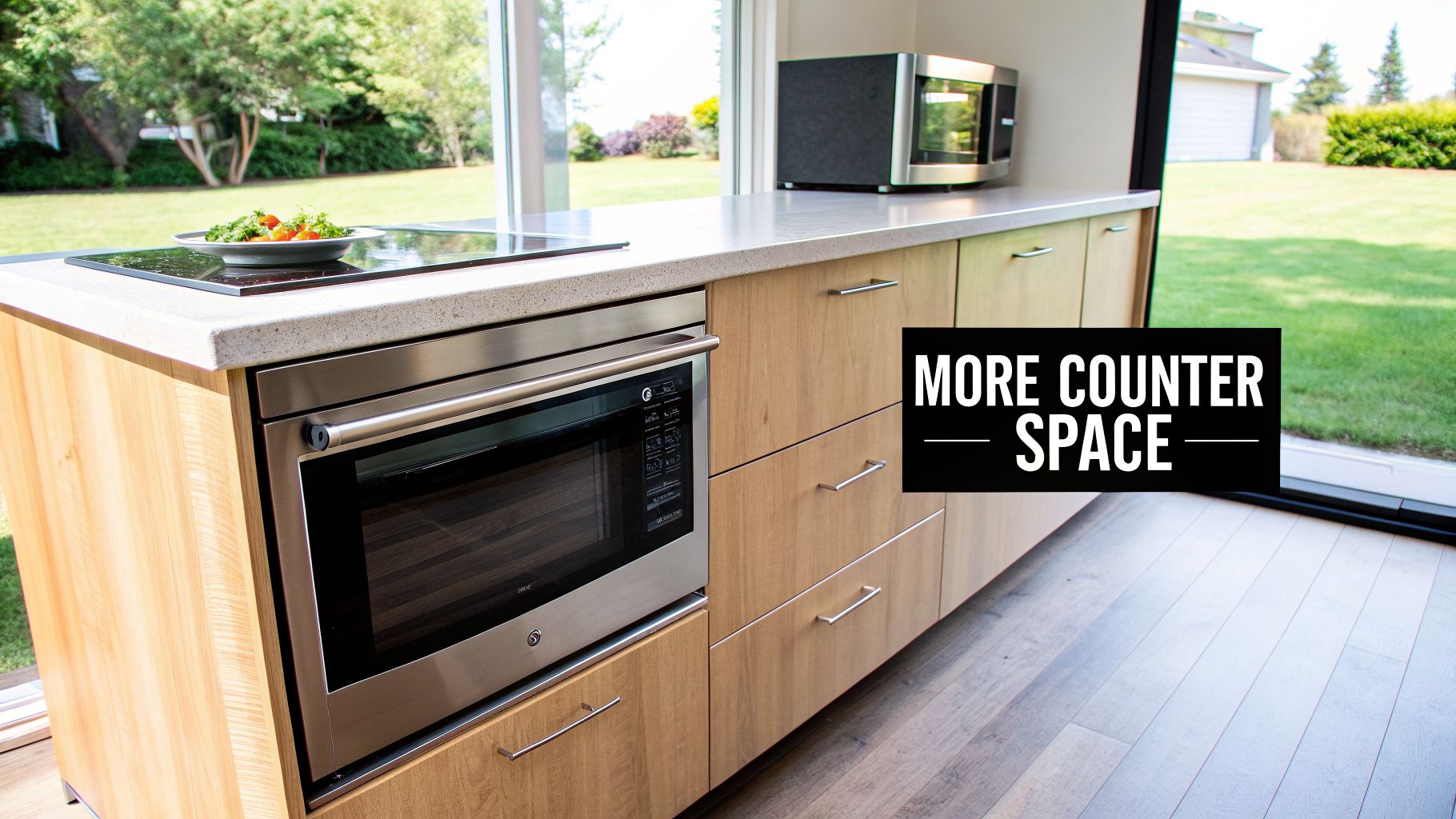
Let's break down the real-world benefits that go far beyond just looking good.
To quickly see how these models stack up, here’s a look at the key differences.
Drawer Microwave vs Traditional Models At a Glance
| Feature | Drawer Microwave | Countertop Microwave | Over-the-Range Microwave |
|---|---|---|---|
| Placement | Under-counter, in an island, or in lower cabinets | On the countertop | Above the cooktop |
| Space Impact | Frees up counter space for a clean, open look | Takes up valuable counter real estate | Saves counter space but creates visual bulk |
| Ergonomics | Easy top-down access; no reaching or bending | Can be awkward depending on counter height/clutter | Requires reaching up, posing a spill risk with hot dishes |
| Accessibility | Ideal for all users, including kids and those in wheelchairs | Standard accessibility | Difficult for shorter individuals or those with mobility issues |
| Installation | Requires cabinet modifications and professional install | Plug-and-play; no installation needed | Requires specific cabinet and ventilation setup |
| Cost | Premium investment ($1,500 – $3,000+) | Most affordable option ($100 – $500) | Mid-range price ($400 – $1,200) |
Ultimately, a drawer microwave integrates into your kitchen's flow and design in a way that standalone models simply can't match.
Reclaim Your Valuable Counter Space
The most obvious win is getting your countertop back. A standard microwave is a space hog, occupying prime real estate you could be using for prep work. By tucking your microwave below the counter, you instantly gain a more open and functional work surface.
This is a game-changer in smaller kitchens where every square inch matters. For more inspiration on maximizing your layout, check out our guide on small kitchen cabinet ideas.
A Smart Investment with Proven Returns
The move toward drawer microwaves is backed by some serious numbers. Canada's microwave market is growing at a 5.12% compound annual growth rate (CAGR), handily outpacing the North American average of 3.92%. This surge is powered by a kitchen renovation boom, especially in hotspots like the Greater Toronto Area. In fact, local surveys show that a staggering 55% of kitchen remodels in Markham and Toronto now feature integrated drawer microwaves.
This trend is also a financially savvy one. In 2024, swapping an old countertop model for a built-in drawer microwave has been shown to boost property values by $10,000 to $15,000 on home flips. It's a powerful upgrade for homeowners and real estate investors alike.
Superior Ergonomics and Accessibility
Think about the awkward motion of using a typical microwave. You’re either reaching up high to pull down a hot bowl from an over-the-range unit or shuffling things around on a crowded counter. A drawer microwave completely changes the dynamic.
- Easy Access: You simply stir or lift dishes out from above. This simple change dramatically reduces the risk of fumbling a hot plate and getting spilled on or burned.
- Universal Design: It’s a fantastic solution for households with people of different heights, especially kids learning to be more independent in the kitchen or family members who use a wheelchair.
- Safety First: Most models come equipped with a child-lock feature, giving you peace of mind that little hands won't be able to operate it accidentally.
How to Plan Your Drawer Microwave Integration
Getting your microwave drawer integration right comes down to planning, long before you start cutting into your beautiful cabinets. Before you even start shopping for a drawer microwave in Canada, you need to figure out exactly where it’s going to live and how you’ll use it. This groundwork is what separates a seamless, functional kitchen from one that just doesn't flow.
The first, and most important, decision is placement. This choice will shape the entire workflow of your kitchen, so it’s worth spending some real time on it.
Find the Perfect Location
Think about your daily kitchen routine. Where do you stand? How do you move? If you’re constantly reheating leftovers from the fridge, putting the microwave drawer in your island across from the refrigerator creates a perfect "reheating station." This simple setup is brilliant—it keeps traffic out of the primary cooking zone, so someone can grab a snack without getting in the chef's way.
Another fantastic spot is right next to your main prep counter. I often suggest this for clients who use the microwave for cooking tasks, like melting butter or defrosting meat. It keeps everything you need within arm's reach.
Here are a few popular and practical locations we see all the time:
- In the Kitchen Island: This is my personal favourite. It frees up counter space and establishes a great secondary work area.
- Under the Counter: A solid choice for a perimeter cabinet run, especially near the pantry or refrigerator for easy access.
- Below a Wall Oven: This creates a clean, vertical appliance column, grouping all your cooking tools in one sleek, organized stack.
If you're working with a more compact space, every centimetre counts. It's worth looking into strategies for maximizing efficiency in a small kitchen to make sure your new appliance enhances the space, rather than crowding it.
Match the Model to Your Lifestyle
With a location picked out, you can start thinking about the appliance itself. They aren’t all the same. If you have a big family or love to entertain, you'll want to check the internal capacity. Most models available in Canada fall between 1.0 and 1.2 cubic feet, so be sure to pick one that can handle your go-to casserole dish.
The controls matter, too. Are you okay with a standard button panel, or would a touch-to-open feature be a game-changer when your hands are full of groceries? For anyone with curious toddlers, a control lock feature is an absolute non-negotiable for safety.
From years of designing kitchens, my best advice is to always prioritize your "kitchen flow." A microwave drawer gives you the freedom to place an appliance based on your habits, not the other way around. It’s a chance to build a kitchen that truly works for you.
Understand Canadian Electrical and Code Requirements
Now for the critical part you absolutely can't skip. In Canada, a built-in appliance like a drawer microwave has strict rules. It must be installed following the Canadian Electrical Code (CEC) and any local bylaws, which means it needs its own dedicated 15- or 20-amp circuit. You can't just plug it into a nearby outlet—that’s a serious fire risk and will fail any electrical inspection.
Before your electrician shows up, find the manufacturer’s specification sheet online. It will list the precise electrical needs and, just as importantly, the required clearances for proper ventilation. Without enough airflow, the unit can overheat, which shortens its lifespan and can even void your warranty. Getting this right is all about safety and protecting your investment.
Measuring and Modifying Cabinets for a Perfect Fit
Alright, this is where the real work begins—turning your plan into a reality. Getting the cabinet measurements and any necessary modifications spot-on is what separates a clunky installation from that sleek, integrated look you're after.
Your most important tool at this stage isn't a saw or a drill; it's the manufacturer's specification sheet. Seriously. This document contains the golden numbers: the exact dimensions for the rough opening your microwave needs. Always, always work from these specs, not from measurements you take off the appliance itself.
This quick visual breaks down the key stages of planning before you even pick up a tool.
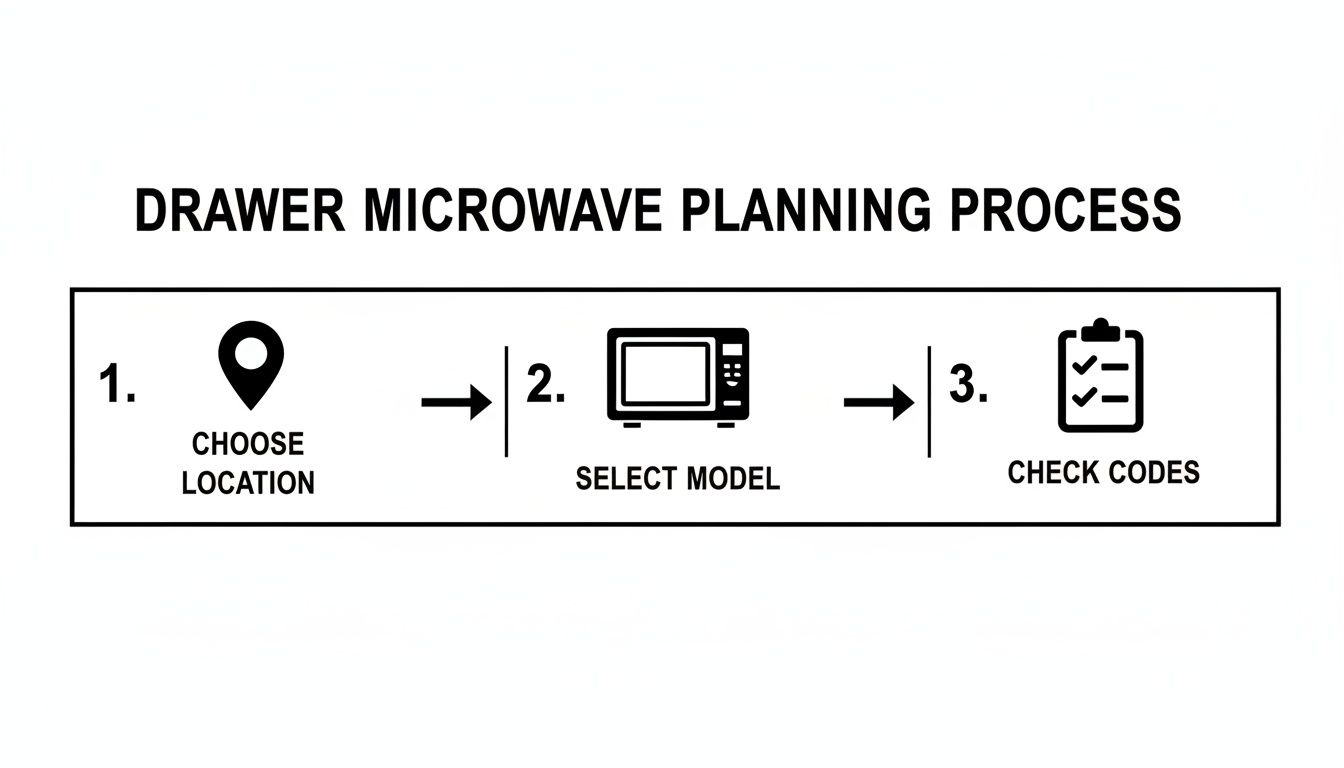
As you can see, figuring out your location and model before you start modifying anything is critical. It’s the classic "measure twice, cut once" philosophy, and it will save you a world of headaches.
Taking Precise Measurements
Precision is everything here. Grab a good tape measure and carefully mark out the height, width, and depth on your cabinet according to the spec sheet.
A classic mistake is forgetting to account for the cabinet's face frame. Your rough opening is measured from the inside of the cabinet box, so be mindful of any lips or frames. You also need to confirm the depth is clear—the last thing you want is to discover plumbing or electrical wiring in the wall right where your new microwave needs to go.
Modifying an Existing Cabinet vs. Ordering a New One
You generally have two options: work with what you've got or start fresh.
Retrofitting Your Cabinet: This is a popular route for remodels where the kitchen layout is staying the same. It involves cutting a precise opening in an existing base cabinet. While it's budget-friendly, it demands a steady hand and some confidence with a saw to avoid splintering or damaging the cabinet's structure. You’ll also need to build a solid support shelf for the microwave to rest on.
Ordering a New Cabinet: If you're doing a full gut-job or a new build, ordering a dedicated microwave drawer base cabinet is the way to go. Working with a supplier means the cabinet arrives built to the exact specs of your appliance, guaranteeing a perfect fit and a much smoother installation.
Exploring options for custom-built cabinetry can really elevate the final look from "good" to "flawless."
A word of caution if you're modifying an existing cabinet: you have to add structural reinforcement. These drawer microwaves are heavy, often tipping the scales at over 30 kg (65 lbs). After you make your cut, reinforce the sides and build a sturdy platform from ¾-inch plywood. This prevents the shelf from sagging under the weight over time.
Creating the Perfect Fit and Finish
The goal here is to make the microwave look like it was always part of the kitchen. A standard installation will have the microwave's outer flange sitting cleanly against the cabinet face, which looks great.
For a truly high-end, flush-mount appearance, the cabinet itself needs a deeper recess. This allows the front of the microwave to sit perfectly level with your cabinet doors and drawer fronts for a completely seamless finish.
Let’s walk through a real-world scenario: retrofitting a drawer microwave in Canada into a kitchen with older, solid-wood cabinets.
- First, you'd remove the cabinet doors and any shelves inside.
- Next, you’d carefully mark the rough opening on the cabinet's face frame and interior sides.
- Then, using a jigsaw or an oscillating multi-tool for clean lines, you’d make your cuts.
- After that, you'd build and install a perfectly level support platform inside, securing it to the cabinet walls.
- Don't forget the anti-tip bracket! It comes with the microwave and is a crucial safety feature that keeps the unit from tipping out when you open the heavy drawer.
- Finally, you'd slide the unit into place, secure it to the cabinet, and double-check that it’s level.
Whether you tackle it yourself or hire a pro, this is the hands-on process that transforms a simple base cabinet into a highly functional and stylish centerpiece for your kitchen.
Alright, you’ve sorted out the placement and figured out your cabinet modifications. Now for the fun part: choosing the actual microwave drawer. When you’re ready to buy, especially here in Canada, there’s a bit more to it than just comparing brands. Think of it as a long-term investment in your kitchen.
To make sure you’re getting a safe, compliant appliance that’s a good value, you’ll want to get familiar with Canadian pricing, safety standards, and even potential energy rebates.
What Should You Expect to Pay in Canada?
Let's be upfront: a drawer microwave is a premium item, and the price tag shows it. In Canada, you're looking at a starting point of around $1,500 CAD for a straightforward model, with high-end units easily surpassing $3,000 CAD.
Here’s a general breakdown of what your money gets you:
- The Essentials ($1,500 – $2,000): These models deliver the core drawer experience—easy access and a clean, built-in look. They’ll have reliable power and basic controls, but you probably won't find features like sensor cooking or an automatic opening mechanism.
- The Sweet Spot ($2,000 – $2,500): This is where most people land. You’ll start to see quality-of-life upgrades like a touch-to-open drawer (a lifesaver when your hands are full), more advanced sensor cooking that doesn't overdo your leftovers, and sleeker control panels.
- The Top Tier ($2,500+): For this price, you’re getting the best of the best. These models often feature flush-mount installation for a completely seamless look, smart home integration to control it from your phone, and panel-ready options to match your cabinetry perfectly.
Knowing these tiers helps you decide which features are "must-haves" versus "nice-to-haves," so you can find the right fit for your budget.
The Non-Negotiable: CSA Certification
When buying any electrical appliance in Canada, this is the one thing you can't compromise on: CSA certification. That little logo from the Canadian Standards Association (CSA) is your guarantee that the product has been tested to meet our national safety standards.
An appliance that isn’t CSA-approved might not be legally installable in a Canadian home, and it could even void your home insurance policy. Always check the product specs online or look for the physical CSA mark on the unit before you buy. For a built-in appliance with permanent wiring, it's absolutely critical.
This isn’t just red tape; it’s a crucial assurance of safety for an appliance that’s wired directly into your home’s electrical system.
Why an ENERGY STAR® Rating Matters
Grabbing a model with an ENERGY STAR® rating is another smart move. These appliances are certified to use less energy than their standard counterparts, which means you’ll see real savings on your electricity bill over the years.
But the benefits don't stop at your monthly bill. An ENERGY STAR® label can also make you eligible for provincial rebates. Ontario, for example, often has programs that can bring down the initial cost. These incentives are always changing, so it's worth doing a quick search for current rebates in your province before you head to the checkout.
The push for smarter, more efficient kitchens is undeniable. In growing urban areas like Toronto and Markham, the demand for smart drawer microwaves is driving a 12.7% CAGR that's expected to continue through 2033. Brands are responding, with models like Sharp's new sensor-cook Microwave Drawer Oven becoming a go-to for new builds and renovations.
When working with a cabinetry supplier like MapleKing, you'll find these IoT-enabled units are designed for seamless integration. They offer practical features like app-controlled reheating that can slash energy consumption by up to 35% under ENERGY STAR guidelines. With 62% of Greater Toronto renovators planning to prioritize smart appliances next year, choosing an efficient model isn't just about saving money—it's a valuable upgrade for your home's future. For more on how these trends are shaping kitchen design, you can dive into recent industry reports.
Working with Professionals for a Flawless Installation

Let's be honest, the temptation to tackle a home project yourself can be strong. But when it comes to installing a drawer microwave, this is one area where I always recommend bringing in the pros. This isn't a simple plug-and-play job. It's a precise blend of custom cabinetry and dedicated electrical work—a mix that leaves zero room for error.
Putting together the right team is the surest way to get a safe, seamless result that looks like it came straight out of a magazine.
The single most important tool for making this happen smoothly is the appliance's specification sheet. Hand this document to every single person on your team before any work begins. Trust me, this piece of paper is the blueprint that prevents costly miscommunications and ensures everyone—from the cabinet maker to the electrician—is working with the exact same numbers.
Assembling Your Installation Team
For a project like this, you'll want a few key experts in your corner. Each one plays a critical role in getting the installation just right.
The Cabinet Supplier: Your cabinet maker is your most important partner here. They'll either modify an existing cabinet or, ideally, build a new base cabinet specifically for your drawer microwave in Canada. A specialist can guarantee that perfect, built-in fit. If you're looking for a trusted partner, our guide to finding the best local cabinet companies is an excellent place to start.
The Licensed Electrician: This is an absolute must. An electrician is the only person qualified to run a new, dedicated circuit to the microwave's location. They'll make sure everything is up to the Canadian Electrical Code, which is crucial for both safety and home insurance compliance.
The General Contractor: If your new microwave is part of a larger kitchen renovation, a good general contractor is invaluable. They'll act as the project manager, coordinating the trades and making sure the electrician and cabinet maker’s work is perfectly timed.
Key Questions for Your Contractor
Before you hire anyone, you need to do a bit of homework. Don't feel awkward about asking direct questions—you're making sure they're the right fit for this very specific job.
The first thing I always ask is: "Have you installed a drawer microwave before?" If they have, ask to see photos of their work. An experienced pro will immediately understand the details, like building a perfectly level support platform and, most critically, installing the anti-tip bracket. That bracket isn't optional; it's a vital safety feature.
Once the work is done, it's time for a final walkthrough. Open and close the drawer multiple times. Does it glide without any friction or catching? Check that the unit is completely level and sits perfectly flush with your cabinets.
Finally, get the thumbs-up from your electrician that all the work is code-compliant. This final check gives you the peace of mind that your beautiful new appliance is also perfectly and safely installed for years of use.
Finalizing Your Drawer Microwave Plans? Your Questions Answered
Alright, so you're getting close to a decision on a drawer microwave, but a few nagging questions are probably still floating around. That's completely normal. This is a big addition to your kitchen, and you want to be sure you've covered all the bases.
Let's walk through some of the most common questions we hear from Canadian homeowners, so you can move forward with confidence.
Are They Really Safe With Kids Around?
This is a big one for families, and the short answer is yes. Drawer microwaves are designed with safety as a top priority. Just about every model you'll find has a child-lock feature, which is a must-have to prevent curious little hands from starting the appliance.
But the real-world safety benefit often comes from the ergonomics. Think about it: with a standard microwave, you're often reaching up and pulling a hot, sloshing bowl of soup down towards you. With a drawer, you're lifting it straight up. That simple change in motion drastically reduces the risk of spills and burns, making it a surprisingly safer option for everyone in the family.
What's the Real Cost in Canada?
There's no sugarcoating it—a drawer microwave is a premium appliance, and its price reflects that. You should plan your budget for a starting point of around $1,500 CAD, with high-end models climbing to $3,000 CAD or more. These top-tier units often include slick features like touch-free automatic opening or designs that sit perfectly flush with your cabinetry.
While the initial investment is higher than a standard countertop or over-the-range model, the value it brings is significant. You’re not just buying an appliance; you're reclaiming valuable counter space, creating a smoother kitchen workflow, and adding a high-end touch that seriously boosts your home's appeal and resale value.
Are They a Pain to Clean?
Actually, most people find them easier to clean than traditional microwaves. Since you're accessing it from above, you can wipe down the sides and bottom without any awkward bending. That hard-to-reach ceiling inside a regular microwave? It's suddenly simple to get to.
The best trick is just to wipe up any splatters as they happen. This keeps the inside looking new and, just as importantly, ensures the drawer's sliding mechanism stays free of gunk so it continues to operate smoothly. If you ever run into more complex issues down the road, having a basic understanding of general microwave repair can be a good starting point for troubleshooting.
Can I Just Install It Myself?
We strongly recommend leaving this one to the professionals. While it might seem tempting for a handy homeowner to tackle, a drawer microwave installation is surprisingly complex.
It involves very precise cabinet modifications to get that seamless, built-in look. More importantly, it requires electrical work that must be done to the strict standards of the Canadian Electrical Code. Getting this wrong isn't just a cosmetic issue—it's a safety hazard. Your best bet is always to hire a qualified cabinet maker and a licensed electrician. It's the only way to protect your home, your family, and your beautiful new appliance.
Ready to bring the sleek functionality of a drawer microwave into your kitchen? MapleKing specializes in creating custom cabinetry solutions that perfectly integrate modern appliances. Explore our stunning cabinet finishes and get a free quote to start designing your dream kitchen today. Visit us at https://maplekingkitchencabinets.com.