
Let's talk numbers. When you start exploring custom kitchen cabinets in Toronto, you'll quickly find that prices can vary quite a bit. As a rule of thumb, you should budget anywhere from $700 to $1,500+ per linear foot.
What does that mean for your total project? A smaller kitchen might land somewhere around $10,000, while a large, more luxurious kitchen with all the bells and whistles can easily exceed $30,000. Think of this as your starting point for figuring out what's possible.
Your Quick Guide To Toronto Custom Cabinet Costs
Planning a dream kitchen is exciting, but the first—and most important—step is getting a handle on the budget. Custom cabinets aren't like the ones you pick up from a big-box store; they're made just for you, to your exact measurements and style. It's the difference between buying a suit off the rack and having one tailored perfectly to you. The quality, fit, and personalization are simply in a different league.
The final cost really boils down to three things: the size of your kitchen, the materials you fall in love with, and how complex your design gets. A cozy condo kitchen will have a different price tag than a sprawling open-concept one in a detached home. Likewise, choosing a classic and durable MDF cabinet will be easier on the wallet than going with premium solid walnut.
To give you a real-world idea of what to expect, we've put together some typical cost breakdowns for different kitchen sizes and material grades right here in the Greater Toronto Area. This should help you set a realistic budget from the get-go.
Estimated Costs By Kitchen Size
In the cabinet world, we measure kitchens in linear feet—it's just a simple, straight-line measurement of all your upper and lower cabinets combined. To make it easier, here's how that usually breaks down:
- Small Kitchens (Approx. 15-20 linear feet): Perfect for condos or smaller townhouses.
- Medium Kitchens (Approx. 20-30 linear feet): What you'll find in most semi-detached or standard family homes.
- Large Kitchens (Approx. 30+ linear feet): Common in spacious, open-concept designs, often with a big island.
So, how does that translate into actual dollars? The table below gives a clearer picture.
Estimated Custom Kitchen Cabinet Costs In The Toronto Area
This table breaks down the typical price ranges for custom kitchen cabinets based on the size of your space and the quality of materials you choose. It moves from budget-friendly options all the way to high-end, premium installations.
| Kitchen Size | Linear Feet (Approx.) | Budget-Friendly Range (e.g. MDF) | Mid-Range (e.g. Maple/Oak) | High-End (e.g. Walnut/Cherry) |
|---|---|---|---|---|
| Small | 15-20 ft | $10,500 – $16,000 | $14,000 – $22,000 | $22,500 – $35,000 |
| Medium | 20-30 ft | $14,000 – $24,000 | $18,000 – $33,000 | $27,000 – $50,000+ |
| Large | 30+ ft | $21,000 – $32,000+ | $27,000 – $44,000+ | $40,000 – $70,000+ |
Just keep in mind, these numbers are ballpark figures for the cabinets themselves. They don't include extras like countertops, installation, hardware, or new appliances, but they're an excellent guide for setting a realistic cabinetry budget.
With this initial cost breakdown, you can start making smarter decisions that match your vision to your budget. In the sections ahead, we’ll dig deeper into how specific materials, finishes, and features can influence these numbers.
Understanding the Key Drivers of Your Cabinet Costs
So, what really determines the final custom kitchen cabinets price on your quote? It helps to think of it like ordering a custom-tailored suit. The base price gets you started, but the specific fabric you choose, the complexity of the cut, and the quality of the buttons all add up. Your kitchen cabinets work the exact same way.
Every choice you make, from the species of wood to the tiny handle on a drawer, plays a role in the final number. Knowing what these key components are gives you the power to make smart decisions, putting your money toward the features that truly matter to you and your home.
Material Selection: The Foundation of Your Budget
By far, the single biggest factor influencing your cabinet cost is the material you choose for the doors and cabinet boxes. This decision sets the stage for both the look and the longevity of your kitchen. It’s the chassis of the car—everything else gets built on top of it.
You can think of materials on a spectrum, from highly practical and budget-friendly to luxurious and statement-making. Each has its own unique character and price point, so you can find the perfect balance for your project.
Here’s a quick rundown of some common options:
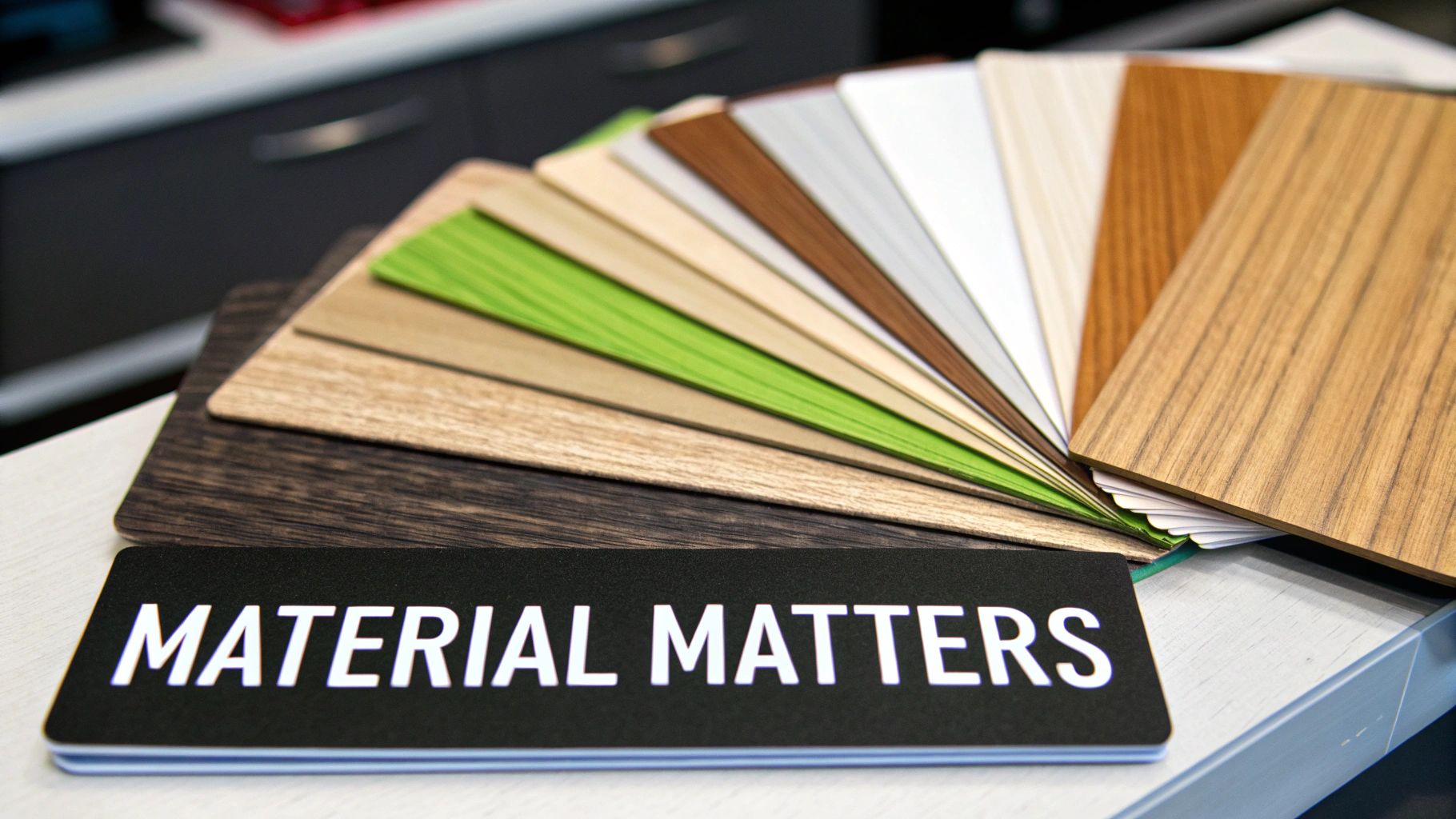
- Medium-Density Fibreboard (MDF): This is an incredibly popular and cost-effective choice, especially if you're planning on painted cabinets. MDF gives you a perfectly smooth, stable surface that won't warp, which is ideal for that clean, flawless look.
- Solid Woods (Maple, Oak, Cherry): These materials bring a natural warmth, beauty, and timeless durability to a kitchen. Every wood has a distinct grain and personality, with prices varying based on how common or hard the wood is.
- High-End Woods (Walnut, Rift Cut Oak): For those after a truly premium finish, woods like walnut offer rich, deep tones and striking grain patterns that create an immediate sense of luxury.
Choosing the right material is about more than just cost; it's about matching your lifestyle and design vision. To help you navigate these choices, we put together a detailed guide on the best materials for kitchen cabinets that breaks down the pros and cons of each.
Door Styles and Finishes: The Face of Your Kitchen
After you’ve landed on your core material, the next big cost driver is the style of your cabinet doors. A simple, flat-panel (or slab) door is far less labour-intensive to produce than an intricate one with raised panels, detailed moulding, or inset construction.
Think of it this way: a clean-lined t-shirt costs less to make than an ornate, hand-beaded blouse. The same principle applies here.
The finish you select also plays a crucial role. A standard paint or stain is the baseline. But if you opt for a high-gloss finish, a custom colour match, or a multi-step glaze, that requires more materials and highly skilled labour, which will be reflected in the price.
Hardware and Accessories: The Functional Details
It’s easy to overlook hardware and internal accessories when you're first budgeting, but these are the finishing touches that can have a huge impact on both your final cost and your daily kitchen experience. Standard knobs and pulls are an affordable choice, but premium, heavy-duty hardware from designer brands can add hundreds or even thousands of dollars to the total.
Beyond what you see on the outside, it's what's inside that really counts. These functional upgrades add immense value but also contribute to the overall price.
Key accessories to consider include:
- Soft-Close Hinges and Drawer Slides: This is practically a standard feature in modern custom kitchens, and for good reason. They prevent slamming and reduce wear and tear—a small upgrade with a huge impact on quality of life.
- Pull-Out Organizers: Solutions like spice racks, utensil dividers, waste bin pull-outs, and pantry organizers are game-changers for maximizing storage and accessibility.
- Corner Cabinet Solutions: Lazy Susans or more advanced blind corner pull-outs make sure no space is wasted and every pot and pan is within easy reach.
- Integrated Lighting: Under-cabinet or in-cabinet LED lighting adds beautiful ambiance and improves functionality, but it does require additional wiring and installation work.
Each of these elements contributes to the custom kitchen cabinets price, but they also transform a standard kitchen into a highly functional, personalized workspace. By understanding these cost drivers, you can prioritize what's most important and build a budget that perfectly aligns with your vision.
Comparing Your Options: Stock, Semi-Custom, And Full Custom
When you start looking at the custom kitchen cabinets price, it really helps to see how they stack up against the other choices out there. Think of it like buying a suit: you can grab one off the rack, get one altered for a better fit, or have one completely made to measure. Each path offers a different level of personalization, quality, and, of course, cost.
Let's break down the three main routes you can take—stock, semi-custom, and full custom—to see which one makes the most sense for your kitchen project.
Stock Cabinets: The Off-The-Rack Solution
Stock cabinets are the ready-to-wear option of the kitchen world. They’re mass-produced in standard sizes and styles and sit waiting for you at big-box home improvement stores. It's like grabbing a standard-sized t-shirt; it's fast, affordable, and gets the job done right away.
The trade-off for that convenience is a lack of flexibility. You're limited to whatever styles and sizes are on the shelf. This often means you’ll need to use clunky filler strips to patch up awkward gaps in your kitchen layout. While they're a great fit for a tight budget or a quick rental flip, stock cabinets just don't offer the polished look or unique personality most people want for their forever home.
Semi-Custom Cabinets: The Tailored Alteration
Semi-custom cabinets are the happy medium, balancing affordability with a good dose of personalization. This is like buying that suit off the rack but taking it to a tailor for alterations. You start with a range of pre-set door styles and finishes but get the freedom to tweak certain dimensions, like cabinet depth or drawer sizes, to better suit your space.
That little bit of extra flexibility makes a big difference. It helps create a more integrated, high-end look and minimizes the need for those obvious filler pieces. You also get a wider palette of colours, finishes, and clever storage add-ons compared to what you'd find in the stock aisle. It’s a fantastic choice if you want something more special than the basics without jumping into a fully bespoke project.
Full Custom Cabinets: The Bespoke Experience
This is the pinnacle of kitchen cabinetry. Full custom is like having a suit meticulously crafted for you by a master tailor. Every single detail—from the exact height, width, and depth to the wood species, door style, and unique finish—is built from scratch to your precise vision. This is how you get a flawless fit, no matter how quirky your kitchen's layout, sloped ceilings, or odd corners may be.
With custom cabinetry, there are no compromises. Your vision dictates the final product, allowing for limitless design possibilities and an unparalleled level of craftsmanship that is built to last for decades.
This is where your creativity can run wild. Want cabinets that perfectly match an heirloom furniture piece? Need a special drawer built to house your specific collection of spices? Full custom makes it happen.
While the initial custom kitchen cabinets price is higher, you can see where the investment goes: superior materials, perfect functionality, and a kitchen that is one-of-a-kind. By working directly with a local manufacturer, you can often get these premium benefits more affordably. Exploring factory-direct kitchen cabinets is a smart way to achieve a high-end result without the retail markup.
To put it in perspective, stock cabinets for a small kitchen often land between $1,500 and $3,000. Semi-custom options will typically run you $3,000 to $12,000, while full custom projects generally start around $5,000 and can easily go beyond $30,000 for larger, more intricate designs.
Cabinet Comparison: Stock vs Semi-Custom vs Custom
To make the decision even clearer, this table gives you a side-by-side look at how the three cabinet types compare across the factors that matter most.
| Feature | Stock Cabinets | Semi-Custom Cabinets | Fully Custom Cabinets |
|---|---|---|---|
| Price | Most Affordable | Mid-Range | Highest Initial Investment |
| Design Flexibility | Very Limited (standard sizes and styles) | Moderate (some size/finish modifications) | Unlimited (built to exact specifications) |
| Material Quality | Often particleboard with veneers | Good (mix of solid wood and composites) | Excellent (premium solid woods and MDF) |
| Fit and Finish | Standard; often requires filler pieces | Better fit; fewer fillers needed | Perfect fit for any space, seamless look |
| Lead Time | Shortest (often in-stock) | Moderate (typically 4-8 weeks) | Longest (typically 6-12+ weeks) |
| Lifespan | 10-15 years | 15-20 years | 20+ years, often a lifetime |
Ultimately, the right choice comes down to balancing your budget, your timeline, and just how much you want your kitchen to reflect your personal style.
Planning for the Full Picture: Hidden Costs & Smart Upgrades
When you’re budgeting for a custom kitchen, it’s easy to focus on the big-ticket items like the cabinet boxes and doors. But the final custom kitchen cabinets price is a lot more than that. The real secret to keeping your project on track is to plan for the "hidden" costs and high-value features from day one. This way, there are no surprises, and you can be sure your investment is going exactly where it counts.
Think of it like buying a car. The sticker price is just the starting point. It’s the optional packages, delivery fees, and premium tires that make up the final number you actually pay. Custom cabinetry is no different; your initial quote is the foundation, and several other critical factors will build upon it to determine your total cost.
Uncovering Potential Hidden Costs
When you get a quote, the first thing you need to ask is what’s not included. Some of the most crucial expenses aren't always itemized upfront, but they are absolutely necessary to get the job done right. Being aware of them puts you back in control of your budget.
Here are a few common costs that can fly under the radar:
- Demolition and Removal: Before your beautiful new cabinets go in, the old ones have to come out. Ripping out and disposing of an old kitchen is a labour-intensive job that often comes with its own fee.
- Delivery and Shipping: Your cabinets are built with precision in a workshop, but they need to get to your home in one piece. Specialized handling and transport are a must, and that's typically a separate charge.
- Complex Installation: A standard installation fee usually covers hanging cabinets on a flat, even wall. If your kitchen has tricky corners, bowed walls, or requires intricate crown moulding, expect the installation cost to go up.
- Site Preparation: Often, a new cabinet layout means your plumbing or electrical outlets are suddenly in the wrong spot. Moving them requires licensed pros and will add to the project's bottom line.
This flowchart gives you a good sense of where custom fits into the bigger picture of cabinet options.
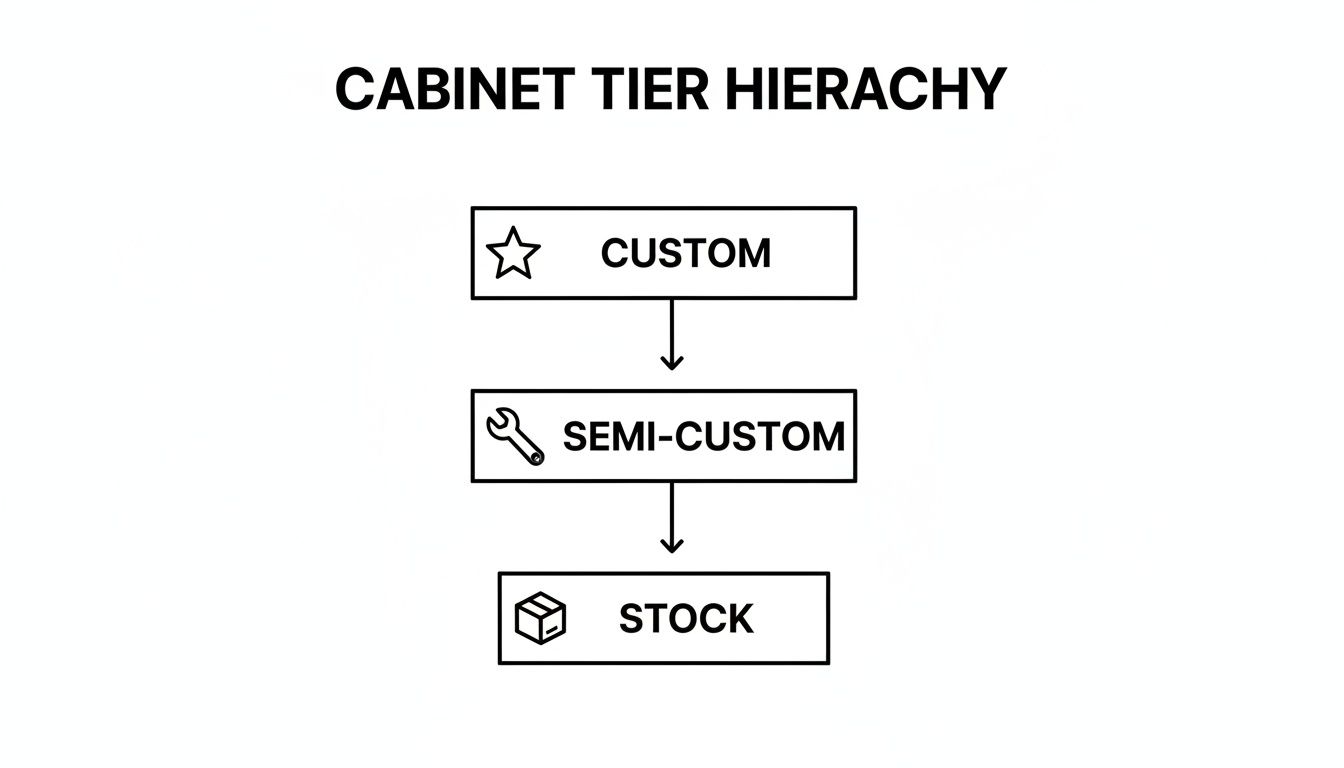
As you can see, moving up the ladder gives you a world of creative freedom—but that freedom also brings more complexity and, potentially, more of these add-on costs.
Investing in Upgrades That Actually Matter
Beyond the nuts and bolts, there are the upgrades that truly transform your kitchen's day-to-day usability. These are the features that make you fall in love with your kitchen all over again, every time you use it. They do add to the initial investment, but their impact is something you'll appreciate for years to come.
A well-planned kitchen isn't just about looking good; it's an efficient, functional workspace. Setting aside a part of your budget for smart interior features is one of the best investments you can make in your home.
Here are a few of the most popular and worthwhile upgrades we see clients choose time and again:
- Custom Pull-Out Pantries: No more digging around in the back of a dark cupboard. These brilliant organizers bring everything right to your fingertips.
- Clever Corner Solutions: Options like a "Magic Corner" or a modern Lazy Susan turn that awkward, dead corner into some of your most valuable storage real estate.
- Integrated Spice Racks and Utensil Organizers: Having your most-used tools and spices perfectly organized and within easy reach makes cooking feel less like a chore and more like a joy.
- Under-Cabinet Lighting: This is a game-changer. It provides beautiful ambient light for the whole room and critical task lighting right where you need it for chopping and prep work.
A savvy approach is to focus on the "bones" of your kitchen first. Investing in high-quality, sturdy cabinet boxes is key. You can always upgrade hardware down the line, and this strategy allows you to update door fronts or finishes in a decade without a full-scale, costly tear-out. After all, semi-custom solutions might last 10-15 years, but quality full-custom cabinets can easily last beyond 20 years. You can read more about the long-term value of cabinet choices on Greenberg.design.
By planning for both the hidden necessities and the strategic upgrades, you can build a realistic budget that delivers the dream kitchen you're truly after.
How To Get An Accurate Custom Cabinet Quote In Toronto
Figuring out the quoting process is probably the most critical step in bringing your dream kitchen to life. A good, detailed quote is so much more than just a number—it’s the actual blueprint for your project. Getting it right from the beginning prevents those nasty misunderstandings and budget blow-ups later on, ensuring your vision and your wallet are on the same page.
Think of it like this: you wouldn't go to the doctor without an idea of your symptoms. In the same way, walking into a cabinet consultation prepared with measurements, ideas, and a clear wish list is the secret to getting a quote you can actually trust.
Prepare For Your Consultation
Before you even start talking to cabinet makers, a little bit of homework goes a long way. The more info you bring to the table, the more accurate their estimate for your custom kitchen cabinets price will be. Your goal here is to move past a vague ballpark guess and get to a solid, actionable plan.
First, just sketch out your current kitchen layout. It doesn’t have to be perfect or professional. Simply grab a tape measure and jot down the dimensions of your walls, note where the windows and doors are, and mark the locations of your major appliances.
Next, it's time for the fun part: building your wish list.
- Your Style: Start saving photos of kitchens that catch your eye. Do you love the clean, modern look of flat-panel doors? Or are you more of a timeless Shaker style person? Maybe something more traditional?
- How You Use It: Think about your daily routine. Would a pull-out spice rack next to the stove make your life easier? What about a dedicated coffee station or a slick, hidden recycling centre?
- Materials & Finishes: Get a feel for what you like. Do you imagine a classic painted finish, the natural warmth of maple wood, or a super-sleek high-gloss look?
Doing this prep work transforms that first meeting from a vague chat into a genuinely productive design session.
Vet Your Potential Partners
Once you have your ideas in order, it's time to find the right team for the job. You've got plenty of options in Toronto and Markham, but they aren't all the same. Asking the right questions is crucial to understanding exactly what you're paying for.
When you sit down with a potential cabinet maker, have a checklist ready.
- Manufacturing: Ask them straight up: do you build your cabinets in-house or farm them out? A company that's factory-direct has much more control over quality and timelines, which can often mean better prices for you.
- Materials and Hardware: Get specific. What materials do they use for the cabinet boxes versus the doors? What brand of hinges and drawer slides do they use? Are features like soft-close standard or an upgrade?
- Warranty: What kind of warranty do they offer on their work and the finish? A solid warranty shows they stand behind their product.
- Timelines: Ask for a clear estimate of the entire process, from the moment you sign off on the final design to delivery and installation day.
A transparent cabinet maker will be happy to answer every single one of your questions in detail. If you get vague answers or they seem hesitant to share specifics, that’s a red flag. True pros are proud of their process and the materials they use.
Getting multiple quotes is always a smart move, but make sure you’re comparing apples to apples. A cheaper price might be hiding inferior materials or extra charges down the line. A truly comprehensive quote will break everything down, from the door styles to whether professional installation is included. To get a better handle on what a full package looks like, you can learn more about what to expect by reviewing guides on kitchen cabinets with installation. Armed with this knowledge, you can confidently choose the right partner to build the kitchen you’ve always wanted.
Your Top Questions About Toronto Cabinet Costs Answered
When you're planning a kitchen renovation, the details can feel overwhelming. You've got questions, and when it comes to the price of custom kitchen cabinets, you need straight answers to budget properly and move ahead with confidence. Let's dig into some of the most common questions we hear from homeowners across Toronto and Markham.
So, let's get right to it: what should you actually expect to pay? For a standard 10×10 foot kitchen in the GTA, a realistic budget for quality custom cabinets—think durable, stylish materials like maple—will typically land somewhere between $12,000 and $18,000.
That price range gets you beautifully crafted cabinetry that’s built to last. Of course, if you’re dreaming of premium woods like walnut or want to include elaborate custom features, that number can easily rise to $25,000 or more. A smart way to plan is to set aside 40-50% of your total kitchen renovation budget just for the cabinets.
Should I Reface or Fully Replace My Cabinets?
This is a big one. It's the classic debate for anyone wanting an updated look without a full-blown demolition. Refacing can definitely save you money, usually costing 30-50% less than a complete replacement. It’s a fantastic option if your cabinet boxes are still in good shape and you’re happy with the overall layout of your kitchen.
But, if your current layout just doesn't work for you anymore, or the insides of your cabinets are showing their age, a full replacement is the smarter long-term investment. New custom cabinets are the only way to truly fix an inefficient workflow, maximize every inch of storage, and seriously boost your home’s value.
A full replacement isn’t just a cosmetic fix; it’s your chance to solve all those old frustrations and create a kitchen that truly works for the way you live.
What Is the Lead Time for Custom Cabinets?
Knowing the timeline is absolutely critical for keeping your renovation on track. Here in Markham and the GTA, you can generally expect a lead time of 6 to 12 weeks for custom cabinets.
That clock starts ticking the moment you sign off on the final designs. The exact timing can vary based on how complex your cabinets are and how busy the manufacturer's workshop is. Always, always confirm this timeline with your cabinet maker right from the start.
Once you have that delivery date, you can line up your other trades—countertop installers, electricians, plumbers—like dominoes. A clear schedule is the key to making sure the whole project comes together smoothly, without stressful and expensive delays.
Ready to get a clear, no-surprise price for your dream kitchen? The team at MapleKing Kitchen Cabinets provides factory-direct pricing that eliminates the middleman, offering premium custom solutions that fit your budget. Start your journey today with a free, detailed quote.