

When you start looking into custom kitchen cabinets, the first question on your mind is probably, "What's this actually going to cost me?" The short answer is that prices typically run anywhere from $500 to over $1,500 per linear foot. For a standard-sized kitchen, you're often looking at a total project cost between $10,000 and $30,000.
That’s a big range, I know. But it reflects the very nature of custom work—every single choice you make, from the wood species to the doorknobs, directly influences the final price tag.
Decoding Your Custom Cabinetry Investment
Figuring out the cost of custom cabinets isn't about finding one fixed price. It’s more about understanding the different ingredients that make up that final number. Think of it like ordering a custom-built car: the base model will get you where you need to go, but upgrading to leather seats, a top-tier sound system, and a more powerful engine will naturally drive up the cost. It's the exact same principle with cabinetry.
The quote you get from a cabinet maker is built on three fundamental pillars. Each one is a crucial piece of the puzzle that determines your total investment.
- Materials and Finishes: This is, without a doubt, the biggest factor. Solid hardwoods like cherry or maple will always be more of an investment than engineered materials like HDF. Likewise, a multi-step, hand-applied finish will cost more than a simple coat of standard paint.
- Design Complexity: The more detailed your design, the more it will cost. A kitchen full of simple, standard-sized cabinets is far more budget-friendly than one featuring intricate crown moulding, specialized pull-out pantries, matching appliance panels, or uniquely sized units.
- Labour and Installation: Don't underestimate the value of craftsmanship. The skill and time it takes for an expert to build and install your cabinets are a significant part of the cost. A perfect installation is what ensures your cabinets look stunning and function flawlessly for years to come.
This visual gives you a quick breakdown of how these factors play out across different budget levels.
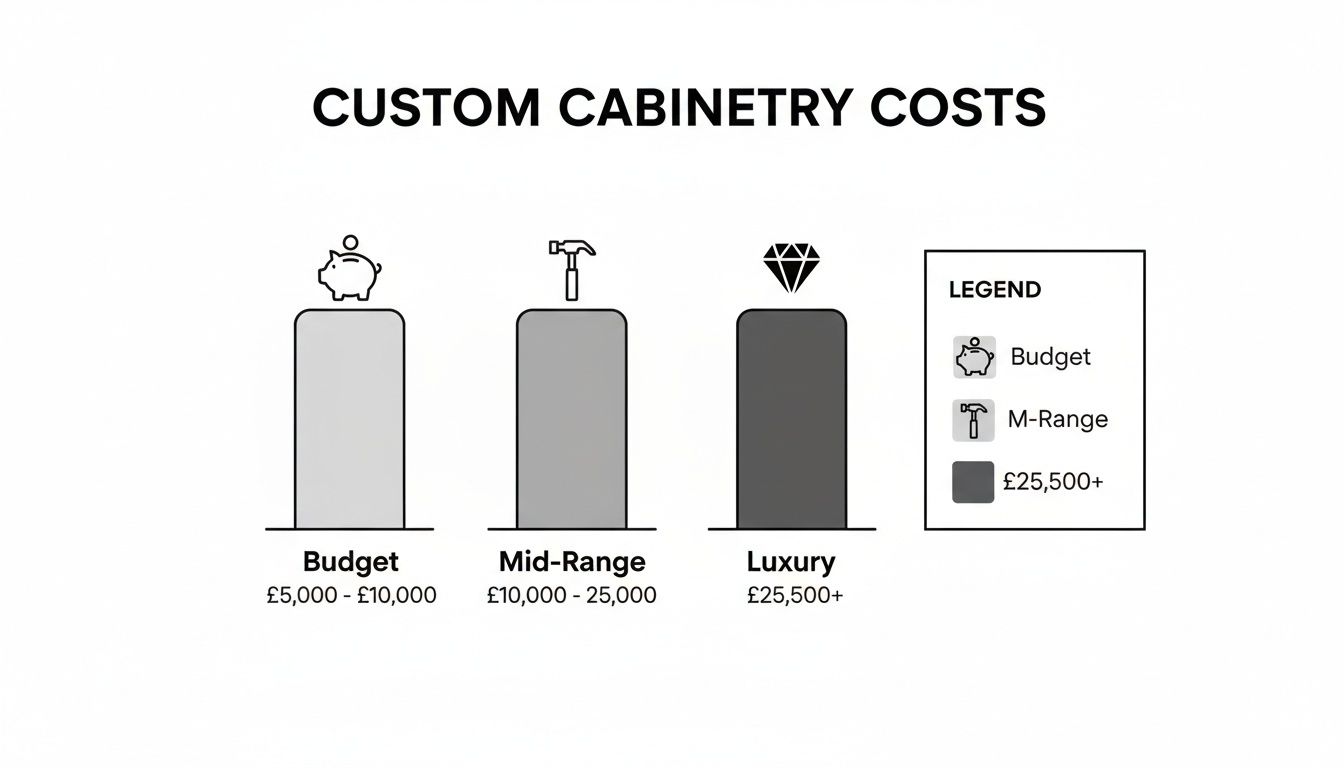
As you can see, the jump from a budget-conscious project to a high-end luxury kitchen is significant. It's all in the premium materials and the complexity of the design.
To give you a clearer picture, I've put together a table that breaks down what you can generally expect within each of these tiers.
Custom Cabinet Cost Tiers at a Glance
| Quality Tier | Typical Price per Linear Foot | Estimated Cost for a 20 Linear Foot Kitchen | Common Materials & Features |
|---|---|---|---|
| Budget | $500 – $750 | $10,000 – $15,000 | MDF or HDF, stock colours, basic hardware, standard box construction |
| Mid-Range | $750 – $1,200 | $15,000 – $24,000 | Plywood boxes, maple or oak, semi-custom colours, soft-close hinges |
| Luxury | $1,200+ | $24,000+ | Cherry or walnut, fully custom finishes, glass inserts, custom inserts |
This table serves as a great starting point for budgeting. It helps you align your vision with a realistic financial plan, showing how different material and feature choices move the needle on your total cost.
How to Measure and Budget per Linear Foot
When you start looking for kitchen cabinets, you’ll hear one term pop up again and again: "per linear foot." It's the industry standard for pricing, but it can be a little confusing at first.
Think of it like buying fabric by the metre; it’s just a straightforward way to calculate a baseline custom kitchen cabinets cost based on the length of wall space you need to cover. Getting a handle on this measurement is your first big step toward creating a realistic budget and having smarter conversations with designers.
Calculating Your Kitchen's Linear Feet
Figuring out your kitchen's linear footage is much easier than it sounds. All you need is a tape measure and a place to jot down a few numbers.
Here’s a simple two-step way to get it done right:
- Measure the Lower Cabinets: Start with your base cabinets. Measure the length of the wall where they will sit, going from one end to the other. If you have an L-shaped or U-shaped layout, just measure each wall segment individually and then add those numbers together.
- Measure the Upper Cabinets: Now, do the exact same thing for your upper cabinets. Often, the uppers and lowers cover the same wall space, so these numbers might be identical. But if your design only has uppers on certain walls, your totals will be different.
Key Takeaway: To get a preliminary total for your budget, just add the measurement for your lower cabinets to the measurement for your upper cabinets. A 10-foot wall with both upper and lower cabinets is 20 linear feet of cabinetry.
From Measurement to a Working Budget
Once you have your total linear footage, you can start putting together a rough budget. Let’s walk through a quick example. Imagine you have a single 12-foot wall that will have both upper and lower cabinets.
- Total Linear Footage: 12 feet (lowers) + 12 feet (uppers) = 24 linear feet
- Mid-Range Cost: If a cabinet maker quotes you $800 per linear foot, your estimated cost would be 24 feet x $800 = $19,200.
- Luxury Cost: If you go for premium materials at $1,200 per linear foot, the cost jumps to 24 feet x $1,200 = $28,800.
Of course, pricing can vary quite a bit depending on your location, mostly because of differences in labour and material costs. For example, custom kitchen cabinets often range from $500 to $1,200 per linear foot, with some regions being 20-30% higher than the national average.
You can see how this plays out globally by looking at guides on carpentry prices in Singapore, including costs per linear foot for kitchen cabinets. No matter where you are, this basic calculation gives you a solid starting point for planning your finances.
How Materials and Finishes Shape Your Cabinet Costs
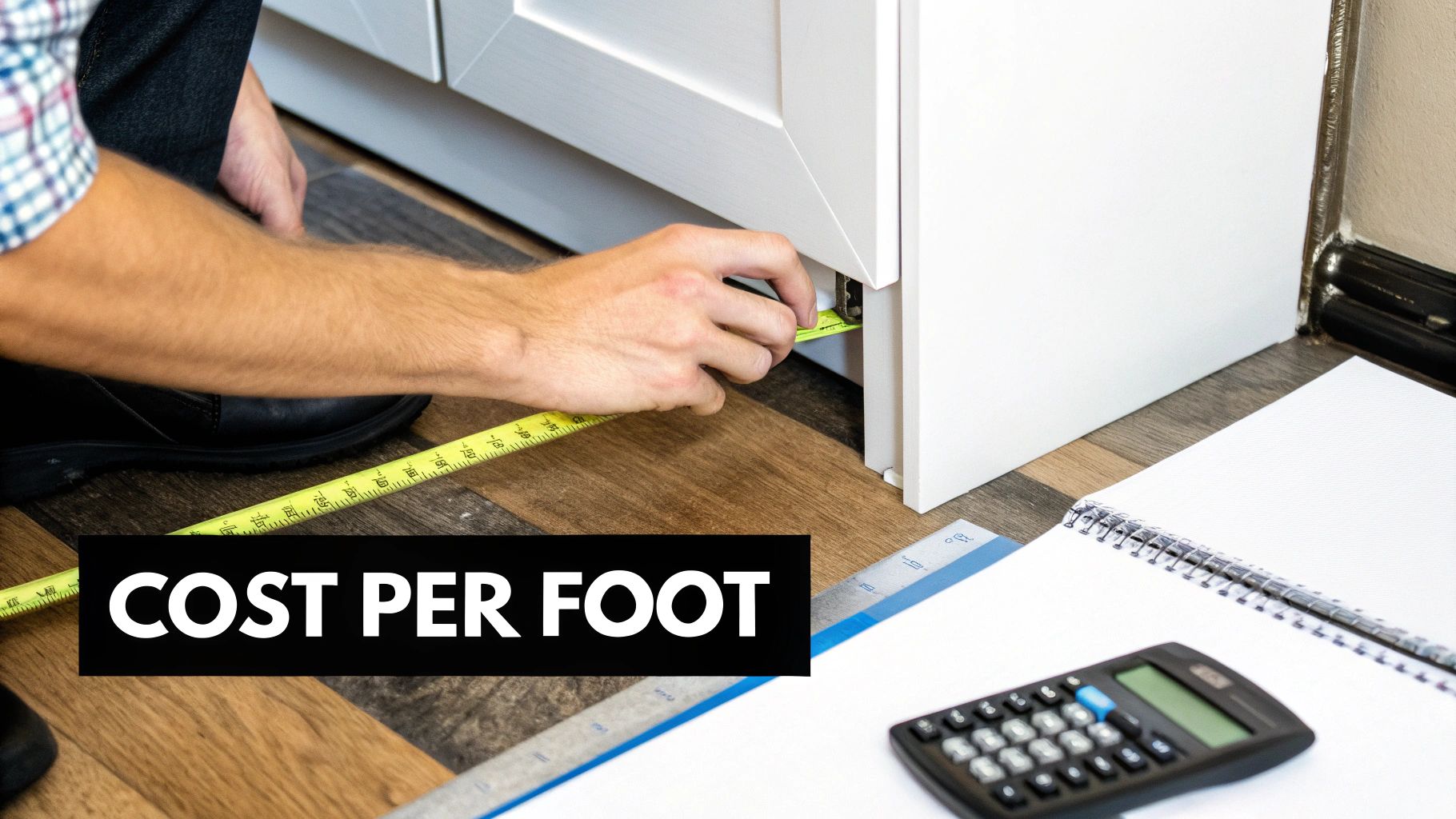
When you're pricing out a kitchen renovation, the material you pick for your cabinets is easily the biggest factor influencing the final number. It's the core decision that impacts not just the price, but also how your kitchen feels, how it wears over time, and its overall personality.
Getting this choice right is all about striking that perfect balance between the look you've been dreaming of and the budget you need to stick to. From high-quality engineered woods to timeless solid hardwoods, each option has its own story of cost, durability, and style.
Engineered Wood: The Modern, Practical Choice
There's a good reason engineered woods like Medium-Density Fibreboard (MDF) and High-Density Fibreboard (HDF) are so popular. They provide an incredibly stable and smooth surface, which is the perfect base for a painted finish. The result is a clean, flawless look that's often hard to get with natural wood.
Because they’re manufactured materials, they don't expand and contract with humidity the way solid wood does. That means no warping or cracking, making them a really durable and smart foundation for a modern kitchen.
Expert Tip: If you're going for a sleek, contemporary kitchen with a consistent painted colour, HDF or MDF is your best bet. They deliver that high-end, uniform appearance without the premium cost of solid wood, giving you a perfect canvas for everything from matte to high-gloss finishes.
Solid Wood: The Timeless Classic
For anyone who loves the natural warmth and unique character of wood grain, solid wood is the undisputed champion. Classic options like maple, oak, or cherry bring their own distinct patterns and tones into your home, creating a space that feels rich and inviting. Solid wood is incredibly strong, can be repaired if it gets nicked, and will literally last a lifetime with a bit of care.
Of course, that kind of quality and longevity comes with a higher price tag. It's also worth remembering that solid wood is a natural material that "breathes" with humidity changes, which can cause slight expansion or contraction. It's a normal characteristic, but something to keep in mind for your long-term investment.
Finishes: The Final Touch That Defines Your Style
The finish is where your cabinets' personality truly comes to life. It’s more than just a protective layer; it’s a major design element that significantly affects both the look and the cost.
- Paint: Gives you a world of colour options and a smooth, modern look, especially on HDF.
- Stain: Lets the natural beauty of solid wood shine through, enhancing the grain for a more traditional or rustic feel.
- Thermofoil: A durable vinyl laminate that's heated and molded over MDF. This creates a tough, seamless surface that's a breeze to clean.
- High-Gloss or Matte Lacquer: These are premium finishes that can create a dramatic, ultra-modern vibe or a sophisticated, understated elegance, but they often come at a higher cost.
When you're trying to nail down a look, checking out the current trends in custom kitchen cabinets can give you some great inspiration for a style that will last. If you're in the GTA, knowing what works for our local homes is key. You can find excellent kitchen cabinets in Toronto that bring together the perfect material and finish to make your kitchen the true heart of your home.
The Hidden Costs of Cabinet Labour and Installation
While the materials and finishes get all the attention, the installation is where your project truly comes to life. The custom kitchen cabinets cost doesn't stop once you've paid for the boxes; professional labour is a huge, and frankly non-negotiable, part of the budget.
Think of it this way: you wouldn't buy a custom-tailored suit and then try to stitch the sleeves on yourself. Bad installation can ruin beautiful cabinets, leaving you with crooked doors, uneven gaps, and a look that just feels… off. A true professional does so much more than just screw cabinets to the wall. They're meticulously levelling, securing, and integrating every piece so your kitchen not only looks stunning but functions perfectly for years to come.
What Professional Installation Truly Involves
Hiring a skilled installer is really an investment in protecting the bigger investment you just made in the cabinets themselves. It’s a job that demands precision and patience.
Here’s a glimpse into what you're really paying for with a professional install:
- Careful Demolition: They’ll take out your old cabinets without wrecking the drywall, floors, or hitting any plumbing or electrical lines hidden in the walls.
- Site Preparation: Before a single new cabinet goes in, they're checking walls for flatness and making sure the entire space is clean, level, and prepped.
- Precision and Skill: This is where the magic happens. Experts use levels, lasers, and years of experience to get every single cabinet perfectly plumb. This is absolutely critical for doors to hang straight and for countertops to sit flat.
- Finishing Touches: All the details that scream "custom"—crown moulding, light valances, filler strips, and hardware—are installed flawlessly to create that polished, high-end look.
As a rule of thumb, set aside 10% to 20% of your total cabinet budget just for the installation. Trying to cut corners here is a classic mistake that can cheapen the look of the entire project.
How Complexity and Location Affect Labour Costs
It’s important to remember that not all installations are the same. A simple, straight run of cabinets in a galley kitchen is a much different job than a large, U-shaped kitchen with an island, appliance panels, and custom trim.
Every complex element—corner cabinets, built-in pantries, or intricate moulding—adds time and requires a higher level of skill, which naturally pushes the labour cost up.
Your postal code also plays a big role. Labour rates can vary significantly from one city to another. A full custom installation can easily run into the thousands, and that price is tied directly to the cost of living and demand for skilled trades in your area. You can see the full scope of what's involved by exploring professional cabinet installation and renovation services that manage the entire process.
For example, in a high-demand market, installation costs can range from $150-$500 per linear foot for semi-custom cabinets and jump to between $500-$1,200 for fully custom builds. This just goes to show why getting a detailed quote from a local installer is the only way to get a truly accurate number for your budget.
Smart Ways to Get a Custom Look for Less
Getting that high-end, custom kitchen look doesn't have to mean emptying your savings account. It’s all about making smart, strategic choices with your design and materials. You can dramatically lower the final custom kitchen cabinets cost without giving up that bespoke feel you're dreaming of.
A classic designer trick, for instance, is to mix and match materials. You can splurge on beautiful solid wood or premium HDF for the cabinet doors and drawer fronts—the parts everyone sees—but use durable, more affordable melamine for the cabinet boxes themselves. No one ever peeks inside the carcass, but you'll definitely feel the difference in your budget.
Another big one? Simplify the design. All those intricate details like ornate crown moulding, decorative legs, and complex door styles really add up, piling on both material and labour costs. Choosing a clean, timeless Shaker-style door or a sleek flat-panel design can literally save you thousands, and the result is still incredibly chic and modern.
Prioritize Function and Smart Sourcing
Take a moment to think about what you actually use day-to-day. A pull-out spice rack right beside the stove might be a non-negotiable game-changer for you, but do you really need a custom organizer in every single drawer? Focusing your budget on a few high-impact upgrades instead of dozens of minor ones is the key to smart spending.
But maybe the single biggest money-saver is cutting out the retail middleman entirely.
When you work directly with a cabinet factory, you sidestep the hefty markup that showrooms and big-box stores tack on. This factory-direct approach can slash your cabinet costs by as much as 50%, suddenly putting a fully custom kitchen well within reach.
Finally, solid planning is your best friend. Lock in your layout, your materials, and all your hardware choices before the first piece of wood is cut. Last-minute changes are the number one cause of budget overruns and frustrating delays.
- Plan Ahead: Finalize every design detail early on to dodge expensive changes mid-project.
- Mix Materials Wisely: Use premium materials where they’ll be seen and appreciated, and cost-effective options for the interiors.
- Simplify Door Styles: Elegant, simpler designs are less complex to manufacture, which directly lowers your cost.
- Buy Factory-Direct: Go straight to the source and avoid paying for retail markups.
By using these strategies, that dream kitchen can become a reality. For homeowners looking at their options in the GTA, checking out affordable kitchen cabinets and renovation services in North York is a great way to get valuable local insights and pricing.
Common Questions About Cabinet Costs
When you're deep in the details of a kitchen renovation, it's natural for a lot of questions to pop up, especially around project timelines and those pesky hidden expenses. To help you lock in your budget and plan with confidence, we've pulled together answers to the most common questions homeowners ask about the cost of custom kitchen cabinets.
Getting a handle on these details upfront means fewer surprises down the road, paving the way for a smooth renovation from start to finish.
Are Custom Cabinets Really That Much More Expensive Than Stock?
Yes, there's a definite price gap, but it's a reflection of a huge jump in quality, durability, and personalization. You can expect custom cabinets to cost anywhere from 50% to 100% more than the standard, off-the-shelf options you'd find at a big-box hardware store.
Stock cabinets are certainly the wallet-friendly choice, but they come with serious limitations in size, style, and finish. That extra investment in custom work buys you total design freedom—cabinets built to fit your space like a glove, made from the exact materials you want, for a kitchen that is truly yours.
What’s the Timeline for a Custom Cabinet Project?
Good things take time, and the custom route is definitely more involved than grabbing boxes off a shelf. From your first design meeting to the final screw being tightened, the whole process typically lands somewhere between 8 to 16 weeks.
This schedule usually breaks down into a few key stages:
- Design & Revisions: 1–3 weeks
- Material Sourcing & Construction: 6–10 weeks
- Shipping & Installation: 1–2 weeks
It's so important to build this timeline into your larger renovation plan. This way, you can coordinate seamlessly with other tradespeople, like your countertop installers, plumbers, and electricians.
Are There Hidden Costs I Should Budget For?
You bet. A few expenses can easily catch homeowners by surprise if they aren't planned for ahead of time. To keep your budget on track, it's smart to set aside a contingency fund for these potential costs.
A detailed, itemized quote is your best defense against surprise costs. Don't be shy about asking your cabinet maker to break down every single line item. You deserve to know exactly where your money is going.
Make sure your budget accounts for these common extras:
- Demolition and Disposal: The cost to tear out and haul away your old cabinets can run from $300 to $800, sometimes more.
- Hardware: Knobs, pulls, and handles are often billed separately. They can range from a few dollars each to over $50 for high-end pieces.
- Unexpected Repairs: Tearing out old cabinets can reveal hidden issues, like needing unplanned plumbing adjustments or electrical work.
- Delivery Fees & Taxes: Always double-check if these are included in the final price or will be added on later.
Ready to see how affordable your dream kitchen can be with factory-direct pricing? The team at MapleKing Kitchen Cabinets offers personalized consultations to help you design the perfect custom cabinets for your home. Explore our gallery and get your free quote today.



