

When you start budgeting for a new kitchen in the Toronto area, the cabinets are often the biggest line item. You can expect to see prices ranging anywhere from $250 to over $1,000 per linear foot. For a complete kitchen cabinet project, this usually translates to a total cost between $10,000 and $40,000+, all depending on your choice of materials, the level of customisation, and how complex the installation is.
Your Quick Guide to Kitchen Cabinet Costs
Trying to pin down the cost of kitchen cabinets can feel like aiming at a moving target. With so many variables, it's easy to get lost in the numbers. A great way to think about it is to compare it to buying a car. A standard model gets the job done at a fair price, but once you start adding upgrades like a sunroof, premium sound system, or custom paint, the price tag climbs.
It’s the exact same story with your cabinets. Every single choice you make shapes the final number on the invoice. From the wood on the doors to the handles you choose and the layout you design, it all adds up. This guide is here to give you a solid, no-nonsense starting point for your budget by breaking down what really drives the cost.
Understanding Price Per Linear Foot
In the cabinet world, the go-to measurement for a quick estimate is the price per linear foot. This simply means the cost for one foot of cabinetry running along the wall, which usually accounts for both your upper and lower cabinets. It's a handy way to get a ballpark figure and compare quotes from different suppliers.
But remember, this is just a starting point. The final price can swing quite a bit based on a few key factors:
- Cabinet Type: Are you looking at basic stock cabinets, semi-custom options, or a fully custom, one-of-a-kind design? Each comes with a very different price tag.
- Material Choice: The material you pick matters a lot. Solid wood, HDF, thermofoil, and laminates all have their own costs.
- Design Complexity: A straightforward galley kitchen is going to cost less per linear foot than a sprawling U-shaped kitchen with a huge island and custom pantry units.
- Finishes and Hardware: Things like custom paint colours, high-end handles, and soft-close drawer glides will also nudge the total higher.
Typical Cost Ranges in the Toronto Area
So, what does this actually look like for homeowners in Toronto and Markham? Here’s a quick overview to give you a clearer picture of potential costs based on kitchen size.
For a smaller 10'x10' kitchen, you might budget around $5,000 to $10,000 for good-quality semi-custom cabinets. A medium-sized kitchen often falls into the $12,000 to $25,000 range, while larger kitchens with more custom features can easily surpass $30,000.
This local trend is part of a bigger picture. The global kitchen cabinets market is booming and expected to hit USD 124.42 billion by 2031. With many homeowners in established areas like Toronto choosing to renovate instead of move, kitchen upgrades have become one of the most popular and value-adding investments you can make.
For a deeper dive, exploring the average cost to replace kitchen cabinets can give you an even better sense of how these numbers fit into the wider industry.
What Actually Drives Your Cabinet Costs?
Ever wonder why one set of kitchen cabinets can cost twice as much as another, even when they look almost identical at first glance? It’s a great question, and the answer isn't a single thing. Instead, it’s a mix of three core factors that all play a role in the final price tag for your project. Getting a handle on these elements is the secret to managing your budget without giving up on the kitchen you've been dreaming of.
Think of it like getting a custom-tailored suit. The fabric you choose sets the baseline cost, the tailor's time and skill add significant value, and any special requests—like unique buttons or a specific lining—will shape the final price. Kitchen cabinets are built on that exact same principle. Every single choice, from the type of wood to the style of the door, has a direct impact on your total investment.
When we break down these cost drivers, the quote you receive suddenly makes a lot more sense. It puts you in the driver's seat, allowing you to make smart decisions and put your money toward the features that you care about most.
The Big Three Cost Drivers
At the end of the day, the total cost of your kitchen cabinets comes down to a blend of three key components. Each one has its own job to do, and tweaking any of them will move the needle on your budget.
- Materials: This is the heavyweight champion, often making up 50% or more of your total cost. It’s everything from the guts of the cabinet box to the wood or HDF on the doors and the type of finish that’s applied.
- Labour: This covers the entire journey from a pile of raw materials to a beautifully finished product. It includes the skilled work of cutting, building, finishing, and, of course, the crucial final installation in your home.
- Customisation: This is where we bring your unique vision to life. Any changes from standard sizes, clever storage solutions, fancy mouldings, or special paint colours fall into this bucket, adding a premium for that made-just-for-you touch.
By looking at your quote through the lens of these three areas, you can see exactly how your choices are adding up. For example, a standard-sized cabinet made from a high-end material might actually cost less than a fully custom-sized cabinet built from a more basic material.
Materials: The Foundation of Your Budget
The material you pick is easily the biggest line item on your cabinet invoice. Just like a brick house has a totally different cost from a timber-frame one, the material you choose for your cabinets sets the financial starting point. Solid woods like maple or cherry are classic, premium choices loved for their natural beauty and sheer durability.
On the other hand, engineered materials like High-Density Fibreboard (HDF) are a fantastic, budget-savvy alternative. HDF gives you a perfectly smooth surface for paint, which means you never have to worry about the hairline cracks that can sometimes appear on natural wood doors as they expand and contract. It's a huge reason why HDF is so popular for modern, sleek kitchens across Toronto and Markham.
Labour: The Cost of Craftsmanship
Labour is usually the second-largest expense, and it’s about so much more than just the crew that shows up to install the cabinets. The clock starts ticking long before that, back at the factory where skilled craftspeople are precisely cutting, assembling, sanding, and finishing every single piece. A flawless, glass-smooth paint job or a door with a complicated profile simply takes more time and a higher level of skill, and that’s reflected in the price.
The installation itself is a skill all on its own. Getting cabinets perfectly level, securely mounted to the wall, and precisely aligned is an art form. A top-notch installation prevents headaches down the road, like sagging doors or uneven gaps, making professional labour a smart investment in the long-term health of your kitchen.
Customisation: Tailoring to Your Taste
Finally, customisation is what adds those personal touches—and the associated costs—to your project. This is anything that steps outside of a manufacturer’s standard lineup. Do you need a cabinet that’s exactly 27.5 inches wide to slide into a specific nook? That’s a custom job.
Other common customisations we see all the time include:
- Specialty Storage: Things like pull-out spice racks, corner "lazy Susan" units, or custom-designed pantry organizers.
- Decorative Elements: Intricate crown moulding at the top, decorative legs on an island, or beautiful glass-front doors.
- Unique Finishes: A custom paint colour matched perfectly to a fabric swatch or a complex, multi-step glazing process.
Each one of these custom features requires extra design work, specialized labour, and often more material, all of which contribute to the final cost of kitchen cabinets. Once you understand this, you can decide where you want to splurge on a truly custom touch and where a standard option will work just as well for your needs.
How Cabinet Materials Impact Your Budget
When you're planning a kitchen renovation, picking the right cabinet material is easily one of the biggest decisions you'll face. It's a choice that affects not just the look and feel of your space, but also the health of your budget. Think of it like choosing the foundation for a house; it dictates the strength, longevity, and a huge chunk of the final cost. In fact, materials can easily eat up 50% or more of your total cabinet spending, so it's a detail worth getting right.
From the timeless warmth of real wood to the flawless, modern appeal of engineered finishes, every option has its own price tag and personality. Let's break down the most popular choices you'll find here in Toronto and Markham, so you can see how their costs, benefits, and styles stack up for your home.
This diagram shows how your choice of materials, the cost of labour, and any customizations you add are the three main forces driving the final price of your kitchen cabinets.
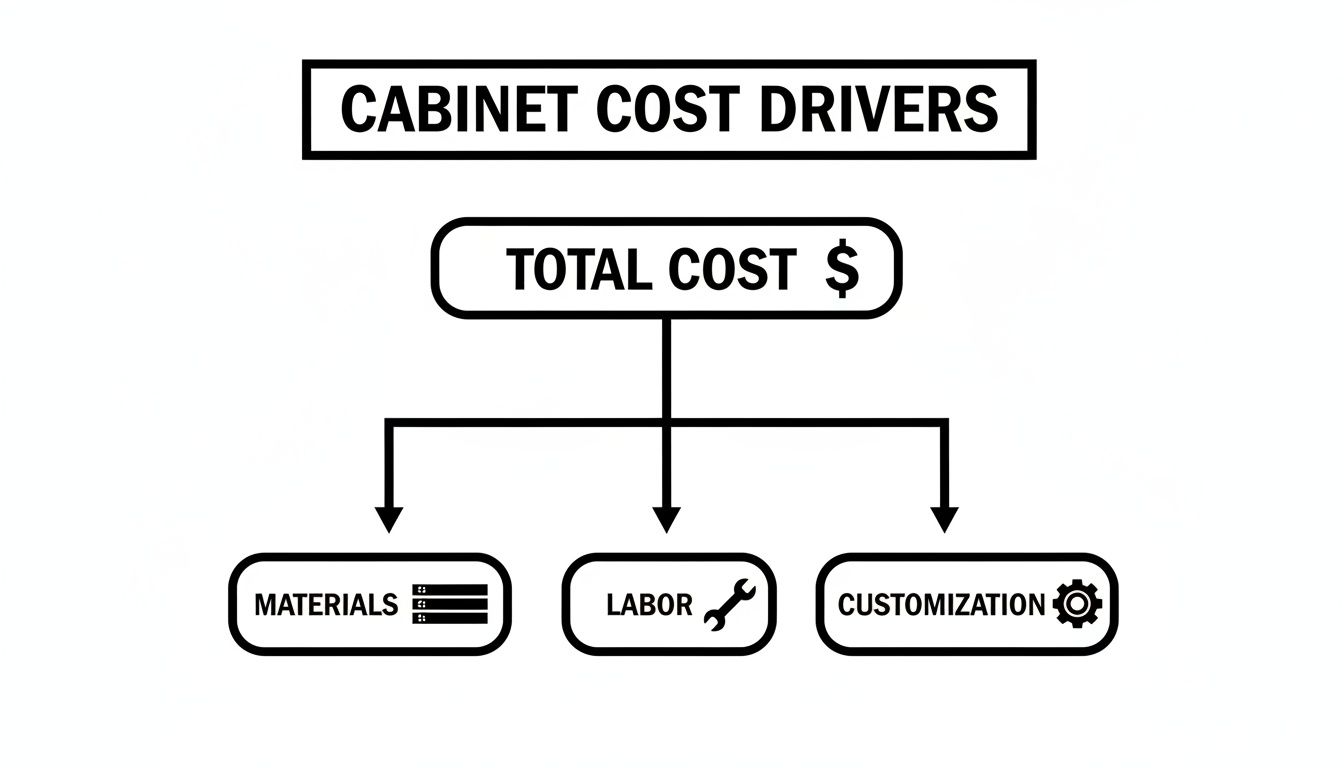
As you can see, while labour and custom features play a big role, your material selection is truly the starting point that shapes everything else.
Real Wood Painted Cabinets
For anyone who loves classic charm and authentic texture, you just can't beat real wood. Even with a coat of paint, those subtle grain patterns peek through, adding a depth and character that manufactured materials can't quite replicate. Of course, that premium look comes with a premium price tag.
- Best For: Perfect for traditional, transitional, and farmhouse kitchens where that touch of natural texture really elevates the design.
- A Key Consideration: Wood is a natural material, so it breathes—expanding and contracting with humidity changes. Over time, you might see tiny hairline cracks in the paint right at the joints of the cabinet doors. Many homeowners actually see this as part of its charm, a sign of authentic aging.
High-Density Fibreboard (HDF)
High-Density Fibreboard, or HDF, has quickly become a go-to for modern cabinetry, and for very good reason. It's an engineered product made by compressing wood fibres with resin under extreme pressure. The result is an incredibly dense, stable, and durable material that's built to last.
The biggest win for HDF is its perfectly smooth, seamless surface. It’s an ideal canvas for paint because, unlike wood, it won’t warp or shift with humidity. That means your painted finish stays flawless for years, with no risk of cracks at the joints. Its stability and more accessible cost make it a phenomenal value. If you want to dive deeper, you can explore the best materials for kitchen cabinets in our detailed guide.
HDF gives you that high-end, painted-wood look but with better durability and a much friendlier price point. It’s no wonder it’s one of the most popular and practical choices on the market today.
High-Gloss and Matte Finishes
For a clean, minimalist vibe, nothing beats the look of high-gloss or matte finishes on an HDF base. Both deliver that sleek, uniform appearance that has come to define contemporary kitchen design.
- High-Gloss HDF: This finish has a reflective, almost mirror-like surface that bounces light all around the room. It’s fantastic for making smaller kitchens feel bigger and brighter. It’s a bold, luxurious look that’s also surprisingly easy to wipe clean.
- Matte HDF: With a soft, velvety texture, matte finishes absorb light for a more understated and sophisticated feel. They are brilliant at hiding fingerprints and smudges, making them a super practical choice for busy families who still want an elegant, modern style.
Both options are typically more affordable than real wood, giving you a high-impact look for a mid-range investment.
To help you visualize the trade-offs, here’s a quick comparison of the most common cabinet materials.
Cabinet Material Cost and Feature Comparison
| Material Type | Relative Cost | Durability | Best For | Maintenance |
|---|---|---|---|---|
| Real Wood (Painted) | High | Very Good | Traditional, Farmhouse | Requires gentle cleaning; paint may show hairline cracks at joints over time. |
| HDF (Painted) | Medium-High | Excellent | Modern, Transitional | Very low; smooth surface is easy to wipe clean and resists cracking. |
| High-Gloss/Matte HDF | Medium | Good | Contemporary, Minimalist | Low; gloss shows fingerprints but wipes clean, matte hides them well. |
| Laminate | Low-Medium | Good | Budget-conscious, Rentals | Very low; highly resistant to stains and moisture, very easy to clean. |
| Thermofoil | Low-Medium | Good | All Styles (Budget-friendly) | Low; seamless surface is easy to clean but can be sensitive to high heat. |
This table gives you a great starting point for weighing what matters most to you—whether it's sticking to a budget, prioritizing durability, or achieving a specific aesthetic.
Laminate Cabinets
Laminate cabinets are made by bonding a layer of decorative paper over a particleboard or MDF core. Today's laminates are a world away from what you might remember from decades past; they now come in a huge range of colours, patterns, and even surprisingly realistic wood-grain textures.
They are famously one of the most budget-friendly options out there. Better yet, their non-porous surface is tough against stains and moisture and is incredibly simple to clean. That durability makes them a smart pick for high-traffic kitchens, rental properties, or anyone aiming for a stylish look on a tighter budget.
Thermofoil Cabinets
Don't let the name fool you—thermofoil isn't actually a metal foil. It's a vinyl-like material that is heated and pressure-moulded over an HDF or MDF core. This process vacuum-seals the vinyl onto the door, creating a smooth, seamless finish that covers the face and edges.
Here’s why it remains a popular choice:
- Cost-Effective: Thermofoil gives you the look of a painted door for a fraction of the cost.
- Easy Maintenance: The non-porous surface is a breeze to wipe down and resists most common kitchen stains.
- Style Versatility: Because it’s moulded, it can be formed into all sorts of styles, from simple flat panels to more detailed, traditional designs.
Thermofoil delivers fantastic value, offering a durable and attractive finish that stands up well to the daily chaos of a busy kitchen without blowing your budget.
The Hidden Costs of Cabinet Installation
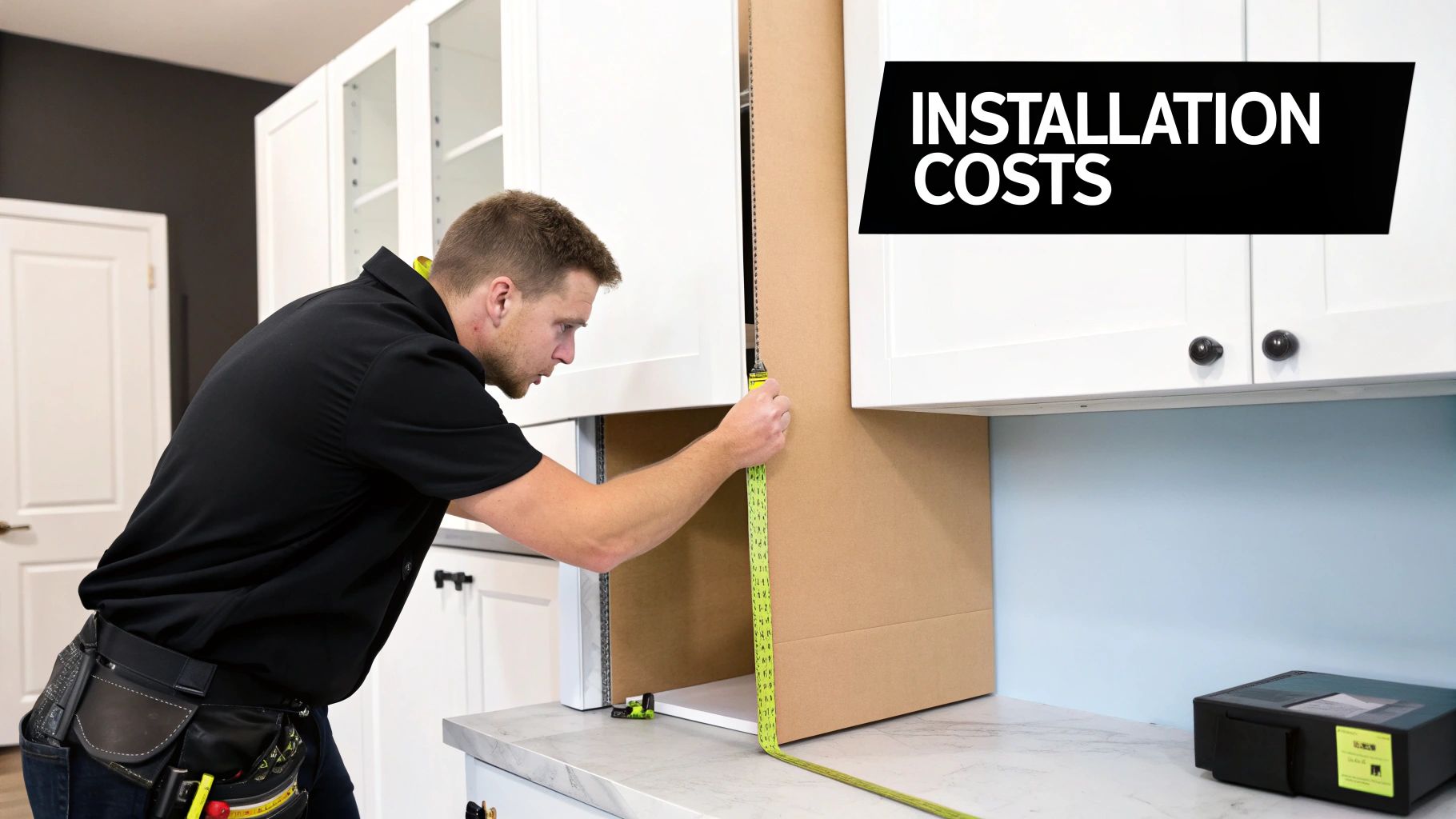
It’s so easy to get caught up in the look and feel of your new cabinets that the cost of putting them in becomes an afterthought. But trust me, the installation is where your kitchen’s fate is sealed. Think of it this way: your cabinets are the high-performance engine, but the installer is the master mechanic who makes sure it all runs perfectly for years to come.
Getting this part wrong is one of the most common budget-busters I see homeowners run into. Professional installation is a game of millimetres, not inches. It’s all about precision—getting every cabinet perfectly level, plumb, and securely fastened to the wall. This is what guarantees your doors will hang straight and your drawers will glide like silk, preventing the dreaded sagging and alignment issues that plague a rushed or inexperienced job.
What’s Actually Included in an Installation Quote?
When you get a quote for cabinet installation, it should be for a lot more than just hanging boxes on a wall. A proper job is a detailed, multi-step process. This is why the total cost of kitchen cabinets is always a blend of the product itself and the skilled labour needed to make it look right.
So, what should you expect? A standard professional installation quote typically bundles in:
- Site Preparation: This is the blueprinting stage, where an installer meticulously measures and marks out the walls to ensure a flawless layout.
- Cabinet Assembly: If you've opted for ready-to-assemble (RTA) cabinets, this step is absolutely critical. It has to be done right.
- Mounting and Securing: This is where the heavy lifting happens. Pros use specialized tools to hang both upper and lower cabinets, ensuring they are rock-solid.
- Levelling and Shimming: Homes are rarely perfect. Installers spend a good chunk of time adjusting for uneven floors and wavy walls to create a perfectly straight run of cabinetry.
- Hardware Installation: The final touch—attaching all your handles and knobs with precision so everything looks uniform and feels great.
Factors That Can Drive Up Labour Costs
Not every installation is a straight shot. Plenty of things can add complexity and hours to the job, especially in the older homes you find all over Toronto and the GTA. Knowing what these potential curveballs are ahead of time will help you build a much more realistic budget.
For instance, walls that aren't perfectly plumb or floors that have settled over decades require a ton of extra work. A skilled installer has to scribe filler pieces and use shims to hide those imperfections and create a seamless look—a true art form that takes time. Similarly, a complex U-shaped layout with a big island is a whole different beast than a simple galley kitchen.
An installer’s real job is to solve problems you didn’t even know you had. The difference between a DIY attempt and a pro job is the ability to adapt to a home's quirks and still deliver a flawless finish.
Other things that can add to your final bill include:
- Demolition and Removal: The labour needed to tear out your old kitchen and haul it away.
- Structural Tweaks: Sometimes walls need reinforcing to provide secure anchor points for heavy cabinets.
- Plumbing and Electrical: Cutting precise openings for sinks, outlets, and under-cabinet lighting. This may even require bringing in a licensed tradesperson.
Why a Pro Installer Actually Saves You Money
It’s always tempting to cut corners and try a DIY installation to save a few bucks. But a bad install can lead to incredibly expensive repairs later on. To avoid this, it's worth putting in the effort of finding trusted kitchen remodeling contractors who know what they're doing.
An even better approach is to go with an all-in-one service. When the same company that designs, builds, and sells you the cabinets is also the one installing them, everything just clicks. There are no communication breakdowns or finger-pointing. You can see how we handle the entire process with our kitchen cabinets with installation service. This integrated approach is your best bet for protecting your investment and ensuring the quality you paid for is what you actually get.
How to Save Money Without Sacrificing Quality
Getting a beautiful, functional kitchen doesn’t mean you have to drain your savings. With a few smart strategies, you can bring down the overall cost of your cabinets quite a bit, all while achieving that high-end look and feel you're after. The secret isn't about cutting corners on quality; it's about making savvy choices that stretch every dollar.
Think of it like buying fresh produce. You could go to an upscale grocery store where the prices are inflated to cover fancy displays and massive overhead. Or, you could go straight to the farmer's market. You get the exact same beautiful, fresh goods, but by cutting out the middleman, the price is much more reasonable. This is precisely the principle you can apply to your cabinet budget.
Go Factory-Direct to Maximize Your Budget
One of the single most effective ways to save is to buy your cabinets from a factory-direct supplier. Most retail showrooms are just intermediaries. They purchase cabinets from a manufacturer and then mark them up significantly to cover their own costs—think showroom rent, staff salaries, and advertising.
When you work directly with the factory, you sidestep that entire layer of cost. Those savings get passed right on to you, which often means you can afford better materials or more features than you thought your budget would allow. It’s the best of both worlds: premium craftsmanship without the premium price tag.
Choosing a factory-direct source is like getting wholesale pricing on a retail product. You can often save 30-50% on the cost of the cabinets themselves, freeing up a huge chunk of your budget for other parts of the reno, like countertops or appliances.
Choose Smart, Cost-Effective Materials
The material you choose is a huge factor in the final price, but you don’t need to spring for the most expensive option to get a durable, beautiful finish. While solid wood has timeless appeal, modern engineered materials deliver incredible performance at a much friendlier price point.
- High-Density Fibreboard (HDF): This is a fantastic choice for any painted cabinet style. HDF creates a flawlessly smooth surface that won't crack at the joints—a common issue with natural wood—ensuring your painted finish stays perfect for years. It’s the secret to getting that coveted high-end look for less.
- Thermofoil and Laminates: These materials have improved dramatically over the years. They’re exceptionally durable against stains and moisture, a breeze to clean, and come in a massive range of styles and colours, making them a brilliant budget-friendly alternative.
Prioritize Features That Matter Most
It’s easy to get swept up in all the available custom features, but not all of them offer the same bang for your buck. The trick is to be selective and focus on upgrades that will genuinely improve how your kitchen works day-to-day.
For instance, instead of adding elaborate decorative mouldings to every cabinet, maybe you invest that money in a high-quality pull-out pantry organizer or soft-close hardware for all your drawers. These practical upgrades will enhance your daily life in the kitchen far more than purely aesthetic touches. By thinking carefully about which custom elements you truly need, you can put your money where it counts and avoid spending on things you won't miss.
Creating a Practical Kitchen Cabinet Budget
Turning that kitchen dream into a reality all starts with a smart financial plan. I know, budgeting can feel like a chore, but it doesn't have to be one big, scary number. The secret is to break it down into smaller, more digestible pieces. That way, you can see exactly where every dollar is going.
A good budget gives you clarity and confidence. It lets you move forward without that nagging worry of surprise costs popping up and derailing your project. When you assign funds to each part of the job, you take back control.
The Four Pillars of Your Cabinet Budget
I always tell my clients to think of their total cabinet budget like a pie. To really understand it, you need to slice it into four key wedges. This percentage-based approach makes the whole process feel much less overwhelming and helps you put your money where it matters most.
Here’s a simple framework that we use to get started:
- Cabinets (50-60%): This is the main event. It covers the actual cabinet boxes, the doors, and the finishes you've chosen.
- Hardware (2-5%): These are the finishing touches—the handles, knobs, and pulls that really give your kitchen its personality.
- Labour and Installation (15-25%): This is for the skilled hands doing the work. It includes demolition, assembly, precise installation, and any on-site adjustments that are needed.
- Contingency Fund (10-20%): This is your safety net, and trust me, you'll want one. It’s set aside for those "just in case" moments, like discovering old plumbing that needs an update or deciding on a last-minute upgrade.
Putting the Budget into Practice
So, how does this look in the real world? Let's say your total budget for the kitchen renovation is $20,000. Using the framework above, we can start mapping out where that money goes.
Your cabinet-specific breakdown might look something like this:
- Cabinets: $10,000 – $12,000
- Hardware: $400 – $1,000
- Installation: $3,000 – $5,000
- Contingency: $2,000 – $4,000
A little expert tip: these percentages are a guide, not a strict rule. If you find a great deal on cabinets by going factory-direct, you can reallocate that extra cash to higher-end hardware or a more complex installation without busting your total budget.
This approach transforms a big, intimidating number into an actionable plan. For a deeper dive into the cost of specific styles, feel free to explore our guide to custom kitchen cabinets price breakdowns. Planning this way helps you track expenses, make smart trade-offs, and finish your renovation on solid financial ground.
Answering Your Top Questions About Cabinet Costs
Embarking on a kitchen renovation naturally brings up a lot of questions, especially when it comes to the budget for your cabinets. To help you move forward with your plans confidently, we've compiled answers to the most common queries we hear from homeowners right here in Toronto and Markham.
Are Custom Cabinets Really That Much More Expensive?
In short, yes. Fully custom cabinets are almost always the biggest investment you can make, typically running 30-50% more than semi-custom or stock options.
It helps to think of it like buying a suit. Stock cabinets are like an off-the-rack suit—functional and affordable. Semi-custom options are like getting that suit altered for a much better fit. But true custom cabinets are the bespoke, tailored suit—crafted from scratch just for you, which means the price reflects that highly personalized design and labour.
What Kind of Return on Investment Should I Expect?
A kitchen remodel consistently offers one of the best returns you can get on a home improvement project. While the exact numbers can shift with the market, it’s common for homeowners to recoup 60% to 80% of what they spend on cabinets when they sell their home.
But beyond the resale value, new cabinetry drastically improves your day-to-day life in the kitchen, and that's a return you get to enjoy immediately.
It’s no surprise that homeowners recognize this value. Recent studies show that 84% of people renovating their kitchen choose to upgrade their cabinetry. Of that group, a solid majority (68%) replace everything, while 27% opt for partial replacements. Functionality is also a huge priority, with 94% adding in specialty storage like pull-out recycling bins or smart organizers for spices and trays. If you want to dive deeper into these trends, you can discover more insights about cabinet upgrades here.
Is Refacing a Good Alternative to a Full Replacement?
Refacing can be a fantastic, budget-friendly choice, but only under specific conditions. If your cabinet boxes are structurally sound and you have no desire to change your kitchen's layout, it’s a great option. The process involves swapping out the old doors and drawer fronts and applying a new veneer to the frames, which can save you up to 40-50% compared to a full tear-out.
The catch is that refacing is purely a cosmetic fix. If your current layout doesn't work for you or the cabinet boxes themselves are deteriorating, a full replacement is a much smarter long-term investment.
How Long Does a Cabinet Project Actually Take?
The timeline for getting new cabinets can vary quite a bit, but here's a general breakdown of what you can expect from start to finish:
- Consultation and Design (1-3 weeks): This is where we meet, measure your space, and nail down the layout and material choices.
- Manufacturing (4-8 weeks): Once you give the green light on the design, your cabinets are built. This lead time depends on the materials you've chosen and how customized they are.
- Installation (3-7 days): The installation itself is usually the quickest part of the process, often taking less than a week for a standard kitchen.
All told, it's a good idea to plan for a total project timeline of about 6 to 12 weeks, from our first conversation to the last handle being installed.
Ready to see how beautiful, factory-direct cabinets can transform your kitchen? The team at MapleKing Kitchen Cabinets is ready to help with a free, no-obligation quote. We'll help you design the perfect space that fits your home and your budget. Visit us online to start your project today!



