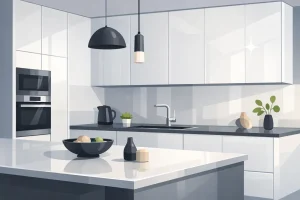

You’re probably standing in your kitchen noticing the same things every day. The oak doors look tired, the finish has dulled, maybe the style screams another decade, but the cabinet boxes still feel solid when you open them. You want a change, but you don’t want your home turned upside down for weeks.
That’s where the search for cabinet reface near me usually starts. Not because you want a shortcut, but because you want a smart upgrade. Most Toronto and Markham homeowners I speak with aren’t chasing a showpiece renovation. They want a kitchen that feels cleaner, brighter, more current, and more enjoyable to use without paying for demolition they may not need.
In the GTA, that matters even more. Condo living, compact townhomes, busy family schedules, and renovation budgets all push homeowners toward practical decisions. Refacing sits right in that sweet spot when the cabinet layout works and the cabinet boxes are still worth keeping.
Your Kitchen Upgrade Starts Here
A typical GTA kitchen problem looks like this. The doors are dated, the drawer fronts are chipped, the finish has faded around the handles, and the whole room feels older than the rest of the home. But the cabinet boxes are still anchored properly, the countertops are staying, and nobody wants six weeks of dust, trades, and takeout dinners.
That’s why cabinet refacing keeps coming up in real conversations with homeowners. It gives the kitchen a visible transformation without tearing everything back to studs. In a Toronto condo, that can mean avoiding the mess and scheduling headaches of a full rebuild. In a Markham townhouse, it can mean getting a cleaner, more modern look while keeping the layout that already works for daily life.
The mistake many people make is assuming they have only two choices. Live with the kitchen as it is, or replace everything. There’s a middle path, and it’s often the one that makes the most financial and practical sense.
Practical rule: If your kitchen feels old but still functions well, the first thing to inspect isn’t the door style. It’s the condition of the cabinet boxes.
Refacing isn’t the right answer for every kitchen. If boxes are swollen, sagging, or poorly installed, replacement may be the better route. But if the structure is sound, refacing can deliver the visual impact most homeowners want without the upheaval they’re trying to avoid.
A good local guide should answer key questions. What does refacing include. When is it worth doing. Which materials hold up best in Toronto-area homes. What should you expect on price, timing, and installation. And how do you sort the solid contractors from the ones selling a polished quote with vague details behind it.
What Is Cabinet Refacing Exactly
Think of cabinet refacing like keeping the frame of a well-built kitchen and replacing the parts you see and touch every day. The cabinet boxes stay in place if they’re in good condition. The doors, drawer fronts, exposed end panels, and outer surfaces get updated with new materials and finishes.

What gets changed
In a proper refacing job, the visible parts of the kitchen are renewed so the room looks cohesive. That usually includes:
- New cabinet doors chosen in a new style, profile, and finish
- New drawer fronts to match the doors exactly
- New exterior skin or veneer on exposed cabinet surfaces
- New hardware such as handles, pulls, and hinges if needed
A well-executed reface should not look like an overlay or patch job. It should read as a complete cabinet upgrade.
How it differs from painting
Cabinet painting and cabinet refacing are not the same thing. Painting keeps your existing doors and drawer fronts and applies a new finish over them. That can work for some kitchens, especially if the door style is already right and the surfaces are in excellent shape.
Refacing goes further. It changes the door style, refreshes worn faces, and gives you factory-finished components rather than relying only on site prep and paint performance. That usually means a more durable and more dramatic result.
If you’re comparing small-budget ideas first, a resource like DIY kitchen refresh on a budget can help you understand where cosmetic fixes stop and proper upgrades begin. For some homeowners, that’s enough. For others, it confirms that a deeper cabinet update is the right move.
Refacing works best when the kitchen’s bones are good and the problem is mainly what you see, not how the cabinets are built.
What it does not solve
Refacing won’t fix a bad layout. It won’t move appliances, create more walkway space, or correct failing cabinet boxes. If your kitchen has structural issues, water damage, or storage problems caused by the original design, refacing can improve the appearance but not the underlying planning.
That’s why a serious contractor checks the cabinet structure before talking style samples.
Is Cabinet Refacing Right for Your Kitchen
For many GTA homeowners, the decision comes down to four things. Cost, timing, cabinet condition, and layout. If you judge the project against those four, the right choice usually becomes clear.
Ontario homeowners often struggle to find local pricing that feels grounded in the GTA rather than generic U.S. search results. For context, the Home Builders' Association of Toronto puts average kitchen remodels at $25,000–$60,000 CAD, while refacing can offer a 40–60% cost reduction in Ontario contexts, as discussed in this GTA refacing cost comparison. That’s one reason many homeowners start by looking at services such as cabinet refinishing in Toronto before committing to full replacement.

Choose refacing if
Refacing makes sense when the kitchen already works, but the finish and style don’t.
- Your cabinet boxes are solid and open and close properly without major sagging or swelling
- You want a new look, not a new layout because the sink, stove, and storage zones already suit your routine
- You need less disruption since you still have to live in the home during the project
- You’re trying to control budget without settling for a purely cosmetic quick fix
This is common in Toronto condos where footprint changes are difficult, and in suburban homes where the cabinetry is sturdy but visually outdated.
Consider replacement if
Replacement earns its cost when the kitchen has deeper problems than appearance.
- The boxes have water damage or the particleboard has broken down
- Shelves and base units are failing and no amount of new doors will hide it for long
- You want a new layout with different cabinet runs, appliance locations, or island design
- The original installation was poor and the whole system feels temporary or out of square
A lot of disappointment comes from choosing refacing to solve a replacement problem. New doors can’t correct weak cabinet structure.
The structural test that matters
Open every lower cabinet and inspect the inside corners, hinge points, and sink base. If you see swelling, crumbling board, loose fasteners, or long-term moisture damage, stop and get a proper assessment first.
This point matters even more in older GTA housing stock. Condos and townhouses built decades ago often hide deterioration behind doors that still look merely dated from the outside.
If the boxes are sound, refacing is often the better value. If the boxes are failing, replacement is usually the honest answer.
A quick side-by-side view
| Decision factor | Refacing | Replacement |
|---|---|---|
| Best use | Updating appearance | Rebuilding structure and layout |
| Works well when | Boxes are solid | Boxes are damaged or layout is wrong |
| Home disruption | Lower | Higher |
| Design freedom | Finish and door style changes | Full reconfiguration possible |
Homeowners often search cabinet reface near me hoping for a universal yes or no. There isn’t one. The right answer depends on what your kitchen needs fixed.
Exploring Cabinet Material and Finish Options
Material choice matters more in the GTA than many homeowners realise. A detached house in Markham, a downtown condo, and a townhouse with limited ventilation don’t all put the same stress on cabinet surfaces. Moisture, everyday cleaning habits, cooking frequency, and sunlight exposure all affect what finish holds up best.
For older condo and townhouse stock in Toronto and Markham, moisture resistance is not a side note. In these homes, 2025 Toronto Building Code updates prioritise moisture-resistant materials, and refacing with modern options like HDF thermofoil and laminates addresses particleboard degradation found in over 60% of pre-2000 GTA units. That’s a practical issue many generic articles miss.
Real wood
Real wood appeals to homeowners who want warmth, visible grain, and a more timeless look. It suits classic kitchens, transitional styles, and homes where natural materials already carry through the flooring or trim.
Wood does require realistic expectations. Grain variation is part of the appeal, but it also means each door can reflect light a little differently. In busy family kitchens, wood also needs sensible care. Not delicate treatment, just sensible treatment.
HDF painted doors
HDF painted finishes work well when you want a cleaner, more uniform surface. They’re a strong choice for shaker styles, contemporary slab doors, and kitchens where consistency matters more than grain character.
They also suit many Toronto homeowners who want colour without the movement and pattern that come with natural wood. If you’re weighing the trade-offs between wood, laminate, and engineered options, this guide to best materials for kitchen cabinets is a useful starting point.
High-gloss and matte HDF
These finishes speak to two very different lifestyles.
High-gloss creates a sharper, more reflective look. It suits modern condos and smaller kitchens where bounce from light can make the room feel brighter. The trade-off is that fingerprints and smudges can show more readily, especially around high-touch areas.
Matte HDF lands differently. It softens the look, hides marks better, and gives a quieter, refined appearance. For households with kids, constant cooking, or frequent kitchen traffic, matte is often easier to live with day to day.
In many Toronto kitchens, the best finish isn’t the boldest sample in the showroom. It’s the one that still looks good on a wet Tuesday night after dinner cleanup.
Laminates
Laminate is one of the most practical choices for homes that need durability and easier cleaning. It resists everyday wear well and is especially useful where humidity and regular wipe-downs are part of normal life.
That’s why laminate makes sense in many condos and rental upgrades. It gives a crisp finish without demanding special treatment, and it handles routine use with less fuss than some homeowners expect.
HDF thermofoil
Thermofoil has a uniform appearance that many homeowners like for clean-lined kitchens. The surface is easy to wipe and doesn’t have open grain, so it works well where people want straightforward maintenance.
In older units with moisture concerns, this category becomes even more relevant. If a kitchen has had years of steam, weak ventilation, or subtle particleboard wear, a moisture-conscious material choice is not optional.
Material Options at a Glance
| Material | Best For | Durability | Maintenance |
|---|---|---|---|
| Real wood | Traditional and transitional kitchens | Good with proper care | Moderate |
| HDF painted | Clean, uniform painted finishes | Good | Moderate |
| High-gloss HDF | Contemporary condo styles | Good | Higher touch-up cleaning |
| Matte HDF | Busy households wanting a softer look | Good | Lower day-to-day upkeep |
| Laminate | Moisture-prone and high-use kitchens | Strong | Easy |
| HDF thermofoil | Seamless modern surfaces | Good when properly specified | Easy |
The best material isn’t the most expensive one. It’s the one that suits your building, your routine, and how much maintenance you’re willing to do.
Cabinet Refacing Costs and Timelines in Toronto
Toronto homeowners usually ask two questions first. What will it cost, and how long will my kitchen be out of commission. Fair questions. Those two answers often decide whether a project moves ahead.
In the GTA, kitchen cabinet refacing typically costs 50–70% less than replacement, with average prices of $4,000 to $9,500 for a standard kitchen, according to this cabinet refacing cost guide. The same guide notes that refacing usually wraps up in 3–5 days, while a full remodel can stretch to 6–12 weeks.

What affects your quote
Not every kitchen lands at the same number, even if the footprint looks similar. Three kitchens can share the same general layout and still price differently based on finish selection, door style, site conditions, and whether the contractor is also updating trim panels, hardware, or interior accessories.
A few practical cost drivers:
- Door style complexity affects fabrication and finishing
- Material choice changes both look and price
- Cabinet condition can add prep work if boxes need correction before refacing
- Add-ons like soft-close hinges or updated drawer hardware increase scope
Why factory-direct pricing matters
In this category, pricing often shifts based on how many layers sit between the homeowner and the finished product. A factory-direct model can reduce retail markup because there’s no separate showroom chain, distributor, and outsourced door supplier all building margin into the same job.
That matters when you want upgraded finishes but don’t want to pay luxury-retail pricing for a practical renovation. It doesn’t make every quote cheap. It makes the quote easier to understand.
The time advantage is real
The timeline difference is one of the strongest reasons refacing wins in occupied homes. Most families can manage a shorter, organised installation window. Few enjoy living around an extended tear-out.
Shorter projects don’t just save time. They reduce decision fatigue, protect the rest of the home from mess, and make it easier to stay on budget.
That’s especially relevant in condos where building access, elevator bookings, and disposal logistics can turn a full remodel into a scheduling puzzle. Refacing keeps the work focused.
A Step-by-Step Overview of the Refacing Process
Most homeowners feel better once they know what happens on site. Cabinet refacing is not mysterious work. A good crew follows a clear sequence and keeps the project moving with as little disruption as possible.
Early in the process, the visible transformation starts to make sense.

Consultation and measurement
The first visit should not feel like a rushed sales appointment. It should feel like an inspection. The contractor measures the kitchen, checks the condition of the cabinet boxes, looks for moisture damage, and asks how you use the space.
Problems are caught early. A sink base with hidden deterioration, an out-of-level run of cabinets, or old panels that need correction should be identified before materials are ordered.
Finish and door selection
Once the structure checks out, the design side gets easier. You choose the new door profile, finish, and hardware direction. This stage is where practical advice matters most.
A responsible contractor won’t just show what looks good under showroom lighting. They’ll explain what cleans easily, what shows fingerprints, and what suits condo humidity or a family kitchen with heavy daily use.
Fabrication
After measurements and selections are final, the doors, drawer fronts, and matching exterior components are made to fit the existing kitchen. Good fabrication is what makes refacing feel intentional rather than improvised.
The benefit here is consistency. Factory-finished components usually give a cleaner result than trying to revive every original piece on site.
Here’s a visual walk-through of a refacing process in action:
Site preparation and installation
When installation begins, the old doors and drawer fronts come off. The crew prepares the cabinet exteriors, applies the new matching surfaces, fits the new doors and drawer fronts, installs hardware, and adjusts everything so reveals and alignment look right.
Not every part of the job takes the same skill. Anyone can screw on a handle. What separates strong work from average work is the prep, the surface matching, and the final adjustments.
- Protect the work area so nearby flooring, counters, and appliances stay covered.
- Remove worn components without damaging the cabinet structure you’re keeping.
- Apply new exterior surfaces carefully so seams and edges stay clean.
- Install and align new fronts so doors hang evenly and drawers run smoothly.
- Complete final tuning with hinge adjustment, hardware tightening, and detail cleanup.
Final review
The last stage should be a real walkthrough, not a quick signature on a completion slip. Open everything. Check alignment. Look at corners and end panels. Make sure the finish is consistent and the hardware feels solid in hand.
A refacing project is successful when the kitchen looks renewed and nothing about the result feels temporary.
How to Choose Your GTA Refacing Contractor
The contractor matters as much as the material. A great door style installed poorly will still disappoint you every morning. The right company should be able to explain the process plainly, show real work, and give you a quote that tells you exactly what you’re buying.
Questions worth asking
Use these in every consultation.
- Ask what happens to the existing boxes if they find swelling, damage, or structural weakness
- Ask who fabricates the doors and matching components because outsourced supply can affect consistency and timing
- Ask what is included in the quote such as end panels, hinge upgrades, hardware installation, and site protection
- Ask to see completed projects similar to your home type especially condos and older townhouses in the GTA
- Ask about warranty terms in writing so you know what is covered and what is not
Red flags that should slow you down
Some warning signs show up quickly if you know what to watch for.
- Vague pricing that bundles everything into one number with little detail
- Pressure to sign immediately before measurements or condition checks are complete
- No discussion of moisture or cabinet integrity in older kitchens
- Only beauty shots, no close-ups of edges, panels, alignment, or hardware installation
A trustworthy refacing contractor talks about limitations as comfortably as benefits. If they promise every kitchen is a perfect candidate, they’re selling, not assessing.
Why local presence matters
When people search cabinet reface near me, they usually want someone nearby for a reason. They want local knowledge, easier follow-up, and accountability after installation. A company serving Toronto and Markham should understand condo access rules, common townhouse layouts, and the moisture issues found in older stock.
If you’re curious how local visibility affects which trades firms show up in those searches, this overview of local SEO for trades businesses gives useful background. It won’t tell you who does the best cabinetry work, but it does explain why some firms are easier to find than others.
If you want a short list to compare, start with established cabinet companies near you in the GTA and judge them on quote clarity, material transparency, and finished project quality rather than slick marketing alone.
The right contractor should leave you feeling informed, not cornered.
If you’re ready to update your kitchen without committing to a full tear-out, MapleKing Kitchen Cabinets is a strong place to start. Their Markham showroom, factory-direct approach, and range of real wood, HDF, laminate, and thermofoil options make it easier to compare finishes, ask practical questions, and get a clear quotation for your Toronto-area home.