

When it comes to your kitchen, choosing the best paint finish for your cabinets is one of those decisions that really matters. It’s not just about the look; it’s about how your kitchen will stand up to real life. For most Canadian homes, we find that a semi-gloss finish hits that sweet spot between durability and style, making it our go-to recommendation.
Your Guide to Selecting the Perfect Cabinet Finish
Picking a paint finish goes way beyond colour. This choice will dictate how your kitchen functions every single day and how it holds its value over time. The finish determines how easily you can wipe away splatters, whether fingerprints become a constant battle, and the overall feel of the room. Think of this guide as your roadmap to making a smart, informed decision for your Toronto or Markham home.
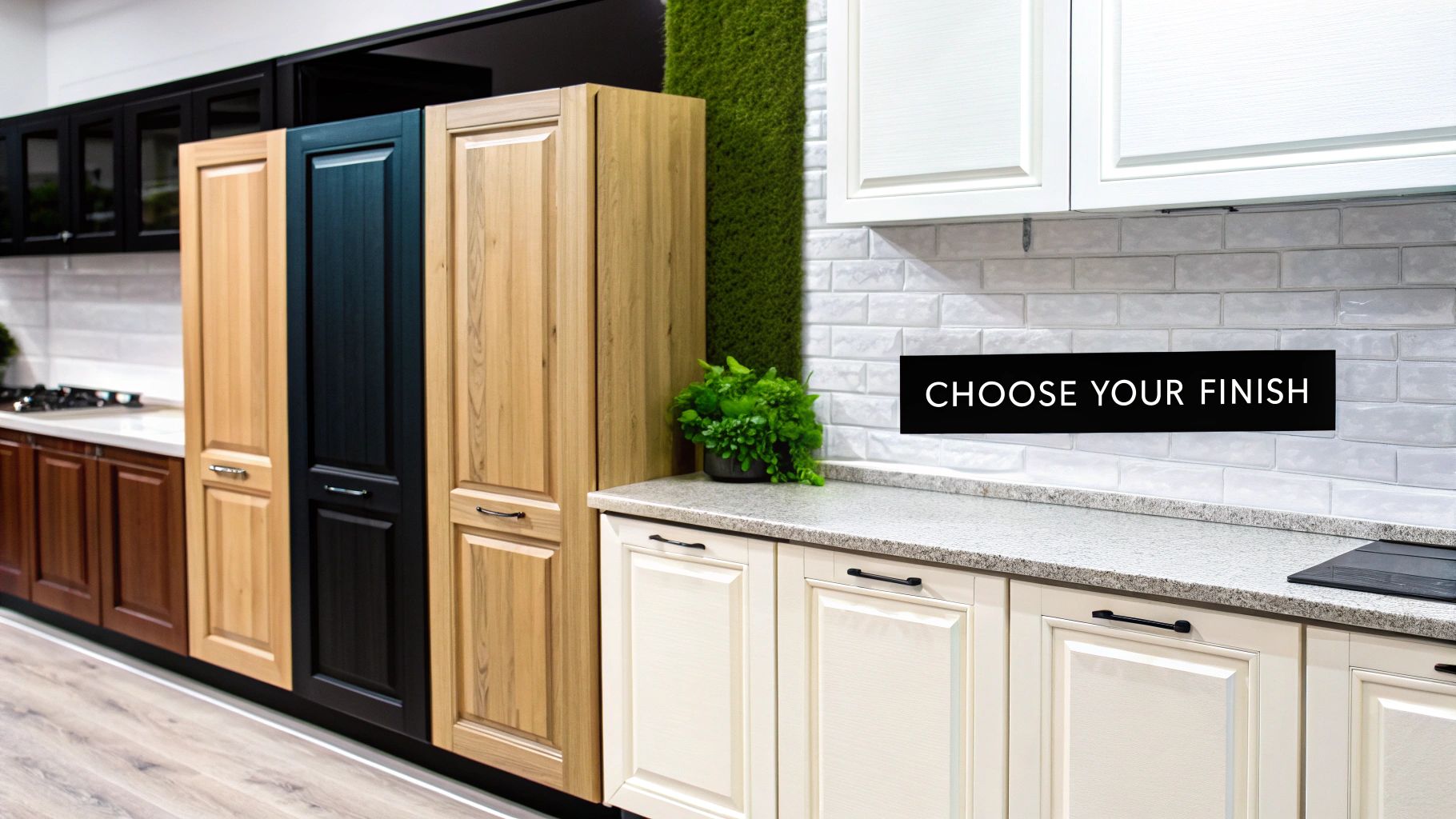
We're going to put the main contenders—satin, semi-gloss, and high-gloss—head-to-head on the criteria that count.
- Durability and Maintenance: How will each finish handle the chaos of a busy kitchen, from spaghetti sauce splashes to constant cleaning?
- Aesthetics and Style: Which sheen will bring your design vision to life? Are you aiming for a sleek, contemporary masterpiece or a warm, traditional gathering space?
- Cost and Application: What are the budget realities, and how does your choice of finish impact the painting process itself?
By breaking it down this way, you'll be able to confidently pick a finish that fits your lifestyle and your design goals perfectly.
Matching Finish with Cabinet Material
Here’s something many people overlook: the performance of any paint finish depends heavily on the quality of the surface it's on. A beautiful semi-gloss on a smooth, high-density fibreboard (HDF) door will give you a different result than the same paint on real wood. We see this all the time at MapleKing Kitchen Cabinets, and it's why we believe the foundation is everything for a lasting renovation. Our cabinet lines are specifically designed to be the ideal canvas for these finishes, ensuring your investment stays beautiful for years. Adopting a professional mindset is key to any project, a principle we explore in our guide on achieving perfection in complex tasks.
The Expert Take: There's no single "best" finish for everyone. The right choice is a careful balance between how you use your kitchen, the look you love, and the cabinet material you've chosen.
To get you started, here's a quick side-by-side comparison to help you see which direction might be right for you.
| Feature | Satin Finish | Semi-Gloss Finish | High-Gloss Finish |
|---|---|---|---|
| Sheen Level | Low lustre, velvety | Noticeable sheen | High-shine, reflective |
| Durability | Good | Excellent | Very High |
| Ease of Cleaning | Moderate | Easy to wipe | Easiest to clean |
| Hides Imperfections | Best | Good | Poor (shows all flaws) |
| Best For | Lower-traffic areas | Most kitchens | Modern, sleek designs |
Understanding the Paint Sheen Spectrum
Before we dive into the different types of cabinet finishes, we need to talk about one of the most fundamental choices you'll make: the paint sheen. "Sheen" is simply the term we use to describe how much light a painted surface reflects. It might sound like a minor detail, but it's a decision that dramatically impacts how your cabinets look, how they wear over time, and how easy they are to keep clean.
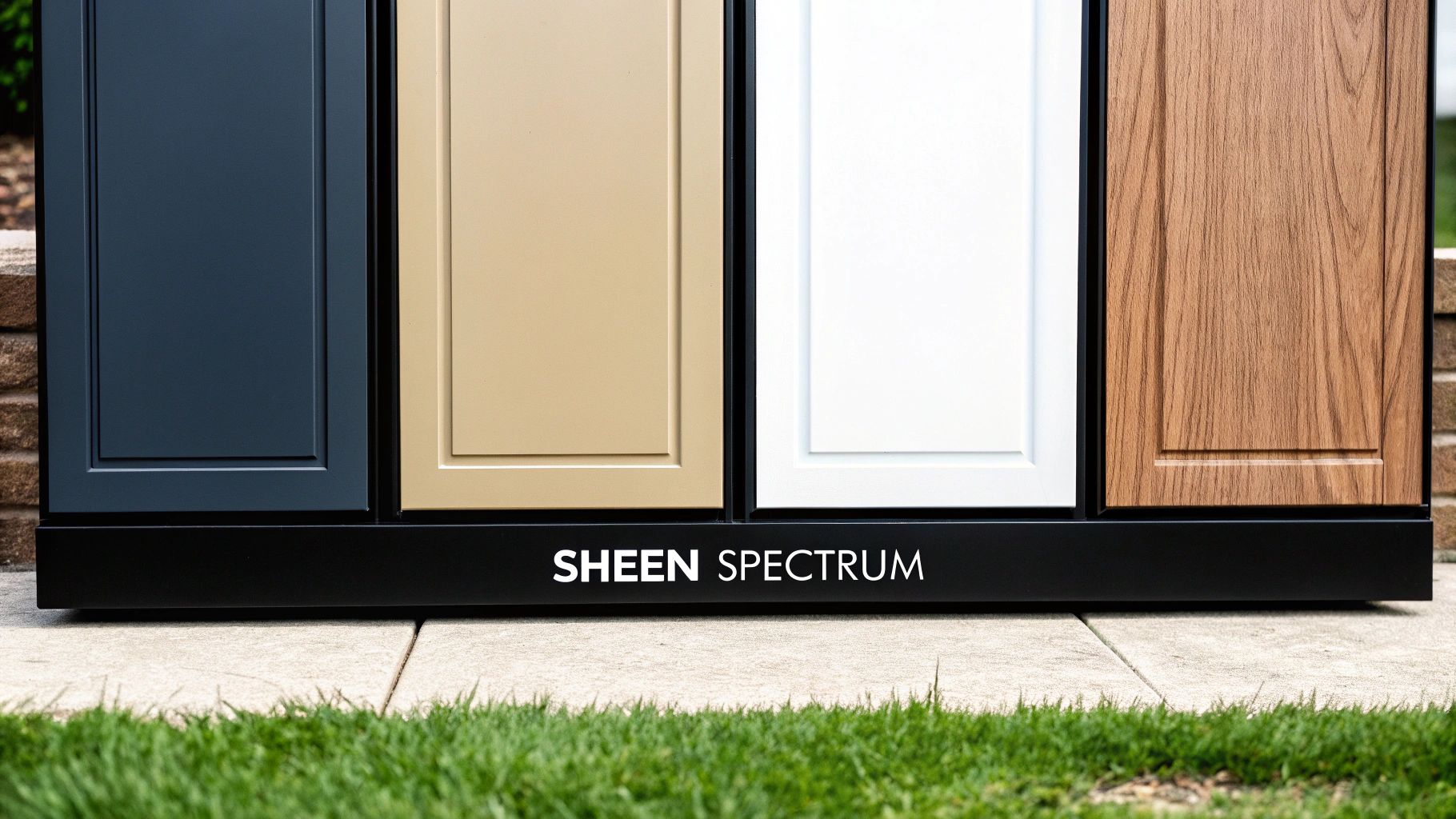
Picture a scale. On one end, you have zero reflection with a matte finish. On the other, you have a mirror-like shine with high-gloss. As you move up that scale, the paint’s formula changes. It becomes harder, less porous, and smoother—and that's the crucial link between aesthetics and performance, especially in a busy kitchen.
The Durability and Sheen Connection
So, how does this work? It’s pretty simple, really. Low-sheen paints like matte feel velvety to the touch because, on a microscopic level, their surface is rough and porous. This texture is great at absorbing light, giving you that soft look, but it’s terrible in a kitchen. It loves to trap grease, dirt, and moisture, making it a real chore to clean and very easy to scuff.
On the other hand, higher-sheen paints are packed with more binders—the resins that create a hard, protective film over the pigment. A semi-gloss or high-gloss finish has a much tighter molecular structure. It forms a non-porous shield that literally repels moisture and stains, meaning you can wipe away spaghetti sauce splatters and fingerprints with ease.
Key Insight: A higher sheen directly translates to a more durable and washable surface. For kitchen cabinets that face daily steam, grease, and cleaning, a finish with at least a moderate sheen isn't just a style choice—it's a practical necessity for longevity.
This is exactly why satin and, more commonly, semi-gloss are the go-to recommendations for cabinetry. They strike that perfect balance, giving you robust protection without the intense, almost-wet look of a full high-gloss finish. For homeowners here in Markham and across the GTA, this balance is the secret to a kitchen that looks fantastic and stands up to real life for years to come.
How Sheen Affects Colour and Imperfections
The amount of sheen also plays a huge role in how you perceive the cabinet’s colour and the surface itself. This is something you absolutely need to consider, whether you're painting brand-new cabinets or giving old ones a facelift.
-
Matte and Satin Finishes: Think of these low-lustre sheens as the masters of disguise. Because they scatter light instead of reflecting it back at you, they are brilliant at hiding minor flaws—small dings, a bit of wood grain, or patch-ups from previous repairs. The trade-off? The colour can sometimes look a little less rich or deep.
-
Semi-Gloss and High-Gloss Finishes: These sheens are the complete opposite. Their reflective nature makes colours pop, looking more saturated and vibrant. But be warned: that same reflectivity acts like a spotlight, highlighting every single imperfection. Any unevenness, drips, or rough spots that weren't sanded perfectly will jump right out at you.
This is why surface preparation is everything when you're using a glossier finish. To get that flawless, factory-smooth look on a material like the HDF we use at MapleKing, the surface has to be absolutely perfect before the first drop of paint is applied. Understanding this dynamic—hiding flaws versus achieving a brilliant, durable finish—is the first real step in picking the perfect sheen for your kitchen renovation.
Satin vs. Semi-Gloss vs. High-Gloss: A Detailed Analysis
Stepping into the world of paint sheens can feel a little overwhelming. But when you’re trying to find the best paint finish for your kitchen cabinets, the choice almost always boils down to three heavy hitters: satin, semi-gloss, and high-gloss. Each one brings a unique mix of style, toughness, and upkeep to the table. Let’s break down what they’re really like to live with, so you can choose the perfect finish for your Toronto or Markham home.
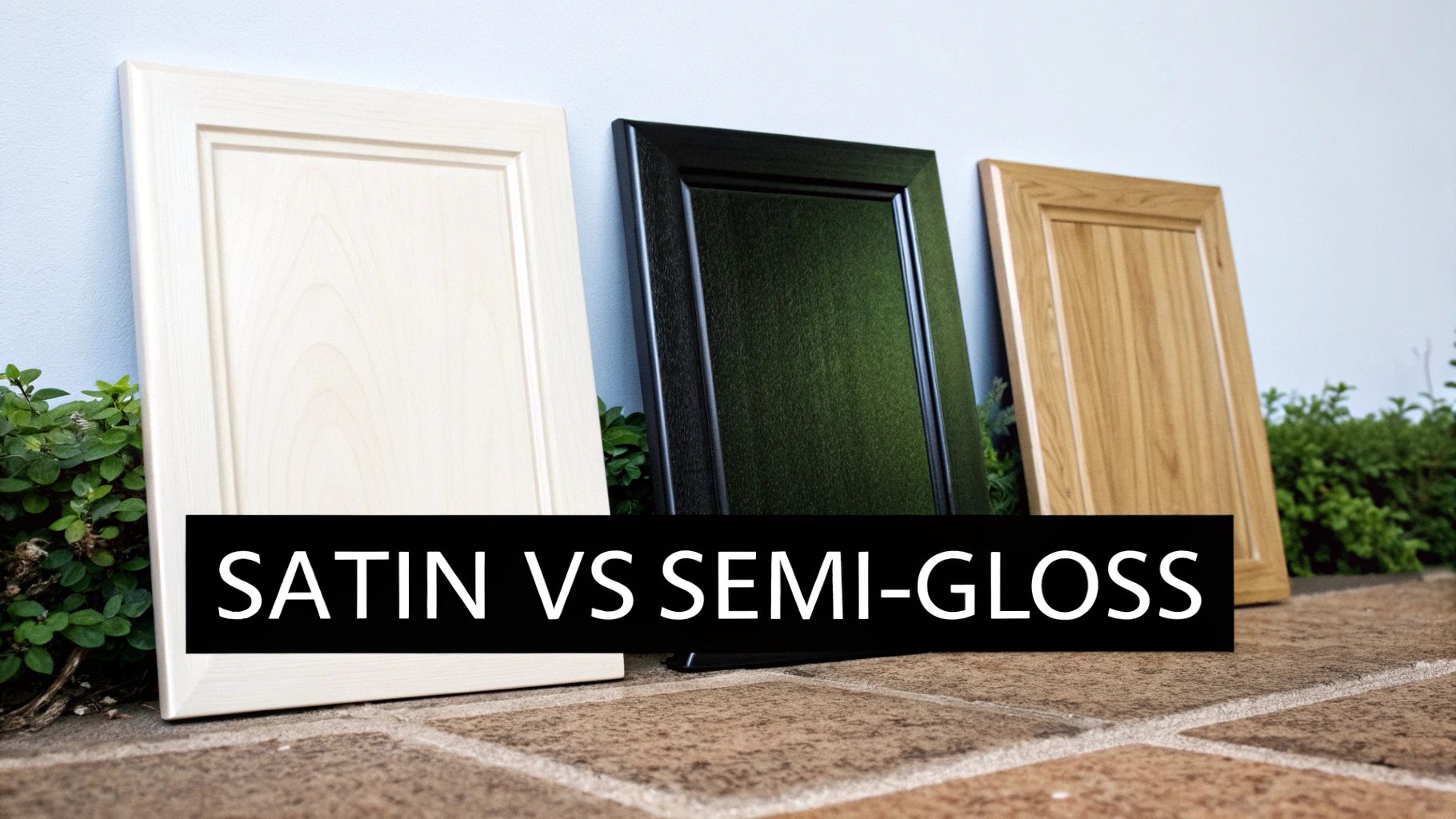
Instead of just giving you a generic pros and cons list, we’re going to get into the practical realities of each finish. We’ll look at how they hold up under the daily pressures of a real, busy kitchen—from fending off moisture to making your cleaning routine easier.
Durability and Moisture Resistance
In a kitchen, durability isn’t a luxury; it’s a necessity. Your cabinets are constantly exposed to steam from the stovetop, splashes from the sink, and all sorts of grease splatters. The finish has to be tough. This is where the amount of resin in the paint, the ingredient that makes it hard, really comes into play.
When it comes to pure, brute-force durability, high-gloss is the undisputed champion. Its formula is packed with binders that cure into a hard, non-porous shell, making it exceptionally resistant to moisture and stains. This makes it an amazing choice for cabinets right above the stove or next to the sink, where the action is most intense.
Semi-gloss is a very close runner-up. It offers fantastic resistance to moisture and scuffs, creating a reliable shield that stands up beautifully to the demands of a family kitchen. For most people, the durability of semi-gloss is more than enough for everyday life.
Satin finish, while still quite durable, is the most vulnerable of the three when it comes to moisture and heavy wear. Its lower sheen means the surface is a bit more porous, so it can be more susceptible to damage if steam or grease sits on it for too long without being wiped away.
Cleaning and Maintenance
How easy your cabinets are to clean is directly linked to their sheen. It’s simple: a smoother, less porous surface makes wiping up messes a whole lot easier. This is a huge quality-of-life factor in any kitchen.
High-gloss surfaces are a breeze to clean. Spills, fingerprints, and grease wipe away with just a soft cloth, often without needing any harsh chemicals. The trade-off? That same reflective quality puts every smudge and water spot on full display, so you might find yourself wiping them down more often to keep them looking pristine.
Semi-gloss strikes a perfect balance here. It’s smooth enough that most daily messes come right off with a quick wipe, but its moderate shine is much more forgiving of minor smudges than high-gloss. This practical middle ground makes it an incredibly popular choice for busy households.
Satin finishes can be a bit more challenging to keep clean. Their lovely velvety texture can sometimes trap dirt and grease, meaning you might need a little more elbow grease. While they are great at hiding fingerprints, you’ll want to be careful not to scuff the surface when tackling stubborn stains.
Expert Insight: The best paint finish for your kitchen cabinets often comes down to your personal tolerance for cleaning. High-gloss is technically the easiest to wipe down, but because it shows everything, many people find that semi-gloss feels lower maintenance in a real-world kitchen.
Aesthetics and Style Impact
Practical concerns aside, the finish you choose will dramatically shape the look and feel of your kitchen. It dictates how light plays in the room, how colours appear, and what overall style your space conveys.
A high-gloss finish screams modern, sleek, and luxurious. It reflects a ton of light, which is a fantastic trick for making smaller or darker kitchens feel brighter and more expansive. You'll often see this finish on flat-panel HDF cabinets, like those from MapleKing, as it’s a hallmark of contemporary and minimalist design.
Semi-gloss offers a more classic and versatile look. It has a noticeable shine that brightens up a room and adds a touch of elegance without being a full-on mirror. Its adaptability means it fits in just about anywhere, from traditional to transitional kitchens.
Satin brings a subtle, sophisticated warmth to a space. Its soft, low-lustre glow creates an almost velvety appearance that feels inviting and understated. This finish is a master at hiding minor surface imperfections and is a go-to for classic, farmhouse, or shaker-style kitchens.
Satin finishes have long been a popular choice for kitchen cabinets, especially for homeowners looking for that sweet spot between durability and a softer look. A 2024 study by the California Home Improvement Research Institute revealed that 37% of homeowners in the state chose satin finishes for their kitchen cabinets, ranking it as the second most popular option after high-gloss. The study pointed out that satin is favoured for its knack for hiding small flaws and fingerprints—a huge plus in high-traffic kitchens. In fact, homeowners with satin finishes reported a 20% higher satisfaction rate with their cabinets' overall appearance compared to those with matte finishes. You can discover more about trends in cabinet finishes and their impact on homeowner satisfaction.
Cost and Application Considerations
Finally, let's talk about the budget and the actual painting process. The price of the paint and the labour needed to get a flawless result can differ quite a bit between sheens.
High-gloss paint is usually the most expensive of the bunch. More importantly, it’s the most difficult to apply. Because its reflective surface highlights every single bump, divot, and speck of dust, the cabinet doors must be prepped to perfection. Achieving that professional, mirror-like finish often takes specialized spray equipment and a lot of skill, which can drive up labour costs.
Semi-gloss and satin paints are typically priced similarly and are much more forgiving to work with. While good prep is still key for any lasting paint job, minor surface flaws are far less obvious than they are with high-gloss. This makes them a more practical choice for both professionals and ambitious DIYers.
Cabinet Finish Comparison At a Glance
To make things even clearer, here's a quick reference table that sums up the key differences between these popular finishes.
| Feature | Satin Finish | Semi-Gloss Finish | High-Gloss Finish |
|---|---|---|---|
| Durability | Good | Excellent | Superior |
| Ease of Cleaning | Moderate | Easy | Very Easy |
| Hides Flaws | Excellent | Good | Poor |
| Light Reflection | Low, soft glow | Medium sheen | High, reflective |
| Best For | Hiding imperfections, classic styles | All-around performance, most kitchens | Modern designs, maximizing light |
| Application Skill | Moderate | Moderate | High |
Ultimately, choosing the best paint finish for your kitchen cabinets means weighing these trade-offs against what matters most to you and your lifestyle. For a truly impeccable, durable, and stylish result, the key is to pair your chosen finish with a top-quality material, like the professionally prepared HDF from MapleKing Kitchen Cabinets.
Looking Beyond Paint: Alternative Cabinet Surfaces
Choosing a paint finish is a huge part of your kitchen's final look, but the story doesn't end there. To really get it right, you need to see how a classic painted cabinet stands up against other popular choices like laminate and thermofoil. These materials bring their own strengths to the table—in durability, maintenance, and style—and one of them might just be the perfect fit for your Toronto home.
This isn't about crowning one "winner." It's about understanding the real-world trade-offs. We’ll break down each option based on the things homeowners actually worry about: how they handle humidity, how they hold up over time, and what they mean for your budget.
Painted Finishes: A Quick Refresher
Painted cabinets, whether applied to solid wood or HDF, give you complete freedom with colour. A professionally sprayed semi-gloss or high-gloss finish creates a tough, easy-to-clean surface that you can always refinish years down the road for a fresh look. That adaptability is their biggest selling point.
But let's be realistic. Even the best paint job can chip if it takes a hard knock. The quality of the material underneath the paint and the prep work involved are everything. A shoddy foundation means the finish will fail, no matter how glossy it is.
The Case for Modern Laminate
Forget the peeling laminate you might remember from decades ago. Today's high-pressure laminate (HPL) is a different beast entirely. It’s a tough, non-porous surface that’s incredibly resistant to scratches, stains, and moisture. For a busy family kitchen, that kind of resilience is tough to top.
Laminate also delivers perfectly consistent colour and pattern, something that natural materials can't always guarantee. It’s a fantastic choice if you're aiming for a sleek, contemporary aesthetic that requires almost zero fuss.
- Pros: Extremely durable, a breeze to clean, looks perfectly uniform, and is often easier on the wallet.
- Cons: You can't refinish it if it gets damaged (the door has to be replaced), and some people simply prefer the character and depth of a painted surface.
Understanding Thermofoil Cabinets
Thermofoil is another strong contender. It's made by heat-fusing a thin layer of vinyl over a medium-density fibreboard (MDF) core. This process results in a perfectly smooth, seamless surface, leaving no cracks or joints for dirt and grime to get trapped in.
That seamless quality makes thermofoil incredibly easy to wipe down and highly resistant to everyday spills and humidity. It's especially popular for achieving that crisp, white, high-gloss look that’s both modern and wonderfully low-maintenance.
A Key Heads-Up: While thermofoil is great for daily use, it can be sensitive to high heat. It is absolutely crucial to use heat shields next to appliances like ovens and toasters to stop the vinyl from peeling or changing colour over time.
Side-by-Side: How the Surfaces Compare
Making the right call means seeing exactly how these options perform in a real kitchen. Let's put them head-to-head on the criteria that matter most.
| Feature | Painted Wood/HDF | Laminate (HPL) | Thermofoil |
|---|---|---|---|
| Durability | Good to excellent; can chip on impact | Excellent; highly scratch-resistant | Very good; seamless and durable |
| Moisture Resistance | Good (with proper sealant) | Excellent; non-porous surface | Excellent; seamless design prevents water |
| Maintenance | Easy to clean; higher gloss shows smudges | Very easy; wipes clean effortlessly | Extremely easy to clean |
| Style Versatility | Infinite colour options; classic appeal | Wide range of colours and patterns | Best for modern, seamless looks |
| Repairability | Can be touched up or fully repainted | Cannot be repaired; requires replacement | Difficult to repair; requires replacement |
| Heat Resistance | Very good | Good | Vulnerable to high, direct heat |
For a deeper dive into the core materials themselves, our comprehensive guide on the best materials for kitchen cabinets offers valuable insights that perfectly complement this discussion on finishes. Ultimately, the best surface for your cabinets is the one that strikes the right balance between the look you love and the demands of your lifestyle.
Choosing the Right Finish for Your Lifestyle
Knowing the technical specs of a paint finish is one thing, but how does that translate to your actual life? The "best" finish for your kitchen cabinets isn't a simple answer you can find on a paint swatch. It’s all about finding the perfect match between the finish's properties and the reality of your household—and, of course, the look you’re trying to achieve.
Let's step away from the paint can and walk through a few real-world scenarios. By looking at three common kitchen profiles, you'll get a much clearer picture of which finish will be the ideal partner for your daily routine.
The Busy Family Kitchen
Is your kitchen the command centre of your home? Think homework station, after-school snack hub, and the backdrop for every family get-together. If so, you know that durability isn't just a nice-to-have; it's a must. This space has to withstand a constant barrage of sticky fingerprints, accidental spills, and splatters from hurried weeknight meals. You need a finish that’s tough, scrubbable, and forgiving.
In this kind of high-traffic environment, semi-gloss is the undisputed champion. Its hard, durable film is fantastic at resisting moisture, grease, and scuffs. More importantly, it’s incredibly easy to wipe clean without worrying that you're going to ruin the paint job. You can confidently scrub away crayon marks or dried-on pasta sauce, knowing the surface will hold up.
Why Not High-Gloss? While it's technically even more durable, high-gloss shows every single smudge and fingerprint. For a busy family, that can become a constant source of frustration. Semi-gloss gives you a similar level of protection with far more grace, making it the practical choice for active households.
The Modern Minimalist
If your design compass points toward sleek, seamless, and contemporary, your choice of finish is absolutely critical. The modern minimalist look is built on clean lines and uncluttered surfaces, where the cabinet finish becomes a central design element, not just a protective coating.
For this style, high-gloss is the ultimate choice. There's nothing quite like its mirror-like sheen for creating that luxurious, polished look that has come to define modern kitchen design. When applied to flat-panel HDF doors, like the ones we offer at MapleKing, a high-gloss finish results in an uninterrupted, reflective surface that bounces light around and creates a feeling of sophisticated simplicity.
This trend toward high-sheen surfaces is only growing. For instance, a 2023 survey found that 42% of homeowners in California opted for high-gloss finishes when repainting their cabinets, citing both durability and ease of cleaning as key factors. Furthermore, 68% of professional painters recommended it for homes with children due to its superior resistance to scuffs and scratches.
Small or Low-Light Kitchens
In many Toronto and Markham homes and condos, making a small or poorly lit kitchen feel bigger and brighter is a top priority. The right design choices can completely transform these spaces, and your cabinet finish plays a surprisingly powerful role in that transformation.
Glossier sheens are your best friends here. Both semi-gloss and high-gloss are brilliant at reflecting light—whether it's natural light from a window or artificial light from your fixtures. This reflection creates the illusion of more space and brightens up dark corners, making the entire kitchen feel more open and inviting.
- Semi-Gloss: Gives you a significant boost in brightness without the stark, mirror-like reflections of high-gloss. It's a versatile choice that works well with many different styles.
- High-Gloss: This is your go-to for maximum light-reflective power. It can dramatically alter the perception of a small, dark space, making it feel expansive.
By thinking carefully about how your finish needs to perform day-to-day, you can land on a choice that's both beautiful and practical. Of course, getting the application right is just as important as the finish itself, a topic we explore in our article about how https://maplekingkitchencabinets.com/perfect-practice-makes-perfect/ in any skilled task.
Common Questions About Cabinet Finishes
It's one thing to compare finishes on paper, but another to live with them day in and day out. Choosing the right paint for your kitchen cabinets is a big deal, and it's totally normal to have a few nagging questions left.
This section gets into the practical stuff we hear all the time from homeowners across Toronto and Markham. We’ll cover the details that really matter down the line, from prep work to fixing those inevitable little dings.
Do I Really Have to Sand My Cabinets Before Painting?
This is the big one, isn't it? The thought of sanding for days is enough to put anyone off a project. While a deep, thorough sanding used to be the only way, modern paints have seriously changed the game.
Many of today's high-quality acrylic or mineral-based paints are designed to stick with minimal prep. For some, all you need is a light "scuff-sand"—just enough to take the shine off the old finish. This is way faster than stripping everything down to bare wood. Others work with a liquid deglosser, a chemical that does the prep work for you, meaning you might not have to sand at all.
Here's the real takeaway: No, you don't always need to sand your cabinets into oblivion. The trick is to follow the specific instructions for the paint you choose. But one step is always non-negotiable: a deep clean to get rid of any kitchen grease or grime. That's the true secret to a lasting bond.
Ultimately, all that prep work has one goal: creating a clean, slightly rough surface for the new paint to grab onto for a finish that lasts.
Oil-Based or Water-Based Paint: Which is Better for Cabinets?
For a long time, oil-based (alkyd) paint was the go-to for cabinets because it created such a tough, durable surface. But times have changed, and modern water-based (latex or acrylic) enamel paints have pretty much taken over for home projects, especially in the kitchen.
Let's break down why that is:
- Water-Based (Acrylic Enamel): This is what most pros reach for now. These paints are incredibly durable, dry much faster, and have far lower VOCs (volatile organic compounds). That means less of that harsh paint smell and better air quality in your home. They also stay flexible and won't turn yellow over time, which is a common problem with oils.
- Oil-Based (Alkyd): They do give you a rock-solid finish, but the trade-offs are significant. They have a very strong odour, take forever to cure, and tend to yellow or crack as they age. On top of that, environmental regulations in Canada have made them harder to find and use.
For the best mix of durability, safety, and colour that stays true, a top-quality water-based acrylic enamel is the clear winner for your kitchen.
How Do I Fix a Chip in My Cabinet Finish?
Life in a busy kitchen means a chip or scratch is bound to happen eventually. The good news? Touching it up is completely doable, especially if you were smart and saved a bit of leftover paint and topcoat.
Here’s a simple process that works every time:
- Clean the Spot: Gently wipe the chipped area with a mild degreaser to make sure it's free of any oil or dirt.
- Lightly Sand the Edges: Use a very fine-grit sandpaper (think 220-grit or higher) to carefully smooth the edges of the chip. You want to avoid scratching the good paint around it.
- Apply Thin Coats of Paint: Grab a small artist's brush and dab a very thin layer of paint onto the damaged spot. Let it dry completely.
- Build It Up: If you can still see the chip, add another thin coat. Keep doing this until the repair is flush with the surrounding surface.
- Seal the Deal: Once the paint has fully cured, use that same small brush to apply a thin layer of your original topcoat. This will seal the repair and make sure the sheen matches perfectly.
Taking your time with this approach will make the repair virtually invisible, keeping your cabinets looking fantastic.
Article created using Outrank



