

Choosing the best kitchen cabinets for your Toronto home isn't about finding a single "best" option—it's about finding the right balance between your budget, your timeline, and the look you want to achieve. For many homeowners, that perfect middle ground is semi-custom cabinetry, which offers a great mix of personalization and value. But for those with a unique vision, nothing beats the limitless potential of custom work.
Kicking off a kitchen renovation can feel overwhelming, but let's simplify it. Your cabinet choice is the single most important decision you'll make. It dictates the entire room's layout, sets the stylistic tone, and defines how your kitchen functions day-to-day.
Think of it like buying a suit. You can grab one off the rack, get a standard one tailored for a better fit, or have one custom-made from scratch. Each approach has its place, and figuring out which one is right for you is the key to a project you'll love for years to come.
The Toronto market is booming, and for good reason. Home renovations are on the rise, and kitchens are at the heart of it all. The North American market for kitchen cabinets and countertops was recently pegged at around USD $394 billion and is expected to climb to nearly USD $537 billion by 2033. This isn't just a trend; it's a reflection of the kitchen's role as the central hub of the modern home. Your cabinet choice is a serious investment in your property's value. If you're interested in the bigger picture, you can read more about these kitchen cabinetry market trends to see where the industry is heading.
Your Three Main Cabinet Paths
So, where do you start? To find the best kitchen cabinets Toronto has to offer for your project, you first need to understand the three main routes you can take. Each one is tailored to different priorities and visions.
-
Stock Cabinets: These are your ready-to-wear, off-the-rack option. They're mass-produced in standard sizes, making them the most affordable choice with the fastest turnaround times. The trade-off? Customization is very limited, usually just a few standard colours and door styles.
-
Semi-Custom Cabinets: This is like getting that off-the-rack suit tailored. These cabinets are built within a manufacturer's existing system, but you get way more options for sizes, styles, finishes, and clever storage solutions. It’s the perfect sweet spot for homeowners who want a more personalized look without the full expense of custom.
-
Custom Cabinets: Think of this as a completely bespoke creation. Custom cabinets are built from the ground up to your exact specifications. You call the shots on everything—the material, the exact dimensions, the design, the finish. This is the go-to for funky kitchen layouts, very specific storage needs, or when you just want a look that is truly one-of-a-kind.
To help you see how your own priorities point you in the right direction, this simple visual breaks it down.
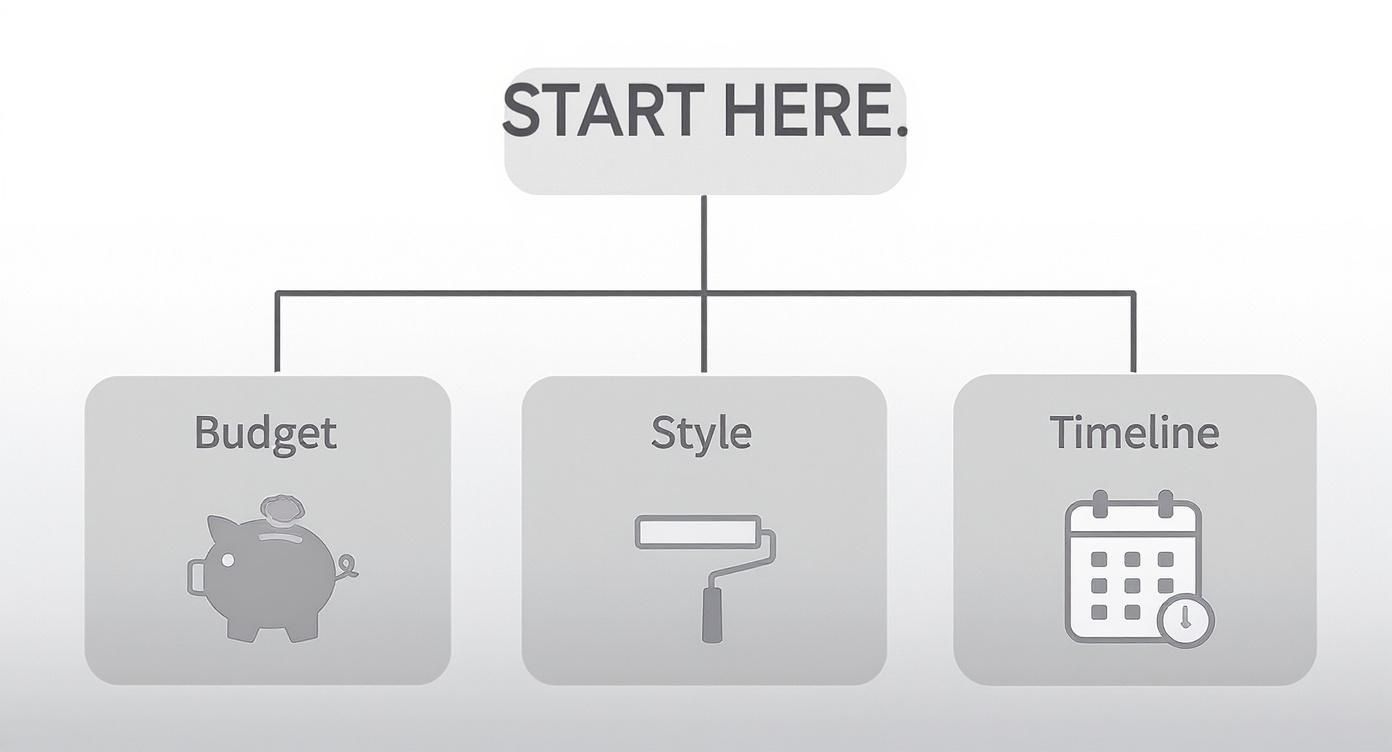
As you can see, what matters most to you—the budget, the final look, or how quickly the job gets done—is your best guide for choosing between these three paths.
Quick Guide to Toronto Kitchen Cabinet Options
To make things even clearer, here’s a quick-glance table comparing the three main cabinet types you'll find in the Toronto market. It breaks down the typical costs, flexibility, and waiting times you can expect for each.
| Cabinet Type | Typical Cost per Linear Foot (Installed) | Customization Level | Average Lead Time |
|---|---|---|---|
| Stock | $150 – $400 | Low | 1-3 Weeks |
| Semi-Custom | $300 – $800 | Medium | 4-8 Weeks |
| Custom | $700 – $1,500+ | High | 8-16+ Weeks |
This table should give you a solid baseline. Stock is fast and affordable, custom offers complete freedom at a higher price and longer wait, and semi-custom sits comfortably in between, providing a balanced solution for most renovations.
Choosing Materials That Last in a Toronto Home
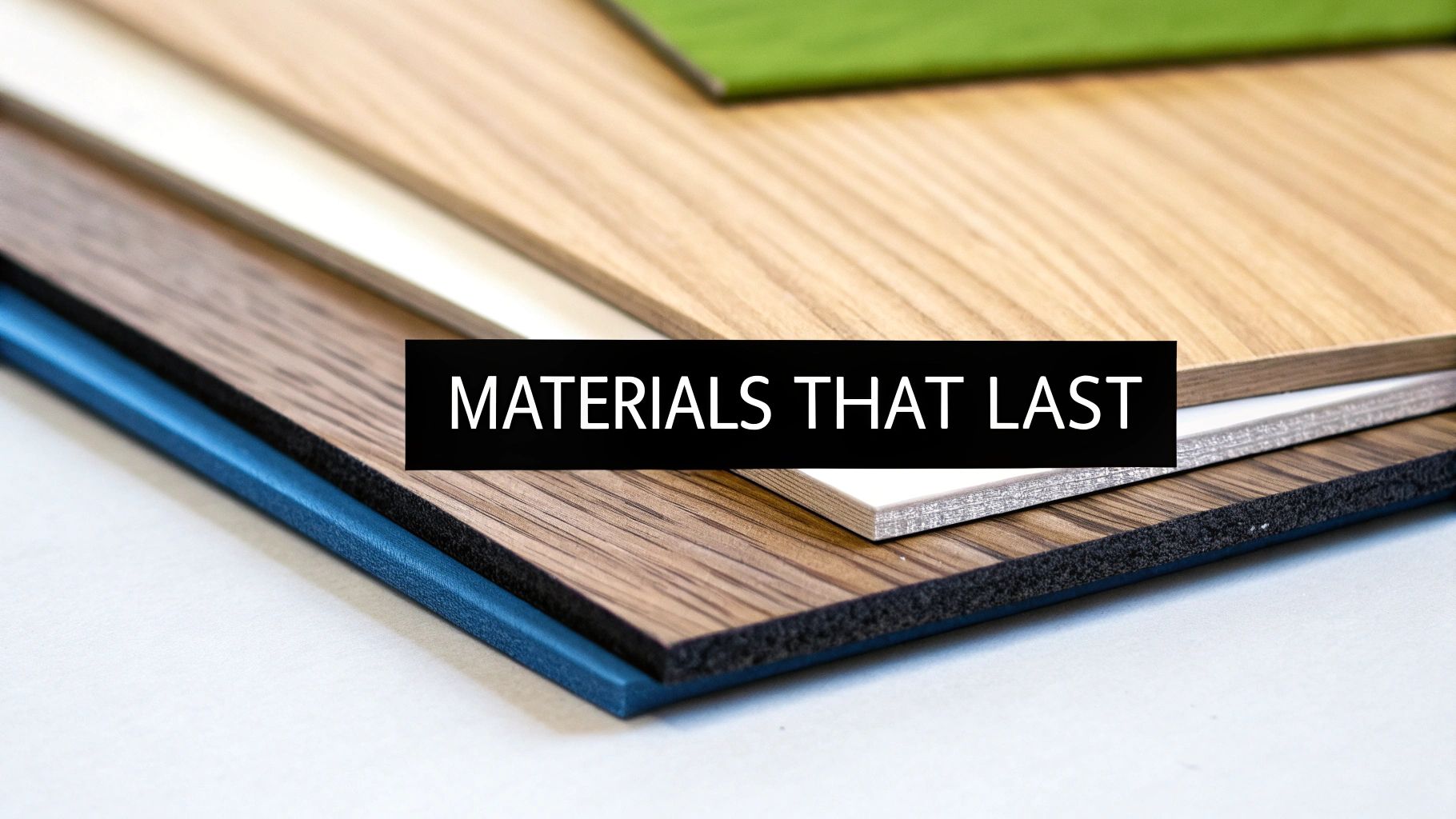
When you're choosing cabinets, you're really choosing the backbone of your kitchen. The materials you pick will dictate not just how your kitchen looks, but how it holds up for years to come. Here in Toronto, we have a unique climate—humid summers that can swell wood and bone-dry winters that can shrink it. Picking the right materials isn't just about style; it's about making a smart investment that can handle our city's weather swings without warping, peeling, or looking tired before its time.
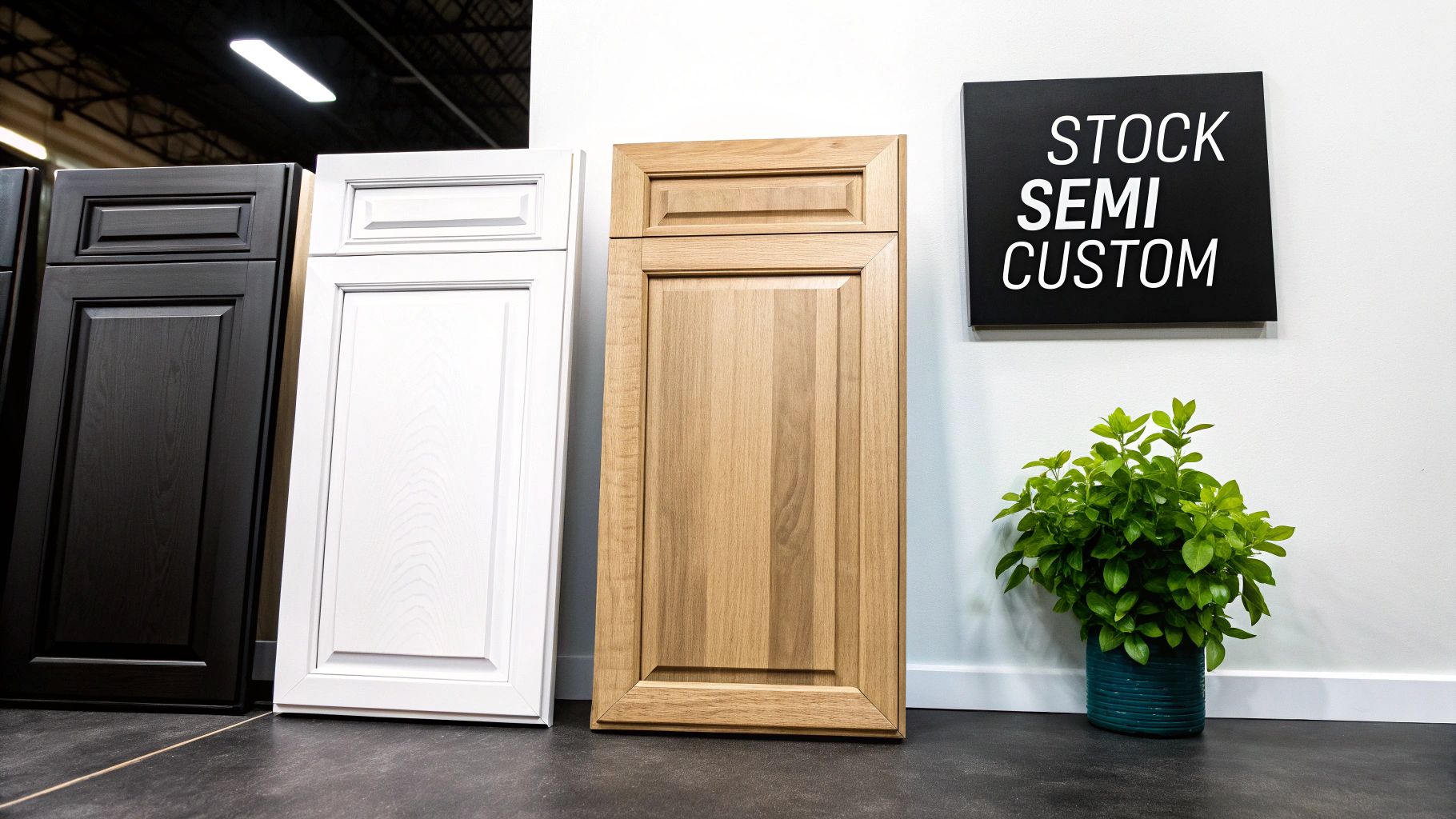
Let's get into the nitty-gritty of what goes into building a great cabinet. Understanding the difference between a cabinet box and a door, and the pros and cons of each material, is the key to creating a kitchen that's as durable as it is beautiful.
The Foundation: Your Cabinet Box Materials
The cabinet box, sometimes called the carcass, is the unsung hero of your kitchen. It's the part you don't really see, but it’s responsible for holding everything up—from your heavy cast iron pans to stacks of dinner plates. Its strength and longevity are everything.
-
Plywood: If you want the best, you want plywood. Think of it like a high-tech wood sandwich. Thin layers of real wood veneer are glued together, with the grain of each layer turned 90 degrees from the last. This cross-graining makes it incredibly strong and, crucially for our climate, far more resistant to moisture and warping than other options. It's the gold standard for a reason.
-
Medium-Density Fibreboard (MDF): MDF is an engineered product made from wood fibres, wax, and resin, all fused together under intense heat and pressure. This process creates a super dense, smooth, and stable panel. Its biggest advantage? It doesn't expand and contract like solid wood, making it the perfect base for a flawless, crack-free painted finish.
-
Particleboard: This is your basic, budget-friendly option. It's made from wood chips and sawdust bonded with resin. While it gets the job done for a lower price point, it’s the most vulnerable to moisture. A small leak under the sink can cause it to swell and crumble, and it doesn't hold screws as securely over time.
For a Toronto kitchen that has to deal with our fluctuating humidity, plywood is hands-down the best choice for cabinet boxes. Its layered structure gives it the stability and moisture resistance needed to last. It’s a key ingredient in a truly high-quality kitchen renovation.
The Face of Your Kitchen: Cabinet Doors and Finishes
While the box does the heavy lifting, the doors are what everyone sees. This is where your personal style shines through. But even here, the material choice has a huge impact on how your kitchen will look and wear over the years.
Solid Wood
Doors made from solid maple, oak, or cherry are timeless. They have a natural warmth and character that’s hard to replicate. You can stain them to let that beautiful grain show through or paint them for a classic look. Just be aware that solid wood is a natural material—it "breathes" with humidity changes. This can cause tiny, hairline cracks in the paint at the joints over time, which is a normal characteristic, not a flaw.
MDF Doors
For that perfectly smooth, painted look, MDF is the industry's top choice. Because it’s so stable, you get a pristine surface that won’t move and crack the paint. This makes it a go-to for countless modern and transitional kitchen designs where a clean, flawless finish is a must.
Thermofoil Doors
Thermofoil is a thin layer of vinyl that's heated and fused over an MDF core. The result is a seamless, durable, and very easy-to-clean door, perfect for sleek, contemporary kitchens. They stand up well to spills and stains but can be sensitive to high heat, so installers often place protective heat shields next to ovens.
Understanding Your Finish Options
The finish is the final touch—the protective coat that defines your kitchen's colour and sheen. It’s about more than just aesthetics; it’s about daily-use resilience.
-
Paint: A painted finish gives you a world of colour possibilities, from a classic like Benjamin Moore's White Dove to a moody, dramatic navy. A high-quality, factory-applied paint is baked on, creating a hard, durable surface that’s easy to wipe down.
-
Stain: Stains are designed to enhance, not hide, the natural beauty of wood. The stain soaks into the wood grain, creating rich, translucent colour that showcases the character of maple or oak. It’s the perfect choice for a warm, organic feel.
-
Laminate: Don't picture the laminates of the 70s! Today's options are incredibly sophisticated and tough. They come in a massive range of colours and even convincing wood-grain patterns. Laminates are champs when it comes to resisting scratches, stains, and moisture, making them a super practical choice for a busy family.
Choosing the right combination of materials is a balancing act between your style, your budget, and how you use your kitchen every day. For a closer look at how these options compare, learn more about the best materials for kitchen cabinets to find the perfect match for your Toronto home. Getting this part right is the first step toward a kitchen you'll still be in love with a decade from now.
Decoding Kitchen Cabinet Costs in Toronto
Trying to nail down a budget for new kitchen cabinets in Toronto can feel a lot like chasing a moving target. The final number isn't just a simple sticker price; it’s a mix of materials, construction quality, and how much custom work you need. Getting a handle on what actually drives these costs is the first step toward setting a realistic budget and making choices you’ll be happy with for years to come.
Think of it like this: a basic, mass-produced t-shirt gets the job done, but a tailored linen shirt costs more because of the superior fabric and skilled stitching. Cabinets are exactly the same. The price tag really just reflects the quality of the raw materials, the complexity of the design, and the level of skill that went into building them.
Breaking Down the Main Cost Drivers
So, what are the big-ticket items that determine your final quote? Knowing these key factors helps you understand where your money is going and where you might have some wiggle room.
-
Material Selection: This is the big one. As we've touched on, the core materials for the cabinet box (think plywood vs. particleboard) and the doors (like solid wood vs. MDF) have the biggest impact on your bill. It’s no surprise that plywood boxes with solid maple doors will cost more than particleboard boxes with thermofoil doors—you're paying for better materials and longevity.
-
Construction Quality: How a cabinet is put together is just as important. High-end cabinets often feature dovetail joints in their drawers. This interlocking construction is incredibly strong and a true sign of quality craftsmanship. On the other end of the spectrum, budget-friendly options might rely on simpler dowels, glue, or staples, which are faster to produce but won't stand up to the same wear and tear.
-
Level of Customization: The more you stray from standard sizes and finishes, the more you can expect the cost to climb. A fully custom pantry with specialized pull-outs, designed to fit perfectly into an awkward corner, requires more design time, skilled labour, and unique materials than a standard, off-the-shelf 30-inch stock cabinet.
-
Finishes and Hardware: A beautiful, factory-applied paint or a complex stain that involves multiple steps takes more time and higher-quality materials than a basic laminate. Similarly, premium soft-close hinges and high-end drawer glides add to the initial cost, but they make a world of difference in how your kitchen feels and functions every single day.
Per-Linear-Foot Pricing in the Toronto Market
To give you a practical starting point, cabinet costs in Toronto are often quoted per linear foot. It’s a handy baseline measurement that makes it easier to compare quotes for stock, semi-custom, and fully custom options.
In the busy Toronto and GTA market, the demand for personalized kitchens has created some clear pricing tiers. Based on market data, stock cabinet installations usually land somewhere between $300 to $500 per linear foot. If you step up to semi-custom, you’re looking at around $750 per linear foot. For premium, fully custom cabinets, prices can start at $1,100 per linear foot and go up from there.
For a typical 150-square-foot kitchen needing about 20 linear feet of cabinetry, this translates to a budget range from $8,000 for basic options to over $22,000 for a high-end custom job. For a deeper dive, you can check out this in-depth analysis of the kitchen cabinetry market.
What Exactly Is a Linear Foot?
A linear foot is just a straight measurement of length—12 inches across. When it comes to cabinets, it’s used to calculate the total length of your uppers and lowers. So, if you have a 10-foot-long wall with cabinets on both the top and bottom, that’s considered 20 linear feet.
Finding Value and Avoiding Hidden Costs
While it can be tempting to go for the lowest price, true value is found in durability and functionality. Sometimes, investing a little more upfront for plywood construction or better hardware can save you a ton of money and headaches on repairs or replacements down the line.
To avoid any nasty surprises, always insist on a detailed, itemized quote. It should clearly break down the costs for the cabinetry itself, the hardware, delivery, installation, and taxes. This kind of transparency allows you to compare quotes fairly and ensures there are no hidden fees.
One of the best ways to manage costs without compromising on quality is to look for companies that offer factory-direct kitchen cabinets. This approach often cuts out the middleman markup, giving you better value for your dollar. By understanding these financial pieces of the puzzle, you can confidently invest in the best kitchen cabinets Toronto has to offer for your home and build a space that’s truly made to last.
Finding the Right Cabinet Partner in the GTA
You’ve spent hours picking out the perfect material and finish for your kitchen cabinets. But here’s the thing: that’s only half the job. Who you choose to supply and install those cabinets is just as crucial, if not more so. This is the team that brings your vision to life, and the wrong partner can quickly turn a dream renovation into a nightmare of delays and budget blowouts.
Toronto is a hotbed for home renovations, and it helps fuel a Canadian cabinet manufacturing industry with revenues hitting around CAD $4.9 billion. That means you have a ton of choices right here in your backyard. But with so many options, doing your homework is absolutely essential to separate the real pros from the rest. For more on this, you can read about the Canadian cabinet manufacturing industry's growth.
So, where do you start? Your first step is figuring out which type of supplier fits your project best.
Big Box Stores vs. Independent Showrooms
The experience you'll have can vary wildly depending on where you go. Each supplier model is built for a different kind of customer and a different type of project.
-
Big-Box Retailers: We’re talking about the major home improvement chains. They’re a solid option for straightforward, budget-friendly projects. If you’re okay with standard sizes and a more limited selection of in-stock cabinets, their convenience and clear pricing are hard to beat. Just know that the design support and installation process might feel a bit less personal.
-
Independent Showrooms: These shops typically carry several semi-custom cabinet lines, offering a more curated selection. You'll work with experienced designers who can guide you through a much wider array of styles, materials, and custom modifications. It’s a great middle-ground—you get expert advice and more choice without the price tag of a fully custom job.
-
Custom Cabinet Makers: When you work directly with a custom shop, you're partnering with true craftspeople. This is the route for ultimate personalization and top-tier quality. It’s perfect for tricky layouts in older Toronto homes, historic properties, or for anyone whose vision simply can't be achieved with off-the-shelf products.
The right choice really comes down to your project's scope and how much guidance you need. For a simple cabinet swap-out, a big-box store might be all you need. For a full-gut reno that demands creative problem-solving, an independent showroom or custom maker is almost certainly a better bet.
Your Vetting Checklist for Installers
Even the most expensive, beautifully crafted cabinets will look terrible and function poorly if they're not installed with precision. A top-notch installer is a master of details—they’re meticulous, communicative, and professional from start to finish. Before you let anyone start work in your home, you need to be sure they’re the real deal.
Vetting suppliers and installers properly is the single best way to protect your investment and ensure a smooth project. We've put together a checklist to help you ask the right questions.
Supplier and Installer Vetting Checklist
| Verification Point | What to Ask or Check For | Why It Matters |
|---|---|---|
| Business Legitimacy | Ask for their business license and HST number. Look up their business online. | Confirms they are a legitimate, registered business operating legally in Ontario. |
| Insurance & WSIB | Request a current certificate of liability insurance and proof of WSIB coverage. | This protects you from any financial or legal liability if a worker is injured on your property. This is a non-negotiable. |
| Verifiable References | Ask for contact info for 3-4 recent clients in the GTA. | Actually call them. Ask about timeliness, communication, and how unexpected issues were handled. Past performance is the best predictor of future results. |
| Detailed Portfolio | Review a gallery of their recently completed work. | Look for precision: tight seams, consistent gaps between doors, and clean trim work. Do their finished projects match the quality you expect? |
| Clear Written Contract | Never work without one. Insist on a detailed, written agreement. | The contract should outline the full scope of work, a payment schedule, the project timeline, and a specific list of all materials and hardware. |
| Communication Style | How responsive are they to your calls and emails during the quoting process? | If they’re hard to reach now, imagine what it will be like when they have your deposit. A professional team communicates clearly and promptly. |
Finding a team you can trust is everything. For a deeper dive into this process, our guide on how to choose the best kitchen cabinets contractor in Toronto offers even more detailed advice. Taking the time to build this reliable team is the final, most important step toward making your kitchen renovation a huge success.
Smart Cabinet Solutions for Toronto Lifestyles
Let's be honest: a kitchen in a historic Cabbagetown Victorian has completely different DNA than one in a sleek CityPlace condo. Toronto's housing is anything but one-size-fits-all, and your kitchen cabinets shouldn't be either. The real success of your renovation hinges on choosing cabinets that genuinely work with your home's character and, just as importantly, your day-to-day life.
This means thinking about the little details that are unique to living here. We have to deal with humid summers that can warp wood, and we need to squeeze every last inch of storage out of our high-rise homes. The best kitchen cabinets for a Toronto home are the ones designed with our city in mind.
Beating Toronto's Climate
Anyone who's lived through a Toronto summer knows about the humidity. That moisture in the air, followed by the dry heat of winter, can be brutal on natural materials like wood. Wood naturally expands when it's humid and shrinks when it's dry. Over the years, this constant movement can lead to warping, cracking, and joint separation if your cabinets aren't built for it.
That’s why the choice of wood and the construction method are so critical.
- Engineered Cores for Stability: This is where cabinet boxes made from high-quality plywood or MDF really shine. Their layered or composite structure makes them far more stable and resistant to the warping that can plague solid wood panels in our climate.
- Durable Finishes as a Shield: Think of a professional, factory-applied finish as armour for your cabinets. It seals the wood or MDF, creating a barrier that stops moisture from getting in and keeps them looking great year after year.
- Smart Door Construction: For painted doors, MDF is often the superior choice. Because it's a single, stable piece, it won't develop those tiny hairline cracks at the joints that can sometimes appear on painted solid wood doors as they expand and contract.
When you're choosing the best kitchen cabinets Toronto's climate can throw at them, always prioritize materials built for stability. A well-constructed cabinet with plywood boxes and high-quality MDF doors is an investment in longevity.
Maximizing Space in Toronto Condos
If you live in a condo in Toronto, you know that space is the ultimate luxury. Standard, big-box-store cabinets just don't cut it—they often leave awkward gaps and waste precious real estate. In a compact home, smart design isn't a bonus; it's essential.
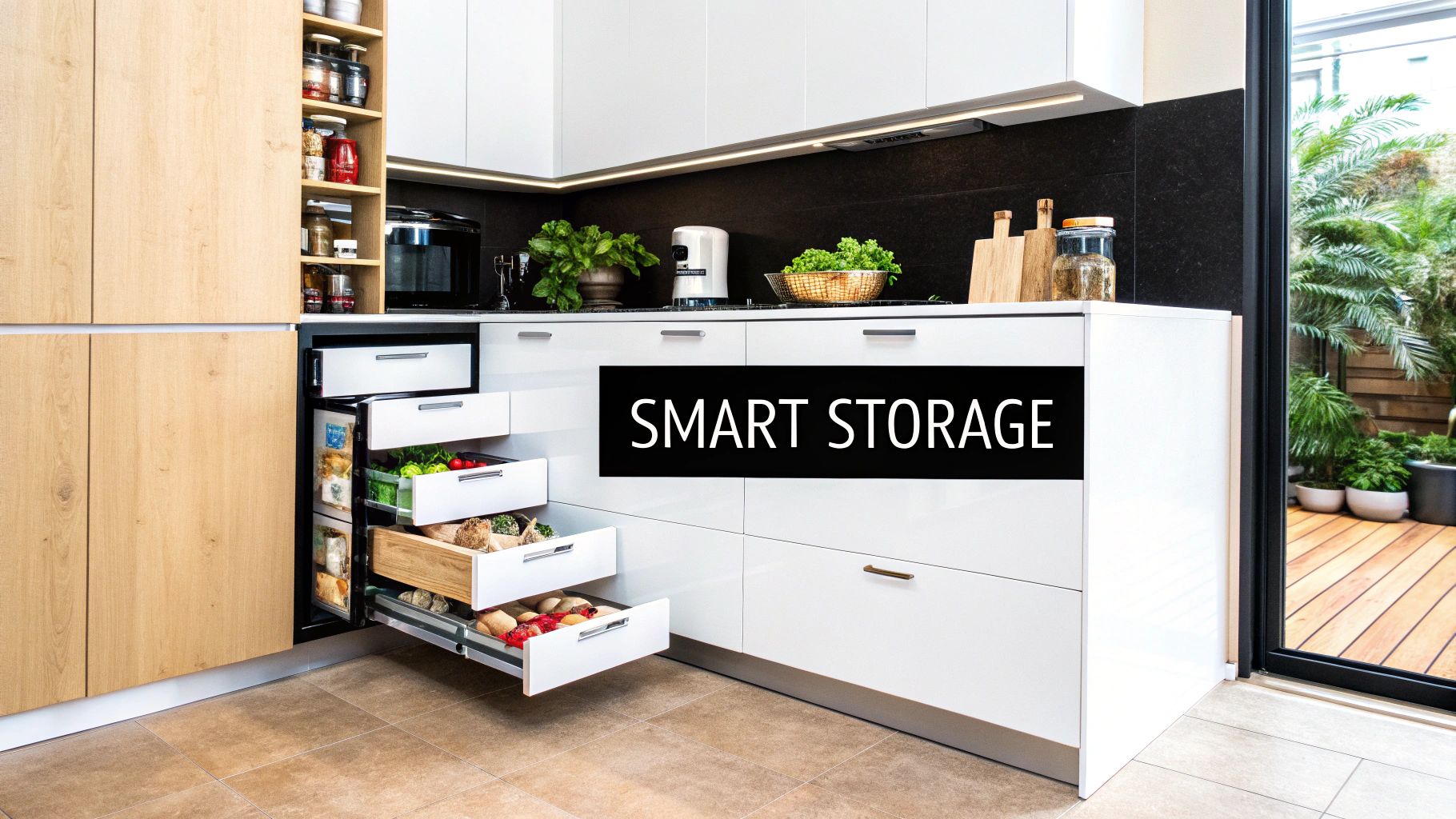
Custom or semi-custom cabinets let you reclaim that wasted space with features designed specifically for tight quarters. It's about thinking vertically and making every corner work.
- Floor-to-Ceiling Cabinetry: Why stop at the standard height? Taking cabinets right to the ceiling is perfect for storing those items you don't use every day.
- Integrated Appliances: A panel-ready dishwasher or fridge makes your kitchen feel larger and less cluttered by creating a clean, unbroken line of cabinetry.
- Pull-Out Pantries: These tall, narrow units are brilliant. They slide out to give you easy access to everything, even items at the very back.
- Corner Solutions: Don't let corners become dead zones. A Lazy Susan or a magic corner pull-out shelf ensures every single inch is functional storage space.
Before you swing a hammer, remember to check with your condo corporation. They all have rules about renovations, covering everything from plumbing and electrical work to the hours construction is allowed. A good cabinet supplier will be familiar with this and can help you get the approvals you need.
Reflecting Neighbourhood Styles
From the classic homes in Rosedale to the modern lofts of Liberty Village, every Toronto neighbourhood has its own distinct personality. The right cabinets should feel like they belong in your home and your area—a choice that can seriously boost your home's value in our competitive market.
A timeless white Shaker door, maybe in a versatile colour like Benjamin Moore’s White Dove, is a perfect match for a family home in The Beaches. But in a downtown condo, a minimalist, high-gloss flat-panel door might feel more appropriate. When your kitchen's style complements your home's architecture, you're creating a look that will last.
Your Top Cabinet Questions, Answered
A kitchen reno always brings up a ton of questions. Let's clear the air. We've compiled some of the most common queries we hear from Toronto homeowners about choosing the right kitchen cabinets. These straight-up answers should help you move forward with your project confidently.
How Long Does a Typical Installation Take?
This is a big one. The timeline for your project really depends on the type of cabinets you choose. Remember, the actual on-site installation is just the final piece of the puzzle.
- Stock Cabinets: These are the speed demons. Once they're on-site, the installation itself is usually wrapped up in just a few days.
- Semi-Custom Cabinets: You'll need to factor in manufacturing time. Expect a lead time of around 4-8 weeks for them to be built. Once they arrive, installation usually takes about 1-2 weeks.
- Custom Cabinets: Patience is key here. The detailed design and building process can take anywhere from 8-12 weeks, sometimes longer. The installation is also more meticulous and can span multiple weeks.
The key takeaway? Always get a detailed, all-in timeline from your supplier before you commit to anything.
Are Custom Cabinets Worth the Cost in Toronto?
For a lot of homeowners in the GTA, it’s a definite yes. While the upfront cost is higher, custom cabinets bring some serious advantages to the table, especially in Toronto's unique housing market. They really pay off in the long run.
Custom cabinets let you use every single inch of your kitchen. This is a game-changer in a snug downtown condo or an older home with an awkward layout. That kind of perfect fit not only makes your kitchen work better for you but can also seriously boost your home's value in our competitive real estate scene.
What Is the Most Durable Cabinet Material?
Toronto's climate, with its humid summers and dry winters, is tough on wood. You need materials that can stand up to that constant expansion and contraction.
For the cabinet boxes—the actual structure—high-quality plywood is the hands-down winner. Its layered, cross-grain construction gives it fantastic stability and strength, fighting off the warping that can plague lesser materials.
When it comes to the doors, the best choice depends on how you want them to look:
- For a Stained Finish: You can't beat solid hardwoods like maple or oak. Just make sure they're sealed properly by the manufacturer to lock out moisture.
- For a Painted Finish: High-quality MDF (Medium-Density Fibreboard) is often the pro's choice. Why? Because it’s incredibly stable. It doesn't expand and contract like solid wood, which means you won't see those annoying hairline cracks in the paint over time. The finish stays smooth and flawless.
Choosing materials designed for our local climate is the secret to a kitchen that stays beautiful for years to come.
Ready to build a kitchen that’s a perfect fit for your Toronto home? MapleKing Kitchen Cabinets gives you factory-direct pricing on stunning custom and semi-custom cabinetry, so you get incredible quality without the retail markup. Explore our collection and get a free quote today.



