

When you're planning a kitchen refresh, one of the first big forks in the road is deciding what to do with your cabinets. Should you hire a painter, or is it better to buy brand new, factory-finished doors?
For many homeowners here in Toronto, bringing in a top-notch cabinet painter is a fantastic way to completely transform a kitchen in less than a couple of weeks. But, and this is a big but, if you're chasing that flawless, automotive-grade finish with maximum durability, new factory-finished doors deliver a level of quality that even the most skilled painter can't match on-site.
Painting vs. New Cabinets: Your First Big Decision
Before you start getting quotes and interviewing contractors, you really need to get clear on which path is right for you. Are you after a budget-friendly facelift that keeps your current layout, or is a perfect, long-lasting finish your top priority? There's no single right answer—it all comes down to your goals, your budget, and the current state of your kitchen.
Understanding the Core Trade-Offs
A professional paint job is a powerful tool. It can completely change the colour and mood of your kitchen without the mess and expense of a full tear-out. It’s the perfect route if your cabinet boxes are structurally sound and you’re generally happy with the layout. You get a whole new look for a fraction of the cost.
On the flip side, when it comes to sheer perfection and durability, new factory-finished doors are the undisputed champion. These doors are made in a controlled factory environment where industrial-strength coatings are applied and cured for ultimate hardness. This process creates a seamless, non-porous surface that stands up incredibly well to chipping, stains, and the general chaos of daily life.
This quick guide can help you visualize the decision.
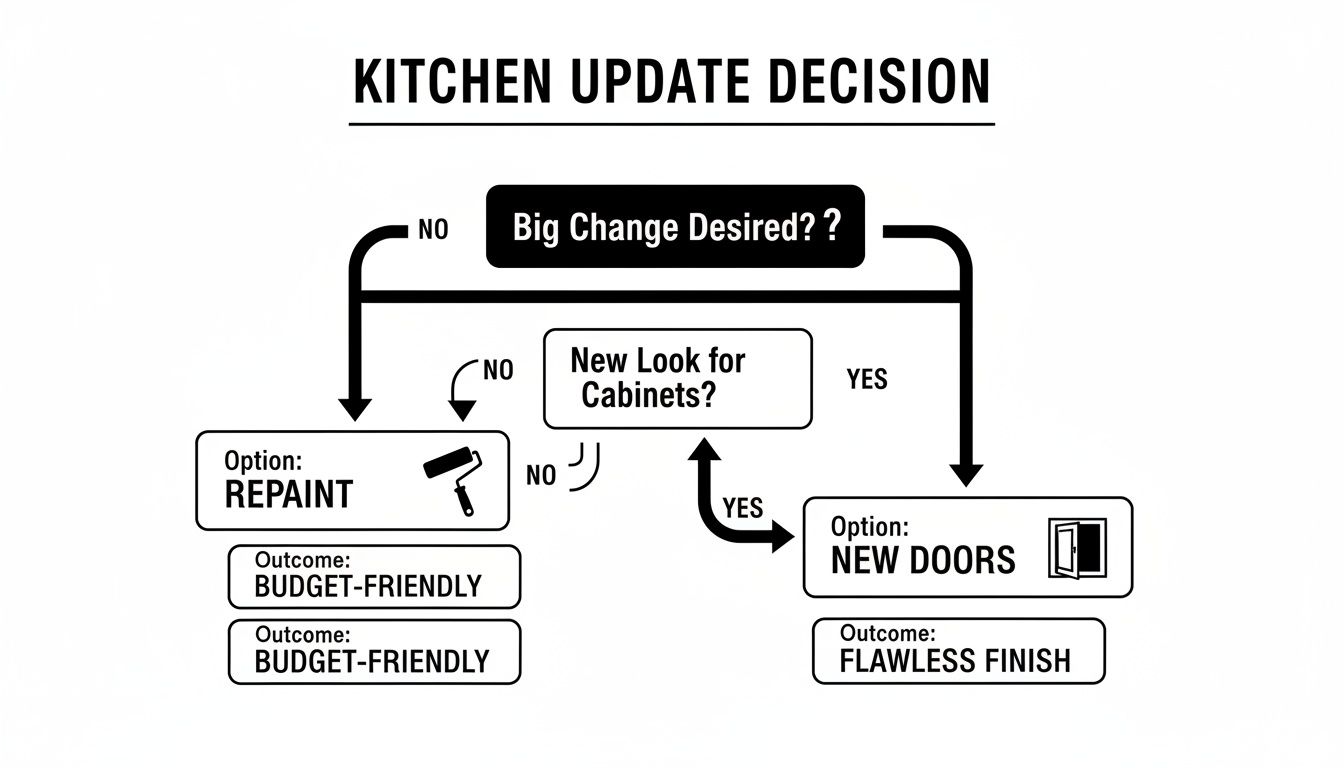
As you can see, while painting offers major savings, new doors are the way to go if you want that pristine, top-of-the-line finish.
To make it even clearer, let's break down the pros and cons side-by-side. This comparison should help you weigh what matters most for your project.
On-Site Painting vs. New Factory-Finished Doors
| Factor | On-Site Cabinet Painting | New Factory-Finished Doors |
|---|---|---|
| Finish Quality | Good to excellent, but can show minor imperfections (brush strokes, dust). Highly dependent on painter skill. | Flawless, uniform, and smooth. Baked-on for an automotive-grade, non-porous surface. |
| Durability | Varies. Professional-grade paints are strong but more susceptible to chipping and wear over time than factory coatings. | Extremely durable. Highly resistant to chipping, scratching, moisture, and staining. The gold standard. |
| Cost | Significantly lower. Typically 60-75% less than a full cabinet replacement. | More expensive than painting, but less than a full cabinet replacement. Offers a higher-end result for the cost. |
| Turnaround Time | Fast. Usually 1-2 weeks from start to finish. Involves on-site work and disruption. | Longer lead time for ordering (4-8 weeks), but installation is very quick (1-2 days). Less on-site mess. |
| Customization | Unlimited colour choice. You can pick any paint colour you can imagine from any brand. | Limited to the manufacturer’s selection of colours, styles, and finishes. |
| Best For… | Budget-conscious updates, structurally sound cabinets, keeping existing layout, or when a specific custom colour is desired. | Homeowners prioritizing a perfect, long-lasting finish, updating door styles, or wanting the most durable option available. |
Ultimately, both are great options. If you want a dramatic change on a tighter budget, painting is tough to beat. But if your goal is the absolute best finish possible, investing in new factory-finished doors is money well spent.
The Financial Case for Painting in Toronto
For many homeowners in Toronto and Markham, the choice really boils down to the numbers. Cabinet refinishing has exploded in popularity across the GTA for one simple reason: massive savings. If you're weighing the costs, our guide on cabinet refinishing in Toronto is a great resource.
Here's the bottom line: a professional kitchen cabinet paint job in Toronto typically runs between $3,000 and $8,500. Compare that to a full replacement, which can easily set you back $15,000 to $30,000 or more. You're looking at a 60-75% savings.
That huge price difference is exactly why professional painting is such a compelling choice for anyone looking to get a high-impact renovation without breaking the bank.
How to Vet a Cabinet Painter Like a Pro
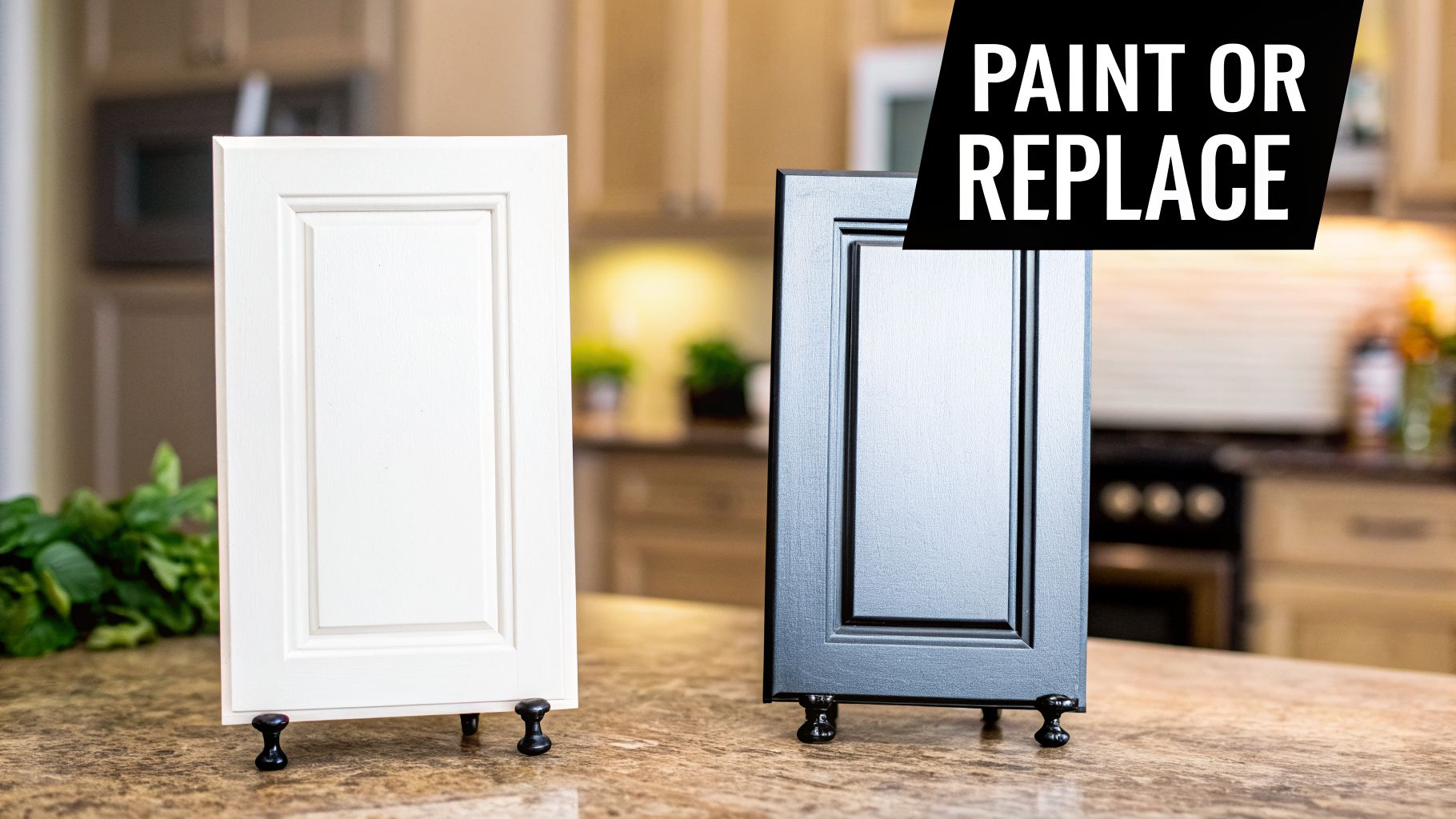
In a market as crowded as Toronto, finding a painter who is a true craftsman takes more than a quick search. The gap between a genuine pro and a low-bidder with a paintbrush is often hidden in the details—details you have to proactively investigate. Think of this as your playbook for seeing past the sales pitch and hiring someone you can trust with your kitchen.
First things first, let's talk about the non-negotiables: credentials. This isn't just about ticking boxes; it's about protecting yourself and your home.
- WSIB Coverage: You must ask for a current WSIB (Workplace Safety and Insurance Board) clearance certificate. If a worker gets injured in your home and the company isn't covered, you could be on the hook financially.
- Liability Insurance: Don't even consider a painter who can't show you proof of at least $2 million in liability insurance. This is what covers your brand-new floors from a paint spill or a dent in your stainless steel fridge.
Any hesitation to provide these documents is a massive red flag. A professional will have them ready to go, no questions asked.
Look Beyond the Pretty Pictures
A painter's portfolio is their highlight reel, but a savvy homeowner knows how to look for more than just a pretty "after" shot. When vetting a cabinet painter, the same principles for hiring other qualified painters apply: you're looking for proof of consistent, high-quality execution.
Instead of just scrolling through photos, zoom in. Really get close. Look for the consistency of the sheen on a big pantry door. Check the sharpness of the lines where the cabinet boxes meet the ceiling or backsplash. Are the edges around intricate crown moulding clean and crisp, or are they a little fuzzy? The work of a top-tier painter stands up to scrutiny.
A portfolio shows you a painter's best day. References tell you about their every day. The best cabinet painter will have a list of happy clients ready to talk about the entire experience, not just how the kitchen looked on day one.
Ask Past Clients the Right Questions
Talking to references is your chance to get an unfiltered look at how a painter really operates. Don’t settle for a simple, "Were you happy?" You need to dig deeper to get the information that truly matters.
Try asking a few of these questions:
- How did the crew handle dust and cleanup? Was your home properly sealed off and protected?
- Now that it's been a while, how is the finish holding up? Look closely at high-use areas like the knobs on your most-used drawers or the cabinet under the sink.
- Did they stick to the timeline and the budget they promised you?
- How did you feel about having the crew in your home every day? Were they professional and respectful?
The answers will tell you far more about their work ethic and the durability of their finish than any photo ever could. You’ll get a clear picture of what the entire process will be like. If you want to be even more prepared on the technical side, our guide to the best paints for kitchen cabinets can help you get up to speed.
Decoding Quotes to Understand the True Project Cost

When the quotes for your cabinet painting project start rolling in, it can feel like you're comparing apples to oranges. You’ll get one that seems shockingly low and another that feels completely over the top. The real trick to finding a top-notch painter is learning to read between the lines to see what each quote truly covers—and, more importantly, what it’s leaving out.
Be wary of a suspiciously cheap quote. It’s almost always a massive red flag. In my experience, it signals that corners are being cut where it matters most: surface preparation. A professional, detailed quote should be a multi-page document, not just a number scribbled on the back of a business card.
This kind of transparency is what separates the pros from the amateurs, especially in a busy market like ours. The Canadian cabinet manufacturing industry is booming, projected to hit a market size of $5.7 billion by 2026. This growth puts skilled refinishers in high demand here in the Toronto area, making it even more critical to choose a painter who provides clear, comprehensive quotes that reflect a commitment to quality.
Anatomy of a Professional Quote
Any legitimate painter worth their salt will provide a quote that breaks down the entire project into itemized sections. If you receive a quote that’s vague, don't hesitate to ask for a more detailed breakdown. A true professional will have no problem providing this.
Here’s what you should look for:
- Surface Preparation: This is the big one and it's non-negotiable. The quote should list specific tasks like degreasing, cleaning, sanding, and filling dents or scratches. If it just says "prep work," that’s far too vague.
- Primer and Paint Details: It should name the exact brand and product line for both the primer and the paint (e.g., Benjamin Moore ADVANCE, Sherwin-Williams Emerald Urethane). This is your chance to see what materials they trust; you can compare their choices against our guide on the best paints for kitchen cabinets to see if they’re using quality products.
- Number of Coats: A proper job always includes at least one coat of high-adhesion primer and a minimum of two top coats of your chosen colour. This detail should be stated clearly.
- Labour Costs: This will always be the largest part of your quote. It needs to cover all the time required for prep, painting, and re-installation.
- Cleanup and Site Protection: The quote should outline exactly how they plan to protect your home from dust and overspray, plus detail their cleanup process.
A quote is more than just a price—it's a statement of work. A detailed quote is proof of a painter's professionalism and thoroughness, while a vague one suggests they might be hiding shortcuts.
Realistic Price Benchmarks in the GTA for 2026
To protect yourself from being overcharged or falling for a low-ball offer that’s too good to be true, it pays to know the going rate.
For a standard-sized kitchen in the Greater Toronto Area, you can expect a high-quality, professional cabinet painting job to cost between $4,000 and $9,000 in 2026.
If a quote comes in well below this range, it likely means they’re rushing the prep, using cheap materials, or operating without insurance. On the other hand, a price significantly higher than this should come with a good explanation, like extensive cabinet repairs, an exceptionally large kitchen, or the use of highly specialized, premium finishes. Knowing these benchmarks gives you the confidence to evaluate each proposal like a pro.
The Interview Questions That Reveal True Expertise
You've done the online legwork—you've sifted through portfolios and spoken to past clients. Now for the most critical step: the in-person interview. This is your chance to look a painter in the eye and separate the true craftspeople from those who just talk a good game.
Forget the surface-level questions about price for a moment. We need to dig into their actual process and product knowledge. The answers you get here will tell you everything you need to know about whether you’ll get a finish that lasts a couple of years or a decade.
Questions About Process and Preparation
I can't stress this enough: a beautiful finish is 90% preparation. This is where many painters cut corners, and it’s where you need to press for details.
"Can you walk me through your exact prep process, from the moment you arrive to when you apply the first coat of primer?"
Listen carefully to their response. A pro won't hesitate. They’ll immediately talk about removing all hardware, degreasing every surface with a professional-grade cleaner like TSP (Trisodium Phosphate), and sanding to scuff up the old finish so the new primer can grip it. They should also mention cleaning away every speck of dust with tack cloths before a single drop of primer is opened. If their answer is a vague "we sand and prime," that's a red flag."Will you be spraying or brushing the cabinet boxes here in my kitchen? What’s your reasoning behind that choice?"
There isn’t a single correct answer here, but a seasoned painter will have a solid justification. Many of the best painters I know spray the doors and drawers off-site in their shop to achieve that flawless, factory-like finish. They then meticulously brush or roll the cabinet frames on-site to contain the mess. If they plan to spray everything inside your home, they had better have an incredibly detailed plan for containment and ventilation to prevent overspray from coating your entire house in fine paint dust.
A painter’s knowledge of specific products is a dead giveaway of their experience. A seasoned pro won't just say "we use good paint." They'll name specific brands and product lines, and more importantly, explain why that product is the right choice for a high-use area like a kitchen.
Probing Their Product and Material Knowledge
The specific coatings they use are what stand between your cabinets and daily abuse from scuffs, grease, and cleaning.
This is a question you must ask directly: "Which specific paint products—brand and line—do you recommend for kitchen cabinets, and why do you prefer them?"
A knowledgeable painter will instantly bring up top-tier, cabinet-specific coatings. They’ll mention products like Sherwin-Williams Emerald Urethane Trim Enamel or Benjamin Moore ADVANCE. They should also be able to tell you why these are the industry standard—explaining how their self-levelling properties minimize brush marks and how they cure to a rock-hard finish that won’t easily chip or yellow over time.
Finally, you need to know what happens if something goes wrong. A simple question like, "What does your warranty cover, and for how long?" is incredibly telling. A confident professional who stands by their work will offer a clear, written warranty covering any workmanship defects like peeling or bubbling for at least two years. Be very wary of anyone who gets cagey or only offers a vague verbal promise.
When New Factory-Finished Doors Are the Smarter Choice
A great painter can work wonders on tired kitchen cabinets, but even the best professional has limitations. Sometimes, painting just isn't the right move. I've seen homeowners invest in a high-end paint job only to be disappointed down the road because their original doors weren't a good candidate to begin with.
Knowing when to skip the paint and opt for new, factory-finished doors is crucial for getting a look that lasts.
The most common red flag? Your cabinet material. If your doors are wrapped in thermofoil (a type of plastic veneer) or are made of laminate, you’re setting yourself up for failure by painting them. These surfaces are non-porous and slick, making it nearly impossible for paint to get a permanent grip. No matter how much a painter preps, you’ll likely see peeling and chipping in a year or two.
Achieving a Finish You Can't Get On-Site
The other big consideration is the look you're going for. If you have your heart set on that flawless, mirror-like high-gloss or a sophisticated, velvety super-matte finish, a factory setting is the only place to get it. These aren't just regular paints; they're specialized industrial coatings applied in an environment that simply can’t be replicated in a home.
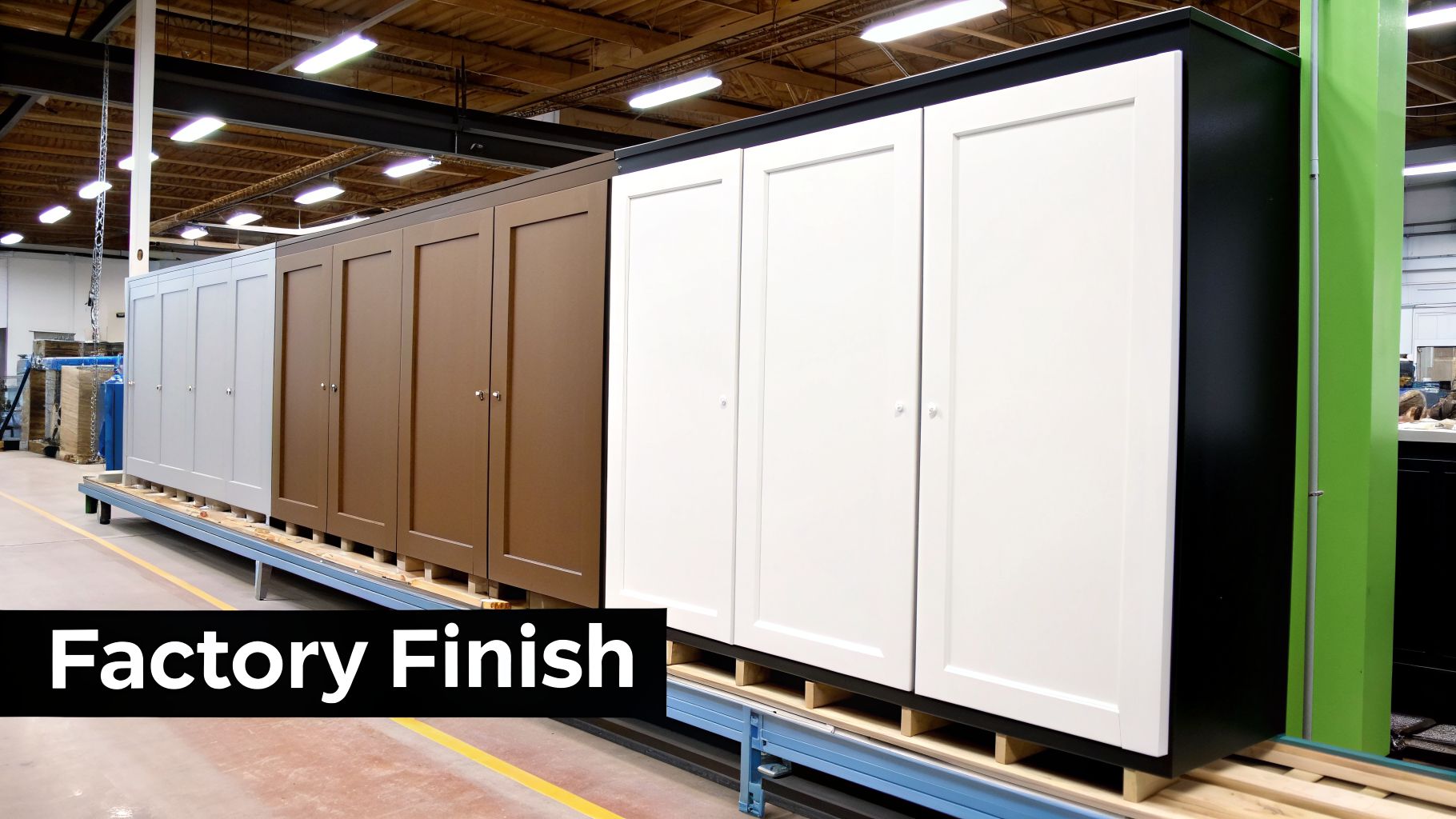
A factory finish uses technology that’s impossible to bring to your kitchen. We’re talking about climate-controlled spray booths, catalyzed conversion varnishes, and infrared ovens that bake the finish right onto the door. The result is a harder, smoother, and far more resilient surface.
This process explains why factory-finished doors offer such predictable, bulletproof results. Homeowners are catching on, and the demand for these durable coatings is booming. In fact, Canada's industrial wood coatings market, which supplies both factory finishers and top-tier cabinet painters, is expected to hit USD 254.21 million by 2032 as people prioritize long-lasting and eco-friendly options. You can explore more on these market trends and how they’re shaping renovation choices.
When Is a Factory Finish the Right Call?
So, how do you decide? It really comes down to what you’re starting with and what you hope to achieve. A new factory-finished door isn’t just a colour change—it's a completely new, engineered product.
It’s probably time to look at new doors if:
- Your current doors are thermofoil, laminate, or MDF. These materials are known for being paint-unfriendly.
- You want a high-gloss or super-matte finish. That sleek, modern aesthetic is born in a factory, not on-site.
- Durability is your number one concern. A factory-cured finish is simply tougher against chips, moisture, and the daily grind.
- You're ready for a new door style. If you want to switch from dated arched panels to a clean Shaker look, ordering new doors is the most direct path.
While a painter can bring incredible new life to solid wood cabinets that are in good shape, new factory-finished doors deliver a guaranteed, flawless outcome when your existing materials aren't up to the task or your design goals are more ambitious.
Common Questions About Cabinet Painting in Toronto
When you start looking into a kitchen refresh in the GTA, the questions pile up fast. Should you repaint or replace? How can you tell if a painter is actually any good? It can feel overwhelming.
We've been in the cabinet business for years, so we've heard it all. To help you cut through the noise, here are some straight-up answers to the questions that pop up most often for homeowners around here.
How Long Should a Professional Cabinet Paint Job Last?
A top-tier paint job, done by a real pro with the right materials, should hold up for 8 to 15 years. But that number hinges on one critical thing: the prep work.
The lifespan of your painted cabinets is directly tied to how well the surfaces were prepared before a single drop of paint was applied. Daily wear and tear and moisture in the kitchen play a part, but a rushed job will start to fail in just a couple of years, no matter how careful you are.
It’s worth noting that factory-applied finishes have a clear advantage here. The controlled environment and industrial curing process create a much harder, more resilient surface from the get-go. Always ask a painter you’re considering about the expected lifespan and what their warranty actually covers.
A professional finish is an investment in your home. While a DIY or low-cost job might save money upfront, a job done by the best cabinet painter will pay for itself in durability and lasting beauty, preventing you from needing to repaint every few years.
Is It Worth Paying More for Low-VOC Paints?
The short answer? Absolutely, yes. If you have young children, pets, or anyone in the house with allergies or respiratory issues, choosing low-VOC paints is a must for your family's health.
VOCs (Volatile Organic Compounds) are chemicals that off-gas into the air as paint dries, and they can linger long after, affecting your home's air quality. While premium low-VOC paints might add a little to your total project cost, the peace of mind is worth every penny.
Any reputable painter will already be familiar with these products. They should offer them as a standard choice or at least a highly recommended upgrade. It’s a good sign that they care about your well-being, not just the final look.
Can My Old Thermofoil or Laminate Cabinets Be Painted?
This is one of the most important questions we get, and the answer is critical. While you can technically paint thermofoil or laminate cabinets, it’s a huge gamble that we almost never recommend.
These materials have slick, non-porous surfaces, like plastic. Paint simply can't get a good grip, even with specialty primers. The result? The finish is extremely likely to peel, bubble, or chip off, especially in a busy kitchen environment.
Most of the best cabinet painters in Toronto will either refuse this work outright or will tell you upfront that there's zero warranty. In these cases, you're far better off replacing the cabinet doors with new, factory-finished ones. It’s the only way to guarantee a beautiful, durable result that won't fail you in a year or two.
Sprayed vs. Brushed Finish: What Is the Difference?
The application method a painter uses will completely change the final texture and look of your cabinets. The best pros often use a mix of techniques to get the job done right.
Here’s a quick breakdown:
- Sprayed Finish: This is the gold standard for a modern, flawless look. The paint is atomized into a fine mist, usually off-site in a clean, controlled spray booth. It creates a perfectly smooth, factory-like finish with zero brush marks or texture.
- Brushed/Rolled Finish: This method is typically used on-site for the cabinet boxes and frames that can’t be removed. A true artisan can get a very clean result with minimal brush strokes, but it will always have a slight texture that a sprayed finish doesn't.
The most common professional approach is a hybrid one: your painter takes the doors and drawer fronts to their shop to be sprayed, then carefully brushes or rolls the cabinet boxes in your home. This gives you the best of both worlds—a perfect finish on the parts you see most, with minimal mess and disruption in your kitchen. Be very cautious of anyone who wants to spray inside your home without a massive, professional-grade containment and ventilation system.
Ready to explore a finish that combines flawless beauty with unmatched durability? MapleKing Kitchen Cabinets offers premium, factory-finished cabinet doors that provide a perfect, long-lasting solution for your Toronto kitchen renovation. Discover our bespoke cabinet designs and get your free quote today.



