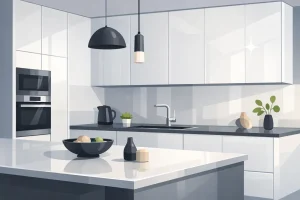

High-gloss kitchen cabinets are usually a premium choice, with common pricing for a standard kitchen starting around $3,000 to $7,500+ for thermofoil gloss and rising to $15,000 to $60,000+ for premium acrylic gloss. In practice, the final cost depends less on the word “gloss” and more on which gloss system you choose and what the cabinet is built on.
If you're in Toronto or Markham right now comparing samples, you've probably had the same reaction many homeowners do. The glossy white slab door looks sharp, modern, and expensive. Then the quotes start coming in, and it's not always clear whether you're paying for the finish, the cabinet box, the install, or all three at once.
That confusion is normal. “High gloss” isn't one product. It can mean an entry-level thermofoil door, a UV or lacquer finish, or a premium acrylic face on a better substrate. Those are very different products with very different price tags.
The local angle matters too. Many articles online give broad U.S. ranges, but that doesn't help much when you're trying to budget a Toronto renovation. In this market, homeowners don't buy cabinet doors in isolation. They pay for design choices, substrate, labour, finishing quality, and the risk of future wear. A Canadian cabinet pricing discussion from 2026 points out that many articles focus only on sticker price, while the more useful question is total project cost in the Toronto and Markham market, especially how much of the premium comes from the finish versus the contractor side of the job (Canadian cabinet pricing context).
The Allure of the Gleam and the Question of Cost
High gloss attracts people for a reason. It reflects light, sharpens lines, and makes a kitchen feel cleaner and more architectural than many standard finishes. In condos, townhouses, and narrower GTA kitchens, that visual lift can matter as much as the cabinetry itself.
But yes, if you're asking are high gloss kitchen cabinets expensive, the honest answer is usually yes. They tend to sit above basic builder-grade options because the finish is more demanding, the look is less forgiving, and buyers usually pair it with a more modern door style, better hardware, and tighter installation expectations.
What homeowners usually miss
The mistake I see most often is comparing a glossy display kitchen to a basic matte quote and assuming the gloss alone caused the whole jump in price. That's rarely true. The difference often comes from several layers of decision-making:
- Finish system: Thermofoil, UV/lacquer, and acrylic don't cost the same.
- Core material: MDF, particle-board, plywood, and solid wood all shift the budget.
- Project scope: Fillers, panels, trim pieces, and custom sizing add up quickly.
- Installation quality: Glossy surfaces show poor alignment faster than forgiving finishes do.
Practical rule: If a door reflects light like a mirror, it will also reflect installation mistakes, uneven reveals, and hardware choices.
Expensive compared to what
That's the key comparison. High gloss is expensive compared with stock or entry-level cabinets, but it isn't automatically out of reach. It often lands in the same broad territory as other premium cabinet builds, especially once the whole project is priced as supplied and installed.
For many Toronto homeowners, the better question isn't “Is high gloss expensive?” It's “Is this specific version of high gloss worth the money for my kitchen, my usage, and my budget?” That's the question that leads to a smarter renovation.
Decoding the Price Tag of High Gloss Cabinets
Think of high-gloss cabinetry the way you'd think about car paint. Two vehicles can both look shiny from across a parking lot, but one has a simple factory finish and the other has a deeper, more durable finish that costs far more to produce and repair. Cabinets work the same way.

The three gloss tiers
A 2026 high-gloss cabinet pricing guide breaks the market into three common tiers: thermofoil gloss at $70 to $120 per linear foot, UV/lacquer gloss at $120 to $200 per linear foot, and premium acrylic gloss at $200 to $500+ per linear foot. For a 10×10 kitchen, that same guide lists about $3,000 to $7,500+ for thermofoil gloss, $6,000 to $18,000 for UV/lacquer gloss, and $15,000 to $60,000+ for premium acrylic gloss. It also notes that premium acrylic can cost roughly 2.5x to 4x more per linear foot than entry-level thermofoil gloss (high-gloss cabinet pricing guide).
Here's how those tiers usually behave in practical terms:
- Thermofoil gloss gives you the glossy look at the lowest entry point. It can work well in budget-conscious projects, rentals, and secondary spaces.
- UV or lacquer gloss moves into a more refined finish category. This is often where homeowners start to see a stronger visual depth and a more premium presentation.
- Acrylic gloss is the polished, high-end version that comes to mind when considering luxury modern kitchens.
A short visual overview can help if you're trying to match these tiers to what suppliers are showing in person.
The cabinet box matters as much as the door
The finish gets attention, but the substrate often decides whether the quote feels reasonable or shocking. A glossy door on a simpler cabinet box is one product. A glossy door on plywood or solid wood is another.
Many homeowners often misunderstand. They think they're comparing gloss versus matte, but they're comparing two completely different cabinet constructions.
What to ask when you review a quote
Use these questions when a supplier says “high gloss”:
- What exactly is the door finish? Ask if it's thermofoil, UV, lacquer, or acrylic.
- What is the core material? MDF and plywood won't price the same.
- Are the end panels, fillers, and exposed sides matching? On glossy kitchens, those details affect both look and cost.
- Is the quoted price supply only or installed? That changes the true comparison.
A cheap gloss quote usually becomes less cheap once you ask what's actually included.
If you want to compare glossy painted doors with other cabinet paint systems, this guide to the best paint finish for kitchen cabinets is useful because it helps separate appearance from performance.
High Gloss Versus Other Finishes a Value Comparison
A Markham condo kitchen and a larger family kitchen in North York should not be finished the same way, even if the cabinet style is identical. High gloss can be excellent value in one room and the wrong spend in another.
The comparison is not gloss versus non-gloss as a design trend. It is what you get for the money in day-to-day use, how the kitchen photographs, and whether the finish suits the way the space is used.
One reason gloss keeps showing up in smaller urban kitchens is simple. It reflects light well and can make a tight room feel brighter and more open, especially in white or pale tones, as discussed in these glossy cabinet design considerations. In Toronto condos and narrower Markham townhomes, that visual lift has real value because it can make an average layout feel more finished without changing the footprint.
Where gloss gives better value
Gloss usually earns its keep in these situations:
- Smaller kitchens with limited natural light. The reflectivity helps the room feel less closed in.
- Modern layouts where flat-panel doors suit the architecture. The finish looks intentional instead of decorative for the sake of it.
- Homes where resale presentation matters. A clean gloss kitchen often reads as newer in photos when the colour palette is controlled.
For homeowners weighing appearance against resale, these Realtor kitchen design insights show how finish and contrast affect how a kitchen reads online and in person.
Gloss loses some of that value in heavy-use kitchens with young kids, a lot of hand traffic, or darker cabinet colours. Fingerprints, smudges, and light scratches show faster on some gloss surfaces than on matte, woodgrain, or textured options. Homeowners who want the sleek look but less maintenance often do better with gloss on uppers and a more forgiving finish below.
The best-value finish is the one that still looks good after a normal week of cooking, cleaning, and people touching every drawer.
Cabinet Finish Comparison
| Finish Type | Average Cost | Aesthetics | Maintenance | Durability |
|---|---|---|---|---|
| High-gloss thermofoil | Lower end of gloss options | Clean, modern, reflective | Easy to wipe, but marks can show | Depends heavily on edge quality and daily use |
| High-gloss acrylic | Premium | Deep, mirror-like contemporary look | Wipes clean, but fingerprints are more visible | Better suited to buyers chasing a high-end modern result |
| Matte HDF | Qualitative mid-range to premium depending on build | Softer, quieter visual effect | Better at disguising smudges | Often easier to live with in high-touch zones |
| Painted wood | Qualitative premium | Classic or transitional, depending on profile | Usually requires more care over time | Can look excellent, but touch-ups vary by finish |
| Textured laminate | Qualitative budget to mid-range | More understated, practical | Good at hiding everyday wear | Often a smart choice for heavy-use households |
The table helps, but trade-offs matter more than labels.
High-gloss acrylic usually looks the most expensive because it has depth and a cleaner reflection. It also costs more and is less forgiving if the surrounding details are weak. A budget install with uneven fillers, poor scribes, or mismatched end panels can make a premium gloss door look disappointing.
Matte HDF and textured laminate often deliver better practical value for busy households. They hide wear better. They also make everyday maintenance less annoying, which matters more than brochure appeal once you have lived with the kitchen for a year.
Painted finishes sit in a different category. They can look richer and more custom, but performance depends heavily on the paint system and the shop doing the work. If you are comparing painted doors to gloss products, this guide to the best paint finish for kitchen cabinets helps clarify how appearance, touch-up potential, and long-term upkeep differ.
What works and what disappoints
Some combinations are consistently strong value:
- Works well: Gloss uppers with matte or textured lowers in modern kitchens.
- Works well: White or light gloss in smaller spaces that need brightness.
- Can disappoint: Full dark gloss in a family kitchen where cabinet fronts are touched all day.
- Can disappoint: Cheap gloss selected from a small sample without checking full-size panels, edge finish, and matching exposed parts.
In practice, the best value usually comes from using gloss strategically, not automatically. That approach gives Toronto-area homeowners the polished, high-end look they want while keeping the parts that take the most abuse easier to live with and less expensive to maintain.
The Toronto and Markham Context on Cabinet Pricing
A glossy cabinet quote found online can be misleading once you bring it into the GTA. Toronto and Markham homeowners aren't shopping in an abstract market. They're buying into local installer availability, finish expectations, project coordination, and construction realities such as condos, narrow homes, and older houses with uneven walls.

Substrate choices shift the budget fast
In the Canadian market, substrate is a major cost driver. High-gloss builds on MDF or particle-board are quoted around $100 to $300 per linear foot, while plywood versions are $300 to $400 per linear foot, which shows how material selection can more than double cost before installation is added (Canadian high-gloss substrate pricing).
That matters in Toronto because many homeowners want a finish that looks sharp but also feels solid when drawers are opened all day, moisture builds up near sinks, and seasonal humidity changes the room. A better box construction can be worth paying for, but only if it matches the rest of the job. Spending heavily on plywood while choosing weak finish details elsewhere doesn't create balanced value.
Why local labour changes the real number
High gloss is less forgiving during installation than many textured or matte finishes. Door alignment, panel spacing, and end-panel finishing all show more clearly once light hits the cabinets. That means the installed result depends heavily on how carefully the kitchen is measured, levelled, and fitted.
In Toronto and Markham, the seemingly “cheap” can become expensive. A lower initial quote doesn't help if gaps look uneven, fillers are awkward, or replacement pieces become necessary after install.
In a glossy kitchen, precision isn't an upgrade. It's part of the product.
If you're budgeting a renovation locally, a better reference point is total cabinetry cost, not just the door style. This breakdown of kitchen cabinet costs in the GTA is useful because it puts cabinetry decisions in the context homeowners face when they price a full project.
How to Get the High Gloss Look for Less
You don't need a fully custom acrylic kitchen to get a polished, contemporary result. Most budget-friendly success with gloss comes from restraint, not from trying to copy a luxury showroom line for line.

Use gloss where it gives the most payoff
One of the smartest ways to control cost is selective placement. Gloss earns its keep on surfaces that catch light and define the room. It doesn't always need to cover every cabinet.
Try approaches like these:
- Upper cabinets only: This keeps the reflective effect at eye level and often reduces the amount of high-touch gloss surface.
- Island feature run: A glossy island can provide the modern punch while perimeter cabinets stay more practical.
- Two-tone layout: Pairing gloss with matte or laminate usually creates a more balanced kitchen anyway.
Choose the right tier for the job
The price gap between cabinet tiers is wide. Stock cabinets can start at $100 to $300 per linear foot installed, while premium acrylic and custom options can reach $500 to $1,200 per linear foot installed, which is why material choice and supplier selection matter so much to the final project cost (cabinet cost ranges by tier).
That doesn't mean the cheapest route is best. It means you should match the product to the room:
- Starter condo or rental refresh: Entry-level gloss can make sense.
- Primary family home: Mid-tier gloss or a mixed-finish design is often the better balance.
- High-end custom renovation: Premium acrylic may be justified if the rest of the kitchen supports it.
Look for value in the supply model
A lot of cabinet cost has nothing to do with whether the door is shiny. It comes from the path the product takes before it reaches your home. Retail markups, layered distribution, and showroom overhead can push a quote higher without improving the cabinet itself.
Factory-direct buying can reduce that overhead. For homeowners trying to keep the glossy look while controlling spending, that model often makes more sense than shopping by display appeal alone. The value isn't just lower pricing. It's getting clearer alignment between what you're paying for and what you're receiving.
Consider refinishing when the boxes are still good
If your cabinet layout works and the boxes are structurally worth keeping, refinishing may be worth exploring instead of full replacement. It isn't right for every kitchen, but it can be a sensible way to chase a new look without rebuilding the whole room.
This guide on painting existing cabinet doors is a good starting point if you're weighing replacement versus refinishing and want to understand what kind of result is realistic.
Frequently Asked Questions About High Gloss Cabinets
Are high gloss kitchen cabinets hard to keep clean
They're usually easy to wipe down because the surface is smooth. The trade-off is that fingerprints, smudges, and hand marks are easier to see than on many matte finishes, especially on darker colours and lower cabinets.
Do high gloss cabinets scratch easily
That depends on the finish system and how the kitchen is used. Premium products generally hold up better than entry-level ones, but any highly reflective surface will show damage more clearly than a lower-sheen finish.
Are they a good choice for a small Toronto condo kitchen
Often, yes. The reflective surface can help a compact kitchen feel brighter and more open, which is one reason many people find the extra cost worthwhile in smaller urban spaces.
Will high gloss go out of style
Not likely in the near term, but the way it's used changes. Full-room gloss can feel more specific to a design era, while selective gloss on clean slab doors tends to age better.
What colour is safest in high gloss
White is usually the easiest choice for a lasting modern look because it keeps the reflective effect without making every touch mark the centre of attention. Dark gloss can look excellent, but it asks for more tolerance in day-to-day use.
Is matte better for family kitchens
Sometimes. If your priority is hiding daily wear, fingerprints, and minor scuffs, matte often feels easier to live with. If your priority is light reflection and a cleaner contemporary look, gloss may still be the better fit.
If you're planning a kitchen renovation in Toronto or Markham and want a clear quote on high-gloss, matte, HDF, laminate, or painted cabinetry, MapleKing Kitchen Cabinets is worth a close look. Their factory-direct model helps homeowners get a custom, high-end look without paying retail middleman markups, and their range covers everything from mirror-like high-gloss HDF to more forgiving matte and laminate options.