
A beautiful and functional kitchen doesn't have to come with a scary price tag. The secret to an affordable renovation isn't about cutting corners; it's about making smart, strategic decisions right from the get-go. It all starts with a plan that focuses on high-impact changes that give you the most bang for your buck.
Your Blueprint for an Affordable Kitchen Transformation
The thought of a kitchen remodel often brings visions of dollar signs, but a stunning new space is more achievable than you might think. The key is to start with an honest look at your current kitchen, long before you swing a single hammer. This initial assessment is the most critical part of keeping your budget in check and making sure you end up with a kitchen you love.
So, before you fall in love with a countertop slab or a specific cabinet colour, take a hard look at what’s really not working. Is it the cramped layout? The lack of storage? The peeling laminate? Figuring out what you truly need versus what you simply want is the first step to a successful, budget-friendly project.
Distinguishing Needs from Wants
A "need" is something that gets in the way of you actually using your kitchen. Maybe your oven barely heats up, the faucet has a constant drip, or you have zero counter space to prep a meal. These are the functional problems that absolutely have to be solved.
A "want," on the other hand, is more about aesthetics or luxury. You might be dreaming of a marble backsplash or a fancy gas range, even though your current tiles and stove work just fine. By labelling these as wants, you can look for more affordable dupes or save them for the "if-there's-money-left-over" category.
The easiest way to get clear on this is to grab a piece of paper and make two columns:
- Needs (The Must-Haves): List everything that’s broken, inefficient, or just plain frustrating. Think: "replace leaky dishwasher," "add under-cabinet lighting," or "fix that one drawer that always jams."
- Wants (The Nice-to-Haves): This is for all your dream features. It could be statement pendant lights, a pot-filler faucet over the stove, or that specific quartz you’ve been eyeing on Pinterest.
This simple list becomes your roadmap. Your budget gets assigned to the "Needs" column first, and only then can you start looking at the "Wants."
Focusing on High-Impact, Low-Cost Changes
One of the biggest secrets to an affordable kitchen renovation is working with what you’ve got. As soon as you start moving walls, rerouting plumbing, or changing the electrical, costs can balloon out of control. Those kinds of structural changes involve multiple trades, expensive labour, and often city permits, which all add up quickly.
By keeping your kitchen's existing footprint, you instantly slash a huge chunk from your potential costs. That frees up money to spend on the things you see and touch every day—the elements that truly define the room, like new cabinets, modern hardware, and fresh countertops.
Instead of a full gut job, think about making strategic cosmetic upgrades. You'd be amazed at what a fresh coat of paint, new cabinet handles, an updated faucet, or even a simple peel-and-stick backsplash can do. These changes deliver a massive visual payoff for a fraction of the cost of a complete overhaul. Centering your initial plan on these high-impact updates creates a realistic foundation for a project that won't break the bank.
Crafting a Realistic Kitchen Renovation Budget
Alright, you’ve sorted out what you absolutely need, what you’d love to have, and what you can live without. Now for the tough part: talking numbers.
Let's be real—an affordable kitchen renovation lives and dies by its budget. A good financial plan isn't just about picking a total number that feels comfortable. It’s about knowing exactly where every dollar is going, keeping tabs on it, and—most importantly—planning for the curveballs every reno inevitably throws at you.
Think of your budget as the single most important tool in your project toolbox. It’s what keeps costs from spiraling out of control, cuts down on sleepless nights, and makes sure you actually finish the job without financial regret. It turns that Pinterest board dream into a real, actionable plan.
Breaking Down the Costs
So, where does all the money go? While no two projects are identical, the costs tend to fall into pretty predictable buckets. Getting a handle on these percentages helps you map out your spending and see red flags if one area starts eating up too much of the pie.
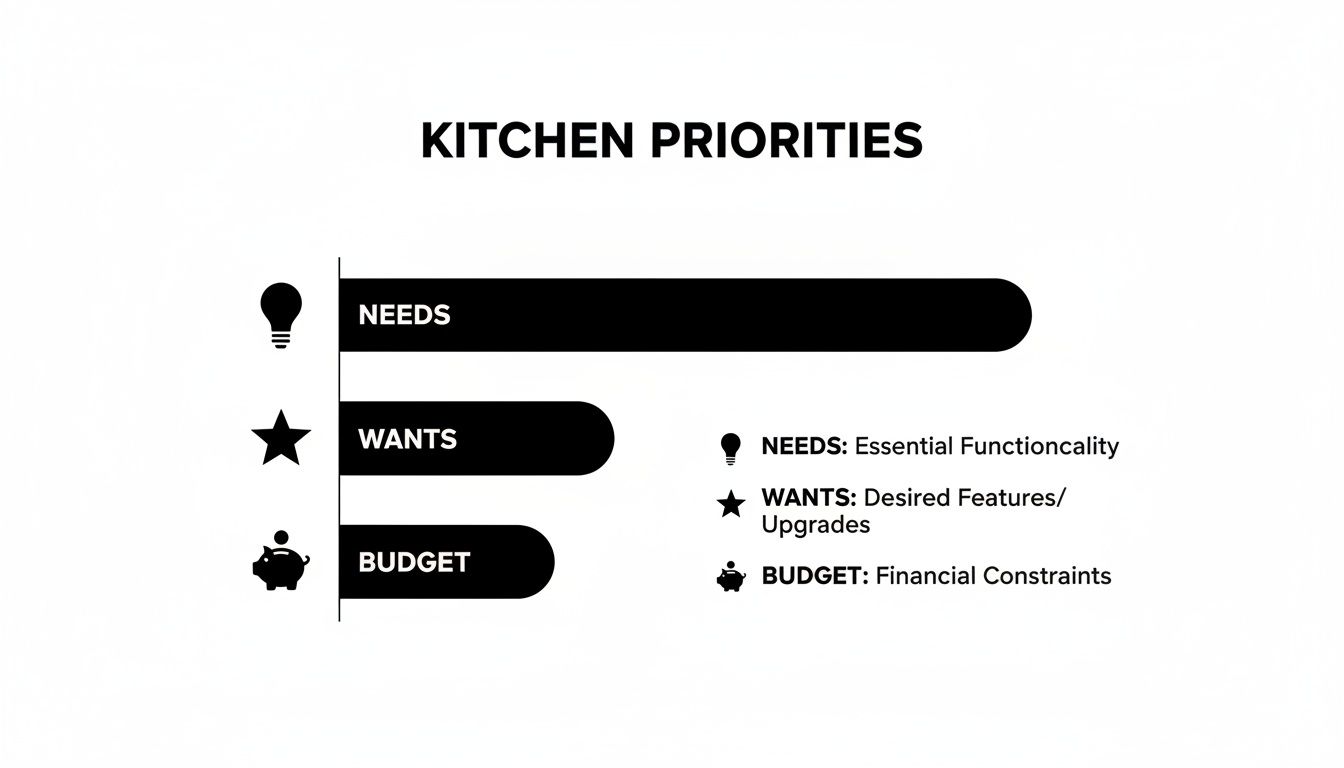
This breakdown really highlights how your needs, wants, and budget have to be in constant conversation. One decision directly impacts the others.
For a typical mid-range kitchen renovation, here’s a common breakdown of where your funds will likely be allocated:
- Cabinetry and Hardware: This is almost always the biggest ticket item, eating up about 30-35% of the total budget.
- Labour and Installation: Skilled tradespeople don't come cheap. Plan for this to be around 15-20% of your costs.
- Appliances: A new suite of appliances will typically account for 10-15%.
- Countertops: Depending on the material you choose, countertops will take up another 10-15%.
- Flooring: Figure on about 5-7% for new flooring.
- The Rest: The final 10-15% gets spread across lighting, plumbing fixtures, paint, backsplash, and permits.
Knowing these numbers helps you stay grounded. For instance, if you fall head-over-heels for a quartz countertop that costs 30% of your total budget, you immediately know you’ll have to make some serious sacrifices elsewhere to make it work.
For a closer look at expenses right here in our area, check out our guide on Toronto kitchen renovation costs.
Before we get into the nitty-gritty, let's look at a sample budget to see how these percentages play out in a real-world scenario.
Sample Kitchen Renovation Budget Breakdown
This table gives you a snapshot of how a typical budget breaks down. Think of it as a starting point to help you allocate your own funds effectively.
| Expense Category | Average Percentage of Total Budget | Cost-Saving Tip |
|---|---|---|
| Cabinetry & Hardware | 30-35% | Opt for ready-to-assemble (RTA) cabinets or cabinet refacing instead of fully custom options. |
| Labour & Installation | 15-20% | Take on some of the work yourself, like demolition or painting, to reduce labour hours. |
| Appliances | 10-15% | Shop during holiday sales events (like Black Friday or Boxing Day) or consider gently used, floor models, or scratch-and-dent. |
| Countertops | 10-15% | Choose high-quality laminates or butcher block over high-end stone like marble or granite. |
| Flooring | 5-7% | Luxury Vinyl Plank (LVP) or laminate offers the look of hardwood for a fraction of the cost and is DIY-friendly. |
| Other (Fixtures, etc.) | 10-15% | Splurge on one or two "wow" items (like a faucet or pendant light) and choose budget-friendly options for the rest. |
| Contingency Fund | 15-20% | This is non-negotiable. Always build this into your initial budget from day one. |
Remember, these are just averages. Your personal priorities will shift these numbers around, but it’s a solid framework to prevent any one category from hijacking your entire budget.
The All-Important Contingency Fund
If you only listen to one piece of advice in this entire guide, make it this one: you need a contingency fund. This is not optional. It is an absolute, non-negotiable part of any smart renovation budget.
Plan to set aside an extra 15-20% of your total project cost for the things you can’t see coming.
And trust me, they will come. Especially in older Toronto homes, you start tearing down drywall and might find ancient knob-and-tube wiring, a slow leak behind the dishwasher that’s rotted the subfloor, or asbestos tiles you now have to pay to get rid of safely.
Your contingency fund isn't "extra" money for upgrades. It’s an essential safety net that stops a small, unexpected problem from wrecking your entire project. Without it, you could be forced to compromise on your beautiful new countertops or, even worse, halt the renovation halfway through.
Tools for Tracking Your Expenses
You can create the most beautiful budget in the world, but it’s useless if you don't track your spending against it. The good news is you don’t need any fancy accounting software. Simple is usually best.
- A Basic Spreadsheet: This is my go-to. Create columns for the item, your estimated cost, the actual cost, and the difference. It gives you a running tally of where you stand at any given moment.
- Budgeting Apps: If you prefer something on your phone, apps like Mint can help you tag reno-related expenses as they come in.
Whatever you use, be diligent. Update it every single time you buy something, no matter how small. That $50 for an extra can of primer or $20 for different cabinet pulls adds up faster than you think. This is the simple discipline that separates a smooth, on-budget project from a stressful, costly one.
High-Impact Design Strategies That Save Money
A great-looking kitchen doesn't have to come from a bottomless budget. In my experience, the most stunning and functional renovations are born from smart, clever decisions, not just throwing money at the problem. If you focus on high-impact design strategies right from the start, you can get that high-end look while keeping your costs firmly on the ground.
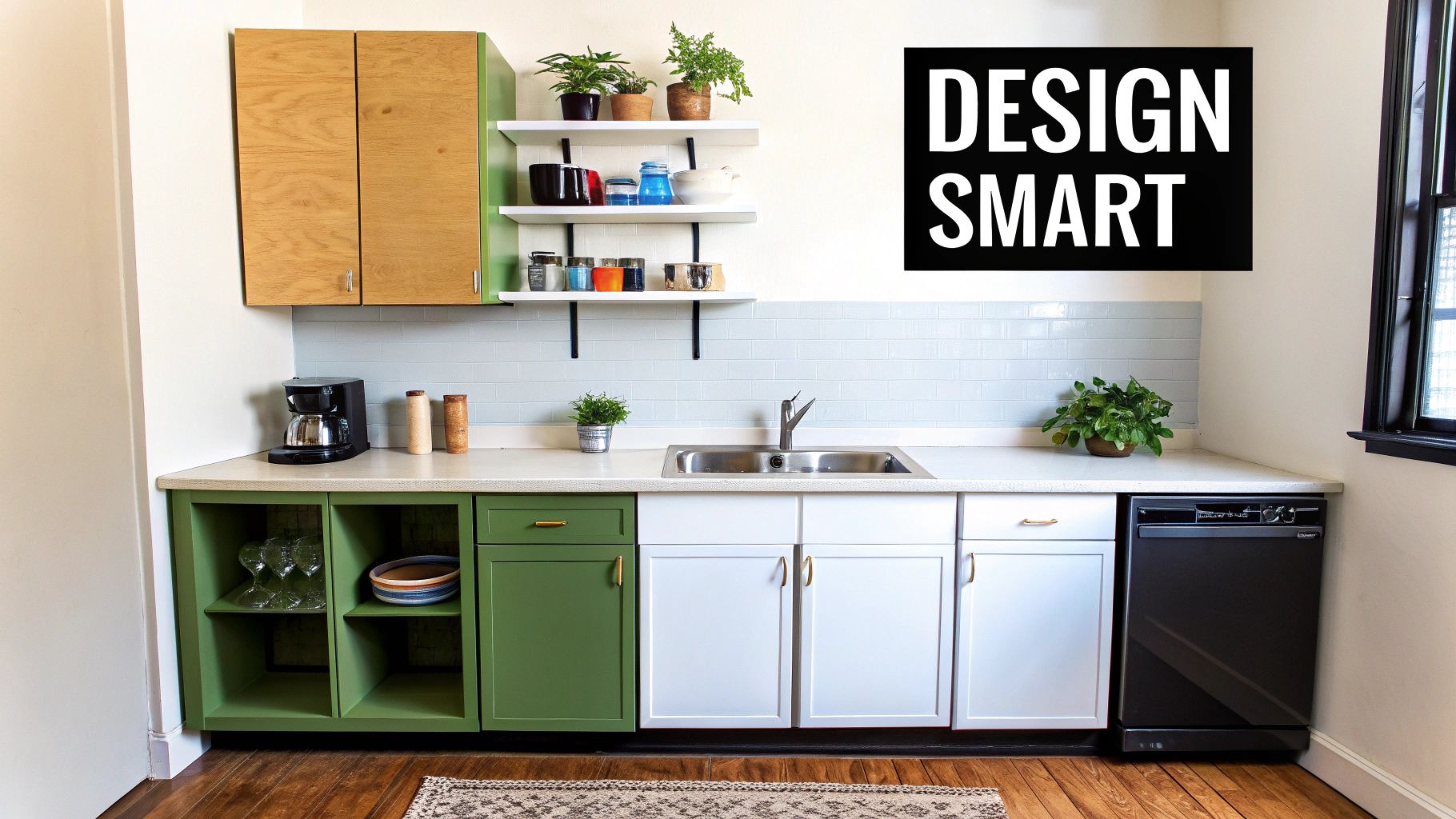
Want to know the single biggest money-saver? Keep your existing kitchen layout. It’s that simple. Making this one decision at the beginning helps you dodge a whole series of expensive and complicated tasks.
Once you start moving walls, rerouting plumbing for a sink, or shifting electrical for an appliance, you’re calling in multiple licensed tradespeople. This not only inflates the cost but also adds serious time and permit headaches to your project. By working within your current footprint, you can channel that money into the things you’ll see and touch every day—like beautiful cabinets, quality countertops, and stylish hardware.
The Great Debate: Reface Versus Replace
Cabinets are almost always the biggest line item in a kitchen budget, but a complete tear-out isn't your only option. Choosing between refacing your current cabinets and replacing them entirely can make a huge difference to your bottom line.
Cabinet Refacing is a fantastic strategy if your cabinet boxes are still in good shape, but the doors are just looking a bit tired or dated. The process is pretty straightforward:
- The old doors and drawer fronts come off.
- A new veneer is applied to the outside of the cabinet boxes to match the new style.
- Brand-new doors, drawer fronts, and hardware are installed.
The end result? Your kitchen looks brand new, but you've spent a fraction of the cost and dealt with far less disruption than a full replacement. You get to completely change the colour and style without the headache of demolishing and reinstalling everything.
Of course, replacing your cabinets is the right move if the boxes themselves are falling apart, have water damage, or if the layout is truly making you miserable. While it costs more, you can still be smart about it. Opting for factory-direct RTA (Ready-to-Assemble) cabinets gives you a high-quality solution without the custom price tag.
Pro Tip: Before you decide, give your cabinets a really honest look. If the boxes are solid wood or plywood and feel sturdy, refacing is probably your most powerful budget-saving move. Sometimes, even a professional paint job and new hardware can provide a dramatic refresh for even less.
The cost difference here is significant. Local surveys show a huge range in renovation costs based on these very decisions. As noted in some regional remodeling reports, custom cabinetry alone can eat up 30–40% of a total budget. Prioritizing cosmetic updates over major structural changes is the key to keeping your project affordable.
Embrace the Openness of Shelving
Here's another design trick I love for saving money while adding style: incorporate open shelving. Swapping out some of your bulky upper cabinets for shelves can completely change the feel of your kitchen, making it seem larger, brighter, and more inviting.
From a budget perspective, the math is easy. Shelves are way cheaper than cabinets, both in materials and installation. It’s a simple switch that cuts costs while giving your kitchen a personal, airy vibe.
Think about the practical upsides:
- Easy Access: Your everyday plates, glasses, and bowls are right there when you need them.
- A Personal Touch: It’s the perfect place to show off nice dishes, a few plants, or other decorative items that reflect your style.
- More Space (Visually): Getting rid of heavy upper cabinets opens up sightlines, which works wonders in smaller or galley-style kitchens.
You don't have to go all or nothing. Even just replacing the cabinets on one wall with a couple of rows of shelving can create a beautiful focal point and save you hundreds, if not thousands, of dollars. It’s one of those rare strategies that delivers maximum visual impact for a minimal investment.
Choosing Affordable Materials Without Compromise
The single biggest lever you can pull to keep your renovation budget in check is your choice of materials. This is where an affordable kitchen renovation really comes to life, proving you don’t need a luxury budget to get a high-end look. It’s all about being strategic—knowing where to save and where a small splurge can elevate the entire space.

From the cabinets you open every single day to the countertops where you prep your meals, smart selections are everything. You're looking for that sweet spot between cost, durability, and a style you’ll still love in five or ten years. That means looking past the obvious, expensive choices and exploring the incredible quality and variety available in more budget-friendly options.
Smart Cabinetry Selections
Cabinetry is the star of the show in any kitchen, and it often eats up the biggest chunk of the budget. But here’s the good news: you have more control over this cost than you might think. Fully custom cabinets are beautiful, but their premium price tag can quickly send an affordable project off the rails.
For most homeowners I work with, the real value is found in stock or semi-custom options.
- Stock Cabinets: These are your most budget-friendly choice, mass-produced in standard sizes. While style and colour options might be more limited, the quality has improved dramatically over the years.
- Semi-Custom Cabinets: A great middle ground. They offer more flexibility than stock, allowing for some tweaks in size, finish, and style without the full custom cost.
- Ready-to-Assemble (RTA) Cabinets: These are shipped flat-packed, which cuts down significantly on labour and shipping costs. Assembling them yourself (or hiring a handyperson) can lead to huge savings.
One of the most effective strategies I recommend is working with a factory-direct supplier. When you cut out the retail middleman, you can often get higher-quality materials and construction for a price that’s on par with big-box store options. It’s truly the best of both worlds: a premium feel without the premium cost. For a deeper look at the pros and cons, our guide on the best materials for kitchen cabinets breaks it all down.
Countertops That Look a Million Bucks
While granite and marble get all the attention, they are far from your only choices. The market today is filled with beautiful, durable alternatives that deliver a similar aesthetic for a fraction of the cost.
High-quality laminate, for example, is a world away from the peeling versions you might remember. Modern options use high-definition printing to convincingly mimic the look of natural stone or wood. Butcher block is another fantastic choice that adds warmth and character, plus it can be sanded and refinished down the road.
Even a premium material like quartz has budget-friendly tiers. By choosing a simpler pattern without the complex veining, you get all the durability and non-porous benefits of quartz at a much more accessible price point.
Finishing Touches: Flooring, Backsplashes, and Hardware
The final details are what tie your whole kitchen together, and they offer even more opportunities to save without compromising on style.
When it comes to flooring, Luxury Vinyl Plank (LVP) has been a total game-changer. It’s waterproof, incredibly durable, and comes in a huge array of realistic wood and tile looks. Better yet, it’s much more DIY-friendly than traditional tile or hardwood, saving you a bundle on installation.
The backsplash is the perfect place to inject some personality. You don’t need to tile an entire wall from counter to ceiling. A simple ceramic subway tile is a timeless classic and one of the most affordable options out there. For an even easier update, look into peel-and-stick tiles—they’ve become surprisingly stylish and resilient.
Finally, never underestimate the power of good hardware. Spending a little extra on high-quality cabinet pulls and knobs can make even inexpensive cabinets feel custom and luxurious. It's a small investment that truly elevates the entire kitchen—think of it as the "jewellery" that completes the outfit. By mixing these high-impact splurges with savvy savings elsewhere, you create a kitchen that is cohesive, beautiful, and genuinely affordable.
Deciding Between DIY and Hiring a Contractor
One of the biggest questions you'll hit during any kitchen reno is just how much you should tackle yourself. The appeal of DIY is strong—after all, labour can eat up 15-20% of your total budget, and saving that cash is tempting. But you need to be brutally honest with yourself about your skills to avoid a simple project spiralling into a nightmare.
Often, the smartest move is a hybrid approach. You handle the tasks you’re confident with and bring in the pros for the tricky stuff. This lets you put your "sweat equity" to good use while making sure the critical parts are done right, giving you the best of both worlds.
Pinpointing Your DIY Sweet Spot
Not every reno job requires a master craftsperson. Some tasks are perfect for a weekend project, demanding more elbow grease and patience than specialized training. Getting these done yourself can save you a surprising amount of money.
Here are a few projects that are usually safe to take on:
- Demolition: Tearing out old cabinets, countertops, and backsplashes can be pretty satisfying. Just make sure you shut off the water and power first, and be careful not to damage anything you plan on keeping!
- Painting: Nothing transforms a room faster than a fresh coat of paint. It’s one of the most cost-effective DIY updates you can possibly make.
- Backsplash Installation: Tiling a backsplash isn't as intimidating as it sounds, especially with all the great tutorials online. If you're detail-oriented, this is a very doable project.
- Hardware Swaps: Changing out cabinet knobs and drawer pulls is a quick win. It's a simple, five-minute job per piece that instantly refreshes the look of your kitchen.
- Assembling RTA Cabinets: If you've ever built furniture from a box, you can handle Ready-to-Assemble cabinets. This alone can save you a bundle compared to buying pre-assembled units.
When to Call in the Professionals
While rolling up your sleeves is great, some jobs are just not worth the risk. Anything that touches your home’s essential systems—plumbing, electrical, and gas lines—is firmly in professional territory. A small mistake here can lead to big, expensive problems like leaks, fires, or code violations that will cost a fortune to fix later.
Never, ever compromise on safety just to save a few bucks. Licensed tradespeople are non-negotiable for any work involving wiring, plumbing, gas connections, or structural changes like taking down a wall. Their expertise is your insurance policy.
Of course, finding the right pro is key. If you're looking for help in the GTA, our guide on how to choose the best kitchen cabinets contractor in Toronto is a great place to start.
In the end, it all boils down to an honest look at your skills, your timeline, and your tools. Do you really have the experience and equipment to get a professional-quality finish? And just as important, do you have the time to do it without rushing? Answering those questions honestly is the secret to keeping your reno on track and on budget.
Getting Your Timeline and Permits in Order
Beyond the exciting design choices and number-crunching, a truly successful kitchen reno comes down to mastering the real-world logistics. A well-thought-out timeline is your best friend here—it’s the secret weapon against unexpected delays and spiralling costs, turning a potentially frantic process into a series of calm, manageable stages.
Mapping out every phase, from the first swing of a sledgehammer to the final brushstroke, is absolutely essential. It helps you line up your tradespeople, order materials so they arrive just in time, and, most importantly, keep your stress levels in check.
It’s all about the right sequence of events. You can’t get those beautiful new countertops measured and installed until your base cabinets are perfectly in place, and you definitely don’t want to start painting while drywall dust is still flying. A logical, phased approach—demolition, then rough-ins for plumbing and electrical, followed by drywall, flooring, cabinet installation, countertop templating, backsplash, and finally the finishing touches—makes everything run smoothly. This is also the perfect time to figure out your temporary kitchen setup; a little planning here goes a long way in surviving the renovation chaos.
What You Need to Know About Local Permits
If you're in Toronto or Markham, you need to get familiar with the local rules. While simple cosmetic updates like painting or changing a faucet usually fly under the radar, bigger changes demand official approval. Trust me, trying to skip this step can lead to stop-work orders and fines that will blow your budget right out of the water.
You'll almost certainly need a building permit if your project involves any of the following:
- Structural Changes: Taking down or modifying any wall that supports the structure of your home.
- Moving Plumbing: Shifting the location of your sink or dishwasher, or running a new gas line for your stove.
- Major Electrical Work: Relocating outlets or adding new circuits typically requires a separate permit from the Electrical Safety Authority (ESA).
- Expanding the Room: Any work that changes the actual footprint or size of your kitchen.
My best advice? Always check with your local municipal office in Toronto or Markham before you start demolition. A quick call can clear up any confusion and save you from massive headaches later on.
Getting a permit isn't instant. It can add several weeks to the start of your project, so you need to build that time into your schedule from day one. It might feel like a hassle, but it's there for a reason. Permits ensure all the work is done safely and up to code, which is non-negotiable for your family's safety and your home's future value. This isn't just about red tape; it's about doing the job right.
Your Kitchen Renovation Questions, Answered
Embarking on a kitchen reno, especially on a tight budget, naturally brings up a lot of questions. Getting clear answers is the first step to feeling confident and in control. Here are a few of the most common things homeowners ask when they start this journey.
What's the Single Biggest Money-Saver in a Kitchen Reno?
Hands down, the most impactful way to keep your costs in check is to work with your existing kitchen layout.
The second you start moving plumbing for the sink, electrical for the stove, or gas lines, you're in a completely different financial ballpark. Relocating these services requires licensed trades, which adds significant labour costs and can trigger a whole new level of permitting headaches. By sticking with your current footprint, you avoid all that drama and expense.
This one decision frees up a huge chunk of your budget for the things that give you the most bang for your buck—the visual upgrades you'll see and appreciate every single day. Think beautiful new countertops, modern cabinet doors, or quality hardware that completely changes the feel of the room.
How Much Should I Really Budget for Contingency?
Don't even think of this as optional. You absolutely need to set aside 15% to 20% of your total budget for a contingency fund. This isn't just "extra" money; it's your safety net for the surprises that are almost guaranteed to pop up, particularly in older Toronto and Markham homes.
This is the fund that saves the day when you pull out the old cabinets and find mould, discover the wiring isn't up to code, or realize the subfloor under that peeling vinyl is rotted.
Without a contingency plan, one unexpected problem can derail everything. You might be forced to make painful compromises on your design, or worse, halt the project entirely. It's the most crucial part of responsible budgeting.
Is It Possible to Get a High-End Look on a Budget?
You bet it is. The secret isn't about using cheap materials across the board; it's about being strategic. The key is to master the "high-low" mix—pairing affordable, quality basics with a few select "splurge" items that become focal points.
For example, you could install classic, budget-friendly Shaker cabinets but pair them with a show-stopping backsplash tile and some seriously nice-feeling hardware. Modern laminate countertops have come a long way and now offer stunningly realistic impressions of natural stone for a fraction of the cost.
Then, you invest in a gorgeous faucet or a set of statement pendant lights over the island. These are the elements that draw the eye and elevate the entire space, making your kitchen look and feel far more expensive than it really was.
Ready to start designing the affordable kitchen of your dreams? The team at MapleKing Kitchen Cabinets offers factory-direct pricing on custom, high-quality cabinetry to fit any style and budget. Explore our gallery and get a free quote today.